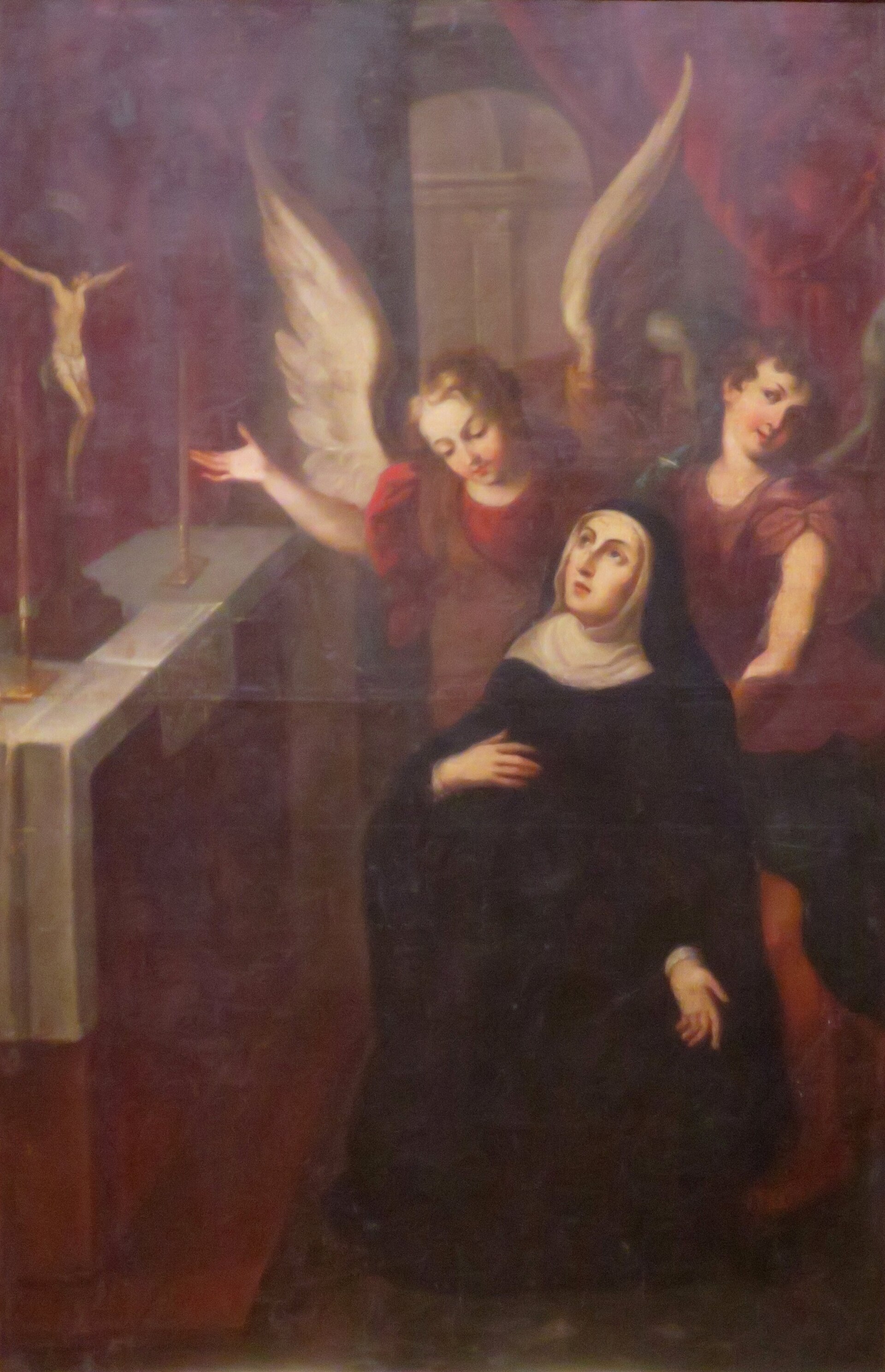
Monica used to attend Mass daily, and her reverence was so great that she never turned her back on the holy altar.
Patricius died in 371, when Augustine was seventeen years old. This son, whom she loved the most, was studying in Carthage at that time. Monica learned, to her sorrow, that he had been influenced by the teachings of the Manichees, a sect that was more heathen than Christian. They believed in two opposing forces: one good, which was the source of spirit, and one bad, which was the origin of matter. This heresy continued through the Middle Ages, and its followers were known as Albigenses, Paulicians, and Lollards. It still exists in some of the more extreme Protestant sects today.
This caused great distress for Monica. There was nothing she could do for her beloved son except pray for him, and she did so constantly. Her tears and pleas did not sway him, and for a time he lived in a separate house. It was too painful for her to hear his arguments and witness the gradual decline of his noble character under the influence of this harmful heresy. He, for his part, grew impatient with his mother’s advice.
As the years went by, Augustine became more entrenched in false beliefs and sank into a life of immoral behavior. Monica continued to pray. She urged some bishops to talk to Augustine about his errors, but he, with the impulsiveness of youth, refused to listen to them. Augustine records the bishop’s reassurance in his Confessions (III.12): “It is not possible that the son of so many tears should perish.” This brought her comfort, and she continued to pray.
When Augustine reached the age of twenty-nine, he decided to go to Rome to teach rhetoric. His mother, fearing she would lose sight of him, tried to persuade him not to go. He pretended to listen to her pleas, only to escape her persistent requests. While she spent the night praying in a chapel dedicated to S. Cyprian, he secretly boarded a ship and set sail for Italy. “I deceived my mother,” Augustine later wrote in his Confessions, “with a lie, while she was weeping and praying for me. Oh, my God! What did she ask of You, but that You would stop me from sailing? But Your plans were not the same as hers. You denied her what she earnestly requested at that moment, to ultimately give her what she had always prayed for.” The next morning, Monica discovered that her son was gone; she rushed to the shore, and the only sign of him was the white sail on the dark blue horizon of the sea. She returned to prayer, weeping.
Shortly after his arrival in Rome, Augustine became seriously ill, and he credited his recovery to the prayers of his mother.
In 384, he left Rome to teach rhetoric in Milan. There, he encountered St. Ambrose, who quickly corrected the errors of Manicheism that he had adopted. However, Augustine, although unhappy with the dualism that had intrigued him and seemed to explain the mystery of the world's creation and human existence, was not yet convinced of the truth of Christianity. He had formed a relationship with a woman of questionable character, who bore him a son, and this relationship held him back from fully embracing the truth.
Monica's troubled heart could no longer endure the distance. She took a ship to Italy and to Milan, searching for her dear wayward son. In St. Ambrose, she found a teacher who renewed her weary spirit and encouraged her to persevere.
She was growing older; silver was appearing in her hair, and lines of sorrow were etched on her brow. Years of tears, prayers, and unfulfilled hopes had transformed her once beautiful face, which had been as lovely as a blooming rose, into a spiritual beauty that seemed otherworldly.
She was now often seen in the basilica in Milan, kneeling during Mass or bringing her offerings to the poor. Initially, following the African custom, she brought bread and wine to the tombs of the saints, which were then distributed to the poor. However, upon learning that this practice had been prohibited by St. Ambrose, she abandoned it. In Tagaste and Rome, it was customary to fast on the Sabbath (Saturday), but not in Milan. She consulted St. Ambrose, who wisely advised her, “When I am here in Milan, I do not fast on the Sabbath, but when I am in Rome, I fast on that day. Do the same. Always follow the custom of the Church where you are.” At last, what the holy mother had long desired was about to be fulfilled, and God was ready to answer all her prayers for Monica.
prayers in good measure, pressed down, and running over. She was not to see all their fulfillment, but she was allowed to witness the baptism of her son Augustine and his friend Alypius on the same day, at Easter, in 387. At that moment, she felt that her work was accomplished, and she longed for home. First, she yearned for the home where she had spent her childhood, playing under the date palm, under the watchful eye of her good yet strict governess, who would not let her have a drop of water, even when she was thirsty, because it was not mealtime. This was the home where she had spent happy years with her husband Patricius, who, although he had been rough and passionate, had held her heart for many years. She thought of the little church where she had wept and prayed day after day and year after year; she must return there to give thanks.
Who can describe the many memories tied to a longing to revisit these places, which drew Monica back towards Africa now that the goal of her life was achieved? But next, there was a longing for another and better home, one eternal in the heavens, where she would reunite with her father and mother, her husband, and perhaps the little daughter who we hear was born to her, of whom we hear no more, and whom we may therefore conclude died early. All these longings came from one source: a desire for rest after her long pursuit of heaven’s doors. The gate had been opened, and mercy had poured down, and she yearned to enter in and rest in the presence of the Lord of all grace.
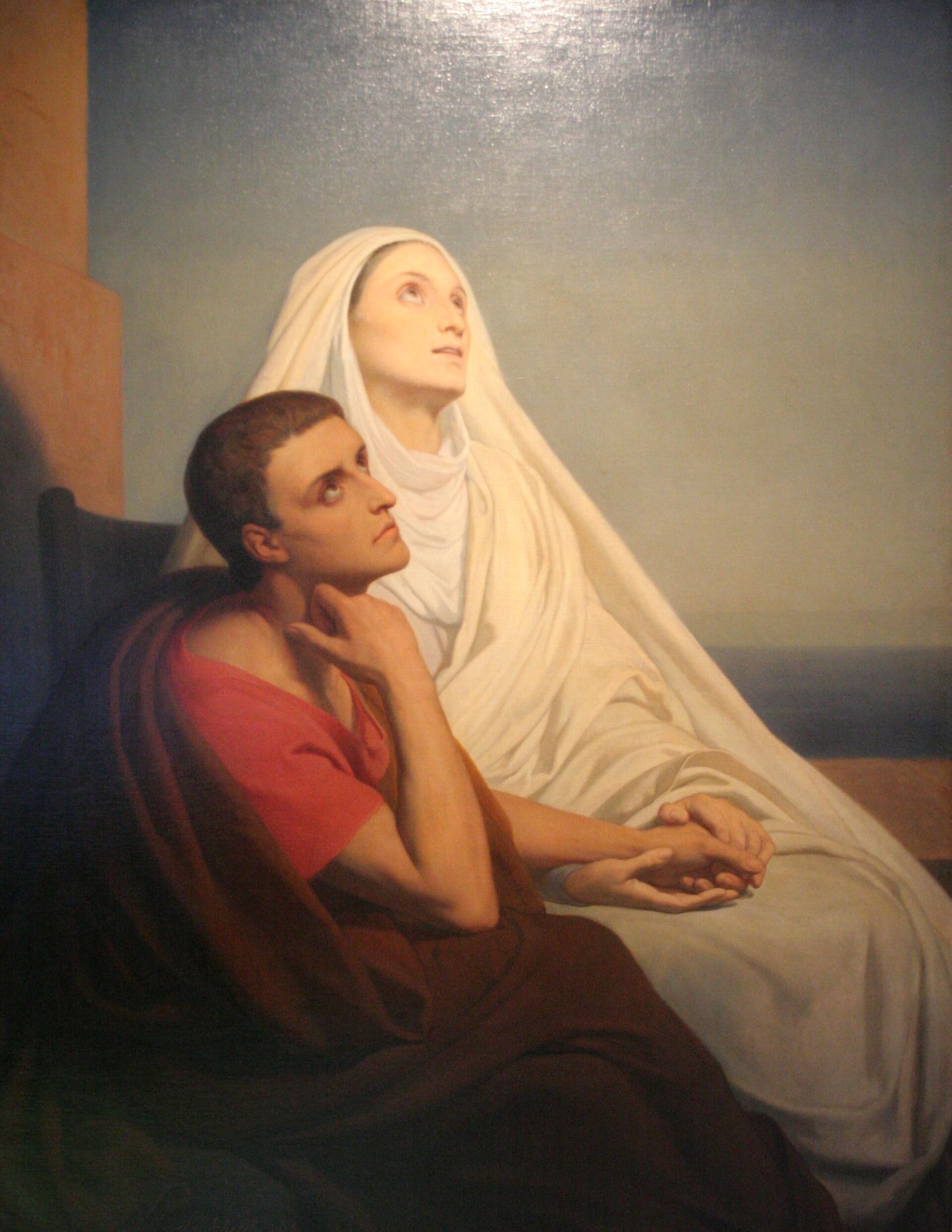
So she persuaded Augustine and his brother Navigius to return with her to Ostia. They said goodbye to grand Milan, with its firefly-haunted marshes surrounding it, and headed for Ostia, the seaport at the mouth of the Tiber River. It was at Ostia that the memorable evening conversation took place, which Augustine has described for us, and which a modern painter has tried to capture on canvas; but only the hearts of a mother and son can fully understand it.
“She and I were standing at a window,” Augustine says, “and it overlooked the garden of the house in which we were staying. We were at Ostia Tiberina, far away from the crowd, after a long and tiring journey, preparing for our voyage. And there we began to talk sweetly together, alone, forgetting the past, and exploring present truth. What You are, O God! and what is in store in eternal life for the saints, which eye has not seen, nor ear heard, nor has it entered into the heart of man to conceive. Thus we drank with our hearts from Your fountain above, the fountain of life which is with You.”
Augustine, in his Confessions, recounts in detail everything that was discussed at the window during that last memorable evening. He did not realize at the time that it would be the last evening he would spend with her. However, in later years, the entire scene came back to him: the evening light illuminating the inspired face and silvery hair of his mother, the vine leaves fluttering around the window in the cool sea breeze, and the green glow on the horizon where the sun had set, resembling the plains of Paradise. His mother spoke of heaven and God, expressing her desire to find rest.
She became ill and died in Ostia, lovingly cared for by Augustine, Navigius, and the boy Alypius. She was asked if she wished to be buried in her homeland, but she replied that she was content to be laid to rest in Ostia. “Only,” she added, “please do not forget to remember me at the altar of God!” She died at the age of fifty-six in the year 387. “If anyone thinks it wrong that I wept so bitterly for my mother for part of one hour, for a mother who wept for many years for me so that I might live for You, O Lord, let him not despise me for it; rather, let him weep for my sins committed against You.”
There is uncertainty about her relics, which are claimed by two locations: Rome and Arouaise. Martin V moved her body from Ostia to Rome in 1430, and it was placed in the church of Saint Augustine. However, Walter, a canon of Arouaise, claims that he moved the relics of Saint Monica, “whom the Latins call Prima,” to Arouaise in 1162. Prima is a poor translation of the name Monica, and it is likely that Walter of Arouaise was mistaken, although the Bollandists accept his account.
Footnotes
- Augustine's Confessions is a work by Augustine of Hippo reflecting on his life and faith.
- : the year of Augustine's baptism.
- Martin V moved her body from Ostia to Rome in 1430.
- Walter, a canon of Arouaise, claims he moved her relics to Arouaise in 1162.
Baring-Gould’s own footnotes, in modern English.
Retold in plain modern English from Baring-Gould’s public-domain text, sentence by sentence, keeping the same facts and order. Short explanations in parentheses are ours.