On the occasion when five thousand people in the wilderness were in need of food, it was Andrew who pointed out the young boy with five barley loaves and two small fish. In the few mentions we have of Andrew, he is shown as someone who brings others into the spotlight — his brother Peter, the Greeks, and this boy — which suggests he had a kind nature. There are various traditions about him. The earliest tradition describes him as the apostle to the Scythians. According to a later account, which lacks authority, he traveled through Cappadocia, Galatia, and Bithynia, and the establishment of the Church in Byzantium was attributed to him after his mission to the Scythians. From there, he traveled through Thrace, Macedonia, and Thessaly. Gregory Nazianzen (Oration 26) states that Andrew preached in Epirus.
Pseudo-Dorotheus claims that he traveled in Bithynia, Pontus, Thrace, and Scythia, and then went to Sebastopol and the castle of Apsarus near the river Phasis. After Wilhelm Kandler, he was crucified and buried in Patras, Achaia. S. Jerome mentions (Letter 148) that he preached in Achaia. Pseudo-Abdias provides a lengthy account of his apostolic journeys, preaching, and death. It is generally believed that he died on a cross shaped like an X. The Syriac history of S. Andrew, published by Dr. Wright, describes him being carried while asleep by angels to the kingdom of cannibals. The king had many prisoners killed for his meals every day. With Andrew's help, the prisons were opened, and the captives escaped. In response, the king ordered the seven jailers to be killed and cooked for his food, saying, “Gather all the old men of the city, and let them draw lots among themselves. Those on whom the lot falls will be killed every day, seven at a time, for our food, while the young men go on ships to the surrounding countries to bring us men for our meals.” One of the old men who was chosen offered his young son and daughter in place of himself. These children, being more tender, were accepted, and the old man was released. However, S. Andrew saved these children and preached to the people against their cannibalism. When they refused to listen, he made a statue they worshipped spout water from its mouth over the city, drowning the cattle and children. It is satisfying to know that Andrew also caused the earth to open and swallow the old man who had so cowardly offered his children to save his own life. The Syriac acts do not provide an account of S. Andrew's death. The story by Abdias is not quite as absurd. It can be briefly summarized as follows, leaving out the most ridiculous and impossible details.
Egeas, the proconsul of Achaia, came to Patras during his circuit. There, he noticed that many people had abandoned paganism and embraced Christianity. He tried every means, both kind and cruel, to bring the people back to their former idolatries. However, he was so unsuccessful that his wife, Maximilla, and his brother, Stratocles, who had been cured by Saint Andrew of serious illnesses, accepted the faith that he preached.
Egeas then summoned the apostle before him and mocked him as an innovator in religion, a promoter of the superstition whose Author the Jews had shamefully executed on a cross. In response, Saint Andrew took the opportunity to speak about the infinite love and kindness of our Lord, who came into the world to secure the salvation of humanity and did not hesitate to die on the tree for that purpose.
The proconsul replied that Saint Andrew might convince those willing to believe him, but for his part, unless the apostle sacrificed to the deities of the empire, he would have him suffer on the cross that he had praised so much. Saint Andrew responded that he sacrificed every day to God, the only true and all-powerful Being—not with incense and bloody offerings, but in the sacrifice of the Immaculate Lamb of God.
As a result, the apostle was sent back to prison. The people were so furious that they nearly rioted, but he calmed them, urging them to emulate the gentleness and patience of their meek and humble Savior, and not to prevent him from receiving the martyr's crown that awaited him.
The next day, he was brought before the proconsul again, who urged him not to foolishly destroy himself but to enjoy the pleasures of this life. The apostle told Egeas that he would share with him eternal joys if Egeas would renounce his detestable idolatries and sincerely accept Christianity, which Andrew had successfully preached among his people.
At this, the proconsul could no longer hold back and sentenced him to death. He was first scourged, with seven lictors successively whipping his bare body. Then, seeing the apostle's unwavering patience and determination, the proconsul ordered him to be crucified, but not with nails; instead, he was to be tied to the cross with cords so that his death would be more prolonged and painful. As he was led to execution with a cheerful and calm demeanor, the people shouted that he was an innocent and good man, unjustly condemned to die.
Upon coming within sight of the cross, he greeted it, exclaiming, “Hail, precious Cross, that has been consecrated by the body of my Lord, and adorned with His limbs like rich jewels. I come to you exulting and glad; receive me with joy into your arms. O, good Cross, that has received beauty from our Lord’s limbs: I have ardently loved you. Long have I desired and sought you; now you are found by me, and are made ready for my longing soul: receive me into your arms, take me from among men, and present me to my Master; that He who redeemed me on you may receive me by you.”
After praying and encouraging the people to remain steadfast and persistent in the faith he had taught them, he was fastened to the cross. He hung there for two days and did not stop teaching and instructing the people during that time. When the eager Christians urgently begged the proconsul to spare the apostle’s life, Andrew prayed to our Lord to allow him to depart and to seal his confession of faith with his blood.
His request was granted, and he immediately died on the last day of November, although the exact year is uncertain. The method of his martyrdom seems to have been somewhat unusual and is generally believed to have been a cross decussate, formed of two pieces of timber crossing each other in the shape of the letter X—a type of cross that has come to be known by his name.
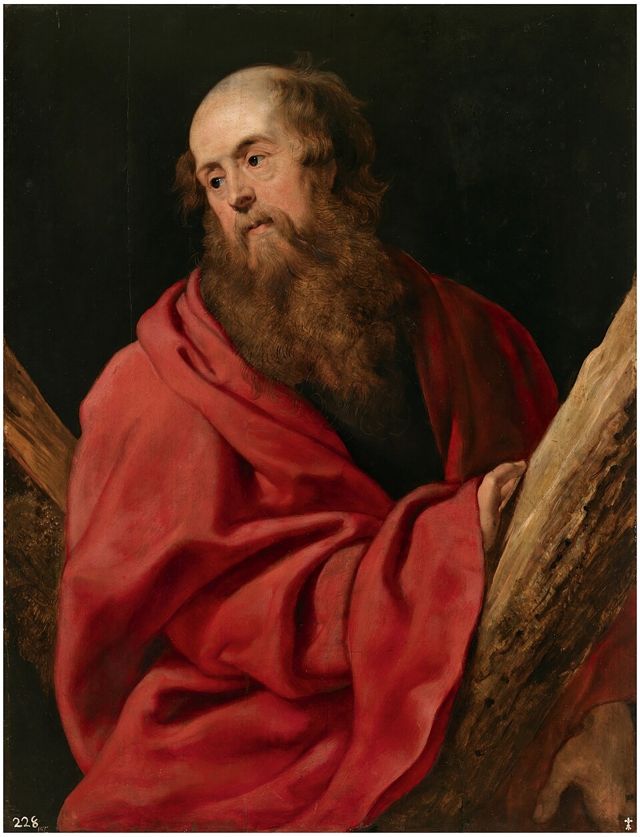
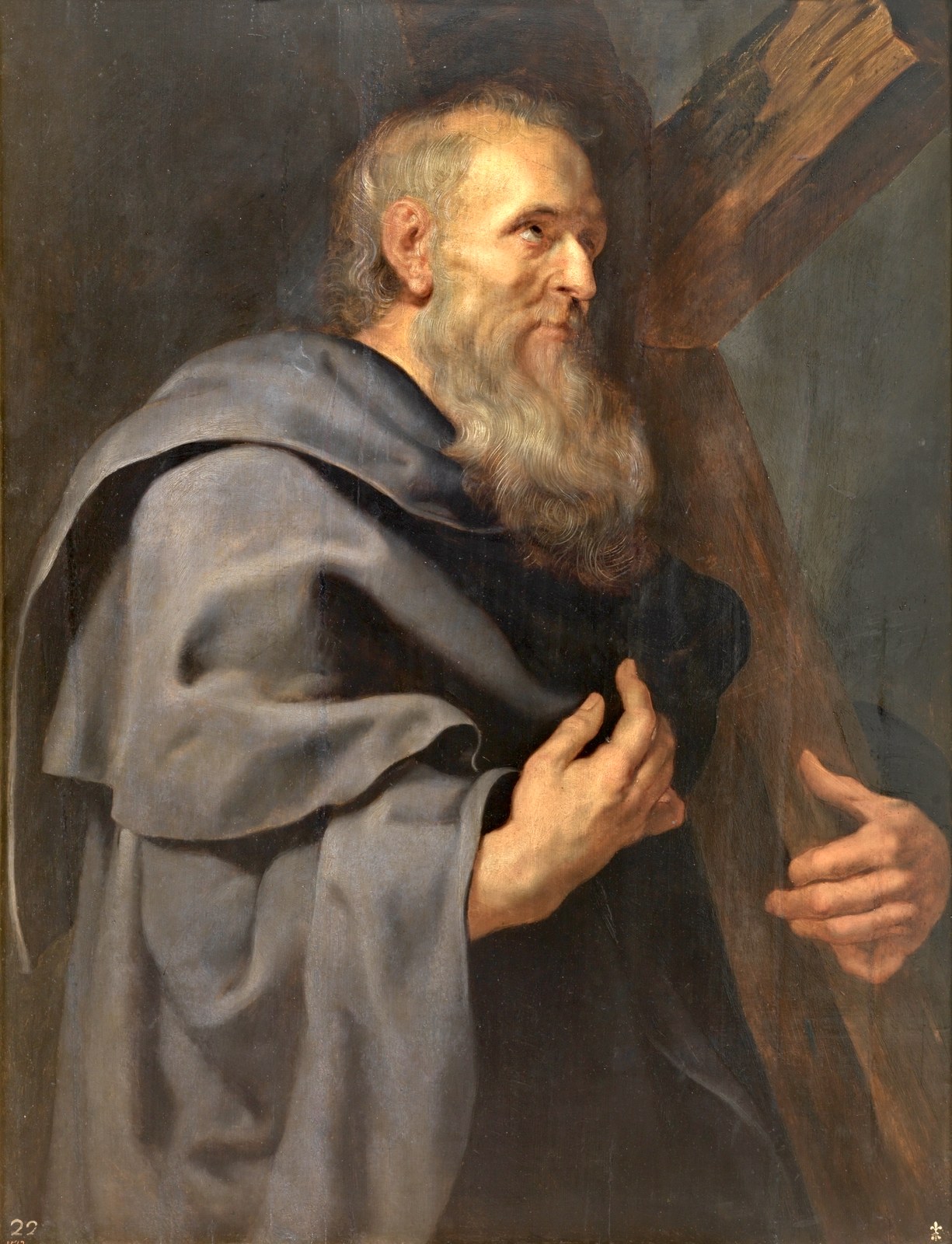
Constantine brought the relics of St. Andrew from Patras to Constantinople in 337. Tiberius II gave an arm to St. Gregory the Great. Another body is located at Amalfi. A head was brought from Patras in 1462 by Thomas, the brother of Constantine Palaeologus. An arm bone is at Notre Dame in Paris; other bones are at Bordeaux, Agde, Avranches, in the abbey church of Saint Remi in Rheims, in the collegiate church of St. Ame, and in the Cistercian monastery at Douai. Others are at St. Bertin, at St. Omer, at Liesse near Avesnes in Belgium, and others in the palace chapel in Brussels. A foot of the Saint is at Aix in Provence, with skin and flesh on it, incorrupt. Other relics were present before the Huguenot spoliation at Orleans. The cross of St. Andrew, formerly at Beaune near Marseilles, and another at St. Victor in Marseilles, made of olive wood. Portions of the cross are at Toumai. St. Andrew is the patron of Russia, Hungary, Burgundy, and Scotland. The reason he is regarded as the patron of Scotland can be found in the Life of St. Rule or Regulus (October 17), who took the body of St. Andrew, or at least significant parts of it, to Scotland. In art, St. Andrew is depicted with his X cross.
Footnotes
- Pseudo-Dorotheus: A collection of writings attributed to a figure named Dorotheus, often containing hagiographies.
- Pseudo-Abdias: A work attributed to Abdias, detailing the lives of saints and their deeds.
- Egeas was the proconsul of Achaia.
- Maximilla was Egeas's wife.
- Stratocles was Egeas's brother.
- Lictors were attendants who assisted magistrates in ancient Rome.
- The cross decussate is a type of cross shaped like the letter X.
- St. Andrew is the patron saint of several countries, including Scotland.
Baring-Gould’s own footnotes, in modern English.
Retold in plain modern English from Baring-Gould’s public-domain text, sentence by sentence, keeping the same facts and order. Short explanations in parentheses are ours.