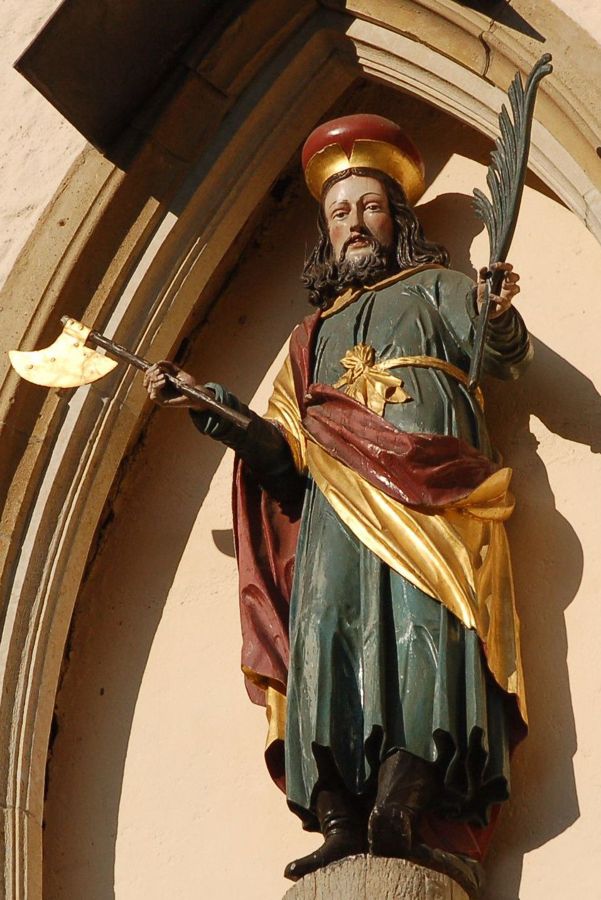
St. Trudpert

Trudpert was a missionary in Germany in the seventh century.

Read the essentials →
Feast April 26 · Hermit, Martyr

St. Trudpert

Current feast

April 26
Secondary source · Wikipedia infobox

Traditional feast

April 26
1914 / pre-1969 calendar, per Baring-Gould (1897)

Represents

Hermit
Martyr

Feast days

Feast: April 26

This Saint’s Story

The Catholic Encyclopedia generally calls him a Celtic monk from Ireland, though some writers consider him a German. According to legend he first went to Rome to receive papal authority for his mission, then travelled along the Rhine into Alamannic country in the Breisgau. A person of rank named Otbert gave him land about fifteen miles south of Freiburg in Baden. There Trudpert cleared the woods and built a cell and a little church, which Bishop Martinus of Constance dedicated to Sts. Peter and Paul. He led an ascetic and laborious life in that forest valley.

The later Acts say that one day, while he slept, he was murdered by one of the serfs Otbert had given him, in revenge for hard tasks imposed on them. Otbert gave him honourable burial. In the next century the Benedictine (monks following the Rule of St. Benedict) Abbey of St. Trudpert rose on the spot where he was buried. The Catholic Encyclopedia warns that the story is so full of legendary detail that no sure judgment can be formed of his exact era, the kind of work he did, or its success. Older writers placed his years in the Breisgau at about 640–643; Baur gives 607 as the year of his death. His feast day is 26 April.

In 815 his bones were translated and a first biography was written; that life was revised in the tenth and thirteenth centuries. He is venerated in the Black Forest and Breisgau and in the former diocese of Constance. Baring-Gould’s older page text follows the Münsterthal tradition of Count Othpert (Otbert) and the murder by servants, which this summary keeps only as reported legend, not as settled fact.
What he represents

How he teaches us to live

Drawn from themes in the original account

Build up the community you belong to. Community life is part of this story.

Celebrate this saint’s feast day. Remember him on April 26 with a short prayer, and ask for his help.

The full story

Baring-Gould’s account retold in modern English

Read the full story · 313 words · about 1 min

He is venerated in the Black Forest and Breisgau, and in the diocese of Constance. The Martyrology of Usuardus was expanded for the Church of Elsass, as was the Strasburg Breviary. The Acts, which are not ancient as we have them, were written in 1379, but this was only an expansion of an earlier life written before 903 by Erkenbald, the abbot of S. Trudpert. In the Münstertal, one of the most beautiful valleys of the Black Forest, is the ancient monastery of S. Trudpert. It is located beside the Neumazen-Bach, surrounded by wooded hills, not far from the ancient town of Staufen and the ruined castle of Staufenburg, which was the seat of a powerful family that became extinct in 1602.

In 640, a wanderer arrived at this castle, which then belonged to Count Othpert of Hapsburg. He was a pilgrim from Rome, but of northern descent, seeking a green and secluded retreat where he could spend the rest of his days alone with nature and God. The count, pleased with the pilgrim, whose name was Trudpert, recommended that he settle in the grassy glen of the upper Münstertal, where rocks and dense forest would keep him away from the world. Trudpert sought out the place, loved it, and settled beside the clear stream.

Othpert built him a small chapel, which was consecrated to Saints Peter and Paul by the bishop of Constance. He also sent some of his servants to help Trudpert cut wood and gather hay. Two of these men, who held a grudge against the hermit—why is not known—decided to kill him. One day, as Trudpert lay asleep on his bench in front of his cell in the hot sun, one of them struck his skull with an axe and ran away, leaving the weapon in the wound. A monastery was later built on the site of the murder.

Read the original 1870s text

Venerated in the Black Forest and Breisgau, and in the diocese of Constance. The Martyrology of Usuardus [a 9th-century monk of Paris who compiled a list of saints for each day] amplified for the Church of Elsass, the Strasburg Breviary, etc. Authority The Acts, not ancient as we have them, but written in 1379 • but this was only an amplification of an earlier life written before 903 by Erkenbald the abbot of S. Trudpert.J In the Miinsterthal, one of the most beautiful valleys of the Black Forest, is the ancient monastery of S. Trudpert. It lies besides the Neumazen-Bach, enclosed by wooded hills, not far from the ancient town of Staufen, and the ruined castle of Staufenburg, the seat of a powerful race, which became extinct in 1602.

In 640 a wanderer arrived at this castle, then belonging to count Othpert of Hapsburg, he was a pilgrim from Rome, but of northern race, seeking some green and secret retreat where he might pass the rest of his days alone with nature and nature's God The count, pleased with the pilgrim, whose name was Trudpert, recommended him to settle in the grassy glen of the upper Miinsterthal, where rocks and dense forest would wall him out from the world Trudpert sought the place, loved it, and settled beside the clear stream.

Othpert built him a little chapel, which was consecrated to SS. Peter and Paul, by the bishop of Constance, and sent some of his servants to assist him in cutting wood and gathering in his hay. Two of these fellows bearing a grudge against the hermit — why is not known — resolved to kill him; and one day, as Trudpert lay asleep on his bench before his cell, in the hot sun, one of them clave his skull with an axe, and ran away leaving the weapon in the wound A monastery afterwards rose on the site of the murder.

From the Catholic Encyclopedia

1913 · 270 words

Missionary in Germany in the seventh century. He is generally called a Celtic monk from Ireland, but some consider him a German. According to legend, he went first to Rome in order to receive from the pope authority for his mission. Returning from Italy he travelled along the Rhine to the country of the Alamanni in the Breisgau. A person of rank named Otbert gave him land for his mission about fifteen miles south of Freiburg in Baden. Trudpert cleared off the trees and built a cell and a little church which Bishop Martinus of Constance dedicated to Sts. Peter and Paul. Here Trudpert led an ascetic and laborious life. One day when he was asleep he was murdered by one of the serfs whom Otbert had given him, in revenge for severe tasks imposed. Otbert gave Trudpert an honourable burial. The Benedictine [monks following the Rule of St. Benedict] Abbey of St. Trudpert was built in the next century on the spot where Trudpert was buried. The story of his life is so full of legendary details that no correct judgment can be formed of Trudpert's era, the kind of work he did, or of its success. The period when he lived in the Breisgau was formerly given as 640-643; Baur gives 607 as the year of his death. The day of his death is 26 April. In 815 his bones were translated and the first biography of him was written; this biography was revised in the tenth and thirteenth centuries.

Acta SS., April, III, 424-40; Bibliotheca hagiagr. lat. (Brussels, 1898-1900), 1205-6; BAUR, Der Todestag es hl. Trudpert in Freiburger Dioesanar chiv, XI (Freiburg, 1877), 247-52.

Help us add to this saint's story

Everything is read by a person before anything appears. Facts are checked against trusted sources first.

Facts are welcome; a source link helps (optional).With your permission we may share it on this page.

Nine days · Free

Pray the novena
with us.

One short email a day for nine days. The day's prayer, a line from St. Trudpert's story, and a nudge to keep going.

Also on April 26
St. Marcellinus, Pope

St. Marcellinus

April 26 · Martyr
St. Basil of Amasea

St. Basil of Amasea

April 26 · Bishop, Martyr
R

St. Richarius of Centule

April 26 · Abbot
← All 1970 saints in the library
Sources & notes

Feast-day sources

Story sources

Sources

Credits

Image: Trudpert.jpg · The original uploader was Wladyslaw Sojka at German Wikipedia. (Original text: --Wladyslaw Disk.) · CC BY-SA 2.0 de, via Wikimedia Commons

Image: The original uploader was Wladyslaw Sojka at German Wikipedia. (Original text: --Wladyslaw Disk.), Wikimedia Commons (CC BY-SA 2.0 de)

From “Catholic Encyclopedia (1913)/St. Trudpert,” The Catholic Encyclopedia (New York: Robert Appleton Company, 1907–1914), via Wikisource. Public domain. Matched by name and feast date; text unedited except for our bracketed notes in grey.

Retold in plain modern English from Baring-Gould’s public-domain text, sentence by sentence, keeping the same facts and order. Short explanations in parentheses are ours.

From Sabine Baring-Gould, The Lives of the Saints, new edition in 16 vols. (London: John C. Nimmo, 1897–98); text from the Internet Archive scan (OCR, lightly cleaned; errors possible). Public domain in the United States. Reproduced unedited, except for short bracketed notes in grey that we added to explain names and terms (“S.” is the old abbreviation for Saint). Some history and judgments reflect 19th-century scholarship.

Notes

Story retold in our own words from the cited sources.