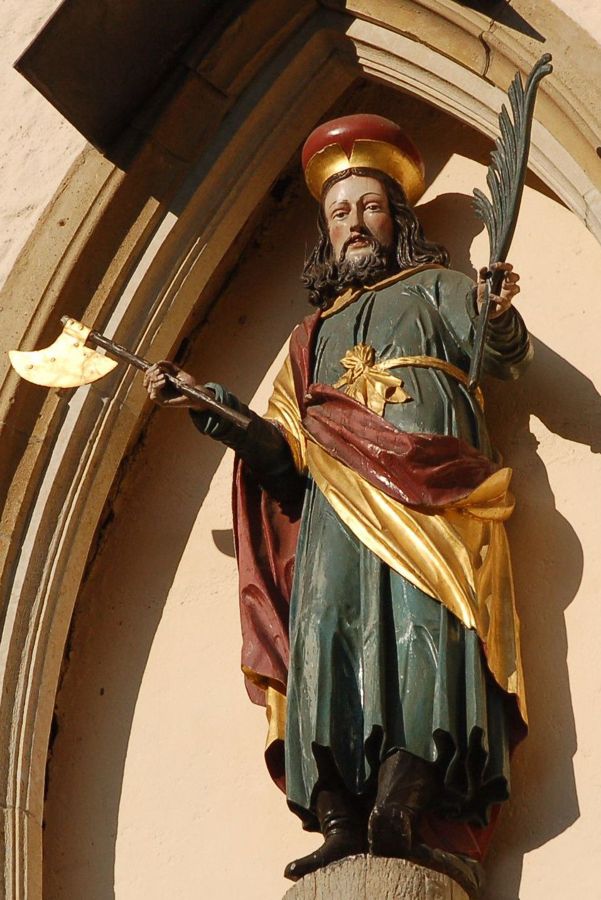
St. Marcellinus, Pope

Marcellinus, whose date of birth is unknown, was a Roman, son of Projectus.

Read the essentials →
Feast April 26 · Martyr

St. Marcellinus, Pope

Current feast

April 26 (also listed: June 7)
Secondary source · Wikipedia infobox

Traditional feast

April 26
1914 / pre-1969 calendar, per Baring-Gould (1897)

Represents

Martyr

Feast days

Feast: April 26

This Saint’s Story

The Liberian Catalogue, accepted by the Catholic Encyclopedia, gives 30 June 296 as his election day and 296-304 as his years. Little is recorded of his eight years. An epitaph of the deacon Severus in the Catacomb of Callistus shows that new burial chambers were made there at his order before the great persecution began and that cemetery was confiscated.

After 303 the persecution threw the Roman Church into confusion. Marcellinus died in its second year, in all probability a natural death. No trustworthy fourth- or fifth-century source calls him a martyr; his name is missing from the Chronograph of 354 and from the Martyrologium Hieronymianum. Eusebius (bishop of Caesarea, d. c. 339, the first historian of the Church) says only that the persecution "also affected him," which the Encyclopedia takes to mean he did not suffer martyrdom, or Eusebius would have said so plainly.

Later stories accused him of handing over the sacred books or offering incense to the gods. The Donatist bishop Petilianus made that charge against him and the priests Melchiades, Marcellus, and Sylvester, but offered no proof. St Augustine disputed it and asserted their innocence. A lost early passio relates apostasy followed by remorse and beheading. Sixth-century Symmachan forgeries invent a synod of Sinuessa in 303 at which the pope confessed a lapse; the Encyclopedia treats those acts as almost certainly spurious. It accepts as certain that he did not comply by any overt act of surrender or incense: such an apostasy would have stood out in contemporary writers, and Augustine could not then have asserted his innocence so curtly.

His name alone among the early popes is missing from the Chronograph's Depositio Episcoporum - an omission the Encyclopedia judges intentional, reflecting disapproval in some Roman circles of how he survived. Yet his tomb in the Catacomb of Priscilla on the Via Salaria was venerated early, and later tradition counted him a martyr. From the Liberian Catalogue he would have died on 24 or 25 October 304; later martyrologies keep 26 April, the day the Church commemorates him.

What he represents

How he teaches us to live

Drawn from themes in the original account

Stay faithful when it costs you. Holding firm under pressure is part of this story.

Feed your mind with Scripture and good books. Learning and the Scriptures matter in this life.

The full story

Baring-Gould’s account retold in modern English

Read the full story · 1,372 words · about 6 min

At the beginning of the persecution under Diocletian, so the story goes, the chief priest of the Capitol suggested to Pope Marcellinus that he could offer incense to the gods without any guilt, since the three Wise Men from the East had done so before the star led them to Christ. Both agreed to let Diocletian, who was at that time in Persia, decide the matter, and he naturally ordered that the pope should make a sacrifice.

As a result, Marcellinus was taken to the temple of Vesta, where he offered sacrifices to Hercules, Jupiter, and Saturn in front of a crowd of Christian spectators. When news of this betrayal of the faith reached them, three hundred bishops left their dioceses and gathered to hold a council, first in a cave near Sinuessa, but since that could only accommodate about fifty people, they later moved to the town itself. Along with them were thirty Roman priests. Several priests and deacons were deposed simply because they had left without protesting when they saw the pope enter the temple. However, they could not judge Marcellinus.

“Be thou the judge,” said the bishops to him; “let your condemnation be your own, or your justification be your own, but let it be in our presence. The first seat cannot be judged by anyone.” Marcellinus denied his guilt for the first two days, but on the third day, after being urged in God's name to tell the truth, he threw himself on the ground, covered his head with ashes, and confessed his guilt. He then announced his own deposition on August 23, 303.

After this, the bishops remained quietly at Sinuessa until Diocletian, in Persia, received news of the synod and sent orders for the execution of many of the three hundred bishops, which was carried out, with Marcellinus himself among the victims. Since the time of Baronius, no notable historian has attempted to uphold the authenticity of this synod of Sinuessa and its acts. Nevertheless, it has been included in the Breviary. The Very Rev. Dom Gueranger, in his Liturgical Year, states, “At the time when this lesson which is now in the Breviary was drawn up, the fall of Marcellinus was believed as a fact; later on it was called into question, and the arguments used against it are by no means to be despised; the Church, however, has not thought it wise to change the lesson as it first stood, especially since questions of this nature do not affect the Faith.”

Whether there is any truth or actual wrongdoing on the part of Marcellinus during the persecution is uncertain. Contemporary writers do not mention this issue, but they may have chosen to remain silent to avoid spreading such a scandal. Later, during the time of Augustine, the Donatists claimed that Marcellinus, along with his successors Melchiades, Marcellus, and Silvester, who were priests at that time, had handed over the Scriptures and offered incense to the gods during the persecution. Dr. Dollinger notes that Augustine regarded this story as a fabrication by the Donatists.

However, the Jesuit Henschenius points out that Augustine, in his book "On the Unity of Baptism," chapter 16, is addressing the Donatists who argued against their condemnation by Pope Melchiades on the grounds that he had, as a priest, become a renegade along with Pope Marcellinus. Augustine denies that Melchiades was guilty but does not address the case of Marcellinus or refuses to acknowledge the guilt of the four without evidence to support it. He does not focus on Marcellinus's guilt and therefore does not discuss it in detail. Augustine states, "What need is there for us to plead the innocence of these bishops of the Church of Rome, who are pursued with such incredible calumnies? Marcellinus and his priests Melchiades, Marcellus, and Silvester are all accused of having surrendered the sacred Scriptures and of offering incense to the gods. But the conviction has not been established to convince us of their guilt with certain documentary evidence. Petilianus claims they were criminal and sacrilegious. I respond that they were innocent, and why should I work to prove my assertion when he makes no effort to substantiate his accusation?" He then goes on to argue that when the charge was brought against Caecilian of Carthage and tried by order of Constantine, no mention of Pope Melchiades was made.

He became pope in 311; Marcellinus died in 304. The condemnation of the Donatists was in 313. This certainly would have been the case, had he been guilty, for he was reigning at that very time. The response of Saint Augustine is clever, and the Bollandists suspect that by focusing all his energy on Melchiades, he aimed to demonstrate the falsehood of the accusation against him. Saint Augustine shows that he believed the situation of Marcellinus was more difficult. Henschenius says, “There can be little question from the actions of the Donatists and the reply of Augustine, which was limited to defending Melchiades, that the Donatists were convinced of the failure of Marcellinus. This led to the slander against Melchiades, whom they claimed had fallen along with the pope. As is typical with all slanderous tales, it was built around a kernel of truth. Furthermore, it is hard for me to believe how such a slanderous story, which was so damaging to the see of Rome, could have been accepted by Roman writers. Augustine in Africa would not have believed it if it lacked any foundation. These writers had every opportunity to verify or disprove it, yet they accepted it into their chronicles and the histories of the popes without discussion, and they did so without mentioning Melchiades and his companions as offenders, against whom the slander had been raised.”

The oldest list of popes, which goes up to the year 530, mentions the fall of a pope. The Catalogue of Pontiffs of Rome, compiled around A.D. 1048, includes an account of the fall of Marcellinus, but it does not mention the council of Sinuessa. It simply states, “He was led to sacrifice and to offer incense, and he did it. After a few days, being led to repentance, he was executed and crowned with martyrdom.” This statement was included in the ancient Breviaries until, unfortunately, Pope Pius V replaced it in 1542 with the myth of the council of Sinuessa. There can be no doubt about the completely mythical nature of that council. It is clear that it was a fiction deliberately created for a specific purpose between the years 498 and 514, during the pontificate of Symmachus. At that time, the two factions of Laurentius and Symmachus were in opposition in Rome. The people, the senate, and the clergy were divided; they fought and killed each other in the streets, and Laurentius held onto part of the churches for several years. Symmachus was accused by his opponents of serious offenses. He had to defend himself at a synod that King Theodoric had called. One faction cried out that if he were found guilty, he must be deposed, while the other faction insisted that a pope has no earthly tribunal. This was when Eunodius wrote his apology for Symmachus, and it was also the time when the forged acts of the mythical council of Sinuessa appeared, along with the “Constitution of Silvester” and the “Acts of Xystus,” where he defended himself against an accusation made by Polychronius of Jerusalem. All these forgeries were created by the same author and for the same purpose. Just like in Eunodius's apology, the “Constitutions,” the “Gesta Xysti,” and the “Acts of Sinuessa” all teach that a pope has no earthly judge over him. If he is under serious suspicion or if charges are brought against him, he must either declare his own guilt and pronounce his own deposition, like Marcellinus, or he must clear himself by simply asserting his own innocence, as Xystus III did.

Dupin states, “It is notorious among all learned men that the acts of the council of Sinuessa are fictitious, and that the story on which they are based is a fable that has no foundation in antiquity.” Fleury ignores both the fall of the pope and the council; so does Natalis Alexander.

Footnotes

  1. A number quite impossible for that country, especially in a time of persecution.
  2. Since the time of Baronius, not a single historian worth mentioning has renewed the attempt to maintain the authenticity of this synod of Sinuessa and its acts.
  3. The words in the lesson were altered to "many bishops" in the revision of the Breviary by Clement VIII.
  4. The forger of this story forgot that the persecution of Diocletian did not begin till after the Persian war, and the return of the emperor.
  5. This lesson was inserted in the Roman Breviary in 1540, and was finally and authoritatively sanctioned by Pius V.; the lesson used before that was simply an account of the martyrdom of the pope.
  6. Augustine treated the story as a Donatist fabrication.
  7. The Papst-Fabeln des Mittelalters.
  8. Henschenius refers to a scholar known for his work on saints' lives.
  9. Dupin says “It is notorious among all learned men that the acts of the council of Sinuessa are fictitious, and that the story on which they are grounded is a fable which has no foundation in antiquity.” Fleury ignores both the fall of the pope and the council; so does Natalis Alexander.

Baring-Gould’s own footnotes, in modern English.

Read the original 1870s text

Baring-Gould’s sources: Roman Martyrology. Bede, Usuardus, Ado, Notker, Hrabanus.J The history of pope S. Marcellinus has been so involved in interested fiction, that it is difficult, if not impossible, to discover how much of truth underlies the fable that obscures it For nearly a thousand years his fabulous history passed for truth along with the equally imaginary synod of Sinuessa, and has been much used by theologians and canonists in support of their theories.

At the beginning of the persecution under Diocletian [Roman emperor 284–305, who began the ‘Great Persecution’ of Christians in 303], so runs the fable, the pontifex of the Capitol represented to Pope Marcellinus that he might without scruple offer incense to the gods, for the three Wise Men from the East had done so, before the star led them to Christ Both agreed to let the point be decided by Diocletian, who was at that time in Persia, and he naturally ordered that the pope should sacrifice. Accordingly Marcellinus was conducted to the temple of Vesta, and offered there, in the presence of a crowd of Christian spectators, to Hercules, Jupiter, and Saturn. At the news of this defection from the faith, three hundred bishops left their sees, 1 and gathered together to hold a council, first in a cavern near Sinuessa, but, as this would not hold more than fifty, afterwards in the town itself. Along with them were thirty Roman priests. Several priests and deacons were deposed merely because they had gone away without protesting, when they saw the pope enter the temple. Marcellinus, on the other hand, they could not judge. “ Be thou the judge,” 1 A number quite Impossible for that country, especially in a time of persecution But Luitprand makes the number 180, a number adopted also by Platlna. In the revision of the Breviary by Clement VIII., the words In the lesson were altered to M many bishops.** said the bishops to him; “let thy condemnation be thine own, or thy justification thine own, only let it be in our presence. The first seat cannot be judged by any.” Marcellinus denied his guilt the first two days; but on the third day, being abjured in God's name to speak the truth, he threw himself on the ground, covered his head ( with ashes, and avowed his guilt Thereupon he denounced his own deposition, on the 23rd August, 303. After this, the bishops remained quietly at Sinuessa, until Diocletian, in Persia, having received intelligence of the synod, sent orders for the execution of many of the three hundred, and this was carried into effect; Marcellinus himself being among the number of sufferers. 1 Since the time of Baronius [Cardinal Baronius (d. 1607), church historian who edited the Roman Martyrology] not a single historian worth mentioning has renewed the attempt to maintain the authenticity of this synod of Sinuessa and its acts. Nevertheless, it has found its way into the Breviary. The Very Rev. Dom Gueranger, in his Liturgical Year, says, “ At the time when this lesson which is now in the Breviary was drawn up, the fall of Marcellinus was believed as a fact; later on it was called in question, and the arguments used against it are by no means to be despised; the Church, however, has not thought well to change the lesson as it first stood, 2 the more so as questions of this nature do not touch upon the Faith.”

Whether any residuum of truth, any actual lapse on the part of Marcellinus in the persecution, lies at the bottom of the fabrication, cannot now be stated with certainty. Contemporary writers says nothing on the subject, but then there may be this reason for their reticence, that they were 1 The forger of this story forgot that the persecution of Diocletian did not begin till after the Persian war, and the return of the emperor. •This lesson was inserted in the Roman Breviary in 1542, and was finally and authoritatively sanctioned by Pius V.; the lesson used before that was simply an account of the martyrdom of the pope.

S. Marcellinus. unwilling to perpetuate the memory of such a scandal. Later on, the Donatists, in the time of S. Augustine, professed to know that Marcellinus, and with him his successors, Melchiades, Marcellus, and Silvester, who were at that time priests, had delivered up the Scriptures, and had offered incense to the gods in the persecution. “S. Augustine treated the story as a Donatist fabrication,” says Dr. Dollinger. 1 But, says the J esuit Henschenius, S. Augustine in his book “ De Uno Baptismo” c. 16, is opposing the Donatists who objected to their condemnation by Pope Melchiades, 8 on the ground that he had, as priest, become a renegade along with Pope Marcellinus. S. Augustine denies that Melchiades was thus guilty, but passes over the case of Marcellinus, or refuses to admit the guilt of the four, without evidence produced to substantiate it He is not concerned with the guilt of Marcellinus, and so does not treat of it at length. The words of S. Augustine are — “ What need is there for us to plead the innocence of these bishops of the Church of Rome, who are pursued with such incredible calumnies? Marcellinus and his priests Melchiades and Marcellus and Silvester are all charged with having surrendered the sacred Scriptures and with offering incense to the gods. But the conviction has not been brought home, so as to convince us of their guilt by certain documentary evidence. Petilianus says they were criminal and sacrilegious. I reply that they were innocent, and why should I labour to prove my assertion, when he makes no effort to substantiate his accusation?” And then he goes on at length to argue that when the charge was brought against Caecilian of Carthage, and tried by order of Constantine; no mention of Pope Melchiades was made, as >“Dle Papst-Fabeln des Mittelalters."

He became pope in 311; Marcellinus died in 304. The condemnation of the Donatists was in 313. certainly would have been the case, had he been guilty, for he was reigning at that very time, 31 1. The answer of S. Augustine is adroit, and the Bollandists [Jesuit scholars who since the 1600s have critically studied the lives of the saints] suspect that by bringing all his energy to bear on Melchiades, to demonstrate the falsity of the accusation brought against him; S. Augustine shows that he felt the case of Marcellinus was more difficult Henschenius says, “ There can be little question from the conduct of the Donatists, and the reply of Augustine, restricted to the defence of Melchiades, that the Donatists were convinced of the lapse of Marcellinus, and that this originated the calumny against Melchiades, whom they pretended had fallen along with the pope; as is the way with all slanderous fables, it was formed around a kernel of truth. And besides, it is incredible to me how so calumnious a fable, and that one so injurious to the see of Rome [a bishop’s “see” is his diocese, named from his seat (Latin sedes)], and one which Augustine in Africa would not believe, if it were destitute of any foundation could have been accepted by Roman writers, who had every opportunity of verifying or exploding it, and that moreover without discussion, and how they could have admitted it into their chronicles and the histories of the popes, and that too without mention of Melchiades, and his companions as offenders, against whom the slander had been raised.”

The oldest list of popes, reaching to 530, contains mention of the fall of the pope. The Catalogue of pontiffs of Rome, which was compiled about a.d. 1048 contains an account of the fall of Marcellinus, but says nothing about the council of Sinuessa, only “ He was led to sacrifice and to offer incense, and he did it And after a few days being led to repentance, he was executed and crowned with martyrdom.” This statement was in the ancient Breviaries, till unfortunately the myth of the council of Sinuessa was substituted for it by Pope Pius V. in 1542. There cannot remain a shadow of doubt as to the utterly April a6j, mythical character of that council 1 There can be no doubt it was a fiction deliberately composed for a definite purpose, between the years 498 and 514, in the pontificate of Symmachus. At that time the two parties of Laurentius and Symmachus stood opposed to each other in Rome. People, senate, and clergy were divided; they fought and murdered in the streets, and Laurentius maintained himself for several years in possession of part of the churches. Symmachus was accused by his opponents of grave offences. He must answer for himself at a synod, which King Theodoric had summoned. If he should be found guilty he must be deposed, cried the one party, while the other party maintained that for a pope there was no earthly tribunal This was the time at which Eunodius wrote his apology for Symmachus, and this was the occasion of the appearance of the forged acts of the mythical council of Sinuessa, and also of the “ Constitution of Silvester,” and the “ Acts of Xystus purging himself of an accusation made by Polychronius of Jerusalem.” All these forgeries were by the same hand, and were composed for the same purpose. As in the apology of Eunodius, so also in the “ Constitutions,” and the “Gesta Xysti,” and the “Acts of Sinuessa,” the principle is inculcated that a pope has no earthly judge over him. If he lies under grave suspicion, or if charges are brought against him, he must himself declare his own guilt, and pronounce his own deposition as Marcellinus, or he must clear himself by the simple asseveration of his own innocence, as did Xystus III.

1 Dupin says “ It is notorious among all learned men that the acts of the council of Sinuessa are fictitious, and that the story on which they are grounded is a fable which has no foundation in antiquity.*' Fleury ignores both the fall of the pope and the council) so does Natalis Alexander.
From the Catholic Encyclopedia

1913 · 1913 words

Date of birth unknown; elected 30 June, 296; died 304. According to the "Liber Pontificalis" he was a Roman, son of a certain Projectus. The Liberian Catalogue of popes (ed. Duchesne, "Lib. Pont." I, 6-7) gives 30 June as the day of his election, and the years 296-304 as the time of his pontificate. These dates, accepted by the author of the "Liber Pontificalis", are verified by that ancient source. Nothing has been handed down concerning the activities of this pope in his reign of eight years. We learn from the Roman deacon Severus's epitaph in the Catacomb of Callistus (De Rossi, "Roma Sotterranea", III, 46 tav. V) that at that time new burial chambers were made in the chief cemetery of the Roman Church. Severus says that he had laid out a double cubiculum with luminare and arcosolium, "jussu papæ sui Marcellini". This happened before the outbreak of the great Diocletian [Roman emperor 284–305, who began the ‘Great Persecution’ of Christians in 303] persecution; for in this the Callistus Catacomb was confiscated, like the other public meeting-places of the Roman community. De Rossi assumes that the Christians blocked up the principal galleries of the catacomb at this time, to protect from desecration the tombs of the numerous martyrs buried there. The Diocletian persecution, whose severe edicts against the Christians were executed by Maximianus Herculeus, caused the greatest confusion in the Roman Church after 303. Marcellinus died in the second year of the persecution and, in all probability, a natural death. No trustworthy sources of the fourth or fifth century mention him as a martyr. His name does not occur either in the list of martyrs or the bishops in the Roman "Chronograph" of the year 354. Neither is he mentioned in the "Martyrologium Hieronymianum". The "Marcellinus episcopus" on 4 Oct. in "Codex Bernensis" (ed. De Rossi-Duchesne, 129) is probably not identical with the pope. In mentioning Marcellinus, Eusebius uses an obscure expression; he merely says: "the persecution also affected him" ('òn kaì a'utòn kateílephon 'o diogmòs "Hist. Eccl.", VII, 32). From this one must obviously conclude that the pope did not suffer martyrdom, otherwise Eusebius would have distinctly stated it. There were even later reports in circulation that accused him of having given up the sacred books after the first edict, or even of having offered incense to the gods, to protect himself from the persecution. But the sources in which this reproach is clearly stated are very questionable.

The Donatist Bishop Petilianus of Constantine in Africa asserted, in the letter he wrote in 400 and 410, that Marcellinus and the Roman priests Melchiades, Marcellus, and Sylvester (his three successors) had given up the sacred books, and had offered incense. But he could not adduce any proof. In the Acts of confiscation of the church buildings at Rome, which at the great Carthaginian conference between Catholics and Donatists, were brought forward by the latter, only two Roman deacons, Straton and Cassius, were named as traitors. St. Augustine, in his replies to Petilianus, disputes the truth of the latter's report ("Contra litteras Petiliani", II, 202: "De quibus et nos solum respondemus: aut non probatis et ad neminem pertinet, aut probatis et ad nos non pertinet"; "De unico baptismo contra Petilianum", cap. xvi: "Ipse scelestos et sacrilegos fuisse dicit; ego innocentes fuisse respondeo"). One can only conclude from Petilianus's accusation that such rumours against Marcellinus and Roman priests were circulated in Africa; but that they could not be proved, otherwise St. Augustine would not have been able to assert the innocence of the accused so decidedly, or safely to have referred to the matter at the Carthaginian conference. But even in Rome similar stories were told of Marcellinus in certain circles, so that in two later legendary reports a formal apostasy was attributed to this pope, of course followed by repentance and penance. The biography of Marcellinus in the "Liber Pontificalis", which probably alludes to a lost "passio" of his, relates that he was led to the sacrifice that he might scatter incense, which he did. But after a few days he was seized with remorse, and was condemned to death by Diocletian with three other Christians, and beheaded. It is clear that this report attempts to combine a rumour that the pope had offered incense to the gods, with the fact that, in other circles he was regarded as a martyr and his tomb venerated.

At the beginning of the sixth century, rather later than this "passio Marcellini", a collection of forged documents appeared, which were manufactured in the dispute between Pope Symmachus and Laurentius. Among them are also found apocryphal Acts of an alleged synod of 300 bishops, which took place in 303 at Sinuessa (between Rome and Capua) in order to inquire into the accusation against Marcellinus that he had sacrificed at Diocletian's order. On the first two days Marcellinus had denied everything, but on the third day he admitted his lapse and repented; however the synod passed no sentence on him "quia prima sedes non judicatur a quoquam". When Diocletian learnt of the occurrence, he had the pope and several bishops of this synod executed (Hefele, "Konziliengeschichte", I, 2 Aufl. 143-45). The spuriousness of these acts is almost certain. The forger has made the most of the rumour of Marcellinus's lapse for his own purposes in a different way from the author of the "passio", which crept into the "Liber Pontificalis". These apocryphal fragments cannot by themselves be considered as historical proofs, any more than the rumours in Donatist circles in Africa. It is accepted as certain that the pope did not comply with the imperial edict by any overt act, such as the surrender of the sacred writings, or even the offering of incense before the statue of a god. Such an apostasy of a Roman bishop would without a doubt have been given the greatest prominence by contemporary authors. Eusebius has not made use of the above mentioned idea. And later, Theodoret was still less in a position to state in his "Church History", that Marcellinus had been prominent in the persecution ton 'en tô diogmô diaprépsanta (Hist. Eccl., I, 2). And Augustine also would not have been able to assert so curtly in answer to Petilian, that Marcellinus and the priests accused with him as traitors and "lapsi" were innocent.

Read the rest of the article

On the other hand it is remarkable, that in the Roman "Chronograph" whose first edition was in 336, the name of this pope alone is missing, while all other popes from Lucius I onwards are forthcoming. In the MS. there is indeed under 16 Jan. (XVIII kal. Feb.) the name Marcellinus, but this is clearly a slip of the pen for "Marcellus"; for the feast of this pope is found both in the "Martyrologium Hieronymianum" and in the old liturgical Roman books under this date, while in the "Liber Pontificalis" and, in connection therewith, in the historical martyrologies of the ninth century, the feast of Marcellinus is transferred to 26 April (Acta SS., June, VII, 185). By certain investigators (Mommsen, de Smedt) the lack of Marcellinus's name was traced to the omission of a copyist, owing to the similarity of the names, and in the "Depositio Episcoporum" they claimed to supplement the "Chronograph": XVII kal. Febr. Marcelli in Priscillæ; VI kal. Maii Marcellini in Priscillæ (de Smedt, "Introductio in hist. eccl. critice tractandam", 512-13). But this hypothesis is not accepted. The dates of the death of the popes, as far as Sylvester in the list of successions, are identical with the days of the month on which their feasts are celebrated. Thus Marcellinus must come first after Gaius, whose name is quoted under the date X kal. Maii. Then Marcellinus is lacking not only in the "Chronograph", but also in the "Martyrologium Hieronymianum", and in all fifth and sixth century lists of popes. This omission is therefore not accidental, but intentional.

In connection with the above mentioned rumours and the narratives of apocryphal fragments, it must indeed be admitted that in certain circles at Rome the conduct of the pope during the Diocletian persecution was not approved. In this persecution we know of only two Roman clerics who were martyred: the priest Marcellinus and the exorcist Petrus. The Roman bishop and the other members of the higher clergy, except the above clerics, were able to elude the persecutors. How this happened we do not know. It is possible that Pope Marcellinus was able to hide himself in a safe place of concealment in due time, as many other bishops did. But it is also possible that at the publication of the edict he secured his own immunity; in Roman circles this would have been imputed to him as weakness, so that his memory suffered thereunder, and he was on that account omitted by the author of the "Depositio Episcoporum" from the "Chronograph", while he found a place in the "Catalogus Liberianus", which was almost contemporary. But his tomb was venerated by the Christians of Rome, and he was afterwards recognized as a martyr, as the "passio" shows. Marcellinus died in 304. The day of his death is not certain; in the "Liber Pontificalis" his burial is wrongly placed at 26 April, and this date is retained in the historical martyrologies of the ninth century, and from them, in the later martyrologies. But if we calculate the date of his death from the duration of his office given in the Liberian Catalogue, he would have died on 24 or 25 Oct., 304. His body was interred in the Catacomb of Priscilla on the Via Salaria, near the crypt where the martyr Crescentius found his resting-place. The Catacomb of Callistus, the official burial place of the Roman Church, where the predecssors of Marcellinus were buried during several decades, was evidently confiscated in the persecution, while the Catacomb of Priscilla, belonging to the Acilii Glabriones, was still at the disposal of the Christians.

The tomb of Marcellinus was venerated at a very early date by the Christians of Rome. The precise statements about its position, in the "Liber Pontificalis", indicate this. In one of the seventh century itineraries of the graves of the Roman martyrs, in the "Epitome de locis ss. martyrum", it is expressly mentioned among the sacred graves of the Catacomb of Priscilla (De Rossi, "Roma sotteranea", I, 176). In the excavations at this catacomb the crypt of St. Crescentius, beside which was the burial chamber of Marcellinus, was satisfactorily identified. But no monument was discovered which had reference to this pope. The precise position of the burial chamber is therefore still uncertain. The lost "passio" of Marcellinus written towards the end of the fifth century, which was utilized by the author of the "Liber Pontificalis", shows that he was honoured as a martyr at that time; nevertheless his name appears first in the "Martyrology" of Bede [English monk and historian (d. 735)], who drew his account from the "Liber Pontificalis" (Quentin, "Les martyrologes historiques", 103, sq.). This feast is on 26 April. The earlier Breviaries, which follow the account of the "Liber Pontificalis" concerning his lapse and his repentance, were altered in 1883.

Liber Pontificalis, ed. DUCHESNE, I, 6, 7, 162-163; cf. Introduction, LXXIV sq. XCIX; Acta Sanct., April, III, 412-415, 999-1001; DE CASTRO, Difesa della causa di S. Marcellino, I, Pont. Rom. (Rome, 1819); LANGEN, Geschichte der römischen Kirche, I, 370-372; ALLARD, Histoire des persécutions, IV, 376-379; DUCHESNE, Histoire ancienne de l'Eglise, II, 92 sq.; MARUCCHI, Il sepolcro del papa Marcellino nel cimitero di Priscilla in Nuovo Bull. di archeol. crist. (1907), 115 sq.

More about St. Marcellinus, Pope

Checked against at least two sources, in our own words

Help us add to this saint's story

Everything is read by a person before anything appears. Facts are checked against trusted sources first.

Facts are welcome; a source link helps (optional).With your permission we may share it on this page.

Nine days · Free

Pray the novena
with us.

One short email a day for nine days. The day's prayer, a line from St. Marcellinus's story, and a nudge to keep going.

Also on April 26
St. Basil of Amasea

St. Basil of Amasea

April 26 · Bishop, Martyr
St. Trudpert

St. Trudpert

April 26 · Hermit, Martyr
R

St. Richarius of Centule

April 26 · Abbot
← All 1970 saints in the library
Sources & notes

Feast-day sources

Story sources

Sources

Credits

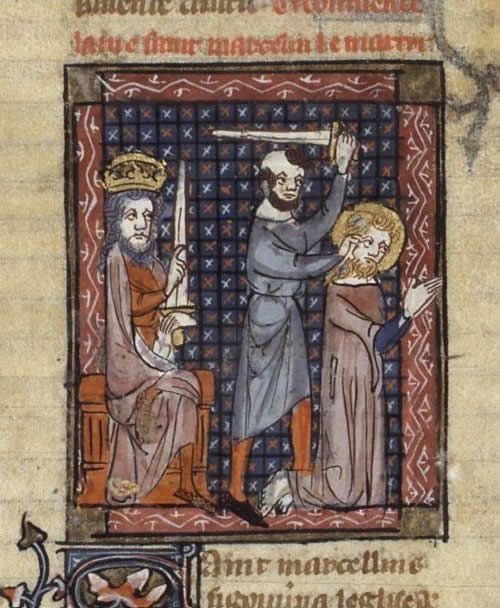
Image: Martyrdom of pope Marcellinus.jpg · Wikimedia Commons · Public domain, via Wikimedia Commons

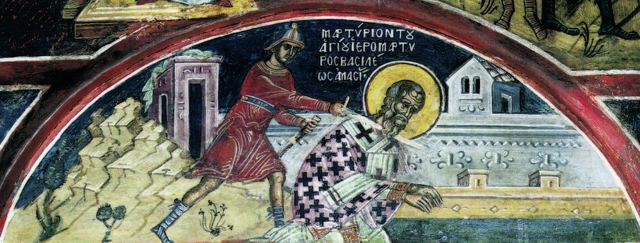
Image: Wikimedia Commons, Wikimedia Commons (Public domain)

From “Catholic Encyclopedia (1913)/Pope St. Marcellinus,” The Catholic Encyclopedia (New York: Robert Appleton Company, 1907–1914), via Wikisource. Public domain. Matched by name and feast date; text unedited except for our bracketed notes in grey.

Retold in plain modern English from Baring-Gould’s public-domain text, sentence by sentence, keeping the same facts and order. Short explanations in parentheses are ours.

From Sabine Baring-Gould, The Lives of the Saints, new edition in 16 vols. (London: John C. Nimmo, 1897–98); text from the Internet Archive scan (OCR, lightly cleaned; errors possible). Public domain in the United States. Reproduced unedited, except for short bracketed notes in grey that we added to explain names and terms (“S.” is the old abbreviation for Saint). Some history and judgments reflect 19th-century scholarship.

Notes

Story retold in our own words from the cited sources.