St. Stanislas Kostka. Paul was a straightforward, brave young man who enjoyed active exercise and healthy fun. In contrast, Stanislas, who had a delicate constitution and a shy nature, preferred solitude, study, and daydreaming. Paul could not understand a personality so different from his own. He treated Stanislas as weak and was rude and rough with him, trying to force him into social situations and to engage in physical activity. Paul was frustrated by his brother’s silence, his self-punishment, and fasting when he needed nourishing food, and by his constant seriousness when Paul wanted to be cheerful.
Stanislas became ill with what seemed to be brain fever and fell into a state of delirium. During this delirium, he imagined he saw a black dog running around the room and jumping at his throat. He screamed, made the sign of the cross, and fought against the imaginary creature with his hands. Stanislas believed he was dying, and since he and his brother lived among Lutherans, he feared he would die without receiving Holy Communion. Bilinski, their tutor, who later became a canon of Posla, would not have allowed that to happen. He recognized that Stanislas was not as ill as he thought and delayed calling for the priest. However, the idea that he might die without Communion troubled his agitated, fevered mind, leading him to believe that St. Barbara came to him, accompanied by two angels, and gave him Communion.
He called out to his tutor to worship the Sacred Presence, and Bilinski, intending to indulge a sick fantasy, knelt down. Later, Stanislas thought that the Blessed Virgin appeared to him and placed the child Jesus on the bed to play with him. After he recovered, he decided to join the Jesuit Order, but the Provincial in Vienna, Father Magius, did not dare to accept him. He then wrote a note explaining his intentions and ran away to see Father Canisius, the Provincial of North Germany, in Augsburg. His brother chased after him, but Stanislas managed to escape.
On his way to Augsburg, he entered a church, thinking it was Catholic, to receive the Holy Eucharist. To his disappointment and disgust, he found that he was among Lutherans. However, he believed that an angel came from heaven and miraculously communicated with him. The vigorous exercise and fresh air helped to dissipate the remnants of the illness that still clung to him, and he arrived in good condition at Augsburg.
Hearing that Father Canisius was not there but at Dillingen, he went there and presented himself before him as a candidate for the honor of the novitiate. Canisius, to test his vocation, ordered him to wait at table for the pensioners of the college and to sweep out their rooms. He did so without complaint and with great enthusiasm. Canisius, finding it impossible to keep him there and wanting to put him beyond the reach of his parents, sent him to Rome. He made the journey on foot with two companions and likely enjoyed the expedition over the Alps, threading through the beautiful valleys between Füssen and Innsbruck, passing through Reutte and Nassereit, and then crossing the Brenner Pass and descending the valley of the Adige, catching sight of the strange Dolomite peaks to the east as he approached Bolzano. Upon reaching Rome, he was received by St. Francis Borgia, who was then the General of the Order, and he was given the habit on the feast of Saints Simon and Jude in 1567, when he was seventeen years old.
His father was very angry, not only with his son but also with the Jesuits for having smuggled the boy out of his reach. He wrote an angry letter to Stanislas, telling him that if he returned to Poland, he would have him imprisoned and put under guard. Stanislas, in the fervor of his profession, replied that he was happy where he was and had no intention of returning. The journey on foot from Vienna to Augsburg and the further walk over the Alps had done wonders for his health and had strengthened him for a while.
But he weakened himself again by fasting, by scourging his back until it bled, and by denying himself necessary sleep. As a result, his naturally delicate constitution gave way before he had been a year in the novitiate. He fell ill on August 9 and died on August 14, 1568, at the age of eighteen, after having spent ten months in his novitiate.
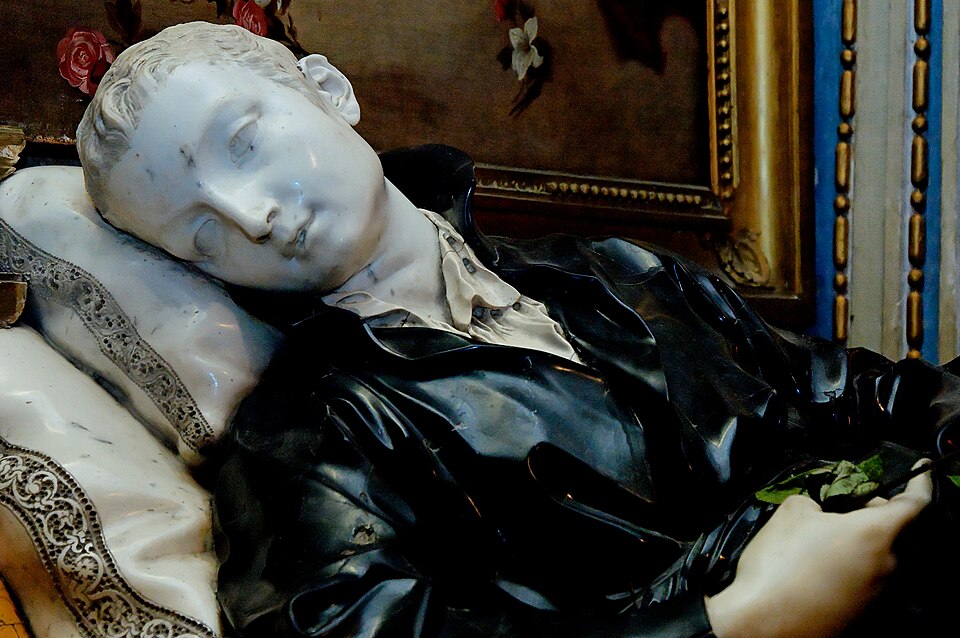
The room he occupied in St. Andrew’s College at the Quirinal is now transformed into a chapel in his honor. Where he died, there is a statue of him made of colored marbles by Legros, a French sculptor, depicting him on his bed. The head, hands, and feet are made of white marble, the cassock is black, and the bed and pillows are yellow marble. The monument is in poor taste. An authentic portrait of St. Stanislas is kept in a nearby room. His relics are preserved in the church under an altar, in an urn made of lapis lazuli. A chapel was built in his honor in Poland, and Clement VII granted ten years’ worth of indulgences and ten Lent indulgences to all who visit it. St. Stanislas is depicted in art as being miraculously communicated with by an angel, who bears a lily, and is dressed in a cassock and short surplice, or as receiving the child Jesus from the Virgin Mother.
Footnotes
- St. Stanislas Kostka is a recognized saint in the Catholic Church.
- St. Francis Borgia was the General of the Society of Jesus.
- Dillingen is a town in Bavaria, Germany.
- Füssen and Innsbruck are towns in the Alps.
- The Brenner Pass is a mountain pass in the Alps.
- Bolzano is a city in northern Italy.
- Clement VII was a pope from 1523 to 1534.
Baring-Gould’s own footnotes, in modern English.
Read the original 1870s text
Baring-Gould’s sources: Roman Martyrology on Aug. 15. Beatified by Clement VIII. in 1604; an office in his honour granted to the churches of Poland by Paul V. This privilege granted to the Society of Jesus by Clement X., who fixed his festival for Nov. 13. Canonized by Benedict XIII. in 1727. Authorities A Life by P. J. Dorl&ns, S.J., Paris, 1672; another by Francis Succhini, S.J., Ingolstast, 1609. “Compendium Vita, virtutum necnon actorum, in causa canonisationis B. Stanislai Kotskse,” Roma, 1726. “Vie de S. Stanislas Kostka, composee en italien, par le P. Cepari, tr. en franjais par Calpin,” Paris, 1816. “ Philosophic sacra, seu Vita S. Stan. Kotska, auct. Paulo Zettle,” Dilingen, 1715. “Vie de S. Stanislas Kotska, S.J. Trad, fibre de la vie itafienne de Bartoii: enrichie de nouveaux documents, par le P. Pouget, S.J.,” Toulouse, 1855. “S. Stanislaus, S.J., atate juvenis, sancdtate consummatus, nuper inter sanctos relatus,... a P. Ant Franc. Mariani, S.J., italice conscript., et latinum trad.,” Munich, 1727. “ Stanislas Kostka, module de saintetd... par le P. Pascal di Mattei, S.J.; trad, de Tltalien; ” Paris, 1857.] Stanislas Kotska, or Kostka, was the son of John Kotsk? and Margaret Kiska, of Polish noble family. He was bom in 1550 in the castle of KotskofF, belonging to his father. At the age of thirteen his father sent him to Vienna with his elder brother Paul, to study in the Jesuit college. > Reg In. Chroo. Pcrtz, i. 570.
S. Stanislas Kotska. Paul was a frank, gallant youth, loving active exercise and healthy amusement; Stanislas, delicate of constitution, and of a shrinking disposition, loved solitude, study, and brooding over his fancies. Paul could not understand a character the reverse of his own, treated him as a milk-sop, and was discourteous and rough with Stanislas, trying to force him into company, and to take healthy exercise. He was provoked by his brother’s reticence, his scourging of himself and fasting, when his health required nourishing food, by his perpetual gravity, when he himself was disposed to be merry. Stanislas fell ill with what appears to have been brain-fever, and became delirious. In his delirium he thought he saw a black dog running about the room, and jumping at his throat. He shrieked, and made the sign of the cross, and battled with his hands against the imaginary beast. Stanislas thought he was dying, and as he and his brother lodged among Lutherans, he fancied that he would be allowed to die without the Holy Communion. Bilinski, the tutor of the two boys, afterwards canon of Posla, would not of course have suffered this; he saw that Stanislas was not as ill as he imagined, and deferred sending for the priest But the notion having entered his head, vexed his excited, fevered brain, and gave occasion to his believing that he saw S. Barbara come to him, accompanied by two angels, and communicate him. He cried out to his tutor to worship the Sacred Presence, and Bilinski, with intention of humoring a sick fancy, knelt down. Afterwards Stanislas thought that the Blessed Virgin appeared to him, and put the child Jesus on the bed to play with him. On his recovery he determined to join the Jesuit Order, but the Provincial at Vienna, Father Magius, did not dare to receive him. He then wrote a note stating his intentions, and ran away to go to Father Canisius, Provincial of North Germany, at Augsburg. His brother pursued him, but Stanislas managed to Lives oj the Saints.
evade him. On his way to Augsburg, he entered a church, thinking it was Catholic, to receive the Holy Eucharist, but found to his disappointment and disgust that he was among Lutherans. He believed, however, that an angel came from heaven and miraculously communicated him. The vigorous exercise, the fresh air, dissipated the remains of the malady which still clung to him, and he arrived in good condition at Augsburg. Hearing that Father Canisius was not there, but at Dilingen, he went thither, and presented himself before him as candidate for the honour of the novitiate. Canisius, to try his vocation, ordered him to wait at table on the pensioners of the college, and sweep out their rooms. He did so without objecting, and with a great spirit of enthusiasm. Canisius, finding it impossible to conceal him there, to put him beyond the pursuit of his parents, sent him to Rome. He made the journey on foot with two companions, and probably enjoyed thoroughly the expedition over the Alps, threading the beautiful valleys between Fiissen and Innsbruck, by Reutte and Nassereit, and then crossing the Brenner and descending the valley of the Adige, catching the weird Dolomite peaks on the East, as he came upon Botzen. On reaching Rome he was received by S. Francis Borgia, then General of the Order, and was given the habit on the feast of SS. Simon and Jude 1567, when aged seventeen.
His father was greatly incensed, not only against his son, but also against the Jesuits, for having smuggled the boy out of his reach. He wrote an angry letter to Stanislas, and told him that should he return to Poland, he would have him ironed and put under ward. Stanislas, in the fervour of his profession, replied that he was happy where he was, and had no intention of returning. The trudge on foot from Vienna to Augsburg, and the further walk over the Alps, had done wonders for his health, and set him up for a while. S. Stanislas Kotska.
But he weakened himself again by his fasting, by scourging his back till the blood flowed, and by denying himself necessary sleep. The consequence was that his naturally delicate constitution gave way before he had been a year in the novitiate. He fell ill on August 9, and died on the 14th August, 1568, at the age of eighteen, after having spent ten months in his novitiate.
The room which he occupied in S. Andrew’s College at the Quirinal is now transformed into a chapel in his honour. Where he died is a statue of him in coloured marbles by Legros, a French sculptor, representing him on his bed. The head and hands and feet are in white marble, the cassock in black, and the bed and pillows in yellow marble. The monument is in bad taste. An authentic portrait of S. Stanislas is kept in a room adjoining. His relics [the bodily remains of a saint, or objects they used, kept with honor] are preserved in the church under an altar, in an urn of lapis-lazuli. A chapel was built in his honour in Poland, and Clement VII. granted ten years’ and ten Lent [the forty days of fasting before Easter] indulgences to all who should visit it. S. Stanislas is represented in art as miraculously communicated by an angel, bearing a lily, and vested in cassock and short surplice, or receiving the child Jesus from the Virgin Mother.