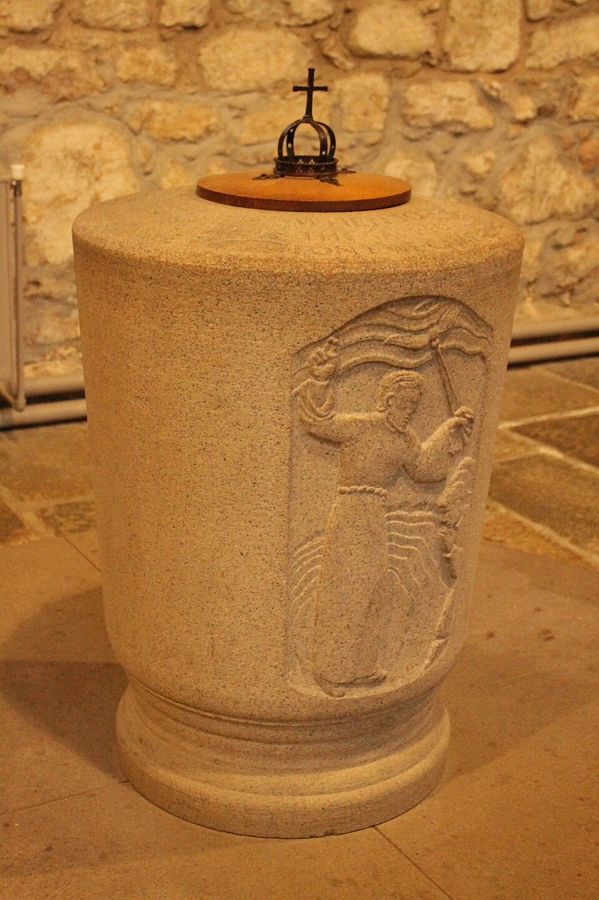
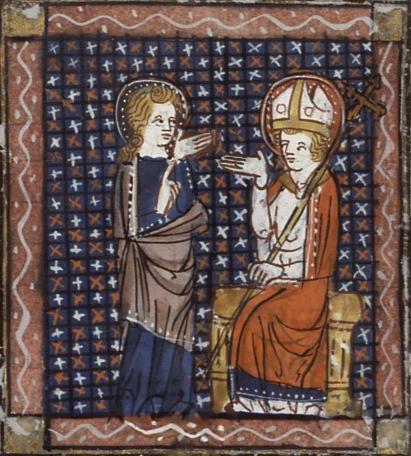
Machar placed himself under Saint Columba in Hy, or Iona, and was sent to convert the inhabitants of the island of Mull. There, he healed seven lepers and turned a boar that charged at him into stone.
He was ordained as a bishop and sent among the Picts with twelve companions. Saint Columba instructed him to stop where a river took the shape of a pastoral staff. After finding such a spot, he built a church and preached the Word with great success. It is said that he accompanied Saint Columba to Rome, where Saint Gregory gave him the name Maurice and appointed him to the vacant episcopal throne of Tours. When they arrived in Tours, the people they encountered were unaware of where Saint Martin was buried. Saint Columba promised to find the body if he was given a relic from it. He prayed, discovered the remains of Saint Martin, and took the missal of the saint that lay with the body. Maurice remained in Tours as bishop and ruled the diocese for three and a half years. After a glorious vision of Christ, Saint Columba, and Saint Martin, he died and was buried in Tours. This story deserves no credit. Saint Columba never went to Rome or to Tours. Saint Gregory the Great became Pope in 590, and Saint Columba died in 597. He was far too old and infirm to have made such a journey in the last years of his life. The church of Tours knows nothing of a Bishop Maurice.
Mochumma, as we learn from O’Donell’s Life of Saint Columba, accompanied the abbot from Ireland when he was banished by the Synod of Teilte in 562. In vain, Columba urged him not to abandon his parents and homeland. “It is you,” answered the young man, “who are my father, the Church is my mother, and my country is where I can gather the largest harvest for Christ.” To make any resistance impossible, he made a solemn vow aloud to leave his country and follow Columba. “I swear to follow you wherever you go, until you have led me to Christ, to whom you have consecrated me.” Thus, his historian says, he forced himself, rather than offered himself, as a companion to the great exile during his apostolic work among the Picts, and he had no more active or devoted helper.
There are two parishes in Aberdeen named after him, and Mackeris Haugh in Kildrummie. It is possible that he was a bishop, and it is probable that he preached in Mull and in Aberdeenshire. Dochonna and Tochannu are variations of his name.
Footnotes
- Saint Columba was a prominent missionary and abbot in the 6th century.
- The Synod of Teilte was a church council held in Ireland.
- The Picts were a group of Celtic tribes in ancient Scotland.
Baring-Gould’s own footnotes, in modern English.
Read the original 1870s text
Baring-Gould’s sources: The Kalendar of David Camerarius on this day. In Dempster on Nov. 12 and Jan. 15. In Adam King’s Kalendar on Nov. 12. The Aberdeen Breviary on the same day. Authority: — The Life in the Lessons of the Aberdeen Breviary. The Life of S. Columba by Marius O’DonelL See also Reeve’s Adamnan.] S. Machar, called also Mauricius and Mochumma, was the son of Fiachna, prince of Ulster, and his wife Finchoemia. He was baptized by S. Colman, who named him Mocumma. He early exhibited signs of sanctity, and angels are said to have sung sweet songs round his cradle, lulling the little child to sleep and dreams of Paradise. His brother died, and was placed in the bed of Machar; the sanctity of the future bishop restored warmth to the dead flesh of the boy, and he sat up.
Machar placed himself under S. Columba [Irish abbot of Iona (d. 597), apostle of Scotland] in Hy, or Iona, and was sent to convert the inhabitants of the island of MulL There he healed seven lepers, and turned to stone a boar which rushed forth against him.
He was ordained bishop, and sent among the Piets with twelve companions, and ordered by S. Columba to stop where a river took the form of a pastoral staff. Having found such a spot, he built a church, and preached the Word with great success. It is said that he accompanied S. Columba to Rome, and that S. Gregory gave him the name of Maurice, and appointed him to the vacant episcopal throne of Tours. On reaching Tours with his master, the people they found were ignorant of where S. Martin [St. Martin of Tours (d. 397), soldier turned bishop] lay. S. Columba promised to find the body if he were given a relic from it. He prayed, discovered the remains of S. Martin, and carried off the missal of the saint which lay with the body. Maurice remained at Tours as bishop, and ruled the diocese three years and a half. Then, after a glorious vision of Christ, S. Cohimba, and S. Martin, he died, and was buried at Tours. This story deserves no credit. S. Columba never went to Rome or to Tours. S. Gregory the Great was made Pope in 590, and S. Columba died in 597. He was far too old and infirm to have made such a journey in the last years of his life. The church of Tours knows nothing of a Bishop Maurice.
Mochumma, as we learn from O’Donell’s Life of S. Columba, accompanied the abbot from Ireland when banished by the Synod of Teilte, in 562. In vain Columba represented to him that he ought not to abandon his parents and native soil. “It is thou,” answered the young man, “who art my father, the Church is my mother, and my country is where I can gather the largest harvest for Christ.” Then, in order to make all resistance impossible, he made a solemn vow aloud to leave his country and follow Columba. “ I swear to follow thee wherever thou goest, until thou hast led me to Christ, to whom thou hast consecrated me.” It was thus, says his historian, that he forced himself, rather than offered himself, as a companion to the great exile, in the course of his apostolical career among the Piets, and he had no more active or devoted auxiliary.
There are two parishes in Aberdeen bearing his name, and Mackeris Haugh in Kildrummie. That he was a bishop is possible, that he preached in Mull and in Aberdeenshire is probable. Dochonna and Tochannu are forms of his name.