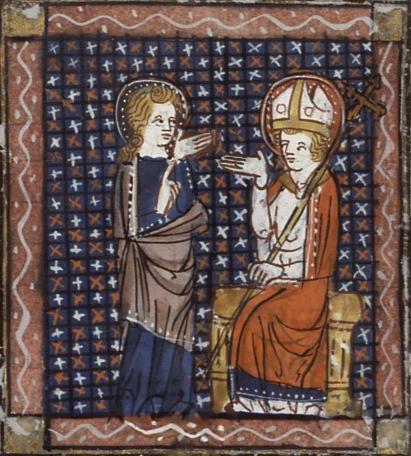
Brice did not recognize the greatness of his master. One day, a sick man came to see Martin and asked Brice, who was then a deacon, where the saint was. “The fool is over there,” answered the deacon, “staring at the sky like a madman.” Later, Martin called Brice to him and said, “So I am a fool?” Brice was taken aback. “I have prayed for you,” said Saint Martin; “you will become bishop of Tours, but your life will not be a peaceful one.”
Brice laughed and said, “I thought he was out of his mind, and now I am sure of it.” One day, Saint Martin scolded Brice for buying horses and slaves at high prices and even for surrounding himself with beautiful young women. Brice was angry and said, “I am a better Christian than you. I have had an ecclesiastical education from my youth, while you were raised in the freedom of the army, and now in your old age, you indulge in all sorts of foolish ascetic practices and are a victim of hallucinations.” After a few moments, he regretted his words, returned, and threw himself at the feet of his master, asking for forgiveness.
Afterwards, Sulpitius Severus, who lived at the time and knew Brice, said, “This same Brice was found guilty of serious crimes, but the saint (Martin) could not bring himself to remove him from the priesthood, fearing it would seem like he was seeking personal revenge. But he often repeated, ‘If Christ endured Judas, why should I not endure Brice?’” After the death of Saint Martin, Brice was likely elected to succeed him as bishop of Tours due to his noble birth and wealth.
As bishop, he apparently showed little improvement and caused great scandal. Lazarus, the bishop of Aix, accused him before several councils, but did not succeed in having him condemned. Eventually, a serious moral outrage was attributed to him, which led to his flight. A nun gave birth to a child and confessed that she had been seduced by Brice. Gregory of Tours says that when the child was brought to Brice and he was accused of being its father, the bishop asked the child—who was then a month old—whether this charge was true, as if the infant could possibly know who its father was. The baby made a sound that was interpreted as a "No." However, the people were not convinced and demanded that the baby should say who its father was if Brice was not. The bishop refused to carry the miracle further, and he either fled from Tours or was deposed. A priest named Justinian was elected to replace him. After Justinian's death, Armentius succeeded him. Brice lived in Rome until Armentius died, and then he returned to Tours to reclaim his position as bishop. He was allowed to take it back; so many years had passed that the accusations against him were forgotten or ignored, and he held the position for seven years. He died after having been nominally bishop for forty-seven years, most of which he spent in exile.
In his old age, when the fires of youth had burned out, he gained the reputation of a saint, and when no evidence could be found to support the charges against him, it was charitably considered a calumny.
Footnotes
- Sulpitius Severus was a Christian writer and historian from the 4th century.
- Gregory of Tours: a 6th-century historian and bishop known for his writings on the history of the Franks.
Baring-Gould’s own footnotes, in modern English.
Read the original 1870s text
Baring-Gould’s sources: Roman and Gallican Martyrologies. Usuardus, Ado, Floras, Wandelbert, &c. Anglican Reformed Kalendar. York, Hereford, and Sarum Kalendars. The translation on April 7. Authorities: — Mention in the Life of S. Martin by Sulpicius Severus, and S. Gregory of Tours, S. Brice— Brictius in Latin— was brought up from infancy in the monastery of S. Martin, near Tours. According to popular tradition he was the son of the Count of Nevers, and by order of his father was exposed in his cradle on the Loire. Martin rescued and adopted him.
Brice did not appreciate the perfection of his master. One day a sick man came to see Martin, and asked of Brice, then a deacon, where the saint was. “ The fool is yonder,” answered the deacon, “staring at the sky like a man distraught.” Afterwards Martin called Brice to him, and said, “So I am a fool 7” Brice was confounded. “ I have prayed for you,” said S. Martin [St. Martin of Tours (d. 397), soldier turned bishop]; “ you will become bishop of Tours, but your lot will not be a peaceful one.”
Brice laughed, and said, “ I thought he was out of his mind, and now I am sure of it.” One day S. Martin rebuked Brice for buying horses and slaves at a high price, and even providing himself with beautiful young girls. Brice was furious, and said, “I am a better Christian than you. I have had an ecclesiastical education from my youth, and you were bred up amid the licence of the camp, and now in your old age you indulge in all sorts of foolish ascetic practices, and are a prey to hallucinations.” He repented after a few moments, and returned and flung himself at the feet of his master, and asked his pardon.
8. BRICK After Cabier. •S. Brice. “Afterwards/* says Sulpidus Severus, who lived at the time, and knew Brice, " this same Brice was convicted of great crimes, but the saint (Martin) could not make up his mind to depose him from the priesthood, lest it should look as though he were revenging his private wrongs on him. But he often repeated, * If Christ endured Judas, why not I Brice?*”1 On the death of S. Martin, Brice, probably on account of his birth and wealth, was elected to succeed him in the see of Tours [a bishop’s “see” is his diocese, named from his seat (Latin sedes)].
As bishop he apparently showed little improvement, and gave great scandal. Lazarus, bishop of Aix, accused him before several councils, but did not obtain his condemnation. At last a gross outrage on morals was attributed to him, and caused his flight. A nun gave birth to a child, and confessed that she had been seduced by Brice. S. Gregory of Tours [bishop and historian of the Franks (d. 594)] says that when the child was brought to Brice, and he was accused of being its father, the bishop asked the child — then a month old — whether this charge were true, as if the infant were likely to know who was its father. The babe uttered a sound which was taken to be a, “ No.** But the people were not convinced, and asked that the babe should say who was its father, if Brice was not. The bishop declined to carry the miracle further, and he either ran away from Tours, or was deposed. A priest named Justinian [Byzantine emperor 527–565] was elected in his room. On the death of Justinian, Armen tius succeeded him. Brice resided in Rome till the death of Armentius, and then ventured back to Tours to reclaim his episcopal throne. He was allowed to reascend it; so many years had passed, that the accusations against him were forgotten or disregarded, and he occupied it for seven years. He died, after having been nominally bishop for forty-seven years, the greater portion of which time he had spent in exile. In his 1 Sulpi. Sever. Dialog, iii. 99.
[Ncnr. Isold age, when the fires of youth had burned themselves out, he acquired the character of a saint, and when no evidence was procurable to establish the charge which had been made against him, it was charitably regarded as a calumny.