St. Nicolas I., Pope

Nicolas I (Nicholas), born at Rome of the Defensor Theodore, date unknown, died on 13 November 867.

Read the essentials →
Traditional feast November 13 · —

St. Nicolas I., Pope

Feast

Traditional feast: November 13 (Catholic Encyclopedia (1913)/Pope St. Nicholas I)
Traditional date · cited source, no current calendar entry found

Traditional feast

November 13
1914 / pre-1969 calendar, per Baring-Gould (1897)

Represents

Feast

Feast days

Feast: November 13

This Saint’s Story

Renowned for piety, learning, and eloquence, he was made subdeacon by Sergius II and deacon by Leo IV. After Benedict’s death the emperor Louis II came to Rome; on 24 April 858 Nicolas was elected, consecrated, and enthroned in St Peter’s in the emperor’s presence. Baring-Gould, following Anastasius, adds that he fled and hid in the Vatican and was drawn out despite his protests. He became one of the great medieval popes, asserting the Roman primacy amid the breakup of Charlemagne’s empire.

He excommunicated Archbishop John of Ravenna for oppressing papal territory and forging claims against Rome, and after flight and appeal forced his submission at Roman synods in 860–861. Against Hincmar of Reims he upheld Bishop Rothad’s appeal and Rome’s right to judge major causes, and later settled the elevation of Wulfad to Bourges. He defended marriage with equal firmness: Ingiltrud, who had left Count Boso, was banned when she ignored Milan; when Lothair II of Lorraine cast off Theutberga for Waldrada and compliant synods at Aachen and Metz approved, Nicolas deposed the legates Gunther of Cologne and Thietgaud of Trier at a Lateran synod in October 863, endured a brief imperial siege of St Peter’s without food, and never ceased urging reconciliation. Toward Judith of Flanders, married without her father’s consent, he urged leniency to protect freedom of marriage.

In the East he refused recognition to Photius, raised after Ignatius’s unlawful deposition, and excommunicated Photius at a Roman synod in April 863. He confirmed St Anschar’s legation to the Danes, Swedes, and Slavs, and answered Prince Boris of Bulgaria’s hundred and six questions in the celebrated Responsa; Boris nevertheless finally joined the Eastern Church. At Rome he rebuilt churches and lived as an earnest ascetic. On the forged pseudo-Isidorian decretals, Baring-Gould (with Milman) charges that Nicolas accepted and used them; the Encyclopedia, following Schrörs, concludes that he did not base his view of the law upon them and had at most a general knowledge from Frankish documents. He was buried before St Peter’s and regarded as a saint; his feast is 13 November. No patronage is clearly assigned to him in the Catholic Encyclopedia.

What he represents

How he teaches us to live

Drawn from themes in the original account

Feed your mind with Scripture and good books. Learning and the Scriptures matter in this life.

Celebrate this saint’s feast day. Remember him on November 13 with a short prayer, and ask for his help.

The full story

Baring-Gould’s account retold in modern English

Read the full story · 414 words · about 2 min

Nicholas I, on his own authority, accepted the decree of a national council made up of the most distinguished bishops of Gaul. This council had already been condemned by everyone who had a natural sympathy for justice and innocence. But Nicholas I, if he did not officially announce them, at least accepted and acted upon the Forged Decretals as authentic. He gave them the weight of papal approval, and it was with their help that he was able to defeat Hincmar, who was trying to maintain the independence of the Teutonic Church.

These Decretals were a collection of forged letters and decrees from the twenty earliest popes, from Clement to Melchiades. Along with the genuine decrees of the popes and councils from Sylvester to Gregory II, they included thirty-nine false decrees and the acts of several unauthentic councils. In this vast collection of judgments, the popes appeared as the lawmakers, guardians, and fathers of the faith throughout the world. It was created to provide the popes with a tool to crush those who opposed their most ambitious claims and to elevate them to the highest level of power in the Church. It was a long, continuous series of letters, an accumulated mass of decrees from councils, none of which could be found in the archives of Rome, and a brief investigation among them could easily show to be false. Nicholas is certainly not guilty of their creation, but he cannot be cleared of the accusation of using them and treating them as genuine when he must have known, or should have known, that they were a wicked invention. In one year’s letters, he showed no awareness of their existence, but in those of the following year, he claimed them triumphantly. Thus, he gave his deliberate approval to this gross historical fraud, the true nature of which could have been proven with just a few hours of study in the papal archives.

Nicholas died in November 867 and was buried before the gates of the basilica of St. Peter. A later writer gives this assessment of his character: “Since the days of Gregory I, no high priest has sat on the throne of St. Peter who can be compared to Nicholas. He tamed tyrants and kings and ruled the world like a sovereign; to holy bishops and clergy, he was mild and gentle; to the wicked and unconverted, he was a terror; so that we may truly say that a new Elijah arose in him.”

Footnotes

  1. Latin Christianity, book v. c. d. VOL. XIII.
  2. Nicolas died in November 867 and was buried before the gates of the basilica of St. Peter.

Baring-Gould’s own footnotes, in modern English.

Read the original 1870s text

Baring-Gould’s sources: Modern Roman Martyrology, inserted by Baronius. Authorities: — Life by Anastasius the Librarian and his own Letters.] Nicolas I., a Roman by birth, was brought up piously from early childhood by his father, Theodosius. He was ordained subdeacon by Sergius, and deacon by Leo. On the death of Pope Benedict, he committed the body to the tomb with many tears. The bishops *and clergy assembled in the church of S. Dionysius after long consultation elected him; Nicolas fled and hid in the Vatican, and was drawn from his place of concealment, and in spite of his remonstrances and protests, was raised to the apostolic throne. The Emperor Louis was then in Rome. It is said that he was the nominee of the emperor, and not favoured by the clergy.1 “ At least three great events signalized the pontificate of Nicolas I.,” says Dean Milman: “the strife of Photius with Ignatius for the archiepiscopal throne of Constantinople; the prohibition of the divorce of king Lothair from his queen Theutberga; and the humiliation of the great prelates on the Rhine, the successful assertion of the papal supremacy, even over Hincmar, archbishop of Rheims. In the first two of these momentous questions, the contest about the see of Constantinople, and that of Lothair, king of Lorraine, with his wife Theutberga, Nicolas took his stand on the great eternal principles of justice, humanity, and sound morals. These were no questions of abstruse and subtle theology, nor the assertion of dubious rights. In both cases the Pope was the protector of the feeble and the oppressed, the victims of calumny and of cruelty. The bishop of Constantinople, unjustly deposed, persecuted, exiled, treated with the worst inhumanity, implored the judgment of the head of Western Christendom. A queen, not only deserted by a weak and cruel husband, but wickedly and falsely criminated by a council of bishops, obtained a hearing at the Court of Rome; her innocence was vindicated, her accusers punished, the king himself compelled to bow before the majesty of justice made venerable by religion. If in both cases the language of Nicolas was haughty and imperious, it was justified to the ears of men by the goodness of his cause. The lofty supremacy which he asserted over the see of Byzantium awoke no jealousy, being exerted in behalf of a blameless and injured prelate. If he treated the royal dignity of France with contempt, it had already become contemptible in the eyes of mankind; if he annulled by his 1 Prudent. Trecens. ap. Pertz, i. 14a.

S. Nicolas I. own authority the decree of a national council, composed of the most distinguished prelates of Gaul [roughly modern France and Belgium], that council had already been condemned by all who had natural sympathies with justice and with innocence.”1 But Nicolas I., if he did not promulgate, at least accepted and acted upon as authentic the Forged Decretals. He gave them the weight of papal sanction, and it was with their aid that he was able to crush Hincmar, who struggled to maintain the independence of the Teutonic Church.

These Decretals were a collection of forged letters and decrees of the twenty earliest popes, from Clement to Melchiades, and together with the genuine decrees of the popes and councils from Sylvester to Gregory II., were incorporated thirty-nine false decrees, and the acts of several unauthentic councils. In this vast repository of judgments the popes appear as the legislators, guardians, and fathers of the faith throughout the world. It was composed with the design of furnishing the popes with a weapon for crushing those who opposed their most ambitious claims, and a means for exalting them to the highest pinnacle of power in the Church. It was a long, continuous, unbroken series of letters, an accumulated mass of decrees of councils, of which the archives of Rome could show no vestige, which the most cursory investigation among them could demonstrate to be false. Nicolas certainly is guiltless of their fabrication, but he cannot be cleared of the charge of employing them, appealing to them as genuine, when he must, or ought to have known that they were a wicked invention. In his letters one year he showed no knowledge of their existence, in those of the following they are triumphantly claimed, and he thus gave his deliberate sanction to this gross historic fraud, the true character of which a few hours of study in the papal archives would have proved.

1 ** Latin Christianity,” book v. c. d. VOL. XIII. 2 1 Nicolas died in November, 867, and was buried before the gates of the basilica of S. Peter. A later writer thus gives his estimation of his character: “Since the days of Gregory I. to our time sat no high priest on the throne of S. Peter to be compared to Nicolas. He tamed tyrants and kings, and ruled the world like a sovereign; to holy bishops and clergy he was mild and gentle; to the wicked and unconverted a terror; so that we may truly say that a new Elias arose in him.” 1

From the Catholic Encyclopedia

1913 · 1369 words

Born at Rome, date unknown; died 13 November, 867; one of the great popes of the Middle Ages, who exerted decisive influence upon the historical development of the papacy and its position among the Christian nations of Western Europe. He was of a distinguished family, being the son of the Defensor Theodore, and received an excellent training. Already distinguished for his piety, benevolence, ability, knowledge, and eloquence, he entered, at an early age, the service of the Church, was made subdeacon by Pope Sergius II (844-47), and deacon by Leo IV (847-55). After Benedict's death (7 April, 858) the Emperor Louis II, who was in the neighbourhood of Rome, came into the city to exert his influence upon the election. On 24 April Nicholas was elected pope, and on the same day was consecrated and enthroned in St. Peter's in the presence of the emperor. Three days after, he gave a farewell banquet to the emperor, and afterward, accompanied by the Roman nobility, visited him in his camp before the city, on which occasion the emperor came to meet the pope and led his horse for some distance.

Christianity in Western Europe was then in a most melancholy condition. The empire of Charlemagne [king of the Franks, crowned emperor in 800] had fallen to pieces, Christian territory was threatened both from the north and the east, and Christendom seemed on the brink of anarchy. Christian morality was despised; many bishops were worldly and unworthy of their office. There was danger of a universal decline of the higher civilization. Pope Nicholas appeared as a conscientious representative of the Roman Primacy in the Church. He was filled with a high conception of his mission for the vindication of Christian morality, the defence of God's law against powerful bishops. Archbishop John of Ravenna oppressed the inhabitants of the papal territory, treated his suffragan [a bishop under the authority of an archbishop] bishops with violence, made unjust demands upon them for money, and illegally imprisoned priests. He also forged documents to support his claims against the Roman See and maltreated the papal legates. As the warnings of the pope were without result, and the archbishop ignored a thrice-repeated summons to appear before the papal tribunal, he was excommunicated. Having first visited the Emperor Louis at Pavia, the archbishop repaired, with two imperial delegates. To Rome, where Nicholas cited him before the Roman synod assembled in the autumn of 860. Upon this John fled from Rome. Going in person to Ravenna, the pope then investigated and equitably regulated everything. Again appealing to the emperor, the archbishop was recommended by him to submit to the pope, which he did at the Roman Synod of November, 861. Later on, however, he entered into a pact with the excommunicated Archbishops of Trier and Cologne, was himself again excommunicated, and once more forced to make his submission to the pope. Another conflict arose between Nicholas and Archbishop Hincmar of Rims: this concerned the prerogatives of the papacy. Bishop Rothad of Soissons had appealed to the pope against the decision of the Synod of Soissons, of 861, which had deposed him; Hincmar opposed the appeal to the pope, but eventually had to acknowledge the right of the papacy to take cognizance of important legal causes (causæ majores) and pass independent judgment upon them. A further dispute broke out between Hincmar and the pope as to the elevation of the cleric Wulfad to the archiepiscopal See of Bourges, but here, again, Hincmar finally submitted to the decrees of the Apostolic See, and the Frankish synods passed corresponding ordinances.

Nicholas showed the same zeal in other efforts to maintain ecclesiastical discipline, especially as to the marriage laws. Ingiltrud, wife of Count Boso, had left her husband for a paramour; Nicholas commanded the bishops in the dominions of Charles the Bold to excommunicate her unless she returned to her husband. As she paid no attention to the summons to appear before the Synod of Milan in 860, she was put under the ban. The pope was also involved in a desperate struggle with Lothair II of Lorraine over the inviolability of marriage. Lothair had abandoned his lawful wife Theutberga to marry Waldrada. At the Synod of Aachen, 28 April, 862, the bishops of Lorraine, unmindful of their duty, approved of this illicit union. At the Synod of Metz, June, 863, the papal legates, bribed by the king, assented to the Aachen decision, and condemned the absent Theutberga. Upon this the pope brought the matter before his own tribunal. The two archbishops, G????nther of Cologne and Thietgaud of Trier, who had come to Rome as delegates, were summoned before the Lateran [St. John Lateran, the pope’s cathedral in Rome] Synod of October, 863,when the pope condemned and deposed them as well as John of Ravenna and Hagano of Bergamo. The Emperor Louis II took up the cause of the deposed bishops, while King Lothair advanced upon Rome with an army and laid siege to the city, so that the pope was confined for two days in St. Peter's without food. Yet Nicholas did not waver in his determination; the emperor, after being reconciled with the pope, withdrew from Rome and commanded the Archbishops of Trier and Cologne to return to their homes. Nicholas never ceased from his efforts to bring about a reconciliation between Lothair and his lawful wife, but without effect. Another matrimonial case in which Nicholas interposed was that of Judith, daughter of Charles the Bold, who had married Baldwin, Count of Flanders, without her father's consent. Frankish bishops had excommunicated Judith, and Hincmar of Reims had taken sides against her, but Nicholas urged leniency, in order to protect freedom of marriage. In many other ecclesiastical matters, also, he issued letters and decisions, and he took active measures against bishops who were neglectful of their duties.

Read the rest of the article

In the matter of the emperor and the patriarchs of Constantinople Nicholas showed himself the Divinely appointed ruler of the Church. In violation of ecclesiastical law, the Patriarch Ignatius was deposed in 857 and Photius illegally raised to the patriarchal see. In a letter addressed (8 May, 862) to the patriarchs of the East, Nicholas called upon them and all their bishops to refuse recognition to Photius, and at a Roman synod held in April, 863, he excommunicated Photius. He also encouraged the missionary activity of the Church. He sanctioned the union of the Sees of Bremen and Hamburg, and confirmed to St. Anschar, Archbishop of Bremen, and his successors the office of papal legate [an official representative sent by the pope] to the Danes [Viking raiders from Scandinavia], Swedes, and Slavs. Bulgaria having been converted by Greek missionaries, its ruler, Prince Boris, in August, 863, sent an embassy to the pope with one hundred and six questions on the teaching and discipline of the Church. Nicholas answered these inquiries exhaustively in the celebrated "Responsa Nicolai ad consulta Bulgarorum" (Mansi, "Coll. Conc.", XV, 401 sqq.). The letter shows how keen was his desire to foster the principles of an earnest Christian life in this newly-converted people. At the same time he sent an embassy to Prince Boris, charged to use their personal efforts to attain the pope's object. Nevertheless, Boris finally joined the Eastern Church.

At Rome, Nicholas rebuilt and endowed several churches, and constantly sought to encourage religious life. His own personal life was guided by a spirit of earnest Christian asceticism and profound piety. He was very highly esteemed by the citizens of Rome, as he was by his contemporaries generally (cf. Regino, "Chronicon", ad an. 868, in "Mon. Germ. Hist." Script.", I, 579), and after death was regarded as a saint. A much discussed question and one that is important in judging the position taken by this pope is, whether he made use of the forged pseudo-Isidorian papal decretals. After exhaustive investigation, Schrörs has decided that the pope wasneither acquainted with the pseudo-Isidorian collection in its entire extent, nor did he make use of its individual parts; that he had perhaps a general knowledge of the false decretals, but did not base his view of the law upon them, and that he owed his knowledge of them solely to documents which came to him from the Frankish Empire [Schrörs, "Papst Nikolaus I. und Pseudo-Isidor" in "Historisches Jahrbuch", XXV (1904), 1 sqq.; Idem, "Die pseudoisidorische 'Exceptio spolii' bei Papst Nikolaus I" in "Historisches Jahrbuch", XXVI (1905), 275 sqq.].
Help us add to this saint's story

Everything is read by a person before anything appears. Facts are checked against trusted sources first.

Facts are welcome; a source link helps (optional).With your permission we may share it on this page.

Nine days · Free

Pray the novena
with us.

One short email a day for nine days. The day's prayer, a line from St. Nicolas I.'s story, and a nudge to keep going.

Also on November 13
A

Sts. Antoninus

November 13 · Martyrs
St. Brice of Tours

St. Brice of Tours

November 13 · Bishop
St. Machar

St. Machar

November 13 · Bishop
← All 1970 saints in the library
Sources & notes

Feast-day sources

Story sources

Sources

Credits

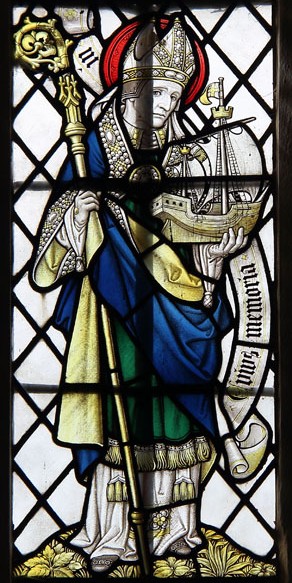
Image: St Nicholas, Great Wakering - Stained glass window - geograph.org.uk - 3916715(cropped).jpg · John Salmon · CC BY 2.0, via Wikimedia Commons

Image: John Salmon, Wikimedia Commons (CC BY 2.0)

From “Catholic Encyclopedia (1913)/Pope St. Nicholas I,” The Catholic Encyclopedia (New York: Robert Appleton Company, 1907–1914), via Wikisource. Public domain. Matched by name and feast date; text unedited except for our bracketed notes in grey.

Retold in plain modern English from Baring-Gould’s public-domain text, sentence by sentence, keeping the same facts and order. Short explanations in parentheses are ours.

From Sabine Baring-Gould, The Lives of the Saints, new edition in 16 vols. (London: John C. Nimmo, 1897–98); text from the Internet Archive scan (OCR, lightly cleaned; errors possible). Public domain in the United States. Reproduced unedited, except for short bracketed notes in grey that we added to explain names and terms (“S.” is the old abbreviation for Saint). Some history and judgments reflect 19th-century scholarship.

Notes

Story retold in our own words from the cited sources.