St. Meinrad

St. Meinrad (died 861) was a hermit in Switzerland murdered by robbers he had welcomed as guests. Einsiedeln Abbey grew up on the site of his hermitage. About the year of grace 797, was born Meinrad, Count of Hohenzollern.

Read the essentials →
Feast January 21 · Hermit, Martyr

St. Meinrad

Current feast

January 21
Secondary source · Wikipedia infobox

Traditional feast

January 21
1914 / pre-1969 calendar, per Baring-Gould (1914)

Represents

Hermit
Martyr

Feast days

Feast: January 21

This Saint’s Story

In our own words · little is known

Meinrad was born around 797 in Swabia and educated at the island abbey of Reichenau, where he became a monk and priest. Seeking solitude, around 835 he settled in the Dark Forest of Switzerland, where he kept a chapel with an image of Our Lady.

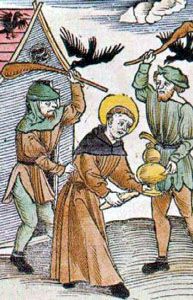
On January 21, 861, two robbers who thought he had treasure murdered him. A 10th-century life says two ravens he had fed followed the killers to Zurich, leading to their capture. A Benedictine (monks following the Rule of St. Benedict) community later grew up at his hermitage. This was Einsiedeln Abbey, still a major Marian pilgrimage site.

What he represents

How he teaches us to live

Drawn from themes in the original account

Make time for silence. Time alone in prayer is part of this story.

Pray a little every day. Prayer is part of this story.

Build up the community you belong to. Community life is part of this story.

Take one thing from this life into your own. Hospitality to the end, even to people who meant him harm.

The full story

Baring-Gould’s account retold in modern English

Read the full story · 3,203 words · about 14 min

Around the year 797, Meinrad was born, who would become the Count of Hohenzollern. He was born in a region of Swabia, then known as Sulichgau, which included the valleys of Steinlach and Sturzel, as well as the towns of Rottenburg and Sülchen.

Meinrad's father, Berthold, had married the daughter of the Count of Sülchen and lived with his wife in the strong castle of Sülchen, located on the Neckar River.

Meinrad lived at home until he was about ten or eleven years old. At that time, the island of Reichenau was home to a highly regarded Benedictine monastery. This island is located in the arm of Lake Constance known as the Zeller See and is very fertile. The monks managed two schools on the island, one for boys training to become monks and another for noble sons who wished to live in the secular world. When Meinrad entered the school, his relative, Hatto of Sülchen, was the abbot.

During this time, the monks aimed to teach the Germans the value of labor. The Germans were a restless people, fond of war, raiding their neighbors' lands, hunting, and fighting, and they held the work of farming and tending livestock in disdain. The monks began to work with their hands, gradually overcoming the prejudices of the time and transforming the Germans into an agricultural society. In 818, when Meinrad was 21 years old, the first vines were planted in Reichenau, which would become the main source of income for its owners to this day. Reichenau's location on the main road to Italy gave it particular significance. Many foreign bishops, who paused there during their travels, took away fond memories of the peaceful isle in the blue lake and returned to spend their final years there. For example, Bishop Egino retired to Reichenau and built the church of Our Lady at the western end of the island in 799, which still stands today. At the time of the church's consecration in 816, Meinrad was in the monastery school. Seven hundred monks, one hundred novices, and four hundred students participated in the ceremony, singing the grand psalms and Cœlestis urbs with remarkable effect.

The time came for Meinrad to leave school and decide on his career. The voice of his heart called him to serve God, and he prepared for Holy Orders. In 821, he was ordained as a deacon, and shortly afterwards, as a priest. He enjoyed studying, but the book that captivated him the most was the account of the Fathers of the Desert, written by Cassian. The images of these venerable hermits in their caves seemed to appear to him and beckon him onward. The voice that had called him to the priesthood said to him, "Friend, go up higher," and he took vows as a monk in the abbey of Reichenau, under his great-uncle Erlebald, who was now the superior after Hatto resigned in 822. He was then twenty-five years old.

At the upper end of Lake Zürich was the small cloister of Bollingen, which depended on Reichenau. It had a prior and twelve brothers who had settled in this wild area, seemingly lost among the mountains, to become teachers for a community steeped in darkness. They established a school for both the gentry and the serfs, where they taught the boys what was appropriate for their different social positions. Needing a master for this school, they sent to the abbot of Reichenau for one. The abbot chose Meinrad, who was immediately sent to the humble priory, located on the edge of civilization, where the mountains and dense forests seemed to say, "Thus far and no further shall you go."

In his new position, Meinrad earned general respect and affection. His wisdom in guiding souls, his knowledge, and his humility endeared him to everyone.

Nevertheless, from the moment he entered the priory, Meinrad felt a deep yearning in his heart for a more secluded life, where he could pray and meditate without distractions. About two leagues away, beyond the lake, stood Mount Etzel, covered with dense forest. Often, from the window of his cell, he gazed longingly at the blue mountain. His desire grew so strong that he decided to visit Etzel and search among its rocks for a place where he could spend his days in peace.

One day, he took one of his pupils with him, and they entered a boat to row to the foot of the desired mountain. A few hours later, he reached the summit, and his heart filled with sweet joy at the sight of a place his yearning soul had long desired. Behind him lay a pathless forest of pines, inhabited by wolves, but he was not afraid of them. He descended the hill toward Rapperschwyl and arrived at the village, which would later be called Altendorf. He rested at the home of a pious widow, who welcomed him warmly.

To her, Meinrad shared his plan and asked her to help him with his needs on the Etzel if he decided to retreat there. She readily promised to assist him. After thanking her, he returned joyfully to Bollingen. He asked the prior for his blessing and permission to pursue his project. The prior, with regret, allowed him to respond to the call of grace. Meinrad immediately separated himself from his companions and pupils and crossed the lake to the beloved mountain. This was in June 828, when Meinrad was thirty-one years old. He took nothing with him except his missal, a book of instructions on the Gospels, the rule of Saint Benedict, and the works of Cassian.

Burdened with these books, he climbed the Etzel and stood on a prominent point. Below him lay the blue lake of Zürich, its waters calm in the sunshine; behind him was the dark, foreboding forest. Beyond that, the Alpine peaks, adorned with glaciers, sparkled in the light, and around him was a solemn silence, broken only by the distant call of a magpie or the creaking of the pines in the breeze.

The first concern of the new solitary was to create shelter from rain and storms. He gathered broken branches and wove them between four pines that served as corner posts for his hovel, roofing it with ferns. This was his first house; however, shortly after, the widow, having learned that he had retreated to the Etzel, built him a hut made of pine logs and a small chapel where he could offer the Holy Sacrifice. She took care of all his needs, as she had promised, and Meinrad was now at the height of happiness.

Strange must have been those first evenings and nights spent in loneliness. There is a sense of mystery that weighs on the spirit when one is alone among the fragrant trees, which stand still and entranced, waiting for night to arrive. For people unaccustomed to the woods, few moments could feel more solemn than those that follow sunset. A shadow falls over the forest, and in the deep winding paths that spread among the grey, moss-covered trunks, the darkness of night quickly gathers.

Mysterious noises can be heard: the rustling of large birds settling in for the night, the sound of falling cones, the cry of a wild cat, or the howl of a wolf. The golden light that has flickered through the branches all day has completely vanished, except for a moment when it appears as a flake of fire on the distant snowy peak. Patches of ash-grey sky, seen through the gaps in the branches, provide no light. Perhaps an evening breeze whispers secrets among the tops of the pines and plays a soft tune that fills the air among the green, needle-like leaves of the fir trees. Then, when night has fully settled in, the moon casts its strange silver light among the moving branches and creates eerie images over the brambles and uneven ground. Branches snap with a sound like a gunshot, and the voices of unseen birds and animals echo like ghosts among the dark aisles of the labyrinth of firs.

It is helpful to imagine these surroundings when we think of the figures of the old hermits. Their challenges were not only hunger, thirst, and cold; they also faced the challenge of nerve.

In the forest cell, Meinrad disciplined his body through strict fasting and his soul through constant prayer. Gradually, his cabin became a place of refuge for pilgrims who came seeking relief for their troubled consciences or enlightenment for their dark understandings. Always connected to God and always aware of His presence, he sought to understand God's will and to completely submit his own will to it.

Seven years passed, and the number of visitors increased every day. Then, finding that his solitude was no longer solitary, he decided to leave the Etzel and hide himself in a secluded spot far from human habitations.

Behind the Etzel mountain extended a vast forest that had never been walked on by humans. Its wild and gloomy solitude attracted Meinrad. While he was thinking about his planned escape, some of his former students from Bollingen came to visit him, as they occasionally did. Meinrad descended the mountain with them to the spot where the river Sihl, after winding through the forest, flows gently through a pleasant valley and empties into the lake. The pines along its banks were reflected in the smooth water, and in its clear depths, many trout could be seen. The young monks wanted to spend a day fishing, so Meinrad crossed the river and entered the forest. He walked silently and thoughtfully, looking around in hopes of finding a suitable place for the purpose that occupied his mind. After walking for an hour and a half to the south, he reached the foot of a range of hills that formed a semi-circle extending toward the Alb. In this basin, enclosed by the mountains, a small stream wound over a bed of moss, springing from a source beneath the roots of two large pines. To the south lay the valley of the Alb, blocked by the rugged, snow-capped peaks of the Mythen. This was exactly the solitude that Meinrad had desired. He fell to his knees and thanked God for bringing him to such a pleasant spot. After drinking from the fountain for the first time, he returned to his companions, who had caught a bag full of fish. They all went back to his hermitage, and as evening fell, the young monks returned to Bollingen.

Meinrad now prepared to leave the Etzel. He went to Altendorf to thank the widow who had cared for him, and then he departed, taking with him one monk from Bollingen and a peasant to carry the supplies he would need in the wilderness. As they descended the hill toward the river, the monk saw a nest of ravens on a branch. He climbed the tree, took the nest, and brought it along with the two young birds it contained to Meinrad, who kept them as companions in his solitude.

A few steps above the spring, where there was a gentle rise, he decided to build his home. There, he constructed a simple hut made of logs. Providence did not abandon him. The abbess Hedwig, who led a small community of women in Zürich, took it upon herself to provide for his needs, in place of the widow from Altendorf. From time to time, she sent him food and other necessities.

He was now left in complete solitude, and often the temptation came to him, as he lay shivering with cold on winter nights, while the snow drifted around his cabin, to give up this way of life and return to the community at Bollingen or Reichenau. But he resisted these thoughts, viewing them as temptations from the evil one, with increased prayer and fasting. In this place, he spent several years in perfect seclusion until a carpenter from Wollerau, who came there one day looking for wood, discovered his cell. After that, he was visited by hunters, and gradually, a stream of pilgrims began to flow toward his home, just as it had on the Etzel. This was further encouraged by the gift of a statue of the Blessed Virgin and Child, made for Meinrad by Hildegard, the daughter of Louis the German, who had been appointed abbess of Zürich by her father in 853. This image quickly gained a reputation for being miraculous, and thus began the continuous pilgrimage that has lasted for over a thousand years to the revered shrine where it is kept.

Meinrad had spent twenty-five years in solitude, and his love for this ascetic and secluded life had grown stronger in his heart as he aged. He welcomed the arrival of winter, with its frost and snow, which blocked the paths and reduced the number of pilgrims. Yet, despite the harshness of the climate during that season and the lack of roads through the forest, he still received many visitors who came to share their troubles with him, like children to a father, and to seek his wise counsel. There were also days when he was alone, and, confined in his log cabin, he heard only the hissing of the wind among the trees and the howling of hungry wolves in the forest; everything around the hermitage felt sad, with flowers, grass, and the little spring lying dormant under the snow, which spread like a white shroud over dead nature. The two ravens, perched on a branch of pine that hung over the cabin door, let out their mournful croak. Meinrad alone was happy. He celebrated the Divine Mysteries, and while holding the eternal Victim in his hands, he offered himself along with the sacrifice of Calvary, earnestly desiring to be found worthy to die the death of a martyr. His prayer was heard.

During the last years of Meinrad's life, pilgrims left gifts at his door and before the image of Mary. He kept those that were used to decorate the chapel and gave the rest to the poor. Two men, one from the Grisons named Peter and the other a Swabian named Richard, suspected that he had a stash of money collected from the pilgrims and decided to rob him. They met in a tavern at Endigen, which is now the site of Rapperswil, where they spent the night. The next day, January 21st, 861, long before daybreak, they took the road to the Etzel and entered the forest. For a while, they lost their way because the paths were covered with snow. However, they eventually found the hermitage. The ravens screamed as they approached and fluttered around the hut, showing signs of alarm. The murderers later confessed that they were somewhat startled by the birds' evident fear.

The assassins reached the chapel door. S. Meinrad had finished his morning prayers and had celebrated Mass. The murderers watched him through a crack in the door, and when he had completed the sacrifice and turned from the altar, they knocked. Meinrad opened the door and greeted them cheerfully. "My friends," he said, "if you had arrived a little earlier, you could have assisted at the sacrifice. Enter and pray to God and His Saints to bless you; then come with me, and I will give you whatever refreshments my poor cell can offer." Saying this, he left them in the chapel and went to prepare food in his own hut.

The murderers rushed after him, and he turned and said with a smile, "I know your intention. When I am dead, place one of these candles at my head and the other at my feet, and escape as quickly as you can so that you are not caught."

He gave one man his cloak and the other his tunic. Then they beat him on the head with their sticks until he fell dead at their feet. After that, they threw his body onto the bed of dried leaves where he used to sleep and covered it with a rush mat. They searched the hut for money but found none. Before leaving, they remembered Meinrad's request and placed one of the candles at his head, taking the other to the chapel to light it at the ever-burning lamp. When they returned, to their astonishment, they saw that the candle at the head of the body was lit. Filled with a vague fear, they set down the other candle and fled.

However, the two faithful ravens pursued them, screaming harshly and attacking the murderers with their beaks and claws, as if they wanted to avenge their master's death. Growing more frightened and continually pursued by the enraged birds, the murderers ran towards Wollerau, where they encountered the carpenter who had discovered Meinrad's retreat. This man recognized the tame ravens of the hermit and suspected something was wrong. He quickly told his brother not to let the two men escape from his sight and then ran to the hermitage, where he found the body of the Saint.

The candle at his feet had set fire to the mat, but the flame had gone out as soon as it reached the corpse. The carpenter immediately returned to Wollerau, where he spread the news of the murder. After asking his wife and some friends to take care of the body of S. Meinrad, he went in pursuit of the assassins on the Zürich road. He soon caught up with them. The ravens were fluttering and screaming at the windows of a house. He entered and denounced the murderers. They were captured and brought to justice. Through their confession, all the details of the martyrdom were revealed.

Relics are at Einsiedeln, where, in 1861, the thousandth anniversary of the Saint's death was celebrated with great pomp.

Here a difficulty arises. There is no such name in the lists of the city prefects. According to this account, he transferred the duty of sentencing her to the deputy, Aspasius. In some accounts, he is called Aspasius Paternus. A Paternus was prefect of the city in 264 and 265; an Ovinius Paternus served in 281. Aspasius Paternus, pro-consul of Africa, around 260, is mentioned by Cyprian. It is likely that Symphronius was not the prefect of the city, but a powerful senator, and that Aspasius is the same person as Ovinius Paternus. Transcribers made many errors with the names in the Acts.

The antiphon to Psalm 109 is "Dixit Dominus," for Saint Agnes' Day, and is found in the Greek Menæa.

This is designated as the antiphon to the Magnificat for Saint Agnes' Day.

Prudentius.

Ibid.

Saint Vincent, Martyr, at Saragossa, in Spain, in the year 304. Saints Vincent, Orontius, Victor, and Aquilina, Martyrs, at Gerunda, in Spain, in the year 304. Saint Blæsilla, Virgin, at Rome, in the year 383. Saint Gaudentius, Bishop of Novara, in Italy, around the year 418. Saints Anastasius and seventy companions, Martyrs, in Assyria, in the year 628. Saint Dominic, Abbot of Sora, in Italy, in the year 1031. Saint Brithwald, Bishop of Wilton, in England, in the year 1045. Blessed Walter Van Bierbeeke, Monk, at Hemmerode, in Belgium, around the year 1220.

Footnotes

  1. Egino was a bishop who retired to Reichenau.
  2. Cœlestis urbs refers to a hymn or psalm sung during the ceremony.
  3. Saint Benedict: a Christian monk who founded the Benedictine order.
  4. Abbess Hedwig was the head of a religious community for women.
  5. Hildegard was appointed abbess of Zürich in 853.
  6. Rapperswil is a town in Switzerland.
  7. S. is an abbreviation for Saint.
  8. This account is a translation of the Acts; it is a very fair specimen of the original documents as written by the Church notaries at the time. The style being too simple to please the taste of later ages, too many of them were re-written in florid diction, and long speeches were put in the martyrs' mouths.
  9. One reading is insolutus, another in soleis.
  10. That is, to intercede for him when he, the martyr, stood in the presence of Christ in Paradise.
  11. That is, extending their arms, so that they formed the symbol of the Cross.
  12. Slightly abbreviated from the Acts.
  13. Aurelian was a special votary of the sun.
  14. There is some blunder here.
  15. S. Hieron, Ep. 6.
  16. S. August. Serm. 274.
  17. Antiphon to Psalm 109 is "Dixit Dominus," for Saint Agnes' Day, and is found in the Greek Menæa.
  18. This is designated as the antiphon to the Magnificat for Saint Agnes' Day.
  19. Saint Vincent, Martyr, at Saragossa, in Spain, in the year 304.
  20. Saints Vincent, Orontius, Victor, and Aquilina, Martyrs, at Gerunda, in Spain, in the year 304.
  21. Saint Blæsilla, Virgin, at Rome, in the year 383.
  22. Saint Gaudentius, Bishop of Novara, in Italy, around the year 418.
  23. Saints Anastasius and seventy companions, Martyrs, in Assyria, in the year 628.
  24. Saint Dominic, Abbot of Sora, in Italy, in the year 1031.
  25. Saint Brithwald, Bishop of Wilton, in England, in the year 1045.
  26. Blessed Walter Van Bierbeeke, Monk, at Hemmerode, in Belgium, around the year 1220.

Baring-Gould’s own footnotes, in modern English.

Read the original 1870s text

Baring-Gould’s sources: Authority, an ancient anonymous and perfectly authentic life in the library of the monastery at Einsiedeln.

About the year of grace 797, was born Meinrad, Count of Hohenzollern. He was born in that part of Swabia, then called Sulichgau, which comprised the valleys of Steinlach and Sturzel, and the towns of Rottenburg and Sülchen.

Berthold, the father of Meinrad, had married the daughter of the Count of Sülchen, and lived with his wife in the strong castle of Sülchen on the Nekar.

Meinrad lived at home till he was ten or eleven years old. At that time the island of Reichenau possessed a Benedictine [monks following the Rule of St. Benedict] monastery of great reputation. This island is situated in the arm of the lake of Constance, called the Zeller-see, and very fertile. The monks superintended two schools in this island, connected with their monastery, one for the boys who were in training to be monks, the other for the sons of nobles, who desired to live in the world. At the time that Meinrad entered the school, his kinsman, Hatto of Sülchen, was abbot.

At this period the great lesson that the monks had to teach the Germans was, the dignity of labour. The Germans were a turbulent people, loving war, harrying their neighbour's lands, hunting and fighting, despising heartily the work of tilling the land, and tending cattle. The monks began to labour with their hands, and by degrees they broke through the prejudices of the time, and converted the Germans into an agricultural people. In 818, when Meinrad was aged 21, the first vines were planted in Reichenau, to become, to this day, the principal source of revenue to those to whom it belongs. The position of Reichenau, on the main road to Italy, gave it a special importance. Many foreign bishops, who, halting there on their journeys, had carried away with them a pleasant memory of that quiet isle in the blue lake, returned to it to spend their last years in peace. Thus the Bishop Egino retired to Reichenau, and built there, in 799, the church of Our Lady, at the western extremity of the island, which still exists. At the time of the consecration of this church, Meinrad was in the monastery school; this was in 816. Seven hundred monks, a hundred novices, and four hundred scholars assisted at the ceremony, and sang the grand psalms and Cœlestis urbs with wondrous effect.

The time came for Meinrad to leave school and decide on his career. The voice of his heart called him to the service of God, and he prepared for Holy Orders. In 821 he was ordained deacon, and shortly afterwards priest. He was fond of study; but the book that most charmed his imagination was the account of the Fathers of the Desert, by Cassian. The forms of these venerable hermits in their caves seemed to appear to him and beckon him on. The voice which had called him to the priesthood said to him, "Friend, go up higher," and he took vows as a monk in the abbey of Reichenau, to his great-uncle Erlebald, now superior, on the resignation of Hatto in 822. He was then aged twenty-five.

At the upper extremity of the Lake of Zürich was the little cloister of Bollingen, dependant on that of Reichenau. It contained a prior and twelve brethren, who had established themselves in this wild neighbourhood, lost, as it were, among the mountains, to become the teachers of a neighbourhood buried in darkness. They established a school for the gentry and also for the serfs, in which they taught the boys what was suitable for their different stations in life. Being in want of a master for this school, they sent to the abbot of Reichenau for one. His choice fell on Meinrad, who was at once despatched to the humble priory, situated on the confines of civilization, to which the mountains and dense forests seemed to say, "Thus far and no further shalt thou go."

In his new situation, Meinrad drew upon himself general esteem and affection. His prudence in the direction of souls, his learning, and his modesty, endeared him to all.

Nevertheless, from the moment of his entering into the priory, Meinrad had felt a yearning in his heart for a life more secluded, in which he could pray and meditate without distraction. About two leagues off, beyond the lake, rose Mount Etzel, covered with dense forest. Often from the window of his cell did his eyes rest, with an invincible longing, on the blue mountain. The desire became, at length, so uncontrollable, that he resolved to visit the Etzel, and seek among its rocks for some place where he might pass his days in repose. One day, accordingly, he took with him one of his pupils, and, entering a boat, rowed to the foot of the desired mount. A few hours after he was at the summit, and his heart beat with a sweet joy at the sight of a place to which his yearning soul had long turned. Behind him was a pathless forest of pines, inhabited by wolves, but he feared them not. He descended the hill by the side of Rapperschwyl, and arrived at the village, called afterwards Altendorf. He rested at the house of a pious widow, who received him hospitably. To her Meinrad confided his design, and asked her to minister to his necessities on the Etzel, should he retire thither. She readily promised to do so. Having thanked her, he returned full of joy to Bollingen. He asked the prior to give him his benediction and permission to accomplish his project. He, with regret, permitted him to respond to the call of grace, and Meinrad at once tore himself from his companions and pupils, and crossed the lake to the beloved mountain. This was in June, 828, when Meinrad was aged thirty-one. He took nothing with him save his missal, a book of instructions on the Gospels, the rule of S. Benedict [father of Western monks (d. c. 547), author of the Rule], and the works of Cassian. Burdened with these volumes, he climbed the Etzel, and stood on a commanding point. At his feet and before him lay the blue lake of Zürich, its waters sleeping in sunshine; behind him was the gloomy horror of the forest. Beyond, the Alpine peaks wreathed in glaciers, glittering in the light, and around him a solemn silence, broken only by the distant scream of a magpie, or the creaking of the pines in the breeze.

The first care of the new solitary was to provide himself with shelter against rain and storm. He collected broken boughs, and interlaced them between four pines that served as corner posts to his hovel, and roofed it in with fern. This was his first house; but shortly after, the widow, having heard that he had retired to the Etzel, built him a hut of pine logs, and a little chapel, in which he might offer the Holy Sacrifice. She attended to all his necessities, as she had promised, and Meinrad was now at the summit of happiness.

Strange must have been those first evenings and nights in loneliness. There is a sense of mystery which oppresses the spirit when alone among the fragrant trees, that stand stiff and entranced, awaiting the coming on of night. To persons unaccustomed to the woods, few moments of greater solemnity could occur than those following the set of sun. A shadow falls over the forest, and in the deep winding tunnels that radiate among the grey, moss-hung trunks, the blackness of night condenses apace.

Mysterious noises are heard; the rustling of large birds settling themselves for the night, the click of falling cones, the cry of the wild cat, or the howl of the wolf. The gold light, that all day has flickered through the boughs and diapered the spine strewn soil, has wholly disappeared, save that for a moment it lies a flake of fire on the distant snowy peak. Patches of ash-grey sky, seen through the interstices of the branches, diffuse no light. Perhaps an evening breeze whispers secrets among the pine-tops and pipes between the trunks, or hums an indistinct tune, pervading the whole air, among the green needle-like leaves of the firs. And then, when night has settled in, the moon shoots its fantastic silver among the moving branches, and draws weird pictures over the brambles and uneven soil. Branches snap with a report like a pistol, and voices of unseen birds and beasts sound ghost-like among the dark aisles of the labyrinth of firs.

It is well to picture these surroundings, when we call up before us the figures of the old hermits. Their trials were not only of hunger, and thirst, and cold; there was the trial of nerve as well.

In the forest cell, Meinrad disciplined his body by rigorous fasts, and his soul by constant prayer. By degrees, his cabin became a resort of pilgrims, who arrived seeking ease to their troubled consciences, or illumination to their dark understandings. Always united to God, always penetrated with the sense of His presence, he strove to know the will of God, and to submit his own will wholly to that.

Seven years passed, and the number of those who visited him increased every day. Then, finding his solitude no more a solitude, he resolved to leave the Etzel, and bury himself in some nook far from the habitations of men.

Behind the Etzel extended a vast forest untrodden by man, whose savage and gloomy loneliness attracted Meinrad. Whilst he was musing on his projected flight, some of his old pupils at Bollingen came, as was their wont occasionally, to visit their former master. Meinrad descended the mountain with them to the point where the river Sihl, after numerous windings in the forest, flows gently through an agreeable valley, and empties itself into the lake. The pines on its banks were reflected in the glassy water, and in its crystal depths could be seen multitudes of trout. The young monks desiring to have a day's fishing, Meinrad crossed the river, and entered the forest. He walked on silent and meditating, looking around him, in hopes of discovering some place suitable for the purpose that occupied his mind. After a walk of an hour and a half, in a southerly direction, he reached the foot of a range of hills which formed a semi-circle as far as the Alb. In this basin, enclosed within the arms of the mountain, wound a little stream over a bed of moss, from a spring beneath the roots of two large pines. To the south lay the valley of the Alb, blocked by the rugged snow-topped crags of the Mythen. This was just such a solitude as Meinrad had desired. He fell on his knees, and thanked God for having brought him to so pleasant a spot, and drinking for the first time from the fountain, he returned to his companions, who, having caught a bag full of fish, went back with him to his hermitage, and as evening fell, returned to Bollingen.

Meinrad now prepared to leave the Etzel. He went to Altendorf to thank the widow who had provided for him, and then he departed, taking with him one monk of Bollingen and a peasant, to carry such things as would be necessary in the wilderness. As they descended the hill towards the river, the brother saw a nest of ravens on a branch; he climbed the tree, and taking the nest, brought it along with the two young birds it contained to Meinrad, who kept them, to be the companions of his solitude.

A few paces above the spring, where there was a gentle rise, he decided should be the site of his habitation, and there accordingly he erected a simple hut of logs. Providence did not desert him. The abbess Hedwig, head of a small community of women at Zürich, undertook to minister to his necessities, in place of the widow of Altendorf; and from time to time she sent him food, and such things as be needed.

He was now left in complete solitude, and often the temptation came upon him, as he lay shivering with cold in the winter nights, and the snow drifted about his cabin, to give up this sort of life, and return to the community at Bollingen or Reichenau. But he resisted these thoughts, as temptations of the evil one, with redoubled prayer and fasting. In this place he spent several years in perfect retirement, till a carpenter of Wollerau, coming there one day in quest of some wood, discovered his cell. After that, he was visited by hunters, and then, by degrees, a current of pilgrims flowed towards his abode, as had been the case on the Etzel. What added to this was the present of a statue of the Blessed Virgin and Child, made to Meinrad by Hildegard, daughter of Louis the German, who had been appointed by her father abbess of Zürich, in 853. This image speedily acquired the credit of being miraculous, and thus began that incessant pilgrimage which has continued for over a thousand years to the venerated shrine where it is preserved.

Meinrad had spent twenty-five years in solitude; and his love for this mortified and retired life had grown stronger in his heart as he grew older. He was glad when winter, the frost, and the snow came to block the paths, and diminish the concourse of pilgrims; yet in spite of the rigour of the climate at that season, and the want of roads through the forest, he still saw many visitors, who came to confide to him their troubles, as children to a father, and to ask counsel of his prudence. There were also days in which he was alone, and, shut up in his log-hut, heard only the hissing of the wind among the trees, and the howling of the wolves, pressed by hunger in the forest; all was sad around the hermitage, the flowers, the grass, the little spring slept under the snow, spread like a white pall over dead nature. The two ravens, perched on a branch of pine which overhung the cabin door, uttered their plaintive croak. Meinrad alone was happy. He celebrated the Divine Mysteries, and holding in his hands the eternal Victim, offered himself, in conjunction with the sacrifice of Calvary; desiring earnestly that he might be found worthy to die the death of a martyr. His prayer was heard.

During the last years of Meinrad's life, pilgrims laid presents at the door of Meinrad, and before the image of Mary. Those that served to adorn the chapel he kept, the rest he gave away to the poor. Two men, one from the Grisons, named Peter, the other a Swabian, named Richard, suspecting that he had a store of money collected from the pilgrims, resolved on robbing him. They met in a tavern at Endigen, where now stands Rapperschwyl, where they spent the night. Next day, January 21st, 861, long before daybreak, they took the road to the Etzel and entered the forest. For a while they lost their way, for the paths were covered with snow. However, at length they discovered the hermitage. The ravens screamed at their approach, and fluttered with every token of alarm about the hut, so that, as the murderers afterwards confessed, they were somewhat startled at the evident tokens of alarm in the birds. The assassins reached the chapel door. S. Meinrad had said his morning prayers, and had celebrated mass. The murderers watched him through a crack in the door, and when he had concluded the sacrifice, and had turned from the altar, they knocked. Meinrad opened, and received them cheerfully. "My friends," said he; "had you arrived a little earlier, you might have assisted at the sacrifice. Enter and pray God and His Saints to bless you; then come with me and I will give you such refreshments as my poor cell affords." So saying he left them in the chapel, and went to prepare food in his own hut.

The murderers rushed after him, and he turned and said, smiling, "I know your intention. When I am dead, place one of these tapers at my head, and the other at my feet, and escape as quickly as you can, so as not to be overtaken."

He gave to one his cloak and to the other his tunic; and they beat him about the head with their sticks, till he fell dead at their feet. Then they threw his body on the bed of dried leaves whereon he was wont to sleep, and cast a rush mat over it. They then searched the hut for money, but found none. Before leaving, they remembered the request of Meinrad, and placed one of the tapers at his head, the other they took to the chapel, to light it at the ever-burning lamp. When they returned, to their astonishment, they saw that the candle at the head of the body was alight. Filled with a vague fear, they set down the other candle and took to flight. But the two faithful ravens pursued them, screaming harshly, and dashing against the heads of the murderers with their beaks and claws, as though desirous of avenging their master's death. Frightened more and more, and continually pursued and exposed to the attack of the enraged birds, the murderers ran towards Wollerau, where they met the carpenter who had discovered the retreat of Meinrad. This man, recognizing the tame ravens of the hermit, and suspecting mischief, hastily bade his brother not allow the two men to escape out of his sight, and then ran to the hermitage, where he found the body of the Saint. The candle at his feet had set fire to the mat, but the flame had expired as soon as it had reached the corpse. The carpenter at once returned to Wollerau, where he spread the news of the murder, and having bade his wife and some friends take care of the body of S. Meinrad, he went in pursuit of the assassins on the Zürich road. He soon overtook them. The ravens were fluttering with shrill screams at the windows of a house. He entered and denounced the murderers. They were taken, and delivered over to justice. By their confession all the circumstances of the martyrdom were made known.

Relics, at Einsiedeln, where, in 1861, the thousandth anniversary of the Saint's death was celebrated with great pomp.

FOOTNOTES:

[100] This account is a translation [the solemn moving of a saint’s relics to a new shrine] of the Acts; it is a very fair specimen of the original documents as written by the Church notaries at the time. The style being too simple to please the taste of later ages, too many of them were re-written in florid diction, and long speeches were put in the martyrs' mouths.

[101] One reading is insolutus , another in soleis .

[102] That is, to intercede for him when he, the martyr, stood in the presence of Christ in Paradise.

[103] That is, extending their arms, so that they formed the symbol of the Cross.

[104] Slightly abbreviated from the Acts.

[105] Aurelian [Roman emperor 270–275] was a special votary of the sun.

[106] There is some blunder here.

[107] S. Hieron, Ep. 6.

[108] S. August. Serm. 274.

[109] Here a difficulty occurs. There is no such name in the lists of the prefects of the city. According to this account, he transferred to the deputy, Aspasius, the duty of sentencing her. In some accounts he is called Aspasius Paternus. A Paternus was prefect of the city in 264 and 265; an Ovinius Paternus in 281. Aspasius Paternus, pro-consul of Africa, in or about 260, is mentioned by S. Cyprian. It is probable that Symphronius was not prefect of the city, but a powerful senator, and that Aspasius is the same as Ovinius Paternus. Transcribers made havoc of the names in the Acts.

[110] Antiphon to Ps. cix. Dixit Dominus , for S. Agnes' Day, and Greek Menæa.

[111] This is appointed as the antiphon to the Magnificat for S. Agnes' Day.

[112] Prudentius.

[113] Ibid.

[114] S. Ambrose [bishop of Milan (d. 397)] lib. I. De Virgin. c. 2.

S. Vincent , D. M., at Saragossa, in Spain , a.d. 304. SS. Vincent, Orontius, Victor, and Aquilina , MM., at Gerunda, in Spain , a.d. 304. S. Blæsilla , W., at Rome , a.d. 383. S. Gaudentius , B. of Novara, in Italy, circ. a.d. 418. SS. Anastasius and Lxx. Companions , MM., in Assyria , a.d. 628. S. Dominic , Ab. of Sora, in Italy , a.d. 1031. S. Brithwald , B. of Wilton, in England , a.d. 1045. B. Walter Van Bierbeeke , Monk, at Hemmerode, in Belgium, circ. a.d. 1220.
Patron saint of

  • Einsiedeln
    His hermitage became the abbey and shrine of Our Lady of Einsiedeln.

Help us add to this saint's story

Everything is read by a person before anything appears. Facts are checked against trusted sources first.

Facts are welcome; a source link helps (optional).With your permission we may share it on this page.

Nine days · Free

Pray the novena
with us.

One short email a day for nine days. The day's prayer, a line from St. Meinrad's story, and a nudge to keep going.

Also on January 21
F

Sts. Fructuosus

January 21 · Bishop, Martyr, Doctor, Martyrs
P

St. Patroclus

January 21 · Martyr
St. Agnes

St. Agnes

January 21 · Virgin, Martyr
← All 1970 saints in the library
Sources & notes

Feast-day sources

Story sources

Sources

Credits

Image: Mainrado.JPG · Original uploader was Elvezio at it.wikipedia · Public domain, via Wikimedia Commons

Image: Original uploader was Elvezio at it.wikipedia, Wikimedia Commons (Public domain)

Retold in plain modern English from Baring-Gould’s public-domain text, sentence by sentence, keeping the same facts and order. Short explanations in parentheses are ours.

From Sabine Baring-Gould, The Lives of the Saints, new and revised edition (Edinburgh: John Grant, 1914; first edition 1872). Public domain in the United States. Reproduced unedited, except for short bracketed notes in grey that we added to explain names and terms (“S.” is the old abbreviation for Saint). Some history and judgments reflect 19th-century scholarship.