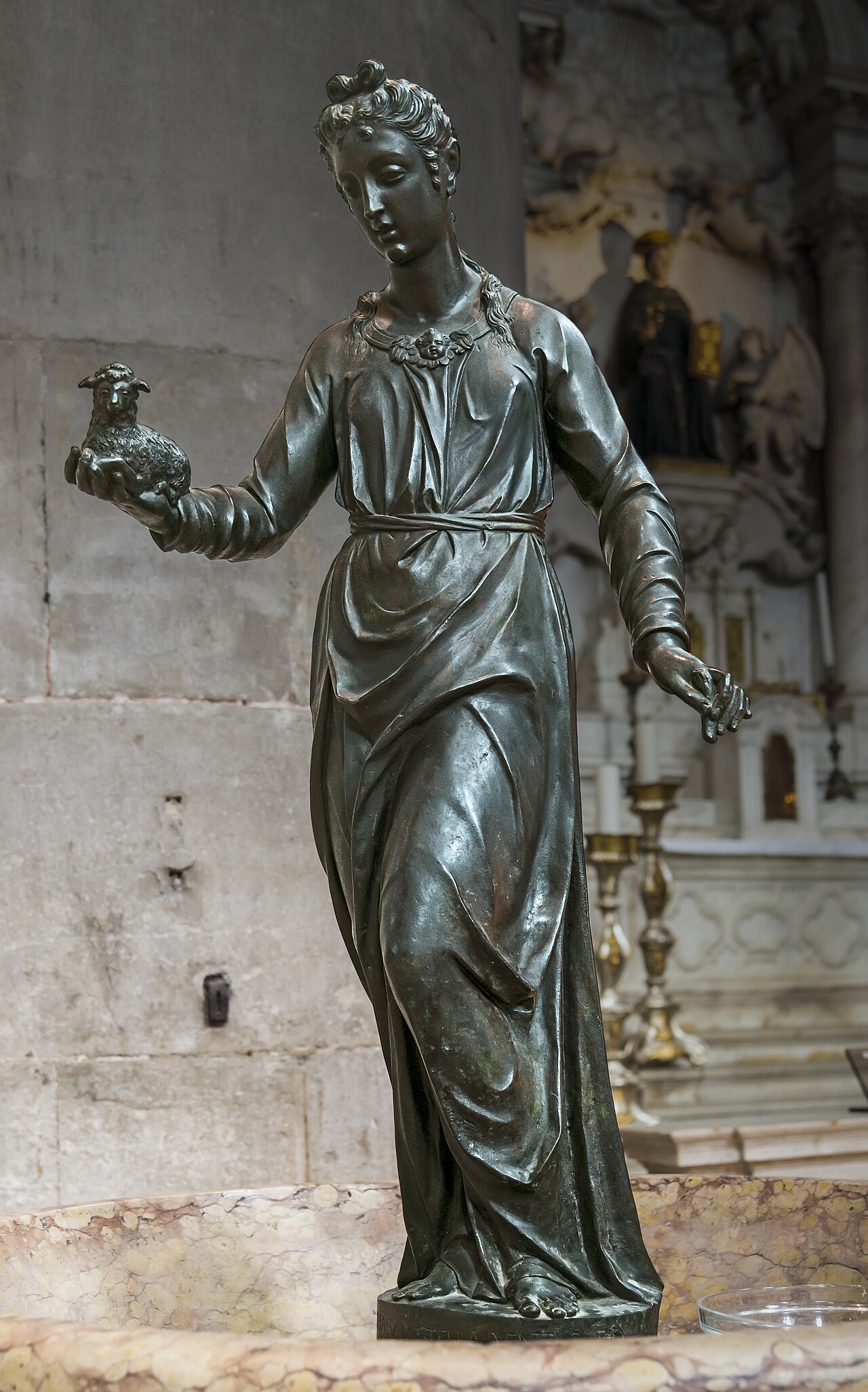
Jerome says that the tongues and pens of all nations are used to praise this Saint, who overcame both the cruelty of the tyrant and the tenderness of her age, and crowned the glory of chastity with that of martyrdom. Augustine notes that her name means "chaste" in Greek and "a lamb" in Latin. She has always been regarded in the Church as a special patroness of purity. We learn from Ambrose and Augustine that she was only thirteen years old at the time of her death. She suffered during the persecution of Diocletian. Her wealth and beauty attracted one of the young nobles of Rome, the son of the city's prefect, who tried to win her hand in marriage. To him, she replied, "I am already engaged to one—to Him alone I keep my troth." When he pressed her further, her response was, "He has already pledged me to Him by His betrothal ring and has adorned me with precious jewels. He has placed a sign upon my brow that I should have no other lover but Him. He has shown me incomparable treasures, which He has promised to give me if I persevere. Honey and milk have I drawn from His lips, and I have partaken of His body, and with His blood has He adorned my cheeks. His mother is a virgin, and His father knew not a woman. Him the angels serve; His beauty is admired by the sun and moon; by His fragrance the dead are raised; by His touch the sick are healed. His wealth never fails, and His abundance never grows less. For Him alone do I keep myself. To Him alone in true confidence do I commit myself. Whom loving I am chaste, whom touching I am clean, whom receiving I am a virgin."
The young man, rejected and filled with jealousy against the unknown lover, complained to Agnes's father, who was very disturbed, unsure whether she was mad or had given her heart to someone without his knowledge. Gradually, it became known that Agnes was a Christian. Then Symphronius, the governor, summoned her parents, and they, worried for her safety, urged her to submit and marry the young man. However, she consistently refused, declaring that she wished to remain a virgin. "Very well," said the Governor; "then become a vestal virgin, and serve the goddess in celibacy."
"Do you think," answered Agnes, "that if I have refused your living son, of flesh and blood, I shall dedicate myself to gods of senseless stone?"
"Do not be headstrong," said Symphronius; "you are only a child, remember, though forward for your age."
"I may be a child," replied Agnes; "but faith dwells not in years, but in the heart."
"I will tell you how I will deal with you," shouted Symphronius. "You will be stripped and driven naked into a house of ill-fame, where you will be subjected to insult and outrage." Then the clothes were taken off the slender body of the girl, and she was forced out into the street. In her shame, she loosened the band that held her abundant hair and let it flow over her body to cover herself. "You may expose my virtue to insult," she said to the prefect, "but I have the angel of God as my defense. For the only-begotten Son of God, whom you do not know, will be to me an impenetrable wall, a guardian who never sleeps, and a protector who never tires."
And so it was. When she was placed in the brothel, the room was filled with light, and an angel brought her a robe, white as snow, to cover her nakedness. Also, when the governor's son burst in at the door in tumultuous excitement, the angel struck him, causing him to fall senseless to the ground. There was an uproar, and the people said she had slain him with her enchantments. But when he regained consciousness, he was ashamed, and the governor was afraid. Therefore, he handed the sentencing of Agnes to the deputy, Aspasius, who ordered that she should be executed immediately. And all the people rushed after her, shouting, "Away with the witch, away with her!"
Then a fire was started, and Agnes was placed on the pyre. But she, lifting her hands in the midst of the fire, prayed, "O Father Almighty, who alone is to be worshipped, feared, and adored, I thank You that through Your holy Son, I have escaped the threats of the profane tyrant, and with an unstained footstep have crossed over the filthy slough of lust; and now, behold, I come to You, whom I have loved, have sought, and have always longed for. I bless Your name, I glorify You, world without end."
And she continued, "Now I am drenched with the Holy Spirit from on high; the furnace grows cold around me, the flame is divided, and its heat rolls back on those who kindled it. I bless You, O Father of my Lord Jesus Christ, who allows me, fearless, to come to You through the fires. Look! What I have believed, that I now see; what I have hoped for, that I now hold; what I have desired, that I now embrace. I confess You with my lips, and with my heart, I desire You completely. I come to You, one true God, who with our Lord Jesus Christ, Your Son, and with the Holy Spirit, lives and reigns through ages of ages. Amen."
And when she had finished praying, the fire became completely extinguished; then Aspasius, the deputy, ordered a sword to be thrust into her throat. "But," he suddenly said, "why is she not bound?" The executioner turned over a number of manacles and selected the smallest pair he could find, placing them around her wrists. Agnes smiled, shook her hands, and they fell off, like S. Paul's viper, clattering at her feet. Then she calmly knelt down and with her own hands pulled her hair forward to expose her neck for the blow. A pause followed, for the executioner was trembling with emotion and could not wield his sword.
As the child knelt alone, in her white robe, with her head inclined, her arms crossed modestly on her chest, and her hair hanging to the ground, veiling her features, she could be compared to some rare plant, with a slender stalk, white as a lily, bending under the weight of its golden blossom. "And thus, bathed in her rosy blood," said the author of the Acts, "Christ betrothed to Himself his bride and martyr."
Then her parents, feeling no sorrow but only joy, took her body and placed it in a tomb on their farm, not far from the city, along the Numentan road. However, a large crowd of Christians followed them, and the pagan mob and soldiers pursued them, driving them away with stones and weapons. Emerentiana, who was the foster-sister of Agnes, a holy virgin, stood bravely and motionless by the tomb, and there she was stoned to death.
After her death, Agnes appeared in glory to her parents.
From the heavenly regions
Surrounded by heavenly legions,
Eight days later, she sought her home;
And a lamb, the whitest,
Loveliest, purest, brightest,
She brought in her loving arms.
"These you see, my mother,
These, and many others,
Are my blessed companions now."
Relics are in the church of Saint Agnes in Rome; portions are in Utrecht; a few small pieces are in Rouen, in the church of Saint Ouen; in Melun; in the Cathedral at Cologne; in the Court Chapel at Brussels; and in the Jesuit Church at Antwerp.
In art, she appears (1) with a lamb, or (2) with an angel protecting her, or (3) standing on a flaming pyre, or (4) with a sword.
Footnotes
- Symphronius was the governor during the time of Agnes's persecution.
- Aspasius: a Roman official serving as deputy to the governor.
- "S. Paul's viper" refers to the incident in Acts 28:3-5 where Paul shakes off a snake.
- Relics are in the church of Saint Agnes in Rome; portions are in Utrecht; a few small pieces are in Rouen, in the church of Saint Ouen; in Melun; in the Cathedral at Cologne; in the Court Chapel at Brussels; and in the Jesuit Church at Antwerp.
Baring-Gould’s own footnotes, in modern English.
Read the original 1870s text
Baring-Gould’s sources: Roman Martyrology, modern Anglican Kalendar, and Greek Menæa. The Greeks commemorate her on Jan. 14th, 21st, and July 5th. Her Acts, attributed to S. Ambrose, are a rhetorical recension of her genuine Acts. S. Ambrose refers to S. Agnes in lib. I. De Virginibus, and in his Commentary on Ps. civ., and in lib. I. c. 4 of his offices. There is also a hymn of Prudentius, relating the Acts of this famous martyr. The Acts are sufficiently elegant to be really by S. Ambrose, and are far superior in style to those of S. Sebastian, falsely attributed to him.
S. Jerome [translator of the Bible into Latin (d. 420)] says that the tongues and pens of all nations are employed in the praises of this Saint, who overcame both the cruelty of the tyrant, and the tenderness of her age, and crowned the glory of chastity with that of martyrdom. [107] S. Augustine observes that her name signifies chaste in Greek, and a lamb in Latin. She has been always looked upon in the Church as a special patroness of purity. We learn from S. Ambrose [bishop of Milan (d. 397)] and S. Augustine, that she was only thirteen years old at the time of her death. She suffered in the persecution of Diocletian [Roman emperor 284–305, who began the ‘Great Persecution’ of Christians in 303]. Her riches and beauty excited one of the young nobles of Rome, the son of the prefect of the city, to attempt to gain her hand in marriage. To him she answered, "I am already engaged to one—to him alone I keep my troth." [108] And when he asked further, her answer was, "He has already pledged me to Him by his betrothal ring, and has adorned me with precious jewels. He has placed a sign upon my brow that I should have no other lover but he. He has showed me incomparable treasures, which he has promised to give me if I persevere. Honey and milk have I drawn from His lips, and I have partaken of His body, and with His blood has he adorned my cheeks. His mother is a virgin, and His father knew not woman. Him the angels serve, His beauty sun and moon admire; by His fragrance the dead are raised, by His touch the sick are healed. His wealth never fails, and His abundance never grows less. For Him alone do I keep myself. To Him alone in true confidence do I commit myself. Whom loving I am chaste, whom touching I am clean, whom receiving I am a virgin."
The youth repulsed, and filled with jealousy against the unknown lover, complained to the father of Agnes, who was much disturbed, doubting whether she were mad, or had given her heart to some one without his knowing it. By degrees it transpired that Agnes was a Christian. Thereupon Symphronius, [109] the governor, sent for her parents, and they, alarmed for her safety, urged her to submit, and marry the young man. She, however, constantly refused, declaring that she desired to remain a virgin. "Very well," said the Governor; "then become a vestal virgin, and serve the goddess in celibacy."
"Do you think," answered Agnes, "that if I have refused your living son, of flesh and blood, that I shall dedicate myself to gods of senseless stone?"
"Be not headstrong," said Symphronius; "you are only a child, remember, though forward for your age."
"I may be a child," replied Agnes; "but faith dwells not in years, but in the heart."
"I will tell you how I shall deal with you," cried Symphronius. "You shall be stripped, and driven naked into a house of ill-fame, to be subjected to insult and outrage." Then the clothes were taken off the slender body of the girl, and she was forced out into the street. In shame she loosened the band that confined her abundant hair, and let it flow over her body, and cover her. "You may expose my virtue to insult," said she to the prefect, "but I have the angel of God as my defence. For the only-begotten Son of God, whom you know not, will be to me an impenetrable wall, and a guardian never sleeping, and an unflagging protector."
And so it was. For when she was placed in the brothel, the room was filled with light, and an angel brought her a robe, white as snow, to cover her nakedness. And also, when the governor's son burst in at the door in tumultuous exultation, the angel smote him, that he fell senseless on the ground. [110] Thereupon there was an uproar, and the people said, she had slain him by her enchantments. But when he was come to himself he was ashamed, and the governor feared. Therefore he committed the sentencing of Agnes to the deputy, Aspasius, who ordered that she should be immediately executed. And all the people rushed after her, crying, "Away with the witch, away with her!"
Then a fire was kindled, and Agnes was placed upon the pyre. But she, lifting up her hands in the midst of the fire, prayed, "O Father Almighty, who alone art to be worshipped, feared, and adored, I give Thee thanks for that through thy holy Son, I have escaped the threats of the profane tyrant, and with unstained footstep have passed over the filthy slough of lust; and now, behold, I come to Thee, whom I have loved, have sought, and have always longed for. Thy name I bless, I glorify, world without end." [111] And she continued, "So now I am bedewed with the Holy Ghost from on high; the furnace grows cold about me, the flame is divided asunder, and its heat is rolled back on them that quickened it. I bless Thee, O Father of my Lord Jesus Christ, who permittest me, intrepid, to come to Thee through the fires. Lo! what I have believed, that now I see; what I have hoped for, that now I hold; what I have desired, that now I embrace. I confess Thee with my lips, and with my heart, I altogether desire Thee. I come to Thee one and true God, who with our Lord Jesus Christ, thy Son, and with the Holy Ghost, livest and reignest through ages of ages. Amen. " And when she had finished praying, the fire became wholly extinct; then Aspasius, the deputy, ordered a sword to be thrust into her throat. "But," said he suddenly, "why is she not bound?" The executioner turned over a quantity of manacles, and selected the smallest pair he could find, and placed them round her wrists. Agnes with a smile, shook her hands, and they fell, like S. Paul's viper, clattering at her feet. [112] Then she calmly knelt down, and with her own hands drew forward her hair, so as to expose her neck to the blow. [113] A pause ensued, for the executioner was trembling with emotion, and could not wield his sword. [114]
As the child knelt alone, in her white robe, with her head inclined, her arms crossed modestly upon her bosom, and her locks hanging to the ground, and veiling her features, she might not inaptly have been compared to some rare plant, of which the slender stalk, white as a lily, bent with the luxuriance of its golden blossom. "And thus, bathed in her rosy blood," said the author of the Acts, "Christ betrothed to Himself his bride and martyr."
Then her parents, having no sorrow, but all joy, took her body, and placed it in a tomb on their farm, not far from the city, on the Numentan road. But there being a great crowd of Christians following, the pagan mob and soldiers pursued them, and drove them away with stones and weapons. But Emerentiana, who was the foster-sister of Agnes, a holy virgin, though only a catechumen [a person preparing for baptism], stood intrepid and motionless by the tomb, and there she was stoned to death.
After her death Agnes appeared in glory to her parents.
From the heavenly regions
Girt with heavenly legions,
Eight days past, her home she sought;
And a lamb, the whitest,
Loveliest, purest, brightest,
In her loving arms she brought.
"These thou seest, my mother
These, and many another,
Are my blest companions now."
Relics, in the church of S. Agnes, at Rome; portions at Utrecht; a few small particles at Rouen, in the church of S. Ouen; at Melun; in the Cathedral at Cologne; in the Court Chapel at Brussels; and in the Jesuit Church at Antwerp.
In art, she appears (1) with a lamb, or (2) with an angel protecting her, or (3) standing on a flaming pyre, or (4) with a sword.