This Saint’s Story
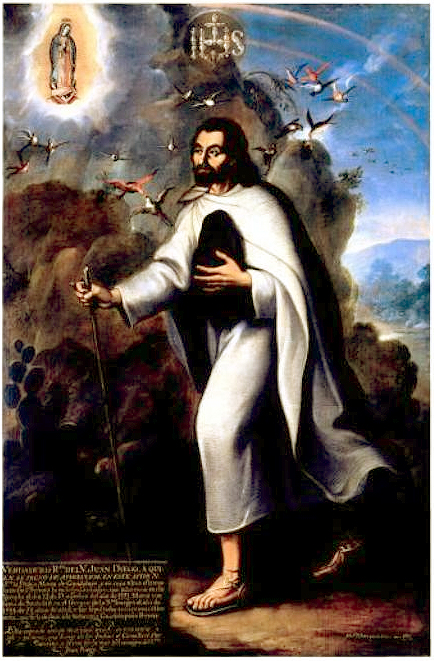
Juan Diego Cuauhtlatoatzin was born around 1474 at Cuauhtitlán, north of Tenochtitlán in the Aztec Empire, among the Chichimeca people. About 1524 or 1525, not long after the Spanish conquest, he and his wife María Lucía received baptism from Franciscan (the order of friars founded by St. Francis of Assisi) missionaries. María Lucía died a few years before the events of 1531. Juan Diego lived simply, walking often to Mass and instruction at the Franciscan center at Tlatelolco.
The traditional account, written in Nahuatl in the seventeenth century and known through the Huei tlamahuiçoltica, says that before dawn on Saturday, 9 December 1531, on the way to Mass, Juan Diego heard a voice calling from Tepeyac Hill. It says Mary appeared there, speaking in his own language, identified herself as the Mother of the true God, and asked that a church be built on that hill so that she might show love to the people. It says he carried the request to Bishop Juan de Zumárraga, that the bishop was cautious and asked for a sign, and that on Sunday Mary promised a sign for the next day. On Monday, the account says, Juan Diego's uncle Juan Bernardino fell gravely ill, and Juan Diego went for a priest instead of keeping the appointment.
On Tuesday, 12 December, the same account says, Juan Diego tried to avoid Tepeyac, but Mary met him on the path, reassured him about his uncle, and sent him up the hill to gather flowers. It says that in mid-December he found Castilian roses blooming out of season, gathered them in his tilma, and brought them to the bishop, and that when the flowers fell, an image of Mary was seen on the cloth. That image is kept at the basilica at the foot of Tepeyac. These are the claims of the tradition. They are not a report written in 1531. The Vatican's biography for the 2002 canonization tells this narrative and follows the tradition. The earliest written Nahuatl account is much later than 1531.
The bishop, according to the tradition, believed and had a chapel built at Tepeyac. Tradition also says Juan Bernardino recovered that same day and that Mary appeared to him as well. Juan Diego lived thereafter near the shrine, welcoming pilgrims, and died in 1548. Pope John Paul II beatified (declared 'Blessed', the step before sainthood) him on 6 May 1990 and canonized (officially declared a saint by the pope) him on 31 July 2002. The General Roman Calendar keeps 9 December. The basilica at Guadalupe is one of the most visited shrines in the Catholic world.
For today: If you tell the story of Guadalupe, say that it comes from the later Nahuatl account and from the image kept at Tepeyac. You can pray with people who love that shrine. The feast is 9 December.