As an amusing example of critical incapacity, it is worth quoting M. D. L. Miorcec de Kerdanet, the editor of the edition of Albert le Grand published in 1837, who said, “This legend is not a tale... it has all its evidence in tradition and in the acts of the churches of Dol and of Leon.”
Once upon a time, in the days of old, the count of Goelo, in Brittany, sought to marry Azenor, the daughter of the count of Leon, who lived at Brest. The beautiful Azenor, “tall as a palm, bright as a star,” agreed to his proposals, and the marriage was celebrated with great pomp, “with sea fights in the gulf and the port, and all sorts of pastimes to show the public rejoicings, during the fifteen days that the wedding lasted.” The count and his wife chose Castel-Audren as their residence, near a large pond full of fish. They had not been married for a year before Azenor's mother died, and her father remarried. The stepmother was, as one might expect, the typical villain found in such tales.
The new countess of Leon was filled with envy of the beauty, virtue, and good reputation of countess Azenor, and she resolved to bring about her ruin. She began to instill suspicion about Azenor's chastity into the minds of both her husband and father. The poison of suspicion had the desired effect. The count of Goelo locked his wife in a tower that overlooked the pond and forbade her to speak to anyone. In her distress, the wronged countess prayed to the Holy Bridget of Ireland, her patroness. The stepmother, not satisfied with Azenor's imprisonment and thirsting for her blood, further shaped and solidified her slanders. The count of Goelo gathered all his barons and council to judge his wife, who was accused of adultery. The unfortunate Azenor was brought into the hall for her trial and “seated on a little stool in the midst of the floor.” The charges against her were read, and she was asked what she had to say in response. She sobbed and declared her innocence. But despite this,
“...the stepmother had a stepmother, who was full of malice, through whom the calumny arose.” — Proper of Dol.
Azenor was condemned to be sent back in disgrace to her father at Brest because there was no evidence for her conviction. The count of Léon tried her, and she was sentenced to death by being put into a barrel and cast into the sea, to be carried wherever the winds and tides took her. The sentence was carried out. The barrel floated on the ocean for five months, tossed up and down. The barrel drifted along the Cornish coast, rounded the Land’s End, and headed towards Ireland. During the five months at sea, an angel provided Azenor with food by pushing it through the bung-hole. While in the barrel, Azenor also became a mother, with the angel and Saint Bridget assisting her as medical attendant and midwife. As soon as the baby was born, she made the sign of the cross on his brow, made him kiss the crucifix, and waited for a chance to get him baptized. The child began to talk even while still in the barrel, before they reached land. Eventually, the barrel washed ashore at Aberffraw, or Youghal harbor, in Ireland, in County Cork. An Irish peasant, thinking he had found a barrel of wine when he saw the cask stranded, performed joyful antics. He then got a gimlet and was about to tap the barrel to drink its contents when the baby inside shouted, “Don’t hurt the cask.”
“May I ask, who are you inside there?” inquired the Irishman, withdrawing the gimlet. “I am a child desiring baptism,” replied the baby. “Go at once to the abbot of this monastery, to which this land belongs, and tell him to come and baptize me.” The Irishman hurried to Youghal and delivered the message to the abbot. “You are deceiving me,” said the abbot. “And is it likely I would be telling your reverence about my find on the seashore if there was anything better than a baby in the barrel?”
The abbot went down to the shore, broke open the cask, and rescued the countess of Goelo and her son. The child was baptized and named Budoc, and he was educated by the abbot of Youghal. Meanwhile, the wicked stepmother had become very ill, and as she was near death, she confessed that she had made up the accusations against Azenor, and that they were completely false. After making this confession, she died. The count of Goelo, filled with sorrow for having sent away his wife based on a false charge, set out on a long and somewhat unclear journey to find the barrel. His good fortune led him to Ireland, where he landed at Youghal, and there he was joyfully reunited with his wife and met his son for the first time. The count then had a grand ship prepared and got ready to return to Brittany with his wife and child.
However, unfortunately, the sea voyage had affected his health, and he died before he could set sail. Azenor, not wanting to return to Brittany, dismissed her husband's servants and dedicated herself to good works, prayer, and caring for her son. Budoc, at a young age, decided to pursue a religious life, and he was given the monastic habit by the abbot of Youghal. According to another account, Azenor returned to Brittany and built a convent on the headland of Raz, which was dedicated to S. Azenor. At Languengar, the remains of S. Azenor can be seen. Women drink from the well of Clesmeur to increase their milk supply. Once, a young man drank from the holy well, and to his shock, he found that his breasts swelled and filled with milk. His tears, prayers, and deep shame softened the saint, and she kindly allowed the fountains of his bosom to dry up.
It is possible that the Azenor associated with these springs and the ruined convent at Raz may be different from the mother of S. Budoc.
Budoc, after the death of his father and mother and the abbot, was elected to lead the monastery of Youghal. When the king of Ireland died, the locals elevated him to both the temporal and spiritual thrones, making him the sovereign of all Ireland and the archbishop of Armagh. For two years, Budoc managed the demanding responsibilities of his dual role, and then he called together the estates of his realm to announce his resignation. However, the Irish people were filled with despair. They surrounded the palace and kept watch to prevent him from escaping. One night, while he was praying in his metropolitan church, an angel instructed him to go to the seashore, take a boat, and cross to Brittany. He is unknown to Irish historians.
He left his palace, found the guards either asleep or drunk, and made his way to the shore, but there was no boat available, only a stone trough. He boldly stepped into this trough, and it floated him across the sea to Porspoder in the diocese of Lion. The locals pulled the stone container out of the water and built a chapel and hermitage for the holy man.
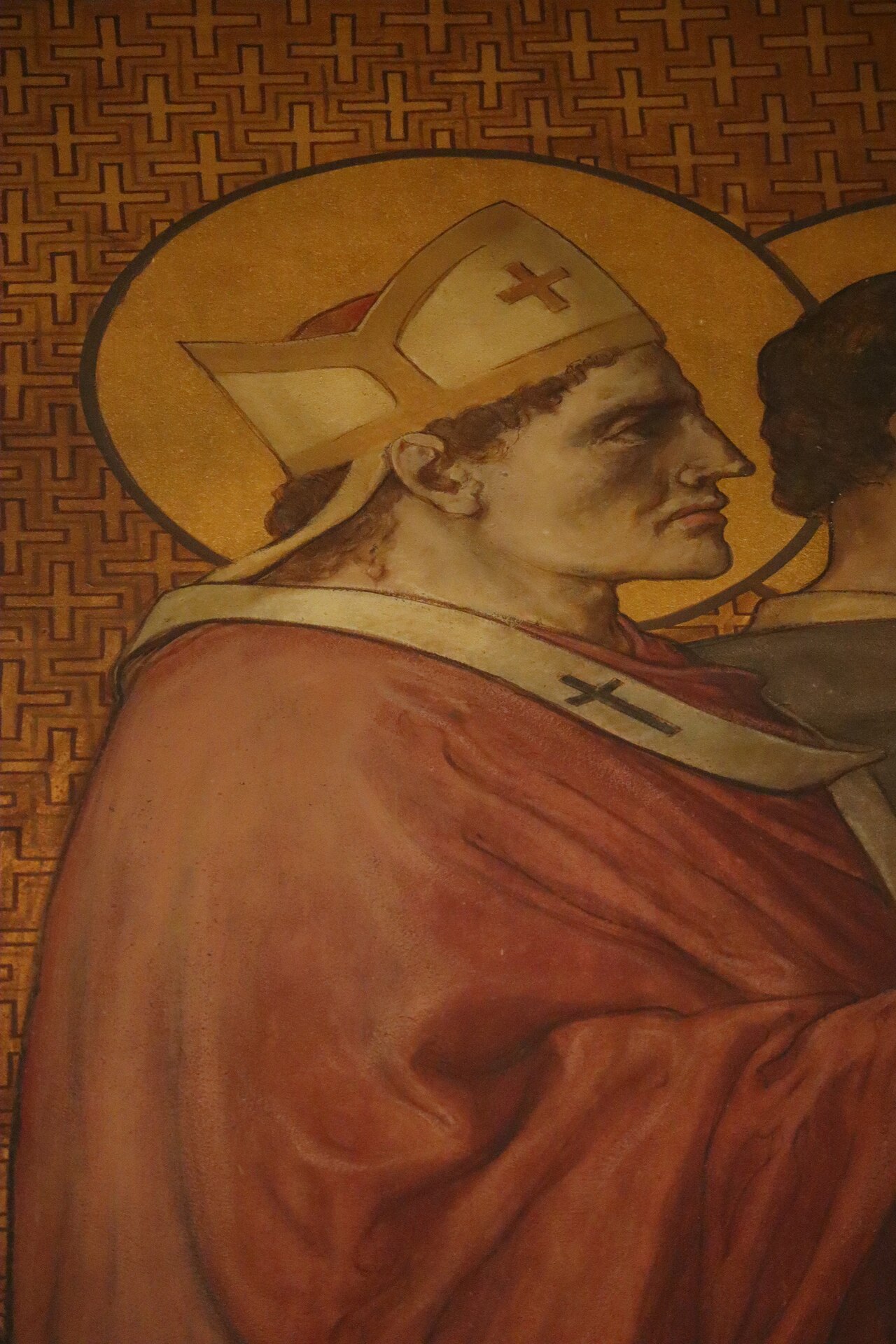
After spending a year at Porspoder, Budoc, who could not tolerate the noise of the waves, had his stone box placed on a cart. He yoked two oxen to it and decided to follow the cart, settling wherever the oxen stopped. The cart broke down at Plourin, and there Budoc stayed for a short time. However, he could not remain there long. His protests against certain nobles who had behaved disorderly forced him to leave, and he went to Dol, where he was warmly welcomed by Saint Maglorius, the bishop. Soon after, Maglorius resigned his position in favor of Budoc. The saint led the church of Dol for about twenty years and died in the early part of the seventh century.
Probably the only element of truth in this long story is that he was a hermit at Porspoder, then at Plourin, and was later made bishop of Dol.
There was a certain stone area, like a hollow rock, where he was accustomed to lie at night. He saw it nearby, and with the help of an angel, he crossed over as if using a boat. He had a certain green stone, like a chest, and he heard the voice of an angel saying, "Place yourself on the stone." He quickly obeyed the voice of the angel, and the stone, like a vessel, carried him over the sea.
The origin of the legend of saints traveling in stone troughs, which is not uncommon among Breton saints, likely comes from this. In ancient Celtic mythology, the dead were believed to be transported across the western sea to Glasinis, the Isles of the Blessed. They were often buried in boats to make the necessary journey. Christian abbots and bishops were buried in stone coffins, and among the common people, it was said that they traveled to the Blessed Land in stone boats.
On December 10, we remember Saints Carpophorus, Martyr, and Abundius, Martyr, at Spoleto; Saints Eulalia and Julia, Virgin Martyrs, at Merida, around the year 303; Saints Menas, Hermogenes, and Eugraphius, Martyrs, at Alexandria; Saints Mercurius and Companions, Martyrs, at Lentini, around the year 313; Saint Milchiades, Pope at Rome, around the year 314; Saint Genellus, Martyr, at Ancyra, around the year 362; Saint Diniol, Bishop of Bangor, in the 7th century; Saint Sandocus, Bishop of Vienne, around the year 650; and the Translation of the Holy House to Loreto, in the year 1294.
Footnotes
- Azenor was condemned to be sent back in disgrace to her father at Brest because there was no evidence for her conviction.
- The count of Léon tried her, and she was sentenced to death by being put into a barrel and cast into the sea, to be carried wherever the winds and tides took her.
- The barrel floated on the ocean for five months, tossed up and down.
- The barrel drifted along the Cornish coast, rounded the Land’s End, and headed towards Ireland.
- During the five months at sea, an angel provided Azenor with food by pushing it through the bung-hole.
- While in the barrel, Azenor also became a mother, with the angel and Saint Bridget assisting her as medical attendant and midwife.
- As soon as the baby was born, she made the sign of the cross on his brow, made him kiss the crucifix, and waited for a chance to get him baptized.
- The child began to talk even while still in the barrel, before they reached land.
- Eventually, the barrel washed ashore at Aberffraw, or Youghal harbor, in Ireland, in County Cork.
- An Irish peasant, thinking he had found a barrel of wine when he saw the cask stranded, performed joyful antics.
- He then got a gimlet and was about to tap the barrel to drink its contents when the baby inside shouted, “Don’t hurt the cask.”
- “May I ask, who are you inside there?” inquired the Irishman, withdrawing the gimlet.
- “I am a child desiring baptism,” replied the baby.
- “Go at once to the abbot of this monastery, to which this land belongs, and tell him to come and baptize me.”
- The Irishman hurried to Youghal and delivered the message to the abbot.
- “You are deceiving me,” said the abbot.
- “And is it likely I would be telling your reverence about my find on the seashore if there was anything better than a baby in the barrel?”
- Infans ab intus loquitur: Ne dolium lania. Piscator, mirans auditu, Retulit: Qui est ibi tu? Baptizandus sum eja. Vade, inquit, quae vidisti Die abbati det ut Christi Mihi baptismalia.
- image of a mother and child, and the story was told there that a great piece of wood had been washed ashore, and the prior was informed in vision that inside it was a Madonna and child.
- One is led to suspect in the story of Budoc a trace of the myth of Velund in the Wilkina Saga.
- He is unknown to Irish historians.
- The locals pulled the stone container out of the water and built a chapel and hermitage for the holy man.
- The legend of saints boating in stone troughs is common among Breton saints.
- Glasinis refers to the Isles of the Blessed in Celtic mythology.
- The year 303 marks the martyrdom of Saints Eulalia and Julia.
- The year 313 marks the martyrdom of Saints Mercurius and Companions.
- The year 314 marks the papacy of Saint Milchiades.
- The year 362 marks the martyrdom of Saint Genellus.
- The 7th century marks the time of Saint Diniol.
- The year 650 marks the time of Saint Sandocus.
- The year 1294 marks the Translation of the Holy House to Loreto.
Baring-Gould’s own footnotes, in modern English.
Read the original 1870s text
Baring-Gould’s sources: The day of the death of S. Budoc was Dec. 8, but the festival is transferred to Dec. 9, in the diocese of Dol, on account of the 8th being the Feast of the Immaculate Conception. In the diocese of L&n the Feast of S. Budoc was formerly observed on Nov. 18. The Gallican Martyrology of Saussaye on Nov. 19. Authorities: — A Life of the Saint in the L&n and Dol Breviaries, and in Legendaries used by Albert le Grand. Lobineau is angry with Le Grand for his Life, and says it is "remplie de fables,” but the "fables” are in the Breviary.1] The legend of S. Budoc of Dol is one of those delightful tales with which the long winter evenings over the fireside were wiled away in the Middle Ages, and which, from the mouths of minstrels and professional reciters passed into the sanctuary, and losing its poetic form, was read in prose in cathedral and church choirs, as a narrative of facts to be believed. The story ranks with “ Pierre de Provence and the Beautiful Maguelonne,” “ Hirlanda,” “ Robert the Devil,” “ The Seven Sons of Aymon,” “ Genoveva of Brabant,” “ Caesar Octavianus,” and “ Fortunatus and his Wishing Cap.”
1 Ak an amusing instance of critical incapacity, it is worth while quoting M. D. L. Miorcec de Kerdanet, editor of the edition of Albert le Grand published in 1837, “ Cette legende n'est point un conte... elle a toutes ses preuves dans la tradition et dans les actes des iglises de Dol et de Lion.” S. Btuioc \ Once upon a time in the days of old, the count of Goelo, in Brittany, sought in marriage Azenor, daughter of the count of Léon, who lived at Brest. The beautiful Azenor, “ tall as a palm, bright as a star,” consented to his proposals, and the marriage was solemnized with great pomp, “ with seafights in the gulf and the port, and all sorts of pastimes to exhibit the public rejoicings, during the fifteen days that the wedding lasted.” The count and his wife chose as their residence Castel-Audren, near a large mere full of fish. They had not been married a year before the mother of Azenor died, and her father married again. The stepmother was, it may be at once conjectured, of the type usual in tales of this sort.1 The new countess of Léon was filled with envy of the beauty, virtue, and good fame of the countess Azenor, and she resolved to compass her ruin. She began accordingly to instil suspicion of Azenoris chastity into the minds of both her husband and father. The poison of suspicion had its desired effect. The count of Goelo shut up his wife in a tower that commanded the mere, and forbade her to speak to any one. In her tribulation, the maligned countess prayed to the Holy Bridget of Ireland, her patroness. The stepmother, not satisfied with the incarceration of Azenor, but thirsting for her blood,2 gave her calumnies further shape and consistency. The count of Goelo assembled all his barons and council to judge his wife, accused of adultery. The unfortunate Azenor was brought into the hall for trial, and " seated on a little stool in the midst of the floor.” The heads of the accusation were read out, and she was asked what she had to answer. She sobbed and declared her innocence. But in spite of 1 '* Matrera habuit novercam, Nequitue plenam, per quam Prodiit calumnia.” — Proper of Dol.
Azenom summopere si tie ns," &c.—Ibid, there being no evidence for her conviction, she was condemned to be sent back in disgrace to her father at Brest. The count of Léon tried her, and she was sentenced to death by being put into a barrel and cast into the sea, to be carried wherever the winds and tides listed. The sentence was executed. The barrel floated five months on the ocean, tossed up and down.1 The barrel swam along the Cornish coast, doubled the Land’s End, and drifted towards Ireland. During the five months’ voyage, Azenor was supplied with victuals by an angel, who poked them in to her through the bung-hole. Whilst in the barrel, moreover, Azenor became a mother, the angel and S. Bridget assisting her as medical attendant and midwife.8 As soon as the babe was born she made the sign of the cross on his brow, made him kiss the crucifix, and waited her opportunity for getting him baptized. The child began to talk even in the cask, before they came ashore.3 At last the barrel was rolled ashore at Aberffraw, or Youghal harbour, in Ireland, in the county of Cork. An Irish peasant, thinking he had found a barrel of wine, when he saw this cask stranded, after performing capers expressive of his delight, got a gimlet and was proceeding to tap the barrel, that he might sit and drink his full of its contents, when the babe from within shouted, “ Don’t hurt the cask.” “ And, pray, may I ask, who may you be there inside ? ” 1 "Hoc parato judido Mensibus quinque, dolio Mari mansit devia." — Proper of Dot " Tandem peperit filium Azenor, intra dolium Quftdam ut in regift.
Ubi, cum luce splendidfi Ministrans sancta Brigitta Dabat necessaria.** — Hymn in Lfton Breviary. lobiscum esL*’ — Lect. Brev. Lfton.
S. Budoc. inquired the Irishman, withdrawing the gimlet. “ I am a child desiring baptism,” replied the babe. “ Go at once to the abbot of this monastery, to which this land belongs, and bid him come and baptize me.”1 The Irishman tore off to Youghal, and gave the message to the abbot. “ You are deceiving me,” said the abbot. “ And is it likely I should be telling your reverence of my find on the sea shore,” answered the man, “ if there had been anything better than a baby in the barrel ? ”
The abbot went down to the shore, stove in the cask, and extracted the countess of Goelo and her son.2 The child was baptized and named Budoc, and was educated by the abbot of YoughaL In the mean time the wicked stepmother had fallen very ill, and being at the point of death, confessed that she had fabricated the accusations against Azenor, and that they were wholly destitute of truths When she had made this confession, she died. The count of Goelo, filled with grief at having sent away his wife on a false charge, started on an extensive and somewhat vague expedition in quest of the barrel. His good luck led him to Ireland, and he disembarked at Youghal, where he was happily reunited to his wife, and made acquaintance with his son. The count then had a stately ship got ready, and prepared to return to 1 “ Infans ab intus loquitur: Ne dolium lania.
Piscator, mirans auditu, Retulit: Qui est ibi tu? Baptizandus sum eja. Vade, inquit, quae vidisti Die abbati det ut Christi Mihi baptismalia.” — Lect. Brev. Lion.
image of a mother and child, and the story was told there that a great piece of wood had been washed ashore, and the prior was informed in vision that inside it was a Madonna and child.— 44 Monasticon Hibernicon " of Archdall, ©d. by Dr. Moran, t. i. p. 151- One is led to suspect in the story of Budoc a trace of the myth of Vclund in the Wilkina Saga.
Brittany with his wife and child. But unfortunately the seavoyage had upset his constitution, and he died before he was ready to embark. Azenor, not caring to return to Brittany, dismissed the servants of her husband, and devoted herself to good works, prayer, and the care of her son. Budoc, at an early age, resolved on embracing the religious life, and was invested with the monastic habit by the abbot of Youghal. According to another account, Azenor returned to Brittany and built a convent on the headland of Raz, bededicated to S. Azenor are seen at Languengar. Women drink from that of Clesmeur to augment their supply of milk. A young man once took a draught from the holy well, and to his horror found his breasts swell and fill with milk. His tears, his prayers, his burning shame softened the saint, and she kindly suffered the fountains of his bosom to fail.
It is possible that the Azenor of these springs and the ruined convent at Raz may be different from the mother of S. Budoc.
S. Budoc, after the death of his father and mother and that of the abbot, was elected to rule the monastery of Youghal. On the decease of the king of Ireland, the natives raised him to the temporal and spiritual thrones, making him at once sovereign of all Ireland and archbishop of Armagh.1 For two years Budoc exercised the fatiguing duties of his double rule, and he then convoked the estates of his realm to announce his resignation. But the Irish were wild with despair. They surrounded the palace and watched lest he should attempt to escape. But one night as he was praying in his metropolitan [the archbishop who heads a group of dioceses] church, an angel bade him go to the sea-shore, take boat, and cross to Brittany. 1 He is unknown to Irish historians. “ Ab Hibernise populo Rex et Archiepiscopus desideratissirae nominatur, exoptatur, deligitur.” — Brev. Leon. Iff * S. Budoc.
He left his palace, found the guards asleep, or drunk, came to the shore, but found there no boat, only a stone trough. He boldly stepped into this, and it floated him across the sea to Porspoder in the diocese of Lion.1 The natives drew the stone coffer out of the water, and built a chapel and hermitage for the holy man.
Having spent a year at Porspoder, Budoc, who could not endure the roar of the waves, had his stone box mounted on a cart, and having yoked two oxen to it, resolved to follow the cart, and settle wherever the oxen halted. The cart broke down at Plourin, and there Budoc settled down for a short while. But he could not remain there long. His remonstrances with certain nobles who had acted in a disorderly manner obliged him to depart, and he went to Dol, where he was well received by S. Maglorius, the bishop, who soon after resigned his see in favour of Budoc. The saint ruled the church of Dol about twenty years, and died in the early part of the seventh century.
Probably the only element of truth in this long story is, that he was a hermit at Porspoder, and then at Plourin, and was afterwards made bishop of Dol.
1 " Erat autem illi velut area lapidea qusedam, concava petra, in qua noctu jacere solitus erat, quam, angeli ministro, mart proximam conspexit; cujus suasu, tanquam navi quad am usus, transfretavit.” —Brev. Léon. “ Habebat quamdam petram viridem, velut arcam... et audivit vocem angeli, dicentis: Pone te super petram. Mox obedivit vod angeli, et petra, velut navigium, portavit cum supra mare.” — Brev. Dol. The origin of the legend of saints boating in stone troughs, which is not uncommon among Breton saints, probably was this. In ancient Celtic mythology, the dead were supposed to be shipped across the western sea to Glasinis, the Isles of the Blessed, and they were often buried in boats in which to make the necessary voyage. The Christian abbots and bishops were buried in stone coffins, and among the vulgar it was said of them that they shipped to the Blessed Land in boats of stone.
[Dec. xo. December io. SS. Carpophorus, P.M., and Abundius, D.M. at Spoleto; SS. Eulalia and Julia, VV. MM. at Merida; a.d. 303. SS. Menas, Hkrmogbnks, and Eugraphius, MM. at AlexanSS. Msrcurius and Comp., MM. at Lentini; circ. a.d. 3x3. S. Mklchiades, Pope at Rome; a.d. 314.
S. Genellus, M. at Ancyra; arc. a.d. 362. S. Dkiniol, B. of Bangor; 7 th cent. S. Sandocus, B. of Vienne; circ. a.d. 650. The Translation of the Holy House to Loreto, a.d. 1294.