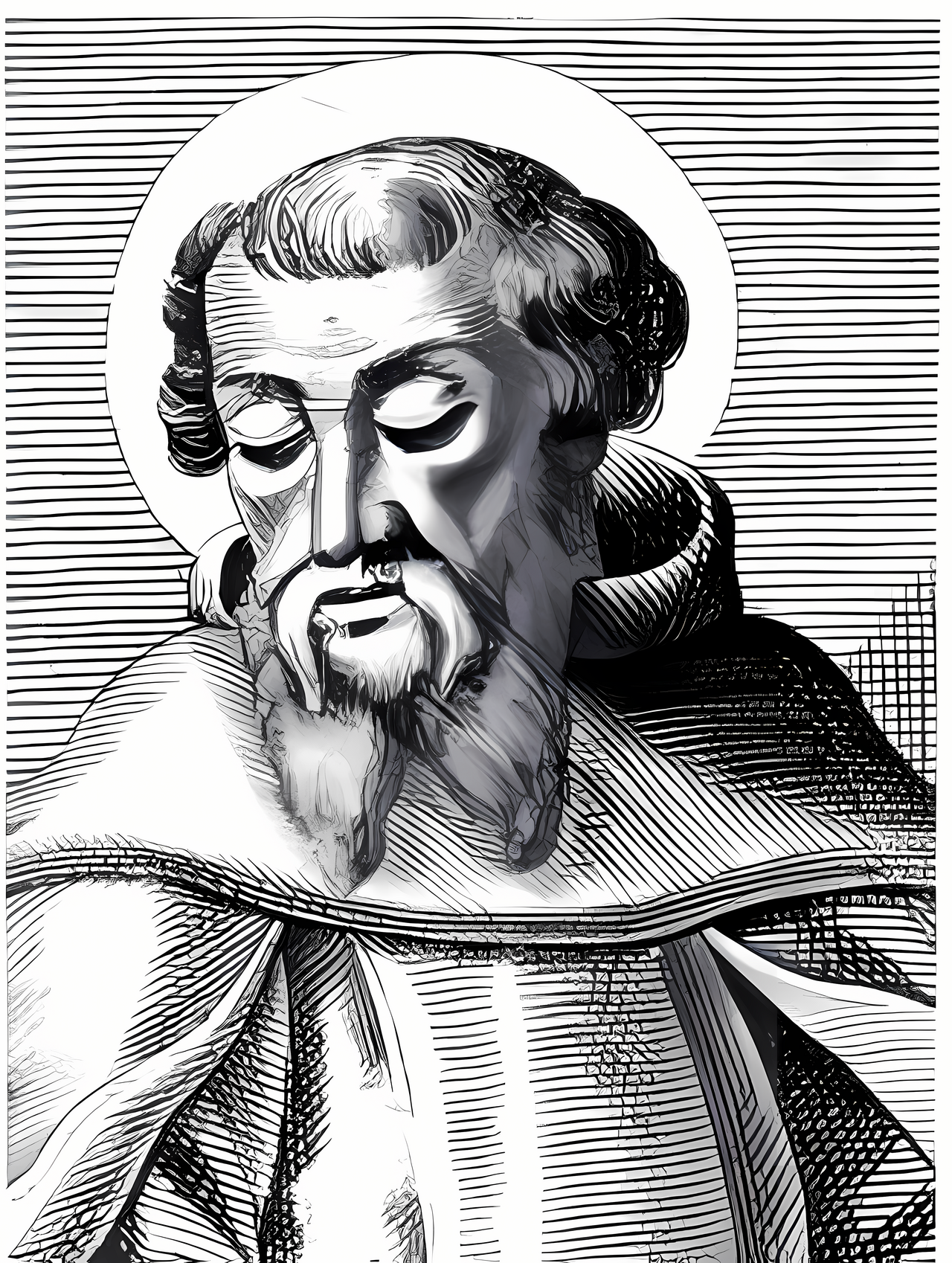
St. Irenaeus of Lyons

Information as to his life is scarce, and in some measure inexact. He was born in the Roman province of Asia, or somewhere nearby, in the first half of the second century; the exact year is disputed, with estimates ranging from about 115 to 142.

Read the essentials →
Feast June 28 · Bishop, Doctor of the Church

St. Irenaeus of Lyons

Current feast

June 28
Verified · General Roman Calendar (Wikipedia list)

Traditional feast

June 28
Traditional date (see Catholic Encyclopedia, 1913)

Represents

Bishop
Doctor of the Church

Feast days

Feast: June 28

This Saint’s Story

Irenaeus (bishop of Lyon, d. c. 202, who listed the early popes), Bishop of Lyons and Father of the Church, was born in Proconsular Asia, or a neighbouring province, in the first half of the second century. The exact year is disputed: some place it between 115 and 125, others between 130 and 142. While still young at Smyrna he saw and heard the holy Bishop Polycarp (d. 155), who had known the apostle John. That living link to the Apostolic Age is what gives his testimony its special weight.

During the persecution of Marcus Aurelius he was a priest of the Church of Lyons. About 177 or 178 the clergy there, many of them in prison for the Faith, sent him to Rome with a letter to Pope Eleutherius concerning Montanism, and praised him warmly. Returning to Gaul he succeeded the martyr St Pothinus as Bishop of Lyons. In the quieter years that followed he combined pastoral and missionary work with writing almost entirely against Gnosticism, then spreading in Gaul and elsewhere.

Around 190 or 191 he interceded with Pope Victor to lift the excommunication laid on the Churches of Asia Minor that kept the Quartodeciman Easter. Nothing certain is known of the date of his death, at the end of the second or the beginning of the third century. Later writers call him a martyr, but the Catholic Encyclopedia judges that unlikely. His feast is 28 June in the Latin Church and 23 August in the Greek.

His chief work, the Detection and Overthrow of the False Knowledge (commonly Adversus haereses), survives whole in an ancient Latin version and is a primary witness to second-century doctrine, including early testimony on the Gospels, the Eucharist and the primacy of the Roman Church. A later work, the Proof of the Apostolic Preaching, survives in Armenian. Pope Francis declared him a Doctor of the Church (a title the pope gives to a saint whose teaching is of special value to the whole Church) in 2022.
What he represents

How he teaches us to live

Drawn from themes in the original account

Stay faithful when it costs you. Holding firm under pressure is part of this story.

Celebrate this saint’s feast day. Remember him on June 28 with a short prayer, and ask for his help.

Read more

The full original · 487 words

Read the full Catholic Encyclopedia article

Information as to his life is scarce, and in some measure inexact. He was born in Proconsular Asia, or at least in some province bordering thereon, in the first half of the second century; the exact date is controverted, between the years 115 and 125, according to some, or, according to others, between 130 and 142. It is certain that, while still very young, Irenaeus had seen and heard the holy Bishop Polycarp (d. 155) at Smyrna. During the persecution of Marcus Aurelius, Irenaeus was a priest of the Church of Lyons. The clergy of that city, many of whom were suffering imprisonment for the Faith, sent him (177 or 178) to Rome with a letter to Pope Eleutherius concerning Montanism, and on that occasion bore emphatic testimony to his merits. Returning to Gaul [roughly modern France and Belgium], Irenaeus succeeded the martyr Saint Pothinus as Bishop of Lyons. During the religious peace which followed the persecution of Marcus Aurelius, the new bishop divided his activities between the duties of a pastor and of a missionary (as to which we have but brief data, late and not very certain) and his writings, almost all of which were directed against Gnosticism, the heresy then spreading in Gaul and elsewhere. In 190 or 191 he interceded with Pope Victor to lift the sentence of excommunication laid by that pontiff upon the Christian communities of Asia Minor which persevered in the practice of the Quartodecimans in regard to the celebration of Easter. Nothing is known of the date of his death, which must have occurred at the end of the second or the beginning of the third century. In spite of some isolated and later testimony to that effect, it is not very probable that he ended his career with martyrdom. His feast is celebrated on 28 June in the Latin Church, and on 23 August in the Greek.

Irenaeus wrote in Greek many works which have secured for him an exceptional place in Christian literature, because in controverted religious questions of capital importance they exhibit the testimony of a contemporary of the heroic age of the Church, of one who had heard St. Polycarp, the disciple of St. John, and who, in a manner, belonged to the Apostolic Age. None of these writings have come down to us in the original text, though a great many fragments of them are extant as citations in later writers (Hippolytus, Eusebius, etc.). Two of these works, however, have reached us in their entirety in a Latin version:

Of his other works only scattered fragments exist; many, indeed, are known only through the mention made of them by later writers, not even fragments of the works themselves having come down to us. These are

The four fragments which Pfaff published in 1715, ostensibly from a Turin manuscript, have been proven by Funk to be apocryphal, and Harnack has established the fact that Pfaff himself fabricated them. A. Poncelet.

Learn more about this saint →Their full life, teachings, every verified quotation in their own words, legacy, and free public-domain reading.

Help us add to this saint's story

Everything is read by a person before anything appears. Facts are checked against trusted sources first.

Facts are welcome; a source link helps (optional).With your permission we may share it on this page.

Nine days · Free

Pray the novena
with us.

One short email a day for nine days. The day's prayer, a line from St. Irenaeus of Lyons's story, and a nudge to keep going.

Also on June 28
L

St. Luperculus

June 28 · Bishop, Martyr
P

St. Pappian

June 28 · Martyr
St. Heimerad

St. Heimerad

June 28 · Priest
← All 1970 saints in the library
Sources & notes

Feast-day sources

Story sources

Sources

Credits

Image: Saint Irenaeus of Lyons.png · Exanx777 · Public domain, via Wikimedia Commons

Image: Exanx777, Wikimedia Commons (Public domain)

From The Catholic Encyclopedia (New York: Robert Appleton Company, 1907–1914), via Wikisource. Public domain in the United States. Reproduced unedited, except for short bracketed notes in grey that we added to explain names and terms (“S.” is the old abbreviation for Saint). Some history and judgments reflect 19th-century scholarship.

Notes

Story retold in our own words from the cited sources.