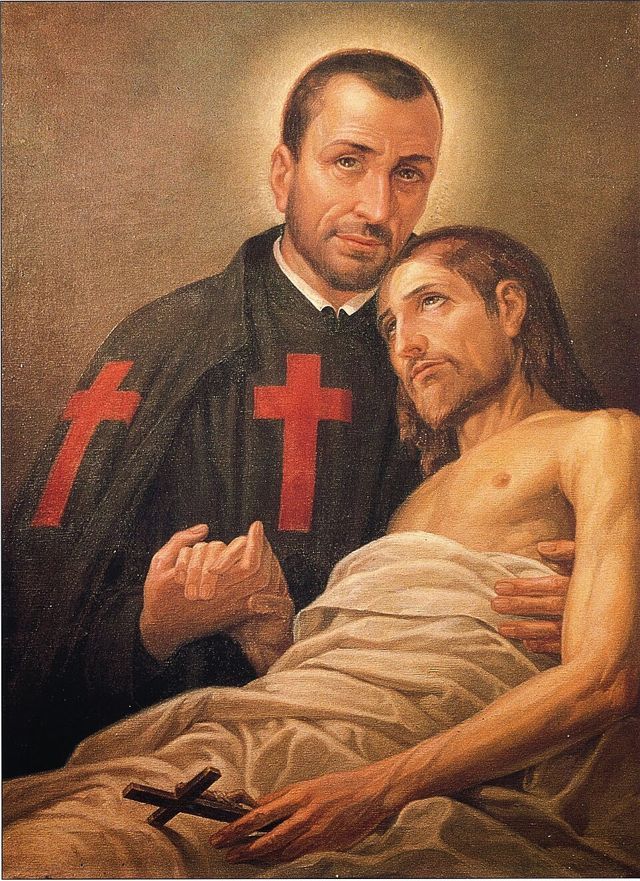
In his youth, Camillus showed no signs of becoming a good person. He spent his time indulging in pleasure and excess, and he had a deep passion for gambling. As a result, he lost his health, his fortune, and his reputation. He became a soldier of fortune, moving from one military service to another. He gambled away everything he owned, eventually betting his sword, his gun, his cloak, and his coat. Reduced to extreme poverty, he was forced, filled with shame, to beg for alms until he could find work to support himself. He took a job as a laborer for some masons who were building for the Capuchins of Siponto. While working there, his conscience began to trouble him about his past excesses. One day, the Guardian of the convent took him aside and, while walking in the garden, spoke to him seriously about the state of his soul. The next day, while on horseback running an errand, Camillus remembered the Guardian's words. Overcome with anguish, and feeling the pull of divine grace, he realized he had strayed far from God. He understood that he needed to respond to the voice calling to his heart, or it might stop speaking to him forever. He jumped off his horse, fell to his knees in the middle of the road, and began to cry and pray for forgiveness.
Saint Camillus of Lellis. Upon reaching the convent, he sought the sacrament of penance and reconciled his soul with God. He then humbly requested to be admitted into the Franciscan Order. He had to wait for some time before his request was approved. During this period, he was assigned to sweep the convent, work in the garden, and perform the most menial tasks. However, as he remained steadfast in his determination, he was sent to complete his novitiate at the convent of Trirento. Unfortunately, an ulcer developed on his leg, which led the Franciscans to decline his admission, forcing him to leave. He then went to Rome, where he worked for four years in a hospital. As his leg healed, he applied again to join the Minorite Order. But once more, the old wound reopened, and he had to leave the convent. He began to feel that God did not want him to become a Capuchin.
His experience in the hospital convinced him that those who care for the sick should be part of a religious community, rather than just hired help. Therefore, he decided to establish an Order dedicated to serving in hospitals.
He then set out to learn enough to be ordained. In school, he became the target of jokes among the boys, who found it amusing to see a tall man, much taller than them, sitting at their desks and standing with them in class.
He persevered, distanced himself from his youthful companions, and was ordained a priest in 1584. He founded his Congregation in the same year. Only two men joined him. They cleaned the hospital wards, made the beds, applied poultices, and did everything possible to help and comfort the sick. The Order grew and was given a house and church in Rome, and it spread to Naples, Milan, and Genoa. In 1591, it received the approval of Pope Gregory XIV. After a holy and devoted life in religion, which was very different from the life he had lived in the world, Saint Camillus breathed his last on July 14, 1614, at the age of sixty-five. He died murmuring, “May the gentle and joyful face of Christ Jesus appear to me.”
His relics are preserved in the church of Saint Mary Magdalen in Rome. He is generally depicted in art accompanied by an angel, as he is said to have often seen his guardian by his side.
Footnotes
- Saint Camillus of Lellis.
- Pope Gregory XIV was the head of the Catholic Church from 1590 to 1591.
- Saint Mary Magdalen is a church in Rome dedicated to Mary Magdalene.
Baring-Gould’s own footnotes, in modern English.
Read the original 1870s text
Baring-Gould’s sources: Roman Martyrology. Beatified by Benedict XIV., in 1742, and canonized in 1746. Authority: — A Life by his disciple, Cicatelli.] The little town of Bacchianico, in the Abruzzi, has the honour of being the birthplace of this Saint. He was bora of aged parents, and it is said that his mothei dreamed that she was about to give birth to a child with a cross on his breast, but it is probable that this is a pious fable of later times.
In his youth Camillus gave no promise of good things; he spent his time in pleasure and dissipation, and had an inveterate passion for cards, so that he lost at once his health, his fortune, and his reputation. He became a soldier of fortune, passing from one service to another. He gambled away everything he had, and staked at last his sword, his arquebus, his cloak and coat. Then, reduced to abject destitution, he was forced, burning with shame, to solicit alms, till he could work for his livelihood. He hired himself as hod-man to some masons engaged in building for the Capuchins of Siponto. It was when thus engaged, his conscience reproaching him with his past excesses, that the Guardian of the convent took him aside one day, and walking up and down the garden walks, spoke to him seriously about the condition of his soul. Next day Camillus was on horseback on some errand, when his mind recurred to the words of the father. Struck with anguish of spirit, his soul melted by divine grace, he felt that he had erred far from God, and that the voice that called to his heart must be answered, or it would cease to speak again. He flung himself from the horse, and falling on his knees in the middle of the road, burst into tears and prayer for pardon.
S. Camillus of Lellis. On reaching the convent, he sought the tribunal of penance, and reconciled his soul with God. Then he humbly asked to be admitted into the Franciscan Order. He was tried for some time before his request was granted. He was made to sweep the convent, work in the garden, and do the most servile tasks for the convent. But as he remained constant in his resolution, he was sent to pass his noviciate in the convent of Trirento. But the breaking out of an ulcer on his leg made the Franciscans decline to accept him, and he was obliged to leave them. He went to Rome, where he served for four years in the hospital; and as his leg became again healed, he once more applied for admission into the Minorite Order. But again the old wound opened, and he was obliged to leave the convent He now felt satisfied that God did not will him to become a Capuchin.
His work in the hospital had convinced him that to minister to the sick, the nurses should belong to a religious congregation, and not be mere hirelings. He determined therefore to found an Order whose special work should be in the hospitals.
He now set to work to learn sufficient to take holy Orders. In the schools he was an object of joke among the boys, who saw a tall man, head and shoulders higher than themselves, sitting with them at their desks, standing up with them in class.
He persevered, distanced his youthful companions, and was ordained priest in 1584. He founded his Congregation in the same year. Only two men joined him. They cleansed the hospital wards, made the beds, applied poultices, and did all that was possible to succour and cheer the sick, The Order grew, and was given a house and church in Rome, spread to Naples, Milan, Genoa. In 1591 it received the sanction of Gregory XIV. After a holy and devoted life in religion, very different from that he had lived in the world, S. Camillus breathed forth his happy soul on July 14th, a.d. 1614, at the age of sixty-five. He expired murmuring, “ Mitis atque festivus Christi Jesus mihi aspectus appareat.”
His relics [the bodily remains of a saint, or objects they used, kept with honor] are preserved in the church of S. Mary Magdalen in Rome. He is generally represented in Art accompanied by an angel, as he is said often to have seen his guardian by his side.