As the governor's orders to prevent any of us from escaping were very strict, several pagans who served Christians were captured along with their masters. These slaves, fearing they would face the same tortures they saw the saints endure, were influenced by the devil and the soldiers to accuse us of eating human flesh and other blasphemous acts that our religion forbids us to mention or even think about. These false accusations incited the people to rage against us, to the point that they literally foamed with anger. It is impossible to describe the severity with which the ministers of Satan treated the holy martyrs on this occasion, trying to force some blasphemous words from their mouths.
The fury of the governor, the soldiers, and the people fell most heavily upon Sanctus, a native of Vienne and a deacon; also on Maturus, who, although recently baptized, was bold and strong enough for the fight; on Attalus, a native of Pergamum, who had always been a pillar and support of our Church; and on Blandina, a slave, in whom Christ has shown us that those whom people despise and whose status places them below the regard of the world are often raised to the highest honors by Almighty God because of their deep love for Him. She was of such weak constitution that we were all worried for her, and her mistress, one of the martyrs, was very concerned that she might not have the courage and determination to openly confess her faith.
But Blandina was so powerfully assisted and strengthened that she endured all the tortures her executioners, who took turns, could inflict on her from dawn until night. They admitted they were defeated, claimed they had no more tortures left to use, and wondered how she could survive after what she had suffered at their hands. The frequent repetition of these words, “I am a Christian; no wickedness is practiced among us,” dulled her pain and made her seem insensible to all she endured.
The deacon Sanctus also endured the most exquisite torments with more than human patience. The heathens indeed hoped these cruelties would eventually force him to say something inappropriate, but he held firm with such determination that he would not even tell them his name, his country, or his position in the world. To every question they asked him, he replied in Latin, “I am a Christian,” and they could not get any other answer from him. The governor and those torturing the martyrs were extremely angry about this. After trying all other forms of cruelty, they applied hot plates of brass to the most sensitive parts of his body. Yet, supported by the powerful grace of God, he continued to profess his faith. His body was so covered with wounds and bruises that it was unrecognizable. Christ, who suffered in him, made him a glorious instrument for conquering the enemy and a lasting example for others.
There is no reason for fear where the love of the Father exists. A few days later, the martyr was brought out again because the pagans thought that since his whole body was sore and inflamed, and he could not bear to be touched, it would now be easy to defeat him by repeating the same cruelties. They believed that he would either succumb under their hands or at least die, which would instill fear in the other Christians. However, they did not achieve either of these goals. To everyone's amazement, his body, despite the new tortures, regained its former strength and shape, and he was able to use all his limbs perfectly again. This miracle, through the grace of Jesus Christ, turned what was meant to be an additional source of pain into a complete and effective healing.
The devil thought he had Biblis, one of the unfortunate individuals who had renounced the faith, in a secure position. He wanted to increase her guilt and punishment by falsely accusing her, so he had her brought to trial, believing it would be easy to make someone so weak and fearful accuse us of wrongdoing. However, the intensity of the torments had a very different effect on her. They seemed to awaken her from a deep sleep, and the temporary pain made her think about the eternal torments of hell. Contrary to what was expected, she exclaimed, “How can it be imagined that they should feed upon children, whose religion forbids them even to taste the blood of beasts?” From that moment on, she publicly declared herself a Christian and was counted among the martyrs. Since the most severe tortures were rendered ineffective by the patience of the martyrs and the power of Jesus Christ, the devil resorted to other tactics. They were thrown into a dark and filthy place.
These Christians still observed the law of abstaining from eating blood, enacted by the Apostles, Acts 15:20.
Some prisoners were kept in a dungeon, with their feet cramped in wooden stocks, extended to the fifth or last hole. The cruelty they experienced was so severe that many died from the hardships they endured there. Others, after being tortured in such an inhumane way that one would think no care could help them, lay there without any human assistance. However, they were so strongly supported from above, both mentally and physically, that they comforted and encouraged the others. Meanwhile, some who had just been captured and had not yet faced any torture soon died, unable to endure the filth of the prison.
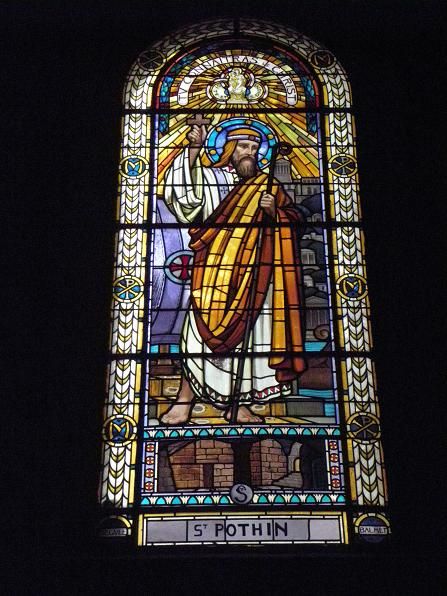
Among those who suffered for their faith on this occasion was the blessed Pothinus, Bishop of Lyons. He was over ninety years old at the time and so weak and frail that he could hardly breathe. Yet, his intense desire to lay down his life for Jesus Christ gave him renewed strength and energy. He was dragged before the tribunal; although his body was worn out from age and infirmity, his life was preserved until that moment so that Jesus Christ might triumph through him. He was brought there by soldiers and magistrates, while the entire crowd hooted and insulted him. When the governor asked him who the God of the Christians was, Pothinus replied that the governor would know when he was worthy of an answer to prevent him from blaspheming. As a result, he was mercilessly dragged about and brutally abused. Those nearby kicked and struck him without regard for his venerable age, while those further away threw whatever they could find at him. He was barely alive when he was thrown into prison, where he died two days later after being confined.
Those who had denied their faith when first captured were also imprisoned and shared the same sufferings as the martyrs, for their apostasy at that time did them no good.
They were easily recognized by their appearance: when the martyrs showed up, their faces displayed a blend of cheerfulness and dignity. Even their chains looked graceful, resembling the adornments of a bride rather than the marks of criminals. In contrast, those who had cowardly abandoned the cause of Christ appeared gloomy and dejected. The pagans themselves criticized them for their lack of courage in renouncing their beliefs. This sight positively influenced several people, strengthening them in their faith and thwarting all the attempts the devil could make to shake their resolve.
After this, the martyrs were subjected to a wide range of tortures; they offered to the eternal Father a sort of garland or crown made of various flowers of different colors. It was fitting that these brave champions, who achieved glorious victories in such a variety of battles, should receive the crown of immortality. A day was designated when the public would be entertained at the cost of their lives, and Maturus, Sanctus, Blandina, and Attalus were brought out to be thrown to the beasts for the amusement of the pagans.
Maturus and Sanctus were taken into the amphitheater and made to endure the same tortures as if they had not previously experienced them. They looked like champions who had defeated their opponents multiple times and were now facing the final test of their courage. Once again, they felt the scourges and were dragged around by the beasts as before; in short, they endured every torment that the enraged crowd demanded. Soon, everyone began to call for the martyrs to be placed in the red-hot iron chair. This request was granted, and the foul smell of their roasted flesh did nothing to lessen the crowd's fury.
They could extract nothing more from Sanctus than his earlier confession. After a long struggle, he and Maturus had their throats cut, and thus their victory became the only entertainment that day.
Blandina was tied to a post to be eaten by wild animals. Her arms were stretched out in fervent prayer. After she had been exposed for some time, and none of the animals could be provoked to touch her, she was untied, taken back to prison, and kept for another fight. Although she was a poor, weak, ordinary slave, by embracing Christ, she overcame all the skill and malice of her enemy. Through a glorious struggle, she achieved the crown of immortality.
Next, Attalus was called forward, and the crowd loudly demanded to see him suffer. He was led around the amphitheater, and a sign in Latin was carried before him: "This is Attalus, the Christian." The entire assembly was ready to unleash their fury on the martyr when the governor, realizing he was a Roman citizen, sent him back to prison. He wrote to the Emperor to ask for guidance regarding Attalus and the other prisoners.
During their time in prison, they showed remarkable charity and humility. Despite enduring various sufferings for their faith, they refused to let anyone call them martyrs. They strongly reprimanded anyone who referred to them with that title, believing it should only belong to Jesus Christ, the faithful and true martyr, or witness—the first-born of the dead and the guide to eternal life. At most, they thought the title could only apply to those who had been freed from the prison of the body. They then pleaded with their fellow believers, in tears, to offer constant prayers that they might be able to endure until the end. However, even though they rejected the title of martyr, every action they took demonstrated the essence of martyrdom.
Their meekness, patience, and the fearless way they spoke to the non-believers showed that they were unafraid and ready to endure whatever their enemies could inflict. However, their main concern, motivated by genuine love, was to rescue those unfortunate individuals who had renounced their faith. Instead of mocking those who had fallen away, they generously provided for their spiritual needs from their own abundance. They expressed a mother’s tenderness for them and shed many tears before their heavenly Father, pleading for their salvation. As a result, they asked for life, and it was granted to them. Their efforts were so fruitful that the Church rejoiced to see several of her children regain their faith, ready to boldly confess the sacred name they had previously renounced and even to offer themselves for trial.
Among the martyrs was Alcibiades, who had long lived a very austere life, surviving solely on bread and water. He seemed determined to continue this practice during his imprisonment. However, after his first battle in the amphitheater, Attalus received a revelation that Alcibiades was causing offense to others by appearing to support the new sect of the Montanists, who sought to distinguish themselves through extreme austerity. Alcibiades heeded this warning and from that point on, he ate everything with gratitude to God.
Meanwhile, the Emperor's order arrived, directing the execution of all who continued to confess their faith while releasing those who had recanted. The governor seized the opportunity of a public festival among the pagans, which attracted large crowds from all around, and ordered the martyrs to be brought before him to entertain the people with their suffering. After re-examining them, finding them steadfast, he sentenced those who were Roman citizens to be beheaded and ordered the others to be thrown to wild beasts. The glory of Jesus Christ was magnified through the unexpected confession of those who had previously denied their faith. The weaker individuals were examined separately, with the intention of granting them freedom; however, upon declaring themselves Christians, they were sentenced to suffer alongside the other martyrs. Some indeed continued in their apostasy, but they were only those who had never shown any sign of true faith and who, by their way of living, had brought shame upon the religion they professed. They may justly be called sons of perdition.
Alexander, who was born in Phrygia and worked as a physician, was present when the apostates were brought before the governor for the second time. He had lived many years in Gaul and was known for his love of God and his boldness in sharing the Gospel, as he was filled with an apostolic spirit. At that critical moment, he stood near the tribunal and made gestures with his eyes and head to encourage them to confess Jesus Christ, showing much agitation, which could not go unnoticed.
The pagans, angered to see those who had recanted now confessing their faith, shouted against Alexander as the cause of this change. In response, the governor turned to him and asked who he was and what he was. Alexander replied that he was a Christian. This enraged the governor so much that, without further inquiry, he condemned Alexander to be thrown to the wild beasts. The next day, he was taken into the arena along with Attalus, who the governor had also sentenced to the same punishment to please the crowd.
After enduring all the various tortures typically inflicted in the amphitheater, they were killed with the sword. Alexander did not sigh or complain at all; he only conversed with God in his heart. When Attalus was placed in the iron chair and the smell of his burning body filled the air, he turned to the people and said to them in Latin, “This may, with some justice, be called devouring men, and thus you are guilty of that inhuman act; but we are neither guilty of this, nor of any other abominable practice of which we are accused.” When asked what the name of his God was, he replied, “God has not a name like us mortals.”
On the last day of the gladiator combats, Blandina and Ponticus, a boy no older than fifteen, were brought into the amphitheater. They had been forced to witness the execution of the martyrs every day, and were now pressured to swear by the idols. When they absolutely refused to comply with this demand, the crowd expressed their anger. They showed no regard for Ponticus's youth or Blandina's gender, subjecting them to all kinds of tortures in vain to make them swear by the idols. Encouraged by his companion, Ponticus bravely endured all the stages of his martyrdom and died gloriously. Blandina was the last to suffer. She acted like a mother, encouraging the other martyrs as if they were her children; and now, going through the same trials, she joyfully followed them. She was whipped, torn by beasts, and placed in a burning chair; afterward, she was wrapped in a net and exposed to a wild bull, which tossed and gored her for a long time. Finally, her throat was cut. Even the heathens were amazed by her patience and courage, acknowledging that no woman among them had ever been known to endure such suffering with such great steadfastness.
Not satisfied with the death of the martyrs, the savage crowd turned their rage against their dead bodies. Those who
The bodies of those who had died in prison were thrown to the dogs, and a strict guard was kept, day and night, to prevent us from taking them away. The remains of the other martyrs, such as the beasts or the fire had spared, their scattered half-burnt limbs, heads, and trunks, were carefully gathered together and watched by the soldiers for several days. Some soldiers foamed at the mouth and gnashed their teeth at the sight of these relics, expressing their eager desire to inflict even more exquisite torments upon them. Others laughed and mocked the martyrs, praising their own idols and claiming that these idols were responsible for the punishment of the martyrs. Even those who had behaved with the most moderation and felt some compassion for their suffering could not help but reproach them, asking, "Where is their God? What has this religion done for them, which they have preferred over life itself?"
These were the attitudes of the heathens at that time, while we were deeply saddened that we could not bury our brethren. The soldiers remained vigilant, not swayed by pleas or money, and ensured that the bodies remained unburied. The martyrs' bodies lay exposed for six days, after which they were burned to ashes and thrown into the Rhone River, so that no part of them would remain above ground. They did this as if they were superior to God and could prevent the resurrection, the hope of which, as they noted, had inspired the martyrs. "Let us now see," said the heathens, "if they will ever return to life, and whether their God can save them and deliver them from our hands."
The dungeons where Saint Pothinus, Saint Blandina, and the other blessed martyrs were imprisoned are located beneath the venerable church of the Abbey of Ainay in Lyons. These are dark cells without light or air, situated below the riverbed. The entrances to these cells are so low that visitors must crawl in on their hands and knees. They are adjacent to a crypt that served as a chapel until the Revolution. Distinct traces of Roman construction can be seen there, and the walls are adorned with modern frescoes of the martyrs, while the floor is laid with fresh mosaics. It has been restored for use.
Footnotes
- These Christians still observed the law of abstaining from eating blood, enacted by the Apostles, Acts 15:20.
- Alcibiades was a martyr known for his austere lifestyle.
- Attalus was a martyr who received a revelation regarding Alcibiades.
- Montanists were a Christian sect known for their strict asceticism.
- The Rhone is a river in southeastern France.
- The Abbey of Ainay is a historic church in Lyons, France.
- The Revolution refers to the French Revolution, which began in 1789.
Baring-Gould’s own footnotes, in modern English.
Read the original 1870s text
Baring-Gould’s sources: Almost all Martyrologiea. Authority The letter written by the Churches of Vienne and Lyons to their brethren in Asia and Phrygia, giving an account of their sufferings, preserved, though not in its entirety, by Eusebius, in bis Ecclesiastical History.] E have, in the letter of the Churches of Vienne and Lyons describing their sufferings under the Emperor Marcus Aurelius, one of the most touching records of primitive Christian times. In the year 177, S. Pothinus was Bishop of Lyons, and S. Irenaeus, who had been sent thither by S. Polycarp out of Asia, — according to a tradition preserved by Gregory of Tours, — was priest of that city. “It is impossible,” say the authors of the letter, “for us to give an exact account, nor will it be easy to conceive the extent of our present calamities, the rage of the pagans against the saints, and the sufferings of the holy martyrs among us. For the adversary directs his whole force against us, and lets us see already what we are to expect when he is let loose, and is in the end of the world allowed to attack the Church. He makes his assaults boldly, and stirs up his agents against the servants of God. Their animosity runs so high, that we are not only driven from private houses, from the baths and public places, but even forbidden to show ourselves at all. But the grace of God, which overmasters all the powers of hell, hath rescued the weak from the danger, and from the temptation of the fiery trial, and exposed such only to the combat as are strong.” At first the people attacked them in a tumultuous manner, struck them, dragged them about the streets, threw stones at them, plundered them. But afterwards they proceeded more regularly. The tribune and the magistrates of the town ordered them to appear in the public place where they were examined before the populace, made a glorious confession of their faith, and then were sent to prison, where they were to wait the arrival of the governor. When the judge came to town, they were carried before him, and used with so much cruelty, that Vettius Epagathus, one of the number, fired with a holy resentment at their treatment, desired to be heard on that subject “He was full of the love of God and his neighbour; a man so virtuous, that, though young, he may be said, like Zacharias, to have walked in all the commandments blameless. He undertook the defence of the injured brethren; and promised to show that the Christians were guilty of no impious practices. But the crowd broke into noisy and tumultuous opposition; and the governor, determined not to grant him that reasonable request, interrupted him, by asking whether he was a Christian. Upon his boldly declaring his faith, he was ranked among the martyrs, with the additional title of The Advocate of the Christians; which, indeed, was justly his due. And now it was easy to distinguish between such as came hither well prepared for the trial, and resolved to suffer all extremities, and such as were not. The former finished Jane a. J SVS*. PotkiflUS & Others. 9 their glorious course with the utmost alacrity; while the latter started back at the near view of what was prepared for them if they persevered, and quitted the field; this was the case with ten persons. Their cowardice and apostasy not only proved an inexpressible affliction to us, but also cooled the zeal of several who were not yet apprehended, and had employed their liberty in a constant attendance on the martyrs, in spite of all the dangers to which their charity might expose them. We were all now in the utmost consternation, not from the fear of torments, but apprehension of losing more of our number in this way. But our late loss was abundantly repaired by fresh supplies of generous martyrs, who were seized every day, till our two Churches were deprived of all their eminent men.
“ As the governor's orders for letting none of us escape were very strict, several pagans in the service of Christians were taken with their masters. These slaves, fearing they should be put to the same torments, which they saw the saints endure, at the instigation of the devil and the soldiers, accused us of feeding on human flesh, and several other impious extravagances, which the principles of our religion forbid us to mention, or even think of. These calumnies excited the people to fury against us, so that they literally foamed with rage. It is impossible to describe the severity wherewith the ministers of Satan treated the holy martyrs on this occasion, to force some blasphemous expression from their mouths. The fury of the governor, the soldiers, and the people, fell most heavily upon Sanctus, a native of Vienne, and a deacon; also on Maturus, who, though but lately baptized, was yet bold and stout enough for the combat; on Attalus, a native of Pergamum, but who had ever been the pillar and stay of our Church; and on Blandina, a slave, in whom Christ ft ft has shown us that those whom men despise, and whose condition places them below the regard of the world, are often raised to the highest honours by Almighty God on account of their ardent love for Him. She was of so weak a constitution, that we were all alarmed for her, and her mistress, one of the martyrs, was full of apprehension lest she should not have the courage and resolution to make an open confession of her faith. But Blandina was so mightily assisted and strengthened, that she bore all the torments her executioners, who relieved each other, could ply her with from break of day till night; they owned themselves conquered, protested they had no more tortures in reserve, and wondered how she could live after what she had endured at their hands. The frequent repetition of these words, “I am a Christian, no wickedness is transacted among us took off the edge of her pains, and made her appear insensible to all she suffered. “ The deacon Sanctus, too, endured most exquisite torments, with more than human patience. The heathens indeed hoped these severities would at last force some unbecoming expressions from him; but he bore up with such resolution that he would not so much as tell them his name, his country, or station in the world; and to every question they put to him, answered in Latin, “I am a Christian nor could they get any other answer from him. The governor, and the persons employed in tormenting the martyrs, were highly incensed at this; and, having already tried all other arts of cruelty, they applied hot plates of brass to the tenderest parts of his body: but, supported by the powerful grace of God, he still persisted in the profession of his faith. His body was so covered with wounds and bruises, that it was shapeless. Christ, who suffered in him, made him a glorious instrument for conquering the adversary, and a standing proof to others, Jooe «.] Potkinus & Others.
that there is no ground for fear where the love of the Father dwells. Some days after, the martyr was brought on the stage again, for the pagans imagined, that as his whole body being so sore and inflamed, and he could not bear to be touched, it would now be an easy matter to overcome him by a repetition of the same cruelties; or, at least, that he must expire under their hands, and thus strike a horror into the other Christians. But they succeeded in neither of these objects; for, to the amazement of all, his body under the latter torments recovered its former strength and shape, and the perfect use of all his limbs was restored: so that by this miracle of the grace of Jesus Christ, what was designed as an additional pain, proved an absolute and effectual cure. The devil thought himself secure of Biblis, one of the unhappy persons who had renounced the faith; and desirous to enhance her guilt and punishment by a false impeachment, caused her to be arraigned, believing it would be no hard matter to bring one so weak and timorous to accuse us of impieties. But the force of the torments had a very different effect upon her; they awakened her, as it were, out of a pro* - N found sleep; and those transitory pains turned her thoughts upon the everlasting torments of hell. So that* contrary to what was expected of her, she broke out into the expostulation, “ How can it be imagined that they should feed upon children, whose religion forbids them even to taste the blood of beasts P”1 From that moment she publicly confessed herself a Christian, and was ranked amongst the martyrs. The most virulent torments being thus rendered ineffectual by the patience of the martyrs, and the power of Jesus Christ, the devil had recourse to other devices. They were thrown into a dark and loath> These Christians still observed the law of abstaining from eating blood, enacted by the Apostles, Acts xv. ao.
some dungeon, had their feet cramped in wooden stocks, and extended to the fifth or last hole. The cruelties exercised were so great, that numbers died of the hardships they endured there. Others, after having been so inhumanly tortured, that one would have thought all the care imaginable could not have recovered them, lay there destitute of all human succour; but so strongly supported from above, both in mind and body, that they comforted and encouraged the rest: whilst others but lately apprehended, and who had as yet undergone no torments, soon died, unable to bear the loathsomeness of the prison. “ Among the persons who suffered for their faith on this occasion was the blessed Pothinus, Bishop of Lyons. He was then above ninety years old; and so weak and infirm that he could hardly breathe. But his ardent desire of laying down his life for Jesus Christ, gave him fresh strength and vigour. He was dragged before the tribunal; for, though his body was worn out with age and infirmity, his life was preserved till that time, that Jesus Christ might triumph in him. He was brought thither by the soldiers and magistrates, the whole multitude hooting and reviling him. On being asked by the governor, who was the God of the Christians, Pothinus told him, to prevent his blaspheming, he should know when he was worthy of having an answer. Upon which he was dragged about unmercifully, and inhumanly abused. Those who were near him, kicked and struck him without any regard to his venerable age; and those who were at some distance, pelted him with what first came to hand. He was scarce alive when he was thrown into prison, where he expired after two days' confinement “ Those who had denied their faith when first taken, were also imprisoned, and shared the same sufferings with the martyrs, for their apostasy at that time did them no service. June *.] sSVS'. Pothinus & Others.
They were distinguished from the others by their very looks: when the martyrs appeared, it was easy to discover cheerfulness and majesty blended in their faces: their very chains appeared graceful, and seemed more like the ornaments of a bride than the marks of malefactors. But those who had basely deserted the cause of Christ, appeared gloomy and downcast The very pagans reproached them with faint-heartedness for renouncing their principles. This sight had a happy influence on several, strengthened them in their profession, and defeated all the attempts the devil could make on their constancy. After this, a great variety of torments was tried on the martyrs; and thus they offered to the eternal Father a sort of chaplet, or crown, composed of every kind of flowers of different colours; for it was fit that these courageous champions, who gained such glorious victories in so great variety of engagements, should receive the crown of immortality. A day was set when the public was to be entertained at the expense of their lives, and Maturus, Sanctus, Blandina, and Attalus were brought out to be thrown to the beasts for the diversion of the heathens. Maturus and Sanctus being conducted into the amphitheatre, were made to pass through the same torments, as if they had not before felt the force of them, and looked like champions, who had worsted the adversary several times, and were just entering on the last trial of their courage. Again they felt the scourges, and were dragged about by the beasts as before; and, in short, they suffered every torment the incensed multitude were pleased to call for. Presently all joined in asking that the martyrs should be put into the red-hot iron chair. This was granted; and the noisome smell of their roasted flesh did not in any way abate their rage. They could extort nothing more from Sanctus than his former confession; Hum a.
and he and Maturus, after a long struggle, had their throats cut; and thus their victory was the only entertainment that day.
u Blandina was fastened to a post to be devoured by beasts; her arms were stretched out in the ardour of prayef. After she had remained thus exposed for some time, and none of the beasts could be provoked to touch her, she was untied, carried back to prison, and reserved for another combat Accordingly, though she was a poor, weak, common slave, yet, by putting on Christ, she overcame all the skill and malice of her enemy, and by a glorious conflict, attained to the crown of immortality. “ Attalus was called for next, and the people were loud in their demands to see him suffer. He was led round the amphitheatre, and the inscription in Latin was carried before him: “ This is Attalus, the Christian.” The whole assembly was ready to discharge its rage on the martyr, when the governor, understanding he was a Roman citizen, remanded him to prison, and wrote to the Emperor to know his pleasure concerning him and the rest of the prisoners. During their reprieve, they gave extraordinary proofs of charity and humility. Notwithstanding such a variety of sufferings for the faith, they would by no means allow us to call them martyrs; and severely reprimanded any of us, who in writing or speaking, gave them that title; which, according to their humble way of reasoning, was due only to Jesus Christ, the faithful and true martyr, or witness — the first-born of the dead, and the guide to eternal life; or, at most, could only be extended to such as were freed from the prison of the body. They then besought the brethren, with tears, to offer up assiduous prayers that they might be enabled to persevere to the end. But, though they refused the title of martyr, yet every action of theirs was expressive of the power of martyrdom; particuJune*.] SS. Pothinus & Others.
larly their meekness, their patience, and the intrepid freedom with which they spoke to the heathens, and which showed them to be void of fear, and ready to suffer anything it was in the power of their enemies to inflict But their chief concern, on the motive of sincere charity, was how to rescue those unhappy persons who bad apostatised. Far from insulting over the lapsed, they freely administered to their spiritual wants, out of their abundance; expressing the tenderness of a mother for them, and shedding floods of tears before their heavenly Father for their salvation. Thus they asked for life, and it was granted them. For their endeavours were so successful, that the Church had the joy of seeing several of her children recover new life, ready to make a generous confession of the sacred name they had renounced, and even offer themselves to the trial “ Among the martyrs, there was one Alcibiades, who had been long used to a very austere life, and to live entirely on bread and water. He seemed resolved to continue this practice during his confinement; but Attalus, after his first combat in the amphitheatre, understood by a revelation, that Alcibiades gave occasion of offence to others, by seeming to favour the new sect of the Montanists, who endeavoured to recommend themselves by their extraordinary austerities. Alcibiades listened to the admonition, and from that time he ate of everything with thanksgiving to God. In the meantime the Emperor’s answer arrived, directing the execution of all who persisted in their confession, and discharging those who had recanted. The governor took the opportunity of a public festival among the pagans, which drew vast crowds from all parts; and ordered the martyrs to be brought before him with a design of entertaining the people with the sight of their sufferings. After a re-examination of them, IJune finding them resolute, he sentenced such of them as were Roman citizens to lose their heads, and ordered the rest to be thrown to wild beasts. And now the glory of Jesus Christ was magnified in the unexpected confession of such as had before denied their faith. Those weak persons were examined apart, with a view of giving them their liberty; but, upon their declaring themselves Christians, they were sentenced to suffer with the other martyrs. Some indeed still continued in their apostasy; but then they were only such as never had the least trace of true faith, and who, by their way of living, had cast a scandal on the religion they professed, and who may justly be styled sons of perdition.
“Alexander, a Phrygian by birth, and physician by pro fession, was present, when the apostates were brought this second time before the governor. He had lived many years in Gaul [roughly modern France and Belgium], and was remarkable for his love of God, and his freedom in publishing the Gospel; for he was full of an apostolical spirit This man being near the tribunal at that critical moment, made signs with his eyes and head, to exhort them to confess Jesus Christ, with much agitation, so that it was impossible it should pass unobserved. The heathens exasperated to see those confess who had recanted, clamoured against Alexander as the author of this change. Upon which the governor turning himself towards him, asked him who and what he was. Alexander answered, he was a Christian; this so enraged the governor, that without any further enquiry, he condemned him to be thrown to the wild beasts. Accordingly, the next day, he was conducted' into the arena with Attalus, whom the governor, to oblige the people, had delivered up the second time to the same punishment Having undergone all the various torments usually inflicted in the amphitheatre, they were despatched with the sword. Alexander was not 6*6*. Pothinus & Others.
heard to sigh or make the least complaint, conversing only with God in his heart When Attalus was placed in the iron chair, and the broiling of his body exhaled an offensive smell, he turned to the people, and said to them, in Latin, “ This may, with some justice, be called devouring men, and thus you are guilty of that inhuman act; but we are neither guilty of this, nor of any other abominable practice of which we are accused.” Being asked what was the name of his God, he replied, “God has not a name like us mortals.”
“On the last day of the combats of the gladiators, Blandina, and Ponticus, a lad not above fifteen years old, were brought into the amphitheatre. They had been obliged to attend the execution of the martyrs every day, and were now urged to swear by the idols. Upon their absolutely refusing to comply with this demand, the people gave vent to their rage; and without regard either to the youth of Ponticus, or to the sex of Blandina, employed all sorts of torments upon them, in vain, to make them swear by the idols. Ponticus, encouraged by his companion, passed cheerfully through all the stages of his martyrdom, and died gloriously. Blandina was the last that suffered. She had acted like a mother, animating the other martyrs as if they were her children; and now, passing through the same trials, she joyously hastened after them. She was scourged, tom by beasts, put into the burning chair; afterward wrapped in a net, and exposed to a wild bull, that tossed and gored her for a long time. Finally she had her throat cut The heathens themselves could not but wonder at her patience and courage, and own, that among them, no woman had ever been known to endure such sufferings with so great constancy.
“Not content with the death of the martyrs, the savage people raged against their dead bodies. Those who VOL. vl 2 (Jane «.
had died in prison were thrown to the dogs, and a strict guard was kept, day and night, to prevent our carrying them off. The remains of the other martyrs, such as the beasts or the fire had spared, their scattered halfburnt limbs, the heads and trunks, were carefully laid together, and watched by the soldiers several days. Some foamed and gnashed their teeth at the sight of these relics [the bodily remains of a saint, or objects they used, kept with honor], expressing their eager desire to inflict more exquisite torments upon them; while others laughed and scpffed at the martyrs, extolling their own idols, ascribing to them the punishment of their enemies. Even those who had behaved themselves with most moderation, and felt some compassion for their sufferings, could not forbear reproaching them now, by asking, Where is their God ? What hath this religion availed them, which they have preferred to life itself? These were the dispositions of the heathens on this occasion, while we were most sensibly afflicted that we could not bury our brethren. The soldiers were always on the guard, not to be gained by entreaty or money, and took care to keep the bodies unburied. The martyrs' bodies lay thus exposed six days, and then were burnt to ashes, and thrown into the Rhone, that no part of them might remain above ground. This they did, as if they had been superior to God, and could thereby have prevented the resurrection, the hope of which, as they observed, had animated the martyrs. Let us now see, said the heathens, if they will ever return again to life, and whether their God can save them, and deliver them out of our hands." The dungeons in which S. Pothinus, S. Blandina, and the other blessed martyrs were immured, are shown beneath the venerable church of the Abbey of Ainay, at Lyons. They are gloomy cells without light or air, below the bed of the river. The apertures by which they are entered are so low that the visitor is obliged to creep into A- A June •.] •SVS*. Marcellmus & Comp.
them upon hands and knees. They adjoin a crypt which was used as a chapel until the Revolution. Traces of Roman work are there distinctly seen, and the walls are covered with modem frescoes of the martyrs, and the floor laid with fresh mosaics. It has been restored to use.