Their Story
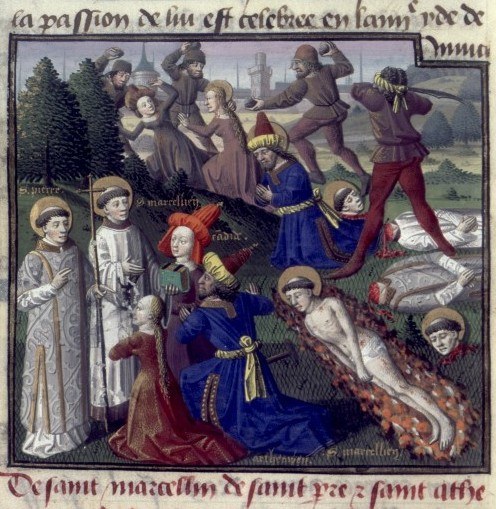
Marcellinus and Peter are Roman martyrs. The Church keeps them on 2 June. Wikipedia says they are venerated as men who were beheaded, and that the later lives place them in Rome in the fourth century. One form of Peter's name calls him Peter the Exorcist. In art they are often shown as middle-aged men with the tonsure and the palm of martyrs.
The early evidence is the cult itself: a cemetery on the Via Labicana bore their names, and the Roman church kept their day. Their names passed into the Roman Canon (Eucharistic Prayer I, the ancient prayer said at Mass; saints named in it after the consecration were honored very early) in some manuscripts, and a basilica on the Via Labicana marked the cemetery. Pilgrims in the early Middle Ages visited that cemetery along with the other suburban graves.
The longer acts are later writings. They add a jailer, a secret burial, and a detailed account of the arrest and the beheading. Those chapters are the later legend, not a court record. The calendar entry and the cemetery are the older facts. The General Roman Calendar keeps them on 2 June as an optional memorial. Other men named Marcellinus, including a pope and a bishop of Embrun, are different people.
For today: You can honor Marcellinus and Peter on 2 June, and still tell a hearer that the beheading is what the later acts report. When a pair of names has a day and a cemetery, and the story of their arrest comes from a later passion, say so.