…us, came down into the valley of life, while Stephen departed from it for Christ. Christ was wrapped in cloths for us, and Stephen was covered with stones for Christ.” There is a fragment from Asterius regarding this festival. Eusebius also mentions it. It is interesting that there is no commemoration of St. Stephen in the old Roman Calendar, published by Bucherius, which dates to the middle of the 4th century, but it does include the Feast of the Nativity. The festival of the Nativity was brought from the West to the East, while that of St. Stephen followed the opposite path. In the sacramentary of St. Leo, we find this festival. Its spread in the Western Church was likely due to the discovery of the relics of St. Stephen in 415, after which, but not before, we see the commemoration in the West. It appears in the Calendar of Ptolemy Sylvius, written in 448. St. Stephen was the leader of the seven deacons appointed by the apostles to assist them in daily tasks and to help care for the widows. His Greek name, which means a wreath, indicates his Hellenistic origin. His significance is emphasized in the narrative by repeated strong phrases. He was “full of faith and of the Holy Ghost,” “full of faith and power,” and his “wisdom and spirit” shown in his speech were irresistible. He is said to have performed great wonders and miracles.
He was arrested at the urging of the Hellenistic Jews and brought before the Sanhedrim (the Jewish council). His eloquent speech pierced the hearts of his listeners, and he was cast out of the court and stoned to death. In the midst of his suffering, he saw heaven opened and our Lord standing at the right hand of the Father, as if risen from His seat to welcome His first martyr. The person who led in his death was Saul of Tarsus, and the answer to Stephen's prayer for his murderers was the conversion of Saul the Persecutor into Paul the Apostle. According to the earliest traditions, the martyrdom occurred outside the Damascus gate of Jerusalem, the very gate through which Saul would one day pass for his miraculous conversion. However, later tradition holds that the site of his death was outside the gate now called the Gate of St. Stephen.
The story of the discovery of the relics of Saint Stephen in 415, by Lucian, a priest from Capharmajala, and John, the patriarch of Jerusalem, is a sad tale of deceit aimed at achieving what was considered a holy purpose. It is not necessary to recount the humiliating details here. This account is provided by Marcellinus, the chancellor of Justinian, in his Chronicle (379-534).
Some of these supposed relics were taken by Orosus (A.D. 418) to the island of Minorca, where they are still kept and honored. Another part of the relics was sent to Uzala, in Africa. However, most of the bones were kept in a church dedicated to him in 422 in Jerusalem. In Ancona, Italy, there is a stone, stained with his blood, that struck him on the head. In Longpont, near Paris, there is a bone of the protomartyr. In Metz, there is a stone stained with his blood and a bottle containing his blood. In Halberstadt, there are some of his blood and two finger bones. There are also some bones in Metz, some at Saint Etienne (the Birmingham of France), and others in the cathedral at Vienna.
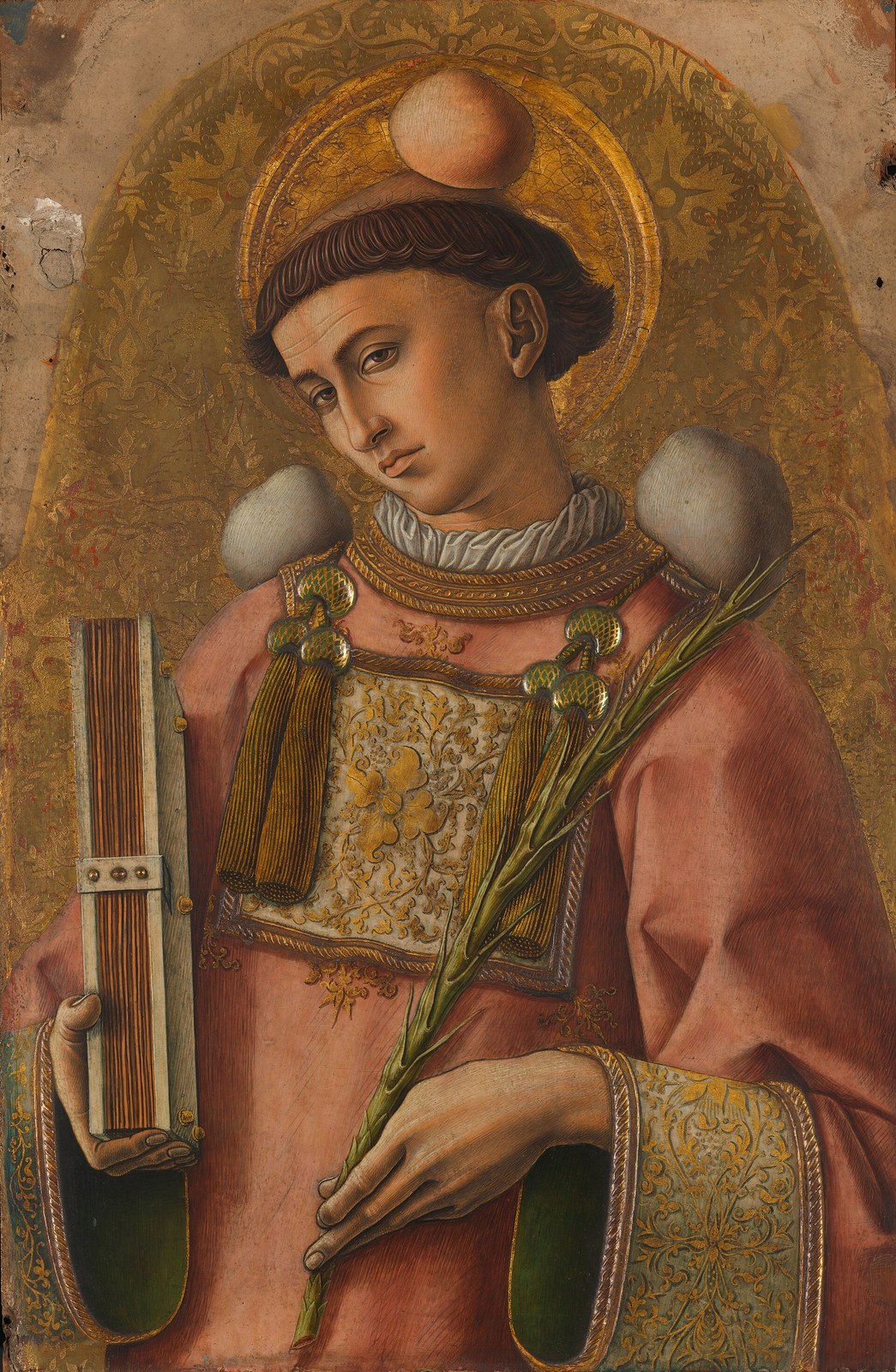
Saint Stephen, who was stoned to death, is the patron saint of stone-cutters. According to Scripture, during his martyrdom, “they saw his face as it had been the face of an angel.” Saint Stephen is always depicted as young and beardless in both Eastern and Western art, except in Spain, where he is shown with a beard and the features of a man around thirty years old. He usually leads the group of deacons and sometimes the entire assembly of martyrs. He wears the dalmatic and other garments of a deacon, although this is historically inaccurate; he holds a palm branch and a book of the Gospels. Stones are often depicted on his head, in his lap, in his hand, or on his book. When this distinctive symbol is missing, it can be hard to tell him apart from Saint Vincent (January 22).
In the south of France, Saint Stephen’s Day was called “Straw Day,” due to the blessing of straw that some rituals prescribed. Therefore, in Germany, it was known as “HaferWeyhe,” with the same meaning. In Northern England, it is referred to as “Wrenning Day,” stemming from the custom of stoning a wren to death, a cruel remembrance of Saint Stephen’s martyrdom. In the South, the pigeon matches that are typically held are a remnant of the old rite. In Denmark, it was sometimes called “Second Christmas Day.”
Footnotes
- The Sanhedrim was the Jewish council.
- Orosus was a historian who lived in the late 4th and early 5th centuries.
- Saint Etienne is a city in France, also known as the Birmingham of France.
Baring-Gould’s own footnotes, in modern English.
Retold in plain modern English from Baring-Gould’s public-domain text, sentence by sentence, keeping the same facts and order. Short explanations in parentheses are ours.