SAINT MATTHIAS, not having been one of the original Apostles chosen directly by our Blessed Lord, does not have many specific mentions in the accounts of the Holy Gospels. He was likely one of the Seventy disciples who followed Christ throughout His public ministry. After the suicide of the traitor Judas created a vacancy among the Apostles, the first action they took upon returning from Mount Olivet—where Our Lord said goodbye to them at His Ascension—was to find a suitable replacement. To this end, S. Peter informed them that, according to prophetic prediction, Judas had fallen from his ministry, and it was necessary to appoint another person in his place. This new Apostle needed to have been a constant companion and disciple of the Holy Jesus, so he could bear witness to His life, death, and resurrection.
Two candidates were proposed: Joseph, called Barsabas and Justus (whom some identify as Joses, one of the brethren of Our Lord), and Matthias. Both were qualified for the position. The method of election was by lots, a practice commonly used by both Jews and Gentiles to resolve uncertain and difficult matters, especially when selecting judges and magistrates. The Apostles chose this method because the Holy Spirit had not yet been given, and they were primarily guided by His inspiration afterward. The lots were placed in an urn, and the name of Matthias was drawn, thus assigning him the Apostolate.
Not long afterward, the promised powers of the Holy Spirit were given to the Apostles, preparing them for the important and challenging work they were to undertake. Among them, S. Matthias took on his responsibilities. He spent the initial part of his ministry in Judea, where he achieved a significant number of conversions. After this, he moved on to other regions. The Greeks, with some credibility, report that he traveled eastward into Cappadocia (which they mistakenly refer to as Ethiopia). There, he encountered a people known for their fierce and unyielding nature, and he was treated with great rudeness and cruelty. After enduring much hardship and suffering, and converting many to Christianity, he ultimately received the crown of martyrdom around the year 64 AD.
Little reliable information exists about the specifics of his death, but the Greek Menæa, supported by several ancient breviaries, state that he was crucified. Just as Judas was hanged on a tree, Matthias suffered on a cross. His body is said to have remained in Jerusalem for a long time before being transferred to Rome by S. Helena, the mother of Constantine the Great. Some supposed fragments of his body are displayed with great reverence there today, while others argue that his relics were taken to and are still kept in Trier (a city in Germany). Among the many apocryphal writings attributed to the Apostles, there was a Gospel published under his name, which was mentioned by ancient ecclesiastical historians and condemned by Gelasius, Bishop of Rome, as it had been rejected by others before him.
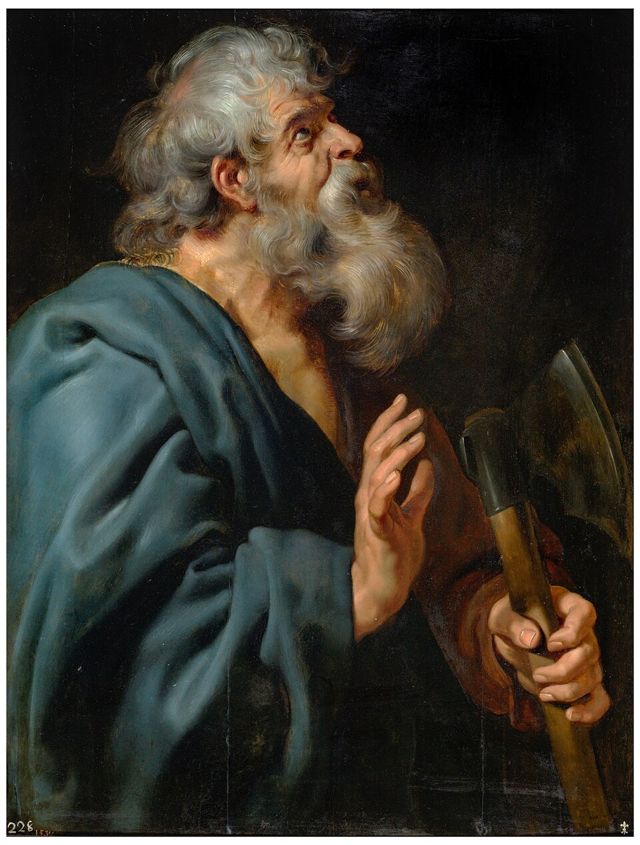
Saint Matthias is rarely depicted in works of art. When his image does appear, he usually holds an axe or halberd, sometimes a spear or lance, and occasionally a book and a stone. The Greeks portray Saint Matthias as an elderly man with a rounded beard.
Footnotes
- Matthias was chosen to replace Judas Iscariot as an Apostle.
- The Greek Menæa are collections of hagiographies (biographies of saints).
- S. Helena was the mother of Emperor Constantine and is known for her role in Christian history.
- Trier is a city in Germany known for its historical significance.
Baring-Gould’s own footnotes, in modern English.
Retold in plain modern English from Baring-Gould’s public-domain text, sentence by sentence, keeping the same facts and order. Short explanations in parentheses are ours.