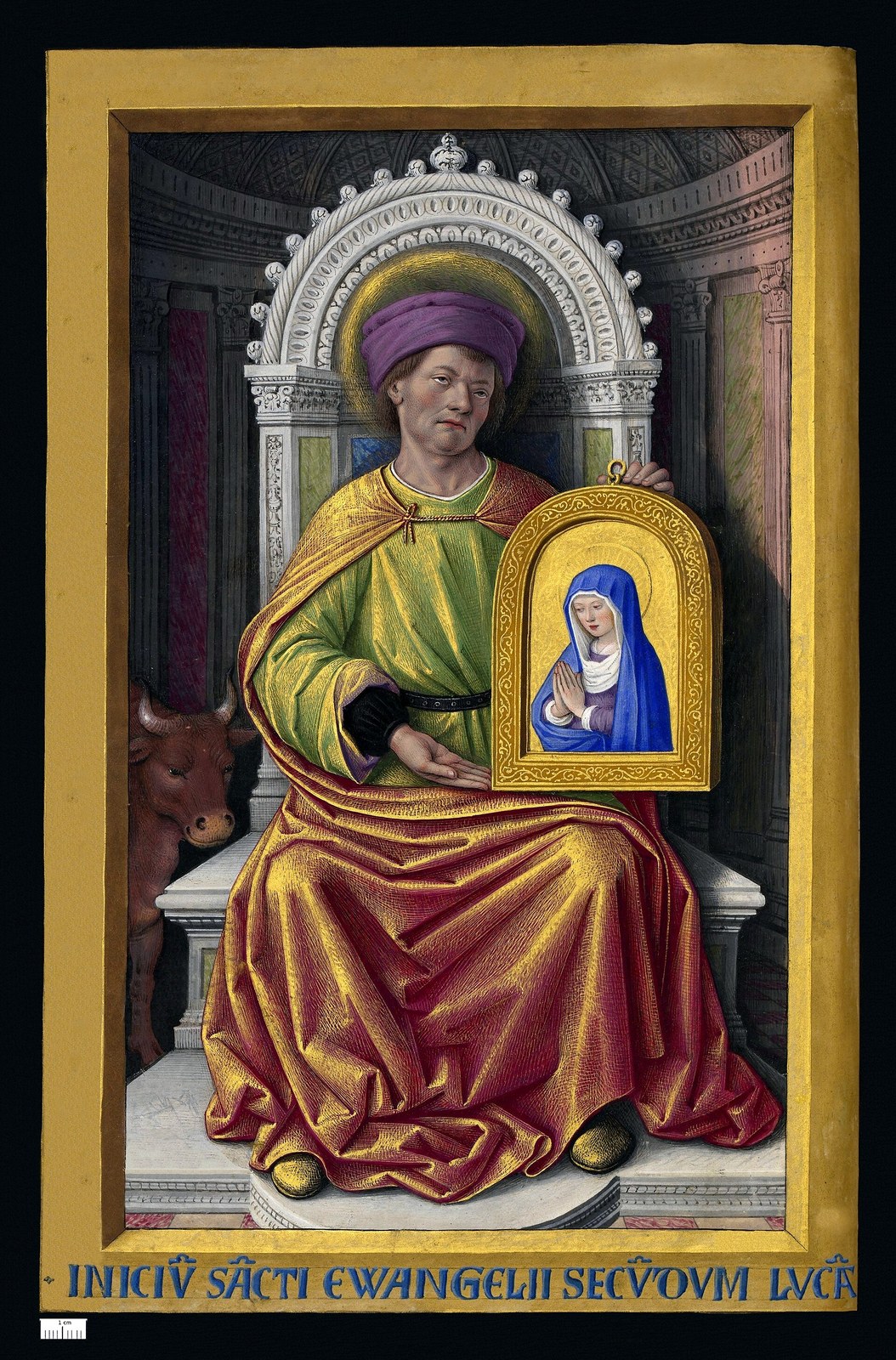
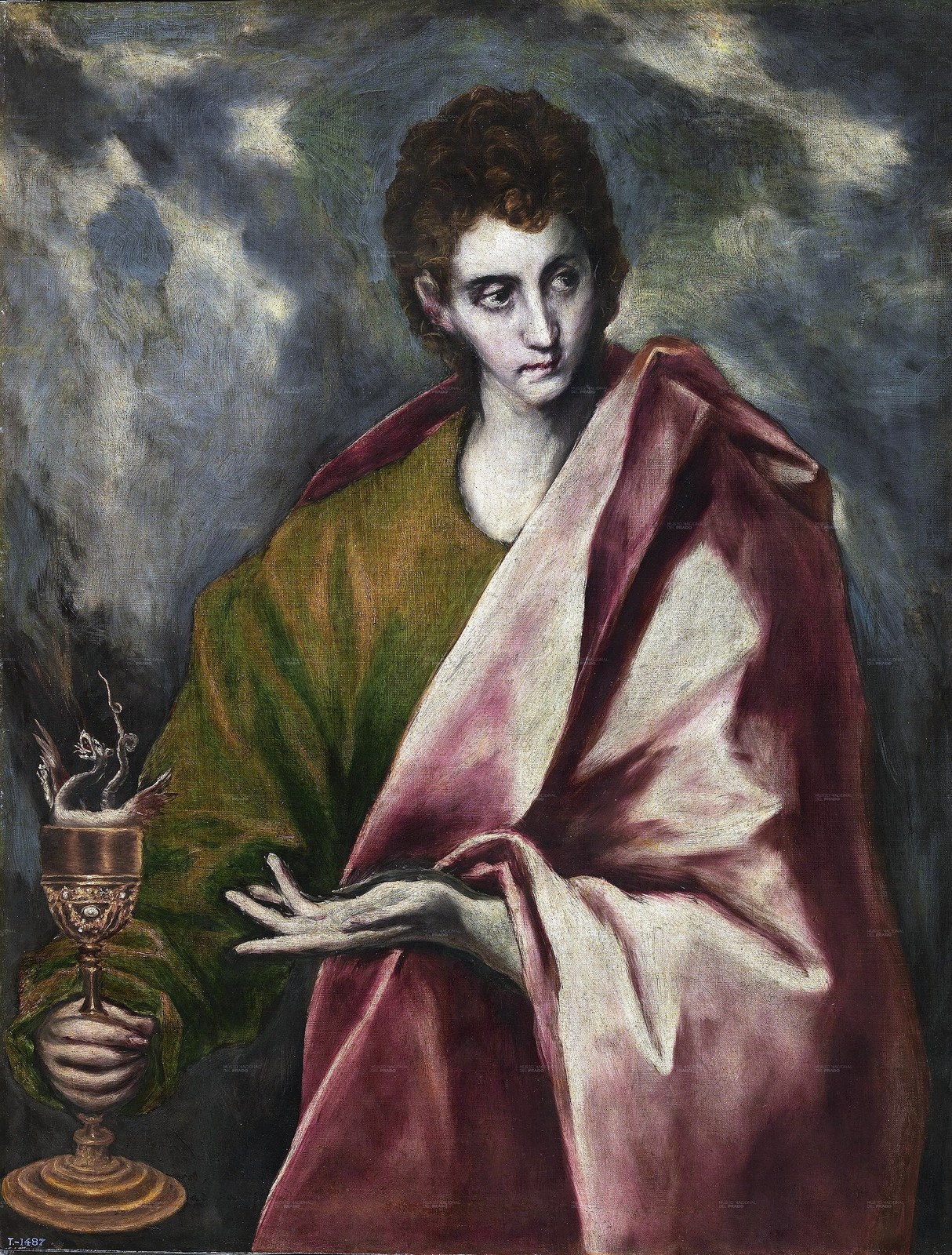
St. Matthew the Apostle

The tax collector who got up and followed

Pray the novena →

St. Matthew

Matthew was sitting at the custom house when Jesus said, “Follow me,” and the Gospel that bears his name says he rose up and followed. The work he left had made him useful to Herod and to Rome, and disliked by his neighbours. The book he is associated with is the one that gives us the Sermon on the Mount.

Feast day

September 21
the evangelist; called from the custom house

Patron of

Tax collectors
Accountants

This Saint’s Story

In our own words, from the sources listed below. An older English account is kept further down this page.

Matthew was a tax collector at Capernaum, sitting at the custom house, when Jesus passed by and said, in the Douay-Rheims, "Follow me." The Gospel that bears Matthew's name says, "And he rose up and followed him." Mark and Luke call the same man Levi. The work he left was not respected. Tax collectors in that country farmed the revenue for Herod and for Rome, and their neighbors often counted them as traitors and as sinners. The same Gospel says that Jesus sat at table in his house with other tax collectors, and that the Pharisees objected. Jesus' answer was that He had not come to call the just, but sinners.

The church has long taken this Matthew to be the author of the first Gospel, a book written for a community that knew the Jewish Scriptures well. It opens with a genealogy, keeps returning to how the law and the prophets are fulfilled, and gives us the Sermon on the Mount. Modern scholars debate whether the apostle himself wrote the Greek text we have, or whether the book rests on an earlier Aramaic account, as Papias, writing in the second century, seems to say. The questions can be stated honestly without taking the Gospel away from him. The book is still the one that begins, for most Christians, the story of Jesus.

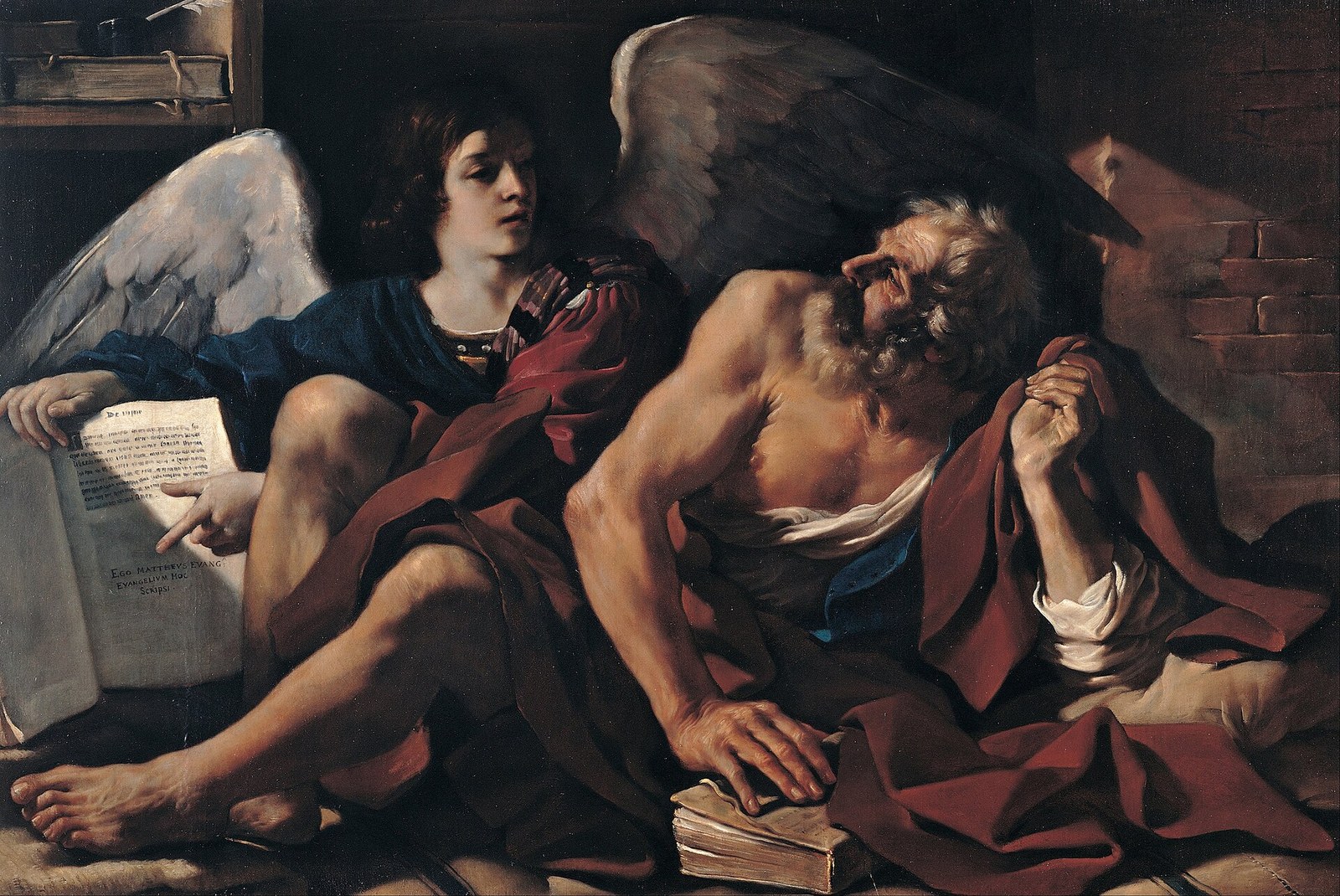
The New Testament does not tell us how he died. Later traditions send him to Ethiopia, or to Persia, or to the East more generally, and some say he was martyred. Those accounts do not agree, and none of them is early enough to treat as certain. His emblem is a man, or an angel, one of the four living creatures of the vision in Ezekiel and in Revelation, long assigned to the four evangelists. The feast is September 21.

For today: Matthew got up from a desk that had made him rich and made him disliked. If your work has become a habit you are not proud of, you can rise from it. You may not be able to leave it this afternoon, but you can take the first step that makes a different life possible, and you can share a table with people other people write off.

The short version

Matthew, also called Levi, was a tax collector at Capernaum. The first Gospel, long attributed to him, is written for a community that knew the Jewish Scriptures well. Scholars debate whether the apostle wrote the Greek text we have; the question can be stated honestly without taking the book away from him. Later traditions about his death do not agree. The feast is September 21.

Did you know?

Mark and Luke call him Levi.

His emblem, among the four evangelists, is a man, or an angel.

He is a patron of people who work with money and ledgers, because that was the desk he left.

Patron saint of

  • Tax collectors and accountants
    He was sitting at the custom house when he was called, and the church has long given him to people who work with money and ledgers.
  • Bankers and civil servants
    A popular extension of the same work. It is devotion, not a formal decree.

The full story

Baring-Gould’s account retold in modern English

Read the full story · 494 words · about 2 min

The publicans, as they were properly called, were individuals who collected Roman taxes. In later times, they were usually Roman knights or wealthy individuals. They employed lower-ranking officers, who were natives of the province where the taxes were collected, known as portitores, a class to which Matthew belonged. Eusebius states that after our Lord's ascension, Saint Matthew preached in Judea, with some sources claiming he did so for fifteen years before going to foreign nations. Socrates mentions that it was Saint Matthew's lot to go into Ethiopia. However, Saint Ambrose claims that God opened the country of the Persians to him. Isidore of Seville states that he went among the Macedonians, while the acts attributed to the pseudo-Abdias say he went to Ethiopia. Heracleon, a disciple of Valentine and the earliest and most reliable authority, states that Saint Matthew died a natural death, and this is also affirmed by Saint Clement, Origen, and Tertullian. The story of his martyrdom emerged much later.

Saint Matthew’s original Gospel, written in Aramaic, consisted of the sayings of the Lord. The accounts of His life were added later. It is claimed that Breton merchants brought the body of Saint Matthew from Ethiopia to Brittany during the reign of King Solomon of Armorica, which was at the beginning of the 5th century, and placed it in the city of Saint Pol de Leon. However, after Solomon was killed by rebellious Bretons, Valentinian punished them by taking the body of Saint Matthew and moving it to Basilicata in Naples. There it remained until the year 954, when it was transferred to Salerno. This story is not credible. An arm bone is located at Monte Cassino; another arm is in the church of Saint Matthew in Rome, which was granted indulgence by Pope Paschal II; another arm is in Santa Maria Maggiore; another is in Saint Marcellus; a rib is in Saint Nicolas in Casiers; other relics are in the Vatican; another arm is in Bologna; a foot covered with skin is at Subiaco; another entire foot covered with skin, as well as an arm in perfect condition, a rib, a tooth, and a shoulder blade are at Prag. At Carlstein, both arms are intact, covered with dried flesh and skin. A large part of the body is at Andechs.

In the Court chapel at Brussels, the entire head of Saint Matthew is displayed. There are two bones at Tournai, others at Saint Sauveur in Bruges; a large part of one arm is at Foppens; a thumb covered with skin is at Liessgin in Hainault. A head is at Saint Pol de Leon, another at Beauvais, another at Chartres, and another at Rengisval in the diocese of Tulle. When Saint Matthew is depicted as an Apostle, he usually appears as an old man with a long beard, holding his Gospel. He is also shown with a purse or moneybox, referencing his previous worldly occupation, and sometimes with a spear or axe.

Footnotes

  1. Eusebius says that after our Lord's ascension, Saint Matthew preached in Judea.
  2. The story deserves no respect.
  3. An arm bone at Monte Cassino; an arm in the church of Saint Matthew at Rome, indulgenced by Pope Paschal II.
  4. A large part of the body at Andechs.
  5. In Psalm 45. Also Saint Paulinus of Nola in poem 19, and the Martyrology of Jerome.
  6. Ap. Clement. Alex. Stromat. lib. iv. in Bavaria.

Baring-Gould’s own footnotes, in modern English.

Retold in plain modern English from Baring-Gould’s public-domain text, sentence by sentence, keeping the same facts and order. Short explanations in parentheses are ours.

Feast days

Feast: September 21

What he represents

How he teaches us to live

Drawn from themes in the original account

Celebrate this saint’s feast day. Remember him on September 21 with a short prayer, and ask for his help.

From the Catholic Encyclopedia

1913 · 794 words

Apostle and evangelist. The name Matthew is derived from the Hebrew Mattija, being shortened to Mattai in post-Biblical Hebrew. In Greek it is sometimes spelled Maththaios, B D, and sometimes Matthaios, CEKL, but grammarians do not agree as to which of the two spellings is the original. Matthew is spoken of five times in the New Testament; first in Matthew 9:9, when called by Jesus to follow Him, and then four times in the list of the Apostles, where he is mentioned in the seventh (Luke 6:15, and Mark 3:18), and again in the eighth place (Matthew 10:3, and Acts 1:13). The man designated in Matthew 9:9, as "sitting in the custom house", and "named Matthew" is the same as Levi, recorded in Mark 2:14, and Luke 5:27, as "sitting at the receipt of custom". The account in the three Synoptics is identical, the vocation of Matthew-Levi being alluded to in the same terms. Hence Levi was the original name of the man who was subsequently called Matthew; the Maththaios legomenos of Matthew 9:9, would indicate this. The fact of one man having two names is of frequent occurrence among the Jews. It is true that the same person usually bears a Hebrew name such as "Shaoul" and a Greek name, Paulos. However, we have also examples of individuals with two Hebrew names as, for instance, Joseph-Caiaphas, Simon-Cephas, etc. It is probable that Mattija, "gift of Iaveh", was the name conferred upon the tax-gatherer by Jesus Christ when He called him to the Apostolate, and by it he was thenceforth known among his Christian brethren, Levi being his original name. Matthew, the son of Alpheus (Mark 2:14) was a Galilean, although Eusebius informs us that he was a Syrian. As tax-gatherer at Capharnaum, he collected custom duties for Herod Antipas, and, although a Jew, was despised by the Pharisees, who hated all publicans. When summoned by Jesus, Matthew arose and followed Him and tendered Him a feast in his house, where tax-gatherers and sinners sat at table with Christ and His disciples. This drew forth a protest from the Pharisees whom Jesus rebuked in these consoling words: "I came not to call the just, but sinners". No further allusion is made to Matthew in the Gospels, except in the list of the Apostles. As a disciple and an Apostle he thenceforth followed Christ, accompanying Him up to the time of His Passion and, in Galilee, was one of the witnesses of His Resurrection. He was also amongst the Apostles who were present at the Ascension, and afterwards withdrew to an upper chamber, in Jerusalem, praying in union with Mary, the Mother of Jesus, and with his brethren (Acts 1:10 and 1:14).

Of Matthew's subsequent career we have only inaccurate or legendary data. St. Irenæus tells us that Matthew preached the Gospel among the Hebrews, St. Clement of Alexandria claiming that he did this for fifteen years, and Eusebius maintains that, before going into other countries, he gave them his Gospel in the mother tongue. Ancient writers are not as one as to the countries evangelized by Matthew, but almost all mention Ethiopia to the south of the Caspian Sea (not Ethiopia in Africa), and some Persia and the kingdom of the Parthians, Macedonia, and Syria. According to Heracleon, who is quoted by Clement of Alexandria, Matthew did not die a martyr, but this opinion conflicts with all other ancient testimony. Let us add, however, that the account of his martyrdom in the apocryphal Greek writings entitled "Martyrium S. Matthæi in Ponto" and published by Bonnet, "Acta apostolorum apocrypha" (Leipzig, 1898), is absolutely devoid of historic value. Lipsius holds that this "Martyrium S. Matthæi", which contains traces of Gnosticism, must have been published in the third century. There is a disagreement as to the place of St. Matthew's martyrdom and the kind of torture inflicted on him, therefore it is not known whether he was burned, stoned, or beheaded. The Roman Martyrology simply says: "S. Matthæi, qui in Æthiopia prædicans martyrium passus est". Various writings that are now considered apocryphal, have been attributed to St. Matthew. In the "Evangelia apocrypha" (Leipzig, 1876), Tischendorf reproduced a Latin document entitled: "De Ortu beatæ Mariæ et infantia Salvatoris", supposedly written in Hebrew by St. Matthew the Evangelist, and translated into Latin by Jerome, the priest. It is an abridged adaptation of the "Protoevangelium" of St. James, which was a Greek apocryphal of the second century. This pseudo-Matthew dates from the middle or the end of the sixth century. The Latin Church celebrates the feast of St. Matthew on 21 September, and the Greek Church on 16 November. St. Matthew is represented under the symbol of a winged man, carrying in his hand a lance as a characteristic emblem.
From the homilies

Preached on Scripture

John Henry Newman · Anglican preacher, later Catholic cardinal, 1801–1890
“The Danger of Riches” (Sermon 28)

What he’s saying: Unless we have been reading the New Testament since childhood, we would be surprised by the strong warnings it gives against not just loving riches, but even having them, reflecting the initial astonishment of the Apostles who believed that wealth was a sign of God's favor.

“Unless we were accustomed to read the New Testament from our childhood, I think we should be very much struck with the warnings which it contains, not only against the love of riches, but the very possession of them; we should wonder with a portion of that astonishment which the Apostles at first felt, who had been brought up in the notion that they were a chief reward which God bestowed on those He loved.”

Text: “Woe unto you that are rich! for ye have received your consolation.”

The novena

Nine days · one intention

A novena is nine days of prayer for one intention, modeled on the nine days the apostles and Mary prayed between the Ascension and Pentecost (Acts 1–2). Pray this each day:

Nine days · Free

Pray the novena
with us.

One short email a day for nine days. The day's prayer, a line from St. Matthew's story, and a nudge to keep going.

Your Confirmation saint?

Choose St. Matthew if…

  • your work has become a habit you are not proud of, and you want a way out
  • you care about Scripture, and about how the old promises are kept
  • you want a saint who shared a table with people other people avoided

Take the saint finder →  Need a sponsor?

“Follow me. And he rose up and followed him.”

Douay-Rheims, Matthew 9:9
Related saints
Sources & notes

Story sources

Sources

Credits

Image: Guercino, Wikimedia Commons (Public domain)

We only print prayer texts we can trace to a public-domain printed source, and we have not verified one for St. Matthew yet. Until we do: for nine days, pray an Our Father, a Hail Mary and a Glory Be, then add your intention and “St. Matthew, pray for us.”

Help us add to this saint's story

Everything is read by a person before anything appears. Facts are checked against trusted sources first.

Facts are welcome; a source link helps (optional).With your permission we may share it on this page.