St. Mark the Evangelist

The one who turned back, and was sent for again

Pray the novena →

St. Mark

Mark turned back once, on the first missionary journey, and the disagreement was sharp enough that Paul and Barnabas parted. Years later Paul asks Timothy to bring him, “for he is profitable to me for the ministry.” A man who had gone home was wanted again.

Feast day

April 25
Peter’s interpreter; the lion

Patron of

Venice
Alexandria

This Saint’s Story

In our own words, from the sources listed below. An older English account is kept further down this page.

Mark the evangelist is taken to be the John Mark of Acts, the Mark of Paul's letters, and the Mark whom Peter, in his first letter, calls his son. No ancient writer of note questioned that these were one man. His mother's house in Jerusalem was a meeting place of the first Christians; Peter went there when he escaped from prison. Mark was a cousin of Barnabas.

Barnabas and Saul took him to Antioch, and he went with them on the first missionary journey as a helper. At Perga in Pamphylia he turned back to Jerusalem. Paul refused to take him on the next journey, and the disagreement was sharp enough that Paul and Barnabas parted: Barnabas sailed with Mark to Cyprus. The story does not end there. Years later Mark is with Paul in Rome during an imprisonment, and shortly before his death Paul asks Timothy to bring Mark, "for he is profitable to me for the ministry." A man who had once gone home was wanted again.

Papias, writing by about the year 130, says Mark was Peter's interpreter and wrote down Peter's teaching accurately, though not in order. That is the oldest account of how the second Gospel was made, and it is still the one most often cited. A somewhat later tradition makes Mark the founder of the church of Alexandria. A later Greek account of his death says he was martyred by being dragged through the streets of that city, but there is no evidence of the martyrdom earlier than the fourth century. His emblem is the lion. Relics honoured as his were later taken to Venice, whose great church bears his name. The feast is April 25.

For today: Mark turned back once, and he was still useful. If you have left a work unfinished, or disappointed someone who trusted you, you can become, in time, the person who is worth sending for. You can also be the Barnabas who is willing to give someone a second journey.

The short version

Mark is taken to be the John Mark of Acts, a cousin of Barnabas, whose mother’s house in Jerusalem was a meeting place of the first Christians. Papias, writing by about 130, says he was Peter’s interpreter and wrote down Peter’s teaching, not always in order. A later tradition makes him founder of the church of Alexandria, and relics honoured as his were taken to Venice. The feast is April 25.

Struggles & surrender

This saint’s struggles

  • Turning back ·
    On the first missionary journey Mark left Paul and Barnabas at Perga and went home to Jerusalem. Paul refused to take him on the next journey, and the two older men parted. Years later Paul writes that Mark is 'profitable to me for the ministry,' and asks Timothy to bring him.

Did you know?

Papias’s account is the oldest we have of how the second Gospel was made.

His emblem is the lion.

Venice’s great church bears his name.

Patron saint of

  • Venice Tradition
    The city has honoured him as its patron since relics associated with him were brought there in the ninth century.
  • Egypt and Alexandria Tradition
    A widespread early tradition makes him the founder of the church there. The claim is old, though not as old as the Gospel itself.

The full story

Baring-Gould’s account retold in modern English

Read the full story · 1,000 words · about 4 min

…for although the Apostles were divinely inspired and, among other miraculous powers, had the gift of languages given to them, the interpretation of tongues was a gift that was more specific to some than to others. It was likely S. Mark's skill in explaining S. Peter's teachings, whether by speaking or writing, to those who did not understand the language in which they were delivered that led him to be so frequently with S. Peter. He accompanied S. Peter during his missionary journeys when he preached the Gospel in Italy and at Rome. He is traditionally believed to have founded the Church in Aquileia and to have written the Gospel that bears his name. From Aquileia, he sent Hermagoras, its first bishop, to be ordained by S. Peter.

S. Mark was then sent to Egypt to establish Christianity in that country, making his main residence in Alexandria and the surrounding areas. His ministry was so successful that he converted many people, both men and women, not only to the Christian faith but also to a particularly strict practice of it. Some have even traced the beginnings of monastic life to his followers.

Saint Mark did not limit his preaching to Alexandria and the eastern parts of Egypt. He moved westward towards Libya, where, although the people were both uncivilized in their behavior and idolaters in their worship, he made progress in spreading the Gospel through his preaching and miracles.

He did not stop until he had not only converted them but also strengthened them in their faith. Upon returning to Alexandria, he preached openly and organized the affairs of the Church. He wisely ensured its future by appointing leaders and pastors. However, the relentless enemy of souls would not allow him to remain at peace for long.

It was the season of Easter, during which the grand celebrations of Serapis were taking place. The people's minds were stirred up in a passionate defense of their idol's honor. A mob attacked Saint Mark while he was engaged in the solemn celebration of Divine worship. They bound his feet with cords and dragged him through the streets and over rocky terrain to the Bucellus, a cliff near the sea. That night, they imprisoned him, but his spirit was uplifted and encouraged by a Divine vision.

Early the next morning, the violence resumed. He was dragged around in the same manner until his flesh was torn and his blood flowed out. Eventually, his strength gave out, and he died. However, their malice did not end with his death. They burned the saint's body, but the Christians gathered his bones and ashes and buried them respectfully near the place where he used to preach.

His relics were ceremoniously transported from Alexandria to Venice at the beginning of the 9th century, where they are highly revered. The saint is recognized as the patron of the state, and one of the most magnificent churches in the world has been built in his honor there. However, it was also believed that Saint Mark's body was in Constantinople, from which his head was taken and given to the Church at Soissons. One arm is located in Cambrai, another arm and hand in Leth, and the Benedictines at Marolles claim to have another arm. It is certain that the body in Venice has not lost its arms, so there must be some confusion regarding the relics.

Saint Mark, Evangelist.

From the Vienna Missal. April 25. Saint Mark the Evangelist. In the Church of Saint Mark in Rome, there is also a portion of his skull and an arm.

Saint Mark suffered martyrdom on April 25th; however, the exact year of his martyrdom is not clearly established by ancient sources. It seems that he outlived Saints Peter and Paul. His Gospel, the only book he left behind, was likely written for Gentile Christians. Some have suggested (though seemingly without strong evidence) that it was composed at the request of converts in Rome, who, not satisfied with just hearing Saint Peter preach, urged his disciple, Saint Mark, to write down a historical account of what he had taught them. Saint Mark's close relationship with Saint Peter must have given him great opportunities to gather detailed information for this purpose. His impartiality is evident in that he does not hide the shameful denial and apostasy of Peter, his beloved teacher, but rather records it with specific details and aggravations that the other Evangelists do not mention. It is uncertain whether Saint Mark's Gospel was originally written in Greek or Latin, though it was probably the former. The Liturgy of Saint Mark, which was used in the Church of Alexandria, appears to be from the time of the Apostles and derived from the teachings and appointment of the blessed Evangelist. On this day (April 25th), the Church sings her Great Litanies in solemn procession to thank God for His blessings and to ask Him to bless the fruits of the earth.

Saint Mark is symbolized by the Lion because he emphasizes the royal dignity of Christ. Alternatively, some believe it is because he begins with the mission of Saint John the Baptist, “the voice of one crying in the wilderness,” which is represented by the Lion. Another interpretation is that the Lion was assigned to Saint Mark due to a medieval belief that lion cubs were born dead and were revived after three days by their father's breath; some authors, however, say the lion revives its young not by breath but by its roar. In either case, the symbolism is the same; the revival of the young lion was seen as a symbol of the Resurrection, and Saint Mark was often called the “Historian of the Resurrection.” Another commentator notes that Saint Mark begins his Gospel with “roaring” the voice of one crying in the wilderness and ends it ominously with a curse, “He that believeth not shall be damned,” and therefore, his fitting symbol is the most fearsome of beasts, the lion.

Footnotes

  1. Hermagoras: the first bishop of Aquileia.
  2. This copy, or one supposed to be the original, was long preserved in the cathedral at Aquileia.
  3. In 615 we hear of it in the monastery of Saint John at Friuli.
  4. In 1085, it was in that of Belinese, whence it was conveyed to the Cathedral of Aquileia at the end of the 13th century or the beginning of the 14th.
  5. It formed a portion of a volume containing the four Evangelists.
  6. Charles IV obtained, in 1357, sheets of it, which he gave to the Cathedral of Prague.
  7. The five other sheets were taken to Venice in 1400, where they still are.
  8. The sheets containing the other Evangelists are preserved at Cividale, in Friuli.
  9. The manuscript is in Latin, in uncial letters; it belongs to the 6th century.
  10. The Liturgy of Saint Mark was used in the Church of Alexandria.
  11. The belief about lion cubs was popular in the Middle Ages.

Baring-Gould’s own footnotes, in modern English.

Retold in plain modern English from Baring-Gould’s public-domain text, sentence by sentence, keeping the same facts and order. Short explanations in parentheses are ours.

Feast days

Feast: April 25

What he represents

How he teaches us to live

Drawn from themes in the original account

Share your faith, in words and by example. Preaching and conversion are part of this story.

Celebrate this saint’s feast day. Remember him on April 25 with a short prayer, and ask for his help.

From the Catholic Encyclopedia

1913 · 2011 words

It is assumed in this article that the individual referred to in Acts as John Mark (xii, 12, 25; xv, 37), John (xiii, 5, 13), Mark (xv, 39), is identical with the Mark mentioned by St. Paul (Col., iv, 10; II Tim., iv, 11; Philem., 24) and by St. Peter (I Peter, v, 13). Their identity is not questioned by any ancient writer of note, while it is strongly suggested, on the one hand by the fact that Mark of the Pauline Epistles was the cousin (ho anepsios) of Barnabas (Col., iv, 10), to whom Mark of Acts seems to have been bound by some special tie (Acts, xv, 37, 39); on the other by the probability that the Mark, whom St. Peter calls his son (I Peter, v, 13), is no other than the son of Mary, the Apostle's old friend in Jerusalem (Acts, xxi, 12). To the Jewish name John was added the Roman pronomen Marcus, and by the latter he was commonly known to the readers of Acts (xv, 37, ton kaloumenon Markon) and of the Epistles. Mark's mother was a prominent member of the infant Church at Jerusalem; it was to her house that Peter turned on his release from prison; the house was approached by a porch (pulon), there was a slave girl (paidiske), probably the portress, to open the door, and the house was a meeting-place for the brethren, "many" of whom were praying there the night St. Peter arrived from prison (Acts, xii, 12-13).

When, on the occasion of the famine of A.D. 45-46, Barnabas and Saul had completed their ministration in Jerusalem, they took Mark with them on their return to Antioch (Acts, xii, 25). Not long after, when they started on St. Paul's first Apostolic journey, they had Mark with them as some sort of assistant (hupereten, Acts, xiii, 5); but the vagueness and variety of meaning of the Greek term makes it uncertain in what precise capacity he acted. Neither selected by the Holy Spirit, nor delegated by the Church of Antioch, as were Barnabas and Saul (Acts, xiii, 2-4), he was probably taken by the Apostles as one who could be of general help. The context of Acts, xiii, 5, suggests that he helped even in preaching the Word. When Paul and Barnabas resolved to push on from Perga into central Asia Minor, Mark, departed from them, if indeed he had not already done so at Paphos, and returned to Jerusalem (Acts, xiii, 13). What his reasons were for turning back, we cannot say with certainty; Acts, xv, 38, seems to suggest that he feared the toil. At any rate, the incident was not forgotten by St. Paul, who refused on account of it to take Mark with him on the second Apostolic journey. This refusal led to the separation of Paul and Barnabas, and the latter, taking Mark with him, sailed to Cyprus (Acts, xv, 37-40). At this point (A.D. 49-50) we lose sight of Mark in Acts, and we meet him no more in the New Testament, till he appears some ten years afterwards as the fellow-worker of St. Paul, and in the company of St. Peter, at Rome.

St. Paul, writing to the Colossians during his first Roman imprisonment (A.D. 59-61), says: "Aristarchus, my fellow prisoner, saluteth you, and Mark, the cousin of Barnabas, touching whom you have received commandments; if he come unto you, receive him" (Col., iv, 10). At the time this was written, Mark was evidently in Rome, but had some intention of visiting Asia Minor. About the same time St. Paul sends greetings to Philemon from Mark, whom he names among his fellow-workers (sunergoi, Philem., 24). The Evangelist's intention of visiting Asia Minor was probably carried out, for St. Paul, writing shortly before his death to Timothy at Ephesus, bids him pick up Mark and bring him with him to Rome, adding "for he is profitable to me for the ministry" (II Tim., iv, 11). If Mark came to Rome at this time, he was probably there when St. Paul was martyred. Turning to I Peter, v, 13, we read: "The Church that is in Babylon, elected together with you, saluteth you, and (so doth) Mark my son" (Markos, o huios aou). This letter was addressed to various Churches of Asia Minor (I Peter, i, 1), and we may conclude that Mark was known to them. Hence, though he had refused to penetrate into Asia Minor with Paul and Barnabas, St. Paul makes it probable, and St. Peter certain, that he went afterwards, and the fact that St. Peter sends Mark's greeting to a number of Churches implies that he must have been widely known there. In calling Mark his "son", Peter may possibly imply that he had baptized him, though in that case teknon might be expected rather than huios (cf. I Cor., iv, 17; I Tim., i, 2, 18; II Tim., i, 2; ii, 1; Tit., i, 4; Philem., 10). The term need not be taken to imply more than affectionate regard for a younger man, who had long ago sat at Peter's feet in Jerusalem, and whose mother had been the Apostle's friend (Acts, xii, 12). As to the Babylon from which Peter writers, and in which Mark is present with him, there can be no reasonable doubt that it is Rome. The view of St. Jerome: "St. Peter also mentions this Mark in his First Epistle, while referring figuratively to Rome under the title of Babylon" (De vir. Illustr., viii), is supported by all the early Father who refer to the subject. It may be said to have been questioned for the first time by Erasmus, whom a number of Protestant writers then followed, that they might the more readily deny the Roman connection of St. Peter. Thus, we find Mark in Rome with St. Peter at a time when he was widely known to the Churches of Asia Minor. If we suppose him, as we may, to have gone to Asia Minor after the date of the Epistle to the Colossians, remained there for some time, and returned to Rome before I Peter was written, the Petrine and Pauline references to the Evangelist are quite intelligible and consistent.

Read the rest of the article

When we turn to tradition, Papias (Eusebius, "Hist. eccl.", III, xxxix) asserts not later than A.D. 130, on the authority of an "elder", that Mark had been the interpreter (hermeneutes) of Peter, and wrote down accurately, though not in order, the teaching of Peter (see below, MARK, GOSPEL OF SAINT, II). A widespread, if somewhat late, tradition represents St. Mark as the founder of the Church of Alexandria. Though strangely enough Clement and Origen make no reference to the saint's connection with their city, it is attested by Eusebius (op. cit., II, xvi, xxiv), by St. Jerome ("De Vir. Illust.", viii), by the Apostolic Constitutions (VII, xlvi), by Epiphanius ("Hær.", li, 6) and by many later authorities. The "Martyrologium Romanum" (25 April) records: "At Alexandria the anniversary of Blessed Mark the Evangelist . . . at Alexandria of St. Anianus Bishop, the disciple of Blessed Mark and his successor in the episcopate, who fell asleep in the Lord." The date at which Mark came to Alexandria is uncertain. The Chronicle of Eusebius assigns it to the first years of Claudius (A.D. 41-4), and later on states that St. Mark's first successor, Anianus, succeeded to the See of Alexandria in the eighth year of Nero (61-2). This would make Mark Bishop of Alexandria for a period of about twenty years. This is not impossible, if we might suppose in accordance with some early evidence that St. Peter came to Rome in A.D. 42, Mark perhaps accompanying him. But Acts raise considerable difficulties. On the assumption that the founder of the Church of Alexandria was identical with the companion of Paul and Barnabas, we find him at Jerusalem and Antioch about A.D. 46 (Acts xii, 25), in Salamis about 47 (Acts, xiii, 5), at Antioch again about 49 or 50 (Acts, xv, 37-9), and when he quitted Antioch, on the separation of Paul and Barnabas, it was not to Alexandria but to Cyprus that he turned (Acts, xv, 39). There is nothing indeed to prove absolutely that all this is inconsistent with his being Bishop of Alexandria at the time, but seeing that the chronology of the Apostolic age is admittedly uncertain, and that we have no earlier authority than Eusebius for the date of the foundation of the Alexandrian Church, we may perhaps conclude with more probability that it was founded somewhat later. There is abundance of time between A.D. 50 and 60, a period during which the New Testament is silent in regard to St. Mark, for his activity in Egypt.

In the preface to his Gospel in manuscripts of the Vulgate, Mark is represented as having been a Jewish priest: "Mark the Evangelist, who exercised the priestly office in Israel, a Levite by race". Early authorities, however, are silent upon the point, and it is perhaps only an inference from his relation to Barnabas the Levite (Acts, iv, 36). Papias (in Eusebius, "Hist. eccl.", III, xxxix) says, on the authority of "the elder", that Mark neither heard the Lord nor followed Him (oute gar ekouse tou kurion oute parekoluthesen auto), and the same statement is made in the Dialogue of Adamantius (fourth century, Leipzig, 1901, p. 8), by Eusebius ("Demonst. Evang.", III, v), by St. Jerome ("In Matth."), by St. Augustine ("De Consens. Evang."), and is suggested by the Muratorian Fragment. Later tradition, however, makes Mark one of the seventy-two disciples, and St. Epiphanius ("Hær", li, 6) says he was one of those who withdrew from Christ (John, vi, 67). The later tradition can have no weight against the earlier evidence, but the statement that Mark neither heard the Lord nor followed Him need not be pressed too strictly, nor force us to believe that he never saw Christ. Many indeed are of opinion that the young man who fled naked from Gethsemane (Mark, xiv, 51) was Mark himself. Early in the third century Hippolytus ("Philosophumena", VII, xxx) refers to Mark as ho kolobodaktulos, i.e. "stump-fingered" or "mutilated in the finger(s)", and later authorities allude to the same defect. Various explanations of the epithet have been suggested: that Mark, after he embraced Christianity, cut off his thumb to unfit himself for the Jewish priesthood; that his fingers were naturally stumpy; that some defect in his toes is alluded to; that the epithet is to be regarded as metaphorical, and means "deserted" (cf. Acts, xiii, 13).

The date of Mark's death is uncertain. St. Jerome ("De Vir. Illustr.", viii) assigns it to the eighth year of Nero (62-63) (Mortuus est octavo Neronis anno et sepultus Alexandriæ), but this is probably only an inference from the statement of Eusebius ("Hist. eccl.", II, xxiv), that in that year Anianus succeeded St. Mark in the See of Alexandria. Certainly, if St. Mark was alive when II Timothy was written (II Tim., iv, 11), he cannot have died in 61-62. Nor does Eusebius say he did; the historian may merely mean that St. Mark then resigned his see, and left Alexandria to join Peter and Paul at Rome. As to the manner of his death, the "Acts" of Mark give the saint the glory of martyrdom, and say that he died while being dragged through the streets of Alexandria; so too the Paschal Chronicle. But we have no evidence earlier than the fourth century that the saint was martyred. This earlier silence, however, is not at all decisive against the truth of the later traditions. For the saint's alleged connection with Aquileia, see "Acta SS.", XI, pp. 346-7, and for the removal of his body from Alexandria to Venice and his cultus there, ibid., pp. 352-8. In Christian literature and art St. Mark is symbolically represented by a lion. The Latin and Greek Churches celebrate his feast on 25 April, but the Greek Church keeps also the feast of John Mark on 27 September.
The novena

Nine days · one intention

A novena is nine days of prayer for one intention, modeled on the nine days the apostles and Mary prayed between the Ascension and Pentecost (Acts 1–2). Pray this each day:

Nine days · Free

Pray the novena
with us.

One short email a day for nine days. The day's prayer, a line from St. Mark's story, and a nudge to keep going.

Your Confirmation saint?

Choose St. Mark if…

  • you have left a work unfinished and want to be useful again
  • you are good at writing down what other people have seen and said
  • you believe in giving someone a second journey

Take the saint finder →  Need a sponsor?

“Take Mark, and bring him with thee: for he is profitable to me for the ministry.”

Douay-Rheims, 2 Timothy 4:11
Related saints
Sources & notes

Story sources

Sources

Credits

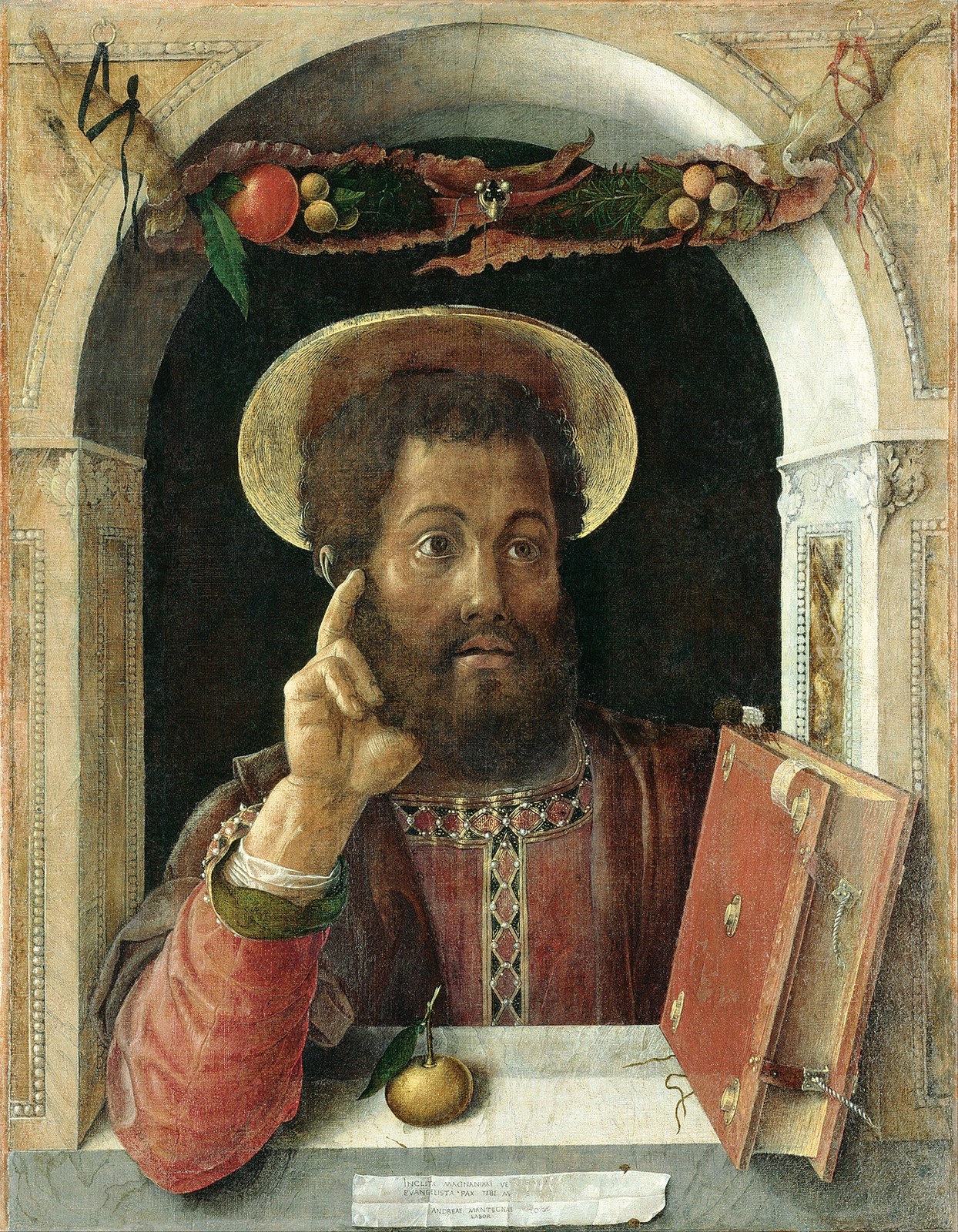
Image: Andrea Mantegna, Wikimedia Commons (Public domain)

We only print prayer texts we can trace to a public-domain printed source, and we have not verified one for St. Mark yet. Until we do: for nine days, pray an Our Father, a Hail Mary and a Glory Be, then add your intention and “St. Mark, pray for us.”

Help us add to this saint's story

Everything is read by a person before anything appears. Facts are checked against trusted sources first.

Facts are welcome; a source link helps (optional).With your permission we may share it on this page.