This Saint’s Story
Lucy was a young Christian of Syracuse, Sicily, martyred during the persecution of Diocletian (Diocletian was Roman emperor 284–305; the 'Great Persecution' of 303–311, when imperial edicts ordered churches and Scriptures destroyed and Christians forced to sacrifice to the Roman gods) around 304. Wikipedia also gives a birth year of about 283. The place and time of her death are about the only details historians treat as secure. The Catholic Encyclopedia treats the fact of a virgin martyr of Syracuse, killed in that persecution, as a solid core that can hardly be questioned. An early inscription found in Syracuse names her feast, and her name is still said at Mass in the Roman Canon (the oldest of the Mass's Eucharistic Prayers), in the 'Nobis quoque peccatoribus' list of martyrs, with Mary, Agatha, Agnes, Cecilia, and others. The Catholic Encyclopedia notes she is one of the few women named there, with special prayers in the early Roman liturgical books, a sign she was venerated very early.
Her Acts (the written account of a martyr's trial and death), probably from the 5th century, tell the story this way. Her father died young, and she had privately consecrated her virginity to God. Her widowed mother Eutychia suffered for years from a hemorrhage, and Lucy took her to the tomb of St. Agatha in Catania to pray. According to the story, the mother was healed, and Lucy persuaded her to give much of the family's wealth to the poor. The young man to whom Lucy had been unwillingly betrothed reported her to the governor Paschasius. He ordered her taken to a brothel, but the Acts say she could not be moved. An attempt to burn her failed, and she was killed with a sword. The Catholic Encyclopedia cautions that these details may echo other virgin-martyr stories and cannot be taken as accurate.
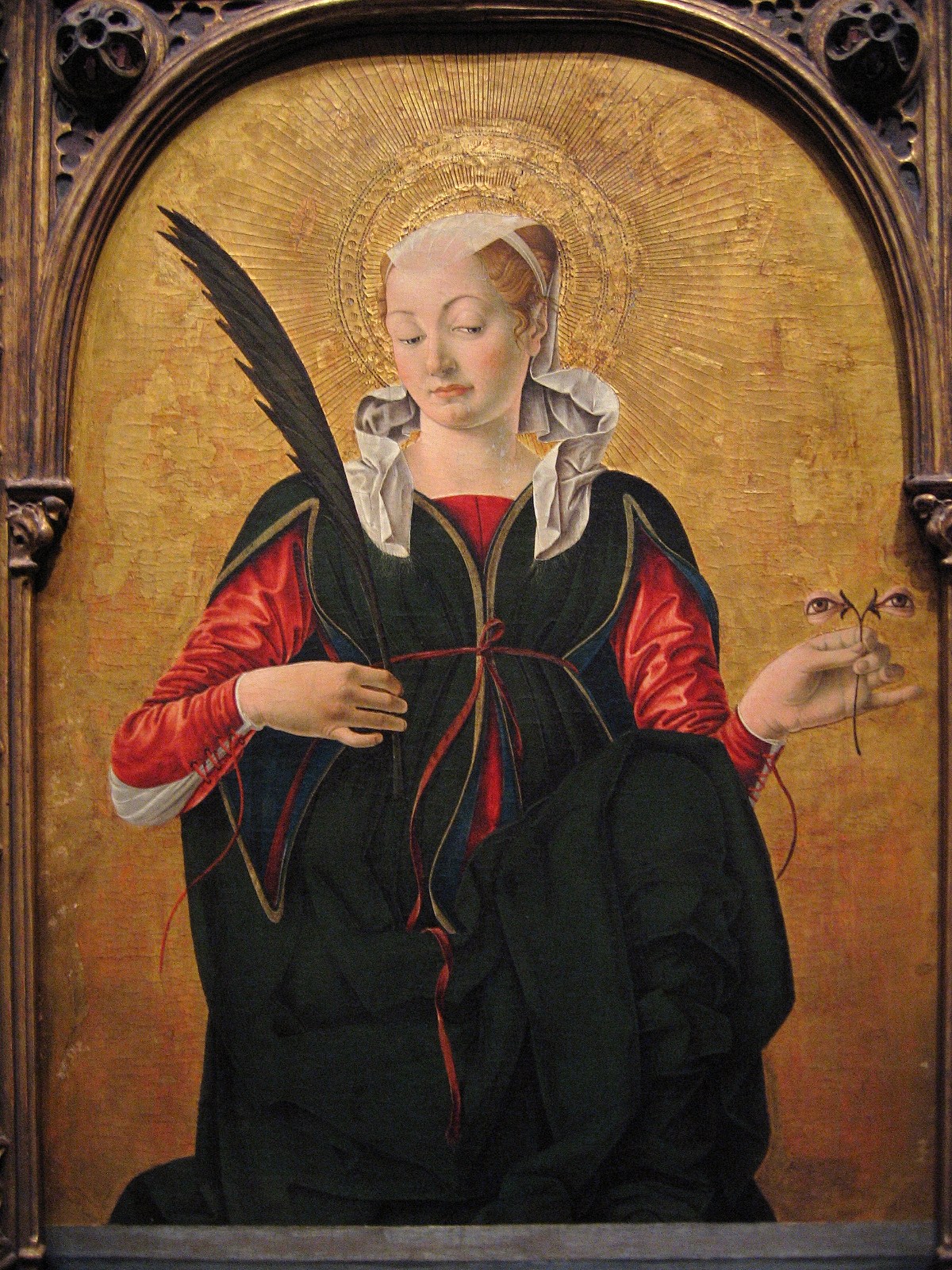
A still later legend says her eyes were torn out, which is why paintings show her holding a dish with eyes. That legend is not part of the earliest notice. Treat the eyes, the fire that would not burn, and the other wonders as tradition. Her name comes from lux, the Latin word for light, and a medieval play on the name is why the eyes entered the pictures. Her feast, December 13, fell near the winter solstice under the old calendar (the Julian calendar, used before the 1582 Gregorian reform). In Sweden girls in white with crowns of candles still mark the day, and parts of Italy keep the feast with lights. Those lights are a custom of the feast. They are not a detail from the fourth century. The General Roman Calendar keeps 13 December.
For today: You can keep Lucy's day with a candle and still sort the layers. A martyr of Syracuse in the Diocletian persecution is the early claim. The eyes on a plate are a later image. You can tell a child the difference.