St. John the Apostle

The disciple whom Jesus loved

Pray the novena →

St. John

John is close to Jesus — at the Transfiguration, in the garden, at the Cross, at the empty tomb — and he still has to unlearn the wish for the best seat and the wish to call down fire. Tradition says he lived to old age at Ephesus, the only one of the Twelve to die in peace.

Feast day

December 27
the beloved disciple; also called the Divine

Patron of

Writers
Theologians

This Saint’s Story

In our own words, from the sources listed below. An older English account is kept further down this page.

John was a son of Zebedee, a fisherman of Galilee, and the brother of James. Jesus called the two of them Boanerges, "sons of thunder." With Peter they form a kind of inner circle in the Gospels: they are taken to the raising of Jairus's daughter, to the Transfiguration, and into the garden of Gethsemane when the others are left behind. Their mother asked that the two of them sit at Jesus' right and left in His kingdom. He asked whether they could drink His cup, and said the places were not His to give.

At the Passion, John's Gospel says, Jesus entrusted His mother to the disciple whom He loved, and that disciple took her into his home. With Peter he runs to the tomb at the first news of the resurrection and arrives first, though Peter goes in first. On the lake at dawn he is the one who recognizes the figure on the shore. In Acts he is still with Peter, going up to the Temple and standing before the council. The same man who had once wanted fire called down on a Samaritan village is later among the first to welcome Samaritans as brethren.

The Gospel of John speaks of a disciple whom Jesus loved. The ancient Church took that disciple to be John the son of Zebedee, and also took him to be the author of the Gospel, the letters of John, and the Revelation. Not all modern scholars agree that one man wrote all of those books, or that the beloved disciple and the son of Zebedee are the same person. The questions are real, and they should be left open on the page.

Tradition says he lived to old age at Ephesus and died a natural death, the only one of the Twelve to do so. Irenaeus (bishop of Lyon, d. c. 202, who listed the early popes) says he settled there after the deaths of Peter and Paul. Jerome says he oversaw the churches of Asia. He probably remained in Jerusalem for some time; the story that he took Mary to Ephesus is late and weak. A later legend says that under Domitian he was put in a cauldron of boiling oil outside the Latin Gate and came out unharmed, then was sent to Patmos, where Revelation was written. Mark the oil as legend. The Gospels do not mention it. Eusebius, citing Irenaeus, tells another story: that John once left a bathhouse on hearing that the teacher Cerinthus was inside, lest the roof fall on him. A later story says that when a young convert fell away, John, already an old man, went after him and brought him back. The Western feast is December 27. In the East he is also called the Theologian.

For today: John is close to Jesus and still has to unlearn things — the wish for the best seat, the wish to call down fire. If you love someone and still want to win, you can stay close and let that wish be corrected. You can also keep a promise of care, as the Gospel says he did for Mary.
The short version

John, son of Zebedee and brother of James the Greater, was one of the Twelve and, in the ancient Church’s reading, the disciple whom Jesus loved and the author of the fourth Gospel. Not all modern scholars agree that one man wrote the Gospel, the letters and the Revelation, and those questions are left open here. At the Passion, the Gospel says, Jesus entrusted His mother to him. Tradition places his last years at Ephesus. The feast is December 27. (A thin June 23 library page titled “St. John” is a different man.)

Struggles & surrender

This saint’s struggles

  • Ambition and a hard unlearning ·
    He and his brother James asked, or their mother asked for them, to sit at Jesus' right and left in His kingdom. He also wanted fire called down on a Samaritan village that would not receive them. The Gospels keep both scenes, and they keep the later ones in which he stays at the Cross and runs to the tomb.

Did you know?

Jesus called him and his brother Boanerges, “sons of thunder.”

A later legend of a cauldron of boiling oil at the Latin Gate is legend, not a line in the Gospels.

The Eastern churches also call him the Theologian.

Patron saint of

  • Writers and theologians Tradition
    The Gospel, letters and Revelation that bear his name have shaped Christian thought, whether or not one man wrote all of them.

The full story

Baring-Gould’s account retold in modern English

Read the full story · 746 words · about 3 min

John apparently followed his new Master to Galilee and was with Him at the wedding feast in Cana. He traveled with Him to Capernaum and from that point on, he never left Him, except when sent on a missionary journey with another disciple, during which he was given the power to heal. John, along with James and Peter, formed the innermost circle of their Lord’s friends. These three were allowed to stay close to Christ when all the other apostles were kept at a distance. Peter, James, and John were with Christ in the Garden of Gethsemane. The mother of James and John, aware of our Lord’s love for His disciples, made a special request for them to sit, one at His right hand and the other at His left, in His kingdom.

The brothers must have had a lot of impulsiveness in their character, as they earned the nickname Boanerges, which means Sons of Thunder. It is not necessary to elaborate on the well-known events of the Last Supper and the Passion. John was given the highest privilege by our Lord: the care of His mother. John and Peter were the first to hear the news of the Resurrection from Mary Magdalene, and they rushed to the tomb. There, when Peter was held back by awe, John eagerly “came first to the sepulchre.”

During the time between the Resurrection and the Ascension, John and Peter were together on the Sea of Galilee, having returned to their old profession and familiar places. When Christ appeared on the shore in the early morning light, John was the first to recognize Him. The final words of the Gospel show the bond that existed between the two apostles. It was not enough for Peter to know his own fate; he also wanted to learn about the future that awaited his friend. The Acts of the Apostles show them still united, entering the Temple together as worshippers and standing together against the threats of the Sanhedrin (the Jewish ruling council). They worked together in the early stages of the Church's expansion. The apostle, whose anger had been ignited by the unbelief of the Samaritans, was the first to accept these Samaritans as brothers. He likely stayed in Jerusalem until the death of the Virgin Mary, although a tradition of no great age or credibility claims that he took her to Ephesus. It is uncertain when he went to Ephesus. He was in Jerusalem fifteen years after Saint Paul’s first visit there. There is no evidence of his presence in Jerusalem during Saint Paul’s last visit there.

Tradition, which is sometimes reliable, adds to the history. Irenaeus says that John did not settle in Ephesus until after the deaths of Peter and Paul, and this seems likely. He was certainly not there when Timothy was appointed bishop of that place. Jerome states that John supervised and governed all the Churches in Asia. He probably finally settled in Ephesus around the year 97. During the persecution under Domitian, he was taken to Rome and placed in a cauldron of boiling oil outside the Latin gate, but the boiling oil did not harm him. He was then sent to work in the mines on Patmos. When Nerva became emperor, he was released and returned to Ephesus, where it is believed he wrote his gospel.

We have examples of his zeal and love from Eusebius, who recounts, based on Irenaeus's account, that John once fled from a bath upon hearing that Cerinthus was in it, fearing that the roof would collapse and crush the heretic. On the other hand, he also demonstrated his love. He once commended a young man he cared about to a bishop, instructing him to keep the young man's trust. Some years later, he learned that the young man had become a robber. Even though John was very old, he pursued him into the mountain hideouts and, through his compassion, brought him back.

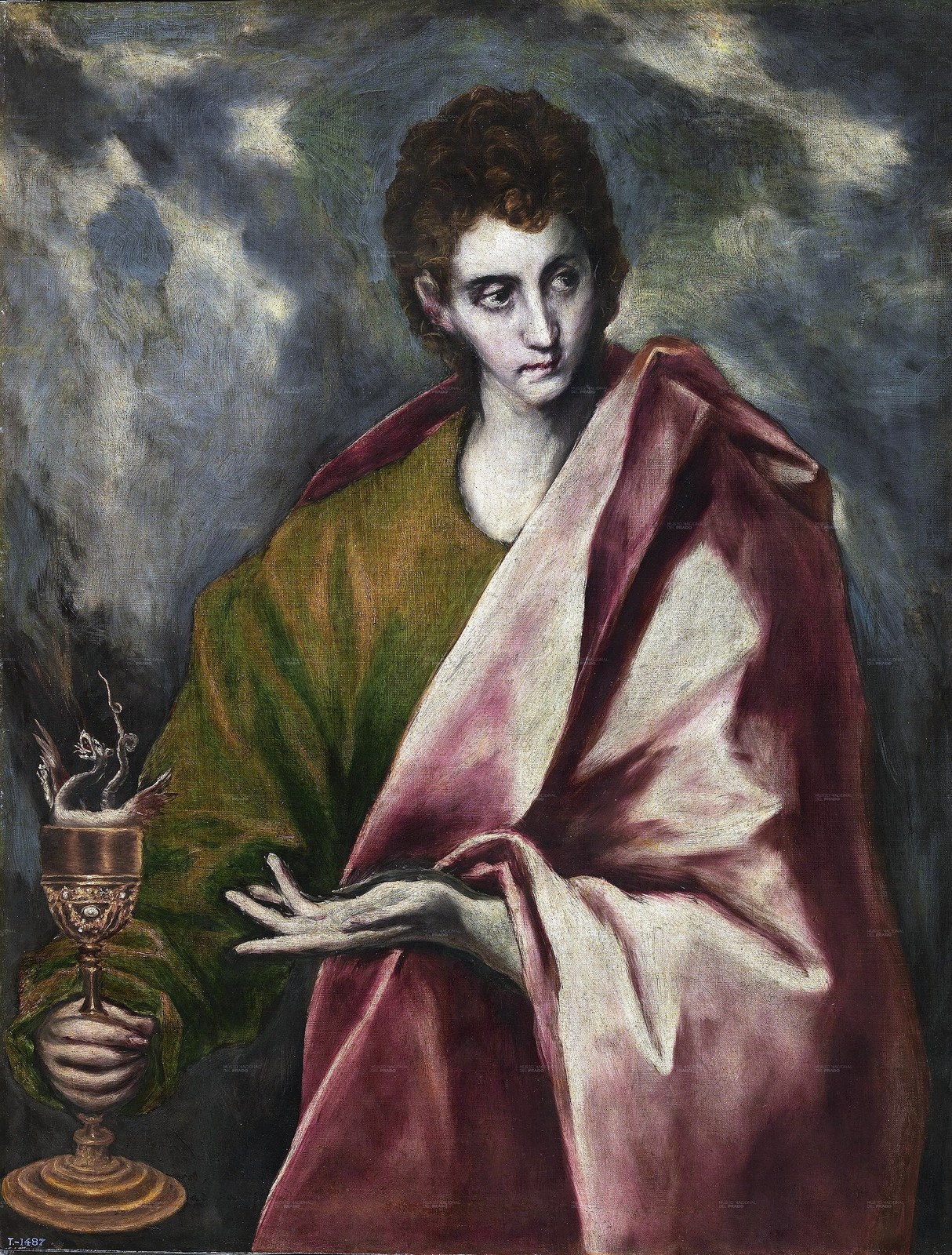
In his old age, when he could do little else, he was carried into the assembly of the Church at Ephesus, and his only exhortation was, “Little children, love one another.” The exact date of his death cannot be determined with precision, but it is certain that he lived to a very old age. He is often depicted holding a chalice from which a dragon emerges, as he is believed to have been given poison that turned out to be harmless. His symbol is also an eagle.

Footnotes

  1. Boanerges means Sons of Thunder.
  2. The Sanhedrin was the Jewish ruling council.
  3. The Virgin Mary refers to the mother of Jesus.
  4. Eusebius makes no mention of this. The legend of the boiling oil occurs in Tertullian and in Jerome.

Baring-Gould’s own footnotes, in modern English.

Retold in plain modern English from Baring-Gould’s public-domain text, sentence by sentence, keeping the same facts and order. Short explanations in parentheses are ours.

Feast days

Feast: December 27

What he represents

How he teaches us to live

Drawn from themes in the original account

Stay faithful when it costs you. Holding firm under pressure is part of this story.

Build up the community you belong to. Community life is part of this story.

From the homilies

Preached on Scripture

John Henry Newman · Anglican preacher, later Catholic cardinal, 1801–1890
“Love of Relations and Friends” (Sermon 5)

What he’s saying: St. John the Apostle is known as the beloved disciple of Jesus, who had a close and special relationship with Him, being one of His closest companions.

“St. John the Apostle and Evangelist is chiefly and most familiarly known to us as "the disciple whom Jesus loved." He was one of the three or four who always attended our Blessed Lord, and had the privilege of the most intimate intercourse with Him; and, more favoured than Peter, James, and Andrew, he was His bosom friend, as we commonly express ourselves.”

Text: “Beloved, let us love one another, for love is of God.”

The novena

Nine days · one intention

A novena is nine days of prayer for one intention, modeled on the nine days the apostles and Mary prayed between the Ascension and Pentecost (Acts 1–2). Pray this each day:

Nine days · Free

Pray the novena
with us.

One short email a day for nine days. The day's prayer, a line from St. John's story, and a nudge to keep going.

Your Confirmation saint?

Choose St. John if…

  • you love deeply and still have a temper to unlearn
  • you want a saint who stayed at the Cross and ran to the tomb
  • you care for someone who was entrusted to you

Take the saint finder →  Need a sponsor?

“Woman, behold thy son. After that, he saith to the disciple: Behold thy mother.”

Douay-Rheims, John 19:26–27
Related saints
Sources & notes

Story sources

Sources

Credits

Image: El Greco and workshop, Wikimedia Commons (Public domain)

We only print prayer texts we can trace to a public-domain printed source, and we have not verified one for St. John yet. Until we do: for nine days, pray an Our Father, a Hail Mary and a Glory Be, then add your intention and “St. John, pray for us.”

Help us add to this saint's story

Everything is read by a person before anything appears. Facts are checked against trusted sources first.

Facts are welcome; a source link helps (optional).With your permission we may share it on this page.