St. Vincent of Lerins

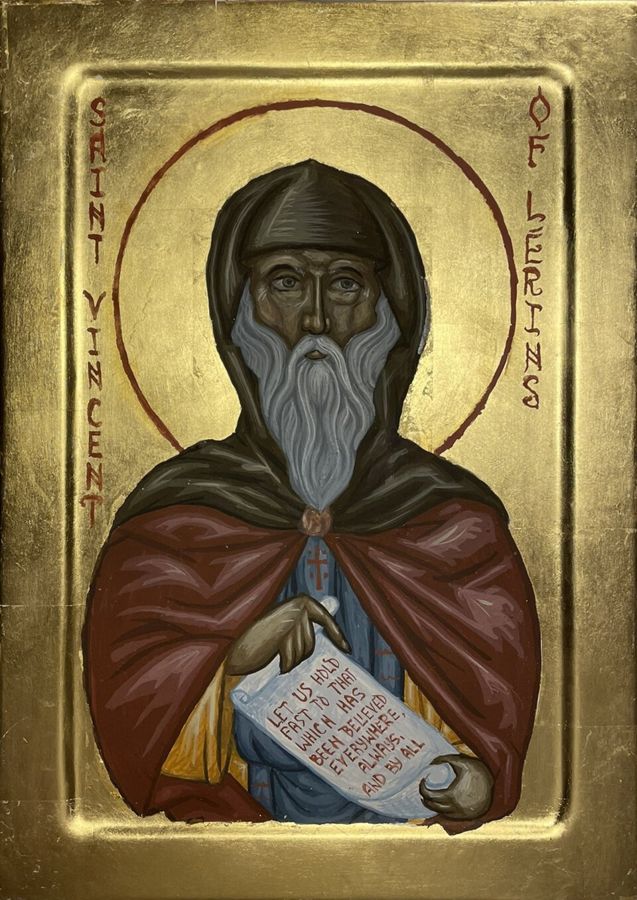
Vincent was a monk of Lérins (a famous island monastery off Cannes) in southern Gaul in the fifth century.

Read the essentials →
Feast May 24 · Priest

St. Vincent of Lerins

Current feast

May 24
Secondary source · Wikipedia infobox

Traditional feast

May 24
1914 / pre-1969 calendar, per Baring-Gould (1897)

Represents

Priest

Feast days

Feast: May 24

This Saint’s Story

Adapted in modern English from the Catholic Encyclopedia (1913) · original text below · little is known

His work is better known than his life. Under the pen name Peregrinus he wrote his 'Commonitorium' in 434, and he died before 450. St Eucherius of Lyons called him a holy man, outstanding in eloquence and knowledge.

The 'Commonitorium' gives a rule for telling heresy from true doctrine: Scripture first and, where that is not enough, the tradition of the Catholic Church, holding 'what has been believed everywhere, always and by all'. It also describes how doctrine can grow without changing. The source notes that he leaned toward the Semipelagian side against St Augustine, before the Church had settled that question.

What he represents

How he teaches us to live

Drawn from themes in the original account

Celebrate this saint’s feast day. Remember him on May 24 with a short prayer, and ask for his help.

The full story

Baring-Gould’s account retold in modern English

Read the full story · 902 words · about 4 min

The Acts of the Apostles and the Roman Martyrology mention these martyrs. However, the accounts are so fantastical that it is impossible to determine where and when these martyrs suffered, if they even existed at all. There were about 252 of them, and when they were killed, they suddenly disappeared, leaving no trace of their bodies. The Acts tell us that they suffered under the Roman Emperor Antoninus, who was struck dead by lightning, and his successor, Emperor Leo. Once we establish the historical context of these emperors, we can determine the date of these martyrs.

To remedy this weakness, God provides grace to help people follow His will. To achieve happiness, a person must choose to serve God, and without grace, their will cannot reach this goal. This is the Catholic doctrine of Predestination and Grace. It is clear that even the slightest disturbance in this balance undermines the doctrine, either making a person's will completely sufficient or making God's grace overpower a person's will. If grace is so powerful, then God is undermining His own creation, removing human free will, and reducing people to the status of animals or plants. Both extremes are heretical. To claim that a person's will is entirely sufficient without the cooperation of grace is Pelagianism, while to assert that God's grace is absolute is Calvinism. The strong emphasis on the sufficiency of human free will by the Pelagians led Saint Augustine to emphasize the power of grace. In some of his writings, he may have used language that could be misinterpreted. In his time, there was no concern about misunderstandings. However, it has since been used to support one of the most damaging heresies that dulls the conscience. The Calvinist and Jansenist doctrine of predestination renders a person powerless in God's hands, meaning that if God wills it, grace will carry a person to heaven, regardless of their indifference or resistance. This annihilates human free will.

The truth can be stated as follows: grace, without the cooperation of a person's free will, cannot bring about salvation; and a person's free will, without the help of grace, is powerless to achieve salvation. To exaggerate the power of free will or the role of grace leads to heresy.

While the Western Church generally respected the authority of Saint Augustine, it was hesitant and fearful of Saint Vincent of Lerins.

Any opinion that might seem to limit the sovereignty of God led to the rise of semi-Pelagianism in another context and under different circumstances. This school developed among the monasteries in the south of France. Some of the most prominent bishops of that region were its supporters. The most notable, if not the first founder, of this Gallic semi-Pelagianism was the monk St. John Cassian. He likely recognized that the predestinarianism of Augustine was being exaggerated by his followers into a fatalism that destroyed all human independence. It is common for lesser minds to exaggerate the teachings of their master, and the distortion of any one doctrine of Christianity to the neglect or denial of the related truth is considered heresy. Cassian opposed this trend. He may have somewhat overstated the independence of the human will, but his teachings were not far from Molinism, which is the accepted doctrine on free will and Grace in the Western Church today.

Semi-Pelagianism aimed to find a balance between Pelagius and Augustine. It sought to navigate a safe middle ground between the extremes into which each had fallen. It firmly rejected Pelagius's heresy of denying original sin. It acknowledged Divine Grace but did not accept Augustine's system, which seemed to make God's grace an unavoidable necessity. However, it took an untenable position on one point. The semi-Pelagians taught that, as a general rule, Grace depended on a person's prior willingness to seek salvation. In contrast, Catholic doctrine states that the will must first be inspired by God. It is God who motivates the will, leaving individuals with the free choice to either accept or reject Grace, to help it progress, or to seek it for that purpose.

Prosper, a layman from Riez and a strong supporter of Augustine, wrote against the semi-Pelagians in response to objections raised against Augustinianism by a certain Vincent of Lerins. Prosper claimed that Vincent had misrepresented Predestinarianism. In the same year, 434, Vincent published his well-known “Commonitory,” which aimed to protect against the harmful innovations of all heretics. The main principle of this famous book, which some attribute to the Quicumque vult (a statement of faith), is widely recognized. The formula in which Vincent expresses the Catholic rule of Scriptural interpretation has become a part of ecclesiastical proverbs.

There has been some doubt about whether the Vincent of Lerins who wrote the “Commonitorium” is the same Vincent of Lerins who is venerated today, but there are no strong reasons for this doubt. He was born in Gaul, likely in Toul. Saint Eucherius of Lyons states that he was the brother of Lupus of Troyes, although Gennadius does not mention this. Vincent initially pursued a military career but later left it to retire to the island of Lerins, which was the monastic center of Provence, similar to how Lindisfarne was the religious capital of Northumbria. He was ordained as a priest and was responsible for the education of Salonus and Veran, the sons of Saint Eucherius. He died around the time of the writing of the “Commonitorium.”

Footnotes

  1. The Acts are so utterly fabulous that it is impossible to make out where and when these martyrs suffered, if they ever existed.
  2. There were some 252 of them, and when slain they suddenly vanished, and no trace of their bodies could be detected.
  3. The Acts inform us that they suffered under the Roman emperor Antoninus, who was struck dead by lightning, and his successor, the Emperor Leo.
  4. When the place of these emperors in history has been fixed, we may determine the date of these martyrs.
  5. To make man’s will all-sufficient without the co-operation of Grace is Pelagianism, to make God’s grace absolute is Calvinism.
  6. The vehemence wherewith the sole sufficiency of man’s free-will was asserted by the Pelagians led S. Augustine to dwell with force on the power of Grace.
  7. In some passages he possibly employed language capable of a dangerous interpretation.
  8. But it has since been claimed in support of one of the heresies most fatally numbing to the conscience which the world has produced.
  9. The Calvinist and Jansenist doctrine of predestinarianism, makes man powerless in the hands of God to will or to refuse.
  10. If God wills, Grace sweeps man away to heaven, however indifferent or restive his will may be.
  11. Man’s free-will is annihilated.
  12. To exaggerate the power of free-will, or the function of Grace, is to lapse into heresy.
  13. While the West in general bowed before the commanding authority of S. Augustine; trembled and shrank from S. Vincent of Lerins.
  14. The famous book aimed to protect against heretical innovations.
  15. The main principle is widely recognized and has become part of ecclesiastical proverbs.
  16. There are no strong reasons to doubt the identity of Vincent of Lerins.
  17. He was born in Gaul, likely in Toul.
  18. He was the brother of Lupus of Troyes, according to Saint Eucherius.
  19. He abandoned a military career to retire to the island of Lerins.
  20. He was ordained as a priest and educated the sons of Saint Eucherius.
  21. He died around the time of the writing of the “Commonitorium.”

Baring-Gould’s own footnotes, in modern English.

Read the original 1870s text

Baring-Gould’s sources: Roman Martyrology; inserted by Baronius from the first edition of Molanus, but on what authority Molanus attributed this day to S. Vincent of Lerins is unknown, and Molanus omitted him in his subsequent editions of his additions to Usuardus. Peter de Natalibus places S. Vincent on June 1st. Authority: — Gennadius of Marseilles (d. 492), <cDe viris illustribus.”] HAT God has given man a free-will; that God has made man for perfect happiness; that perfect happiness is only to be attained by the will of man freely according with the will of God; that the will of man is weakened by the Fall; that to 1 S. Luke viii. 3; xxiii. 49, 56. Roman Martyrology. By the Greeks on the 2nd Sunday after Easter is the Commemoration of Joseph the Just and the holy woman who anointed Christ’s body.

3 Acts xiii., Roman Martyrology. 3 The Acts are so utterly fabulous that it is impossible to make out where and when these martyrs suffered, if they ever existed. There were some 252 of them, and when slain they suddenly vanished, and no trace of their bodies could be detected. The Acts inform us that they suffered under the Roman emperor Antoninus [Antoninus Pius, Roman emperor 138–161], who was struck dead by lightning, and his successor, the Emperor Leo. When the place of these emperors in history has been fixed, we may determine the date of these martyrs.

VOL. V. remedy this weakness, God provides man with grace to strengthen him to follow the will of God; that to obtain happiness man must will to serve God; and that his will without grace is unable, to attain this end; — such is the Catholic doctrine of Predestination and Grace. It will be seen that the slightest disturbance of the equilibrium destroys the doctrine, and makes man’s will all-sufficient, or makes God’s grace overmaster man’s will. But if Grace be so powerful, then God is destroying His own work, He is obliterating man’s free-will and reducing him to the level of a beast or a plant. Either exaggeration is heresy. To make man’s will all-sufficient without the co-operation of Grace is Pelagianism [followers of Pelagius, who taught people could be good without God’s grace], to make God’s grace absolute is Calvinism. The vehemence wherewith the sole sufficiency of man’s free-will was asserted by the Pelagians led S. Augustine to dwell with force on the power of Grace. In some passages he possibly employed language capable of a dangerous interpretation. In his time there was no fear of its being misunderstood. But it has since been claimed in support of one of the heresies most fatally numbing to the conscience which the world has produced. The Calvinist and Jansenist doctrine of predestinarianism, makes man powerless in the hands of God to will or to refuse. If God wills, Grace sweeps man away to heaven, however indifferent or restive his will may be. Man’s free-will is annihilated.

The truth may thus be fairly stated: Grace without the co-operation of man’s free-will is inoperative to effect his salvation; and man’s free-will without the assistance of Grace is powerless to obtain salvation. To exaggerate the power of free-will, or the function of Grace, is to lapse into heresy.

While the West in general bowed before the commanding authority of S. Augustine; trembled and shrank from S. Vincent of Lerins.

any opinion which might even seem to limit the sovereignity of God, semi-Pelagianism arose in another quarter, and under different auspices. This school grew up among the monasteries in the south of France. Among its partisans were some of the most eminent bishops of that province. The most distinguished, if not the first founder, of this Gallic semi-Pelagianism was the monk St, J ohn Cassian. Pie probably saw that the predestinarianism of Augustine was being exaggerated by his disciples into a fatalism destructive of all human independence. It is the habit of inferior minds to exaggerate the teaching of their master, and the exaggeration of any one doctrine of Christianity to the obscuration or denial of the correlative truth is heresy. Against this Cassian arose. He may have somewhat exaggerated the independence of the human will, but his teaching was not much beyond Molinism, the accredited doctrine on free-will and Grace in the Western Church at the present day.

Semi-Pelagianism aspired to hold the balance between Pelagius and Augustine; to steer a safe and middle course between the abysses into which each, on either side, had plunged. It emphatically repudiated the heresy of Pelagius in the denial of original sin; it asserted Divine Grace, but refused to accept the system of Augustine, which seemed to harden the grace of God into an iron necessity. But on one point it took up untenable ground. The semi-Pelagians taught that Grace, as a general rule, was dependent on a pre-existing will in man to obtain salvation, whereas the Catholic doctrine is that the will must receive its first incentive from God. It is God who stimulates the will, and then leaves man by an act of free-will to resist or to concur with Grace, to reject Grace, to enable it to advance, or to seek it for that purpose. Prosper, a layman of Riez, a vehement Augustinian [religious following the Rule of St. Augustine], wrote against the semi-Pelagians, in answer to a series of objections raised against Augustinianism by a certain Vincent of Lerins, who, he said, had misrepresented Predestinarianism. In the same year, 434, Vincent brought out his famous “ Commonitory,” which was designed to be a preservative ‘‘ against the profane novelties of all heretics.5' The general principle of this famous book, to whose author one opinion would ascribe the Qiiicunqiie vult, is well known; the formula in which he states the Catholic rule of Scriptural interpretation has taken its place among ecclesiastical proverbs.1 It has been doubted whether the Vincent of Lerins who wrote the “ Commonitorium " is the Vincent of Lerins venerated this day, but on no adequate grounds. He was a Gaul [roughly modern France and Belgium] by birth, born probably at Toul. S. Eucherius of Lyons says that he was the brother of Lupus of Troyes, but Gennadius does not say this. He first followed a military career, but abandoned arms to retire to the island of Lerins, the monastic metropolis of Provence, as Lindisfarne was the religious capital of Northumbria [the Anglo-Saxon kingdom of northern England and south-east Scotland]. He was ordained priest, and charged with the education of Salonus and Veran, sons of S. Eucherius. He died about the 1 “ Curandum est ut id teneamus, quod ubique, quod semper, quod ab omnibus creditum est; ” c. 3.

From the Catholic Encyclopedia

1913 · 1203 words

Feast on 24 May, an ecclesiastical writer in Southern Gaul [roughly modern France and Belgium] in the fifth century. His work is much better known than his life. Almost all our information concerning him is contained in Gennadius, "De viris illustribus" (lxiv). He entered the monastery of Lérins (today Isle St. Honorat), where under the pseudonym of Peregrinus he wrote his "Commonitorium" (434). He died before 450, and probably shortly after 434. St. Eucherius of Lyons calls him a holy man, conspicuous for eloquence and knowledge; there is no reliable authority for identifying Vincent with Marius Mercator, but it is likely, if not certain, that he is the writer against whom Prosper, St. Augustine's friend, directs his "Responsiones ad capitula objectionum Vincentianarum". He was a Semipelagian and so opposed to the doctrine of St. Augustine. It is believed now that he uses against Augustine his great principle: "what all men have at all times and everywhere believed must be regarded as true". Living in a centre deeply imbued with Semipelagianism, Vincent's writings show several points of doctrine akin to Casian or to Faustus of Riez, who became Abbot of Lérins at the time Vincent wrote his "Commonitorium"; he uses technical expressions similar to those employed by the Semipelagians against Augustine; but, as Benedict XIV observes, that happened before the controversy was decided by the Church. The "Commonitorium" is Vincent's only certainly authentic work extant. The "Objectiones Vincentianae" are known to us only through Prosper's refutation. It seems probable that he collaborated, or at least inspired, the "Objectiones Gallorum", against which also Prosper writes his book. The work against Photinus, Apollinaris, Nestorius [Nestorius (d. c. 451), whose teaching split Christ into two persons; condemned at Ephesus in 431], etc., which he intended to compose (Commonitorium, xvi), has not been discovered, if it was ever written. The "Commonitorium", destined to help the author's memory and thus guide him in his belief according to the traditions of the Fathers, was intended to comprise two different commonitoria, the second of which no longer exists, except in the résumé at the end of the first, made by its author; Vincent complains that it had been stolen from him. Neither Gennadius, who wrote about 467-80, nor any known manuscripts, enable us to find any trace of it.

It is difficult to determine in what the second "Commonitorium" precisely differed from the first. The one preserved to us develops (chapters i-ii) a practical rule for distinguishing heresy from true doctrine, namely Holy Writ, and if this does not suffice, the tradition of the Catholic Church. Here is found the famous principle, the source of so much discussion particularly at the time of the Vatican Council, "Magnopere curandum est ut id teneatur quod ubique, quod semper, quod ab omnibus creditum est". Should some new doctrine arise in one part of the Church, Donatism for example, then firm adherence must be given to the belief of the Universal Church, and supposing the new doctrine to be of such nature as to contaminate almost the entirety of the latter, as did Arianism [followers of Arius, who taught that the Son is a created being, not fully God], then it is to antiquity one must cling; if even here some error is encountered, one must stand by the general councils and, in default of these, by the consent of those who at diverse times and in different places remained steadfast in the unanimity of the Catholic Faith (iii-iv). Applications of these principles have been made by St. Ambrose and the martyrs, in the struggle with the Donatists and the Arians; and by St. Stephen who fought against rebaptism; St. Paul also taught them (viii-ix). If God allows new doctrines, whether erroneous or heretical, to be taught by distinguished men, as for example Tertullian, Origen, Nestorius, Apollinaris, etc. (x-xix), it is but to test us. The Catholic admits none of these new-fangled doctrines, as we see from I Tim., vi, 20-21 (xx-xxii, xxiv). Not to remove all chance of progress in the faith, but that it may grow after the manner of the grain and the acorn, provided it be in the same sense, eodem sensu ac sententia; here comes the well known passage on dogmatic development. "crescat igitur. . ." (xxiii). The fact that heretics make use of the Bible in no way prevents them from being heretics, since they put it to a use that is bad, in a way worthy of the devil (xxv-xxvi). The Catholic interprets Scripture according to the rules given above (xxvii-xxviii). Then follows a recapitulation of the whole "Commonitorium" (xxix-xxx).

All this is written in a literary style, full of classical expressions, although the line of development is rather familiar and easy, multiplying digressions and always more and more communicative. The two chief ideas which have principally attracted attention in the whole book are those which concern faithfulness to Tradition (iii and xxix) and the progress of Catholic doctrine (xxiii). The first one, called very often the canon of Vincent of Lérins, which Newman considered as more fit to determine what is not then what is the Catholic doctrine, has been frequently involved in controversies. According to its author, this principle ought to decide the value of a new point of doctrine prior o the judgment of the Church. Vincent proposes it as a means of testing a novelty arising anywhere in a point of doctrine. This canon has been variously interpreted; some writers think that its true meaning is not that which answered Vincent's purpose, when making use of it against Augustine's ideas. It is hardly deniable that despite the lucidity of its formula, the explanation of the principle and its application to historical facts are not always easy; even theologians such as de San and Franzelin, who are generally in agreement in their views, are here at variance. Vincent clearly shows that his principle is to be understood is a relative and disjunctive sense, and not absolutely and by uniting the three criteria in one: ubique, semper, ab omnibus; antiquity is not to be understood in a relative meaning, but in the sense of a relative consensus of antiquity. When he speaks of the beliefs generally admitted, it is more difficult to settle whether he means beliefs explicitly or implicitly admitted; in the latter case the canon is true and applicable in both senses, affirmative (what is Catholic), and negative or exclusive (what is not Catholic); in the former, the canon is true and applicable in its affirmative bearing; but may it be said to be so in its negative or exclusive bearing, without placing Vincent completely at variance with all he says on the progress of revealed doctrine?

Read the rest of the article

The "Commonitorium" has been frequently printed and translated. We may quote here the first edition of 1528 by Sichardus and that of Baluze (1663, 1669, 1684, Paris), the latter being the best of the three, accomplished with the help of the four known manuscripts; these have been used again in a new accurate collation by Rauschen, for his edition ("Florilegium patristicum", V, Bonn, 1906); a school-edition has been given by Julicher (Frieburg, 1895), and by Hurter (Innsbruck, 1880, "SS. Patrum opuscula selecta", IX) with useful notes.

BARDENHEWER-SHAHAN, Patrology (St. Louis, 1908), 520-2; Kiln, Patrologie, II (1908), 371-5; KOCH, Vincent von Lérins und Gennadius in Texte und Untersuchungen, XXXI, 2 (1907); BUNETIERE, and DE LABRIOLLE, S. Vincent de Lérins; La pensee chretienne (Paris, 1906).
Help us add to this saint's story

Everything is read by a person before anything appears. Facts are checked against trusted sources first.

Facts are welcome; a source link helps (optional).With your permission we may share it on this page.

Nine days · Free

Pray the novena
with us.

One short email a day for nine days. The day's prayer, a line from St. Vincent of Lerins's story, and a nudge to keep going.

Also on May 24
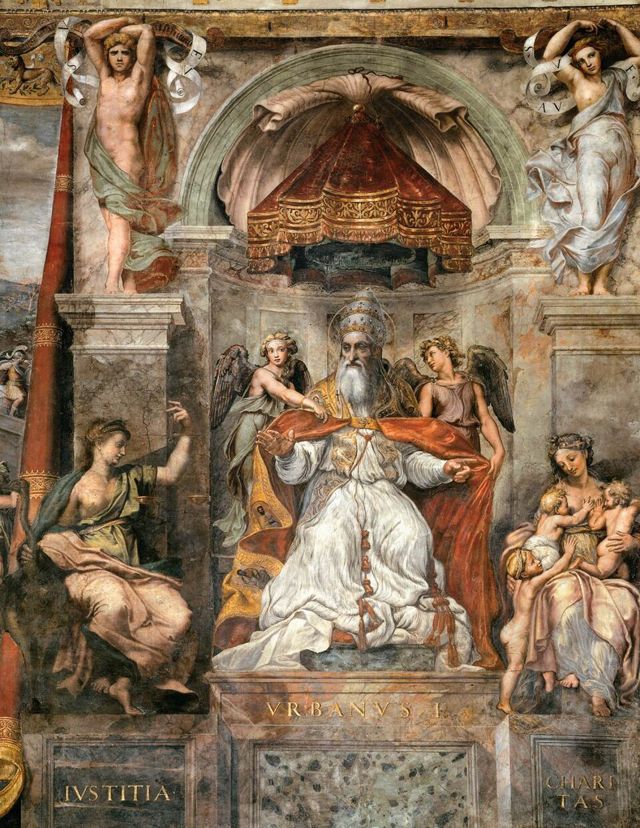
St. Urban I., Pope

St. Urban I.

May 25 · Martyr
M

Sts. Maximus and…

May 25 · Martyrs
I

Sts. Injuriosus and…

May 25 · Feast
← All 1970 saints in the library
Sources & notes

Feast-day sources

Story sources

Sources

Credits

Image: Icon of St Vincent of Lerins by Bojan Teodosijević.jpg · Bojan Teodosijević · CC BY 4.0, via Wikimedia Commons

Image: Bojan Teodosijević, Wikimedia Commons (CC BY 4.0)

From “Catholic Encyclopedia (1913)/St. Vincent of Lérins,” The Catholic Encyclopedia (New York: Robert Appleton Company, 1907–1914), via Wikisource. Public domain. Matched by name and feast date; text unedited except for our bracketed notes in grey.

Retold in plain modern English from Baring-Gould’s public-domain text, sentence by sentence, keeping the same facts and order. Short explanations in parentheses are ours.

From Sabine Baring-Gould, The Lives of the Saints, new edition in 16 vols. (London: John C. Nimmo, 1897–98); text from the Internet Archive scan (OCR, lightly cleaned; errors possible). Public domain in the United States. Reproduced unedited, except for short bracketed notes in grey that we added to explain names and terms (“S.” is the old abbreviation for Saint). Some history and judgments reflect 19th-century scholarship.