…attributed to Julianus Petrus, the arch-priest of Saint Justus in Spain, tells us that Berenice was the daughter of Salome, who was the sister of Herod, and the wife of Saint Amator. Confusing her with a martyr from Antioch named Beronicus, she is said to have suffered martyrdom in that city. Eusebius shares a tradition that was popular in his time. “They say that the woman who had a flow of blood, mentioned by the Evangelists, and who was healed by our Savior, was from Paneas, or Caesarea Philippi, and that her house is shown in the city, along with the remarkable memorials of the benefit she received from our Savior. At the gates of her house, on an elevated stone, there stands a bronze image of a woman on her knees, with her hands stretched out as if pleading. Opposite this is another image of a man, standing upright, made of the same material, decently dressed in a cloak, and reaching out his hand to the woman. At her feet, on the same pedestal, there grows a strange plant, which rises as high as the hem of the bronze garment, and is said to be a remedy for all kinds of diseases. This statue, they claim, represents Jesus Christ, and it has remained to this day, as we ourselves saw when we stayed in that city. It is not surprising that those Gentiles who were once helped by the Savior would have done these things. We have also seen depictions of the apostles Peter and Paul, and of Christ Himself, still preserved in paintings; so it is likely that, following a practice among the Gentiles, the ancients were accustomed to pay this kind of honor indiscriminately to those who helped them.” “Among so many remarkable events that occurred during the reign of Julian,” says Sozomen, “I must mention one that provides clear evidence of the power of Christ and of Divine wrath against the emperor. Having heard that in Caesarea Philippi, also known as Paneas, a city in Phoenicia, there was a famous statue of Christ erected by a woman whom the Lord had healed of a flow of blood, Julian ordered it to be taken down and replaced with a statue of himself. However, fire from heaven struck it, breaking the head and chest, and it was pinned to the ground face down. It can still be seen at the spot where it fell, blackened by the lightning. The statue of Christ was dragged around the city and mutilated by the Pagans, but the Christians recovered the fragments and placed the statue in the church, where it is still kept.” In the Chronicle of John Mamela (circa A.D. 600), there is a supposed petition made to Herod by Beronica, asking for permission to erect the statue. Mamela claims he found this document in the city of Paneas, “in the possession of a certain Rassus, who had converted to Christianity from Judaism.”
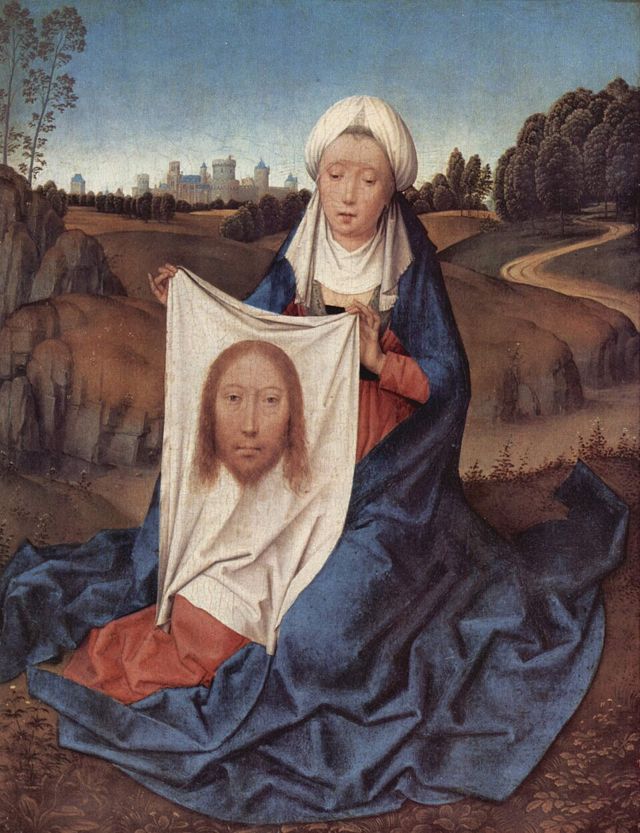
In the apocryphal book, “The Death of Pilate,” which is an early Medieval Latin composition, Veronica's statue has become a picture. She is reported to have said, “When my Lord went about preaching, and I was very unwilling to be deprived of His presence, I desired to have His picture painted for me, so that in His absence, His portrait might give me consolation. And when I was taking the canvas to the painter, the Lord met me and asked where I was going. When I explained my purpose, He asked me for the canvas and gave it back to me, printed with the likeness of His venerable face.” She then brought this to Rome.
The same story appears in “The Vengeance of the Saviour,” another apocryphal work from the same period, a version of which exists in Anglo-Saxon.
Volusinus inquired about the likeness or portrait of the Lord, and all who were there said to him, “A woman named Veronica has it in her house.” Then he commanded that she be brought before him, and he asked, “Do you have the Lord's portrait in your house?” But she denied it. Then Volusianus commanded that she be tortured, and when compelled, she said, “I have it in a clean linen cloth, my lord, and I daily adore it.” Volusianus said, “Show it to me.” Then she showed him the Lord's portrait. Thus, the image of the woman with the issue became the portrait of Christ impressed on canvas, and this passed into the legend of Veronica and the sudarium (a cloth used to wipe Jesus' face) as represented in the Stations of the Cross in every Catholic church. For further particulars, see S. Veronica, February 4th.
Footnotes
- John Mamela was a chronicler from around A.D. 600.
- Paneas is also known as Caesarea Philippi, a city in Phoenicia.
- Veronica is associated with the cloth that bears the image of Christ's face.
- The sudarium is a cloth used to wipe Jesus' face.
Baring-Gould’s own footnotes, in modern English.
Read the original 1870s text
Baring-Gould’s sources: By the Greeks on this day. Authorities Eusebius, Hist EccL, lib. The Greeks give the name of Veronica, or Beronike, to the woman with the issue of blood, healed by our Blessed Lord. The first time this name occurs is in the apocryphal Gospel of Nicodemus, therefore in the 5th cent This name is an alteration of the name Prounike, given to this woman by the Valentinians, one of the Gnostic sects. Origen, in his treatise against Celsus, says, “ The Valentinians, in their lying doctrine, speak of a certain Pi ounice, to whom they give the name of Wisdom, of whom they assert the woman of the Gospel, who had an issue of blood twelve years, was a symbol. Celsus, who heard this, and confounded the ideas of the Greeks, barbarians, and heretics, changed this into the virtue of a certain virgin named Prounice.” 1 In the “Recognitions of S. Peter,” an apocryphal work, attributed falsely to S. Clement, Bernice, the daughter of Justa, the Canaanite, receives into her house at Tyre, SS. Clement, Nicetas and Aquila, arrived from Caesarea, and relates to them the marvels wrought by Simon Magus. According to Eusebius, the woman with the issue was a native of Paneas, or Caesarea Philippi The Chronicle 1 For further particulars see Maury: — Croyences et Legendes de I'Antiquite [July is.
…attributed to Julianus Petrus, arch-priest of S. Justus in Spain, relates that Berenice was the daughter of Salome, sister of Herod, and wife of S. Amator, and confounding her with a martyr of Antioch, named Beronicus, she is made to suffer martyrdom in that city. Eusebius [Eusebius of Caesarea (d. c. 339), the first historian of the Church] relates a tradition popular in his day. “They say that the woman who had an issue of blood, mentioned by the Evangelists, and who obtained deliverance from her affliction by our Saviour, was a native of Paneas, or Caesarea Philippi, and that her house is shown in the city, and the wonderful memorials of our Saviour's benefit to her still remains. At the gates of her house, on an elevated stone, stands the brazen image of a woman on her bended knee; with her hands stretched forth like one entreating. Opposite to this is another image of a man, erect, of the same materials, decently clad in a mantle, and stretching out his hand to the woman. Before her feet, and on the same pedestal, there is a strange plant growing, which, rising as high as the hem of the brazen garment, is a kind of antidote to all kinds of diseases. This statue, they say, is a statue of Jesus Christ, and it has remained even to our days, as we ourselves saw, when tarrying in that city. Nor is it to be wondered at, that those Gentiles who were anciently benefited by the Saviour, should have done these things. For we have also seen representations of the apostles Peter and Paul, and of Christ himself, still preserved in paintings; so that it is probable that, according to a practice among the Gentiles, the ancients were accustomed to pay this sort of honour indiscriminately to those who benefited them.” “Among so many remarkable events which occurred during the reign of Julian,” says Sozomen, “ I must not omit to mention one which affords a manifest proof of the power of Christ, and of the Divine wrath against the emperor. Haying heard that at Caesarea Philippi, otherwise called Paneas, a city of Phoenicia, there was a celebrated statue of Christ, which had been erected by a woman whom the Lord had cured of a flow of blood, Julian commanded it to be taken down, and a statue of himself erected in its place; but fire from heaven was poured down upon it, the head and breast were broken, and it was transfixed to the ground with the face downwards. It is still to be seen on the spot where it fell, blackened by the thunder. The statue of Christ was dragged round the city, and mutilated by the Pagans; but the Christians recovered the fragments, and deposited the statue in the church, where it is still preserved.” In the Chronicle of John Mamela (cca. a.d. 600) is given the pretended petition made to Herod by Beronica, for permission to erect the statue; this document, Mamela pretends, he found in the city of Paneas, “ in the possession of a certain Rassus, who had become a Christian from among the Jews.”
In the apocryphal book, “The Death of Pilate,” an early Mediaeval Latin composition, Veronica's statue has become a picture. She is reported to have said, “ When my Lord went about preaching, and I was very unwilling to be deprived of his presence, I desired to have his picture painted for me, that in his absence, his portrait might give me consolation. And when I was taking the canvas to the painter, the Lord met me, and asked whither I was going. And when I had made known my purpose, he asked me for the canvas, and gave it back to me printed with the likeness of his venerable face.” And this she brings to Rome.
The same recurs in “ The Vengeance of the Saviour," another apocryphal work of the same period, a version of which exists in Anglo-Saxon.
VOL. VII. iq Lives oj the Saints. [July ix “ Volusinus inquired after the likeness or portrait of the Lord, and all who were there said to him, A woman named Veronica has it in her house. Then he commanded her to be brought before him, and he said, Hast thou the Lord's portrait in thy house ? But she denied it Then Volusianus commanded her to be tortured; and being compelled, she said, I have it in a clean linen cloth, my lord, and I daily adore it Volusianus said, Show it me. Then she showed him the Lord's portrait” Thus the image of the woman with the issue became the portrait of Christ impressed on canvas, and thus passed into the legend of Veronica and the sudarium as represented in the Stations of the Cross in every Catholic church. For further particulars, see S. Veronica, Feb. 4 th,