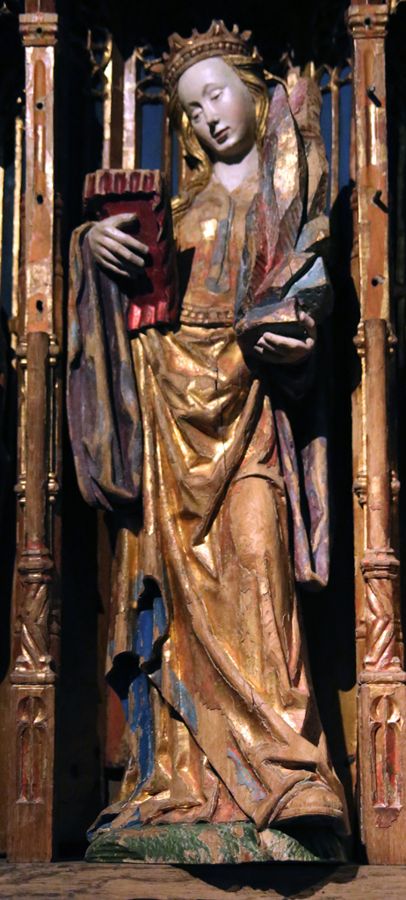
A northern Viking, hearing of her beauty, became infatuated and raided the coasts of Ireland, setting everything on fire because the king hesitated to accept his proposal for his daughter Sunnifa. To save her homeland from destruction by the impatient suitor, the young woman declared her intention to leave Ireland. Her brother Alban and a group of virgins joined her, and they all sailed east, trusting in God. They landed on the island of Selja, off the coast of Norway, and finding it uninhabited, they settled in the caves and lived on fish. However, the island served as a pasture for cattle in the summer, and when the farmers on the mainland saw the people on the island, they assumed they were pirates and appealed to Earl Hako to protect their cattle. The earl quickly gathered some armed men and rowed to the island, but the Christian maidens fled into the caves and prayed to God for protection. Then the rock closed upon them, and they were never seen alive again.
During the reign of Olaf Tryggvason, a farmer found a human head on the island of Selja, which was surrounded by a phosphorescent light and emitted a scent that he found pleasant. He immediately took it to the king, who showed it to Bishop Sigurd. Both recognized signs of holiness, and the king and the bishop went to the island, where they discovered the cave filled with the bones of the saintly refugees. How they learned that they were Irish, and that their leader was named Sunnifa and her brother Alban, is not explained. Two churches were quickly built in Selja, dedicated to Saint Sunnifa and Saint Alban, and countless miracles confirmed the belief that the bones belonged to glorious saints.
The scholar commenting on Adam of Bremen’s Acts of the Bishops of Hamburg adds a final touch to the story: Paul (the deacon), in his History of the Lombards, states that in the far northern regions, among the Scritefings, in a certain cave by the ocean, lie seven men as if they are sleeping, about whom there are differing opinions; some believe they will preach to the people before the end of the world. Others say they are among the eleven thousand virgins whose group separated, and some were wrecked on that rock; miracles are performed there. The church was built there by Olaf. Olaf, a king of righteousness, was the first to lead the Northmen to Christianity. The quotation is from the fourth chapter of the first book of Paul Warnefried’s History of the Lombards. In 1170, the relics of Sunnifa were brought from Selja to Bergen by Bishop Paul, who was the chaplain to King Eysteinn. Saints Sunnifa and Alban are regarded as the proto-martyrs of Norway.
The bones that were discovered were likely those of some shipwrecked foreign travelers who were killed during the reign of Earl Hako. The legend that developed around them is a faint reflection of the legend of Saint Ursula.
Footnotes
- Paul (the deacon) is a historical figure who wrote about the Lombards.
- Olaf Tryggvason was a king known for promoting Christianity in Norway.
- The eleven thousand virgins refer to a legendary group of martyrs.
Baring-Gould’s own footnotes, in modern English.
Read the original 1870s text
Baring-Gould’s sources: Norwegian Kalendar and Breviaries. Greven in his additions to Menardus, and after him Molanus, Canisius and Ferrarius, the Irish Martyr, ologyof Fits-simon, and the Scottish Menology of Dempster. Authorities: — The monk Oddr (12th cent.), Saga of K. Oiaf, the younger Olafs Saga Tryggvasonar, c. xo6 — 8 and X49, and a Latin fragment of the Church Office and Lections for the festival in Langebeck: Sriptores rerum Danicarum, vi. p. 3-4, and 14—23. There is not the smallest foundation for this story, it is only a Scandinavian version of the legend of S. Ursula and the Eleven Thousand Virgins.] In the days of earl Hako, say the Saga writers, there lived in Ireland a king who had a beautiful daughter named Sunnifa, who was endowed with wealth, beauty, and great Christian piety.
A northern viking, hearing of her charms, became CJuly*. enamoured, and harried the coasts of Ireland, setting all in flames, because the king hesitated to accept his suit for his daughter Sunnifa. The damsel, to save her native island from devastation by the impatient suitor, expressed her determination to leave Ireland. Her brother Alban (!) and a multitude of virgins joined her, and all sailed away East, trusting in God. They came ashore on the island of Selja, off the coast of Norway, and finding it uninhabited, they settled in the caves, and lived upon fishes. But the islet served as a pasture for cattle in the summer, and when the farmers on the mainland saw the people on the island, they supposed they were pirates, and appealed to earl Hako to protect their cattle. The earl at once gathered together some armed men and rowed to the island, but the Christian maidens fled into the caves and prayed God to preserve them. Then the rock closed upon them, and they came forth no more alive. In the reign of Olaf Tryggvason, a farmer found a human head on the island of Selja, which was surrounded by a phosphoric light, and which emitted an odour which he was pleased to consider agreeable. He at once took it to the king, who submitted it to the bishop Sigurd. Both recognized the evidences of sanctity, and the king and his bishop went to the island, where they discovered the cave filled with the bones of the saintly refugees. How they found out that they were Irish, that their leader was named Sunnifa, and her brother Alban, we are not told. Two churches were at once erected in Selja, and dedicated to S. Sunnifa and S. Alban, and miracles innumerable confirmed the conviction that the bones belonged to glorious saints.
The scholiast on Adam of Bremen’s Acts of the Bishops S. Grimbald. of Hamburg, 1 gives a finishing touch to the story: u Paul (the deacon), in his History of the Lombards [a Germanic people who ruled much of Italy from 568 to 774], affirms, that in the extreme parts of the North, among the Scritefings, in a certain cave beside the ocean, lie seven men as though sleeping, concerning whom opinions differ; it is believed by some that they will preach to these people before the end of the world. But others say that they are some of the eleven thousand virgins whose company separated, and some were wrecked on that rock; and there miracles are wrought. The church there was erected by Olaf. Olaf, a king of righteousness, first drew the Northmen to Christianity.” The quotation is from the 4th chapter of the 1st Book of Paul Warnefried’s History of the Lombards. In 1170, the relics [the bodily remains of a saint, or objects they used, kept with honor] of Sunnifa were brought from Selja to Bergen, by the bishop, Paul, chaplain to king Eysteinn. SS. Sunnifa and Alban are regarded as the proto-martyrs of Norway.
The bones discovered were probably those of some shipwrecked foreign rovers, massacred in Earl Hako’s reign. And the legend that grew up around them is a distant echo of the legend of S. Ursula.