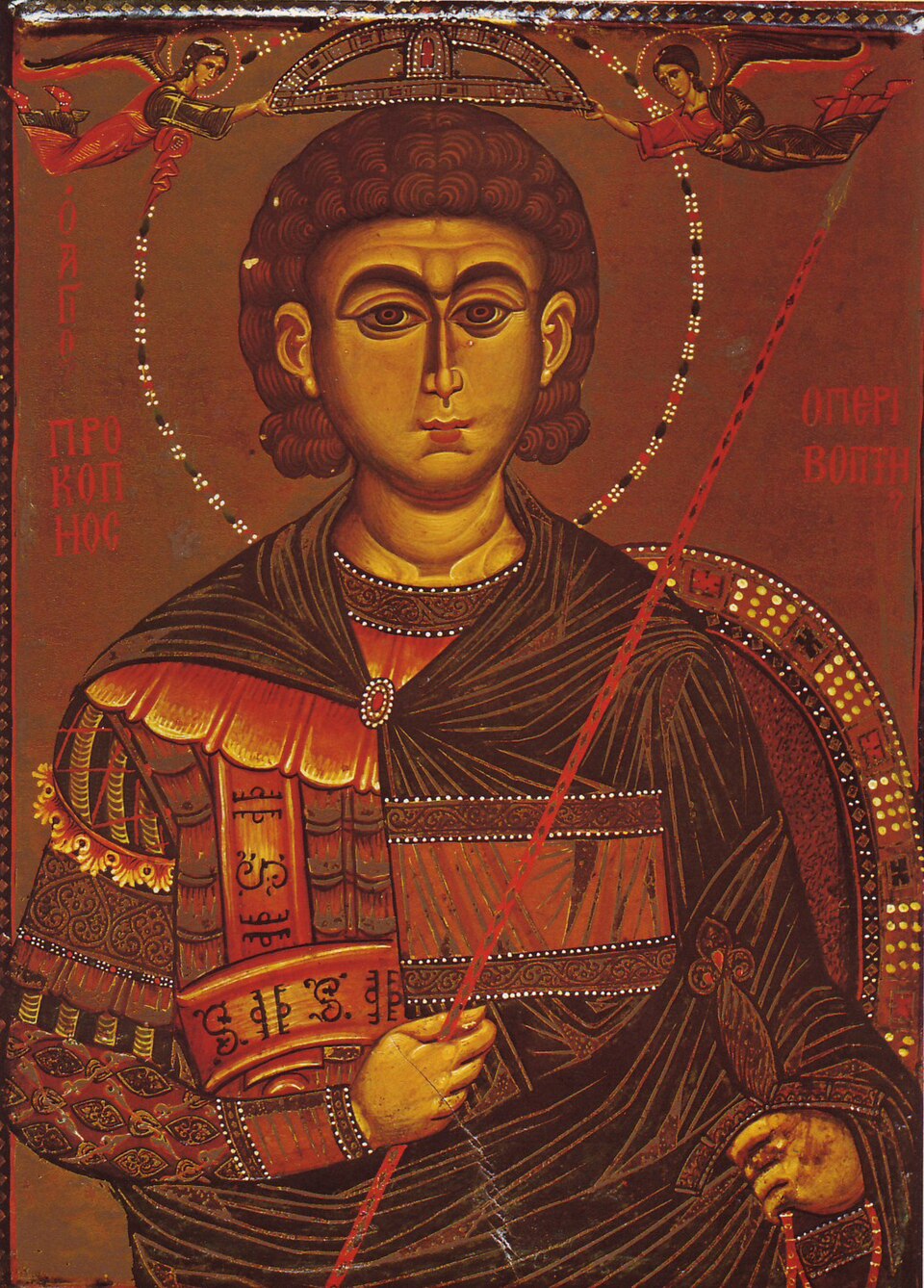
Having been sent from Scythopolis to Caesarea, he was captured at the city gates and taken to the hall of the governor Flavian. Flavian tried to persuade him to sacrifice to the gods. But with a loud voice, he declared that there is only one God, the maker of all things. The governor acknowledged that this was true and that he believed it too, but he urged Procopius to sacrifice to the genius of the emperors. The martyr responded by quoting a line from Homer, “It is not good to have too many masters. There is but one God and one king.”
At Flavian's command, he was taken outside the city and executed by the sword. There is no doubt that this account given by Eusebius, bishop of Caesarea, who was a contemporary of the persecution he describes, is completely trustworthy. However, there is another lengthy Greek version of the Acts of St. Procopius, in which all the events of his story are altered to the point of being barely recognizable. It cannot be doubted that these Acts are entirely apocryphal, yet they were cited as an authority for the use of images, among other equally unreliable testimonies, by the Fathers at the Second Council of Nicaea.
It is also worth noting that these same Acts have been used, word for word, for two other martyr saints, with only a change of name and location: St. Ephysius (January 15) and St. John, the martyr of Constantinople (May 19). The chronological and other errors in these Acts would be enough to dismiss them as apocryphal, even if we did not have a genuine account of the real events from which this web of lies was woven. An outline of these Acts must be provided, and it deserves to be shared, to demonstrate that, although the Acts may be apocryphal, it is not safe for us to deny the existence of those whose actions they claim to describe when we only have manifestly apocryphal Acts.
According to these Acts, there was a widow in Palestine named Theodosia, who was a pagan and had been married to a Christian man named Christopher. She was left with one son, Neanias, whom she brought to the emperor Diocletian, hoping he would show favor to the young man. Diocletian, pleased by Neanias's noble appearance, made him duke of Alexandria and ordered him to go and exterminate the Christians in that area. Therefore, Neanias, filled with threats and violence, set out with a group of soldiers. Suddenly, there was an earthquake, a bright light from heaven, and a voice said, “O Neanias, why are you coming against Me?” He replied, "Lord, who are You?" Then a cross appeared in the heavens, and a voice came from the...
The cross said, “I that speak unto you am Jesus, the crucified. And now behold! In this sign conquer!”
When Neanias entered the city, he called for a goldsmith named Mark and instructed him to create a cross of gold like the one he had seen. With his finger, he traced the design. Mark worked diligently, and as the cross was nearly completed, miraculous images of our Lord, Saint Michael, and Saint Gabriel appeared engraved on it, with the names Emmanuel, Michael, and Gabriel written above them in Hebrew characters.
When Neanias came in and saw the cross and the images, he bowed down and worshipped. He took the cross and carried it into battle against the Hagarenes, who often attacked the city and took the daughters of the citizens to be their wives. By the power of the holy cross, Neanias defeated the Hagarenes and killed six thousand men, while not a single hair on the heads of his own soldiers was harmed.
After the battle, Neanias's mother claimed that the victory was due to the favor of the gods she worshipped. In response, Neanias took a stick and broke all the idols. His mother was furious and reported him to the governor Ulcian, the prefect of Palestine. Ulcian summoned Neanias, tortured him, and then imprisoned him. While in prison, Christ appeared to him personally and changed his name to Procopius.
After converting his jailer and friends, they brought him to Leontius, the bishop of Caesarea, who baptized him. Afterward, Procopius returned to prison. However, Ulcian fell ill with a fever and died, and Flavian became the new governor of Palestine. Flavian tortured Procopius in various ways and ultimately beheaded him.
Some have suggested that there were two martyrs with the same name in Caesarea during the same persecution, which could explain the differences in the accounts. However, this cannot be accepted. Eusebius would not have failed to mention such a well-known martyr if there had been a duke of Alexandria among the victims of the persecution. The hand of Saint Procopius is displayed, dried with skin and nerves, in the Church of the Jesuits at Toumai.
Footnotes
- Eusebius, bishop of Caesarea, was a historian and theologian.
- The Second Council of Nicaea was held in 787 AD to address issues of iconoclasm.
- This scene of conversion is a jumble of the conversion of Saint Paul and the vision of Constantine.
Baring-Gould’s own footnotes, in modern English.
Read the original 1870s text
Baring-Gould’s sources: Roman Martyrology, Usuardus, Ado, Notker, Ac., all commemorate Procopius as Luior and Martyr, on the 8th July. But the Greeks on this day venerate him with the title of Dike and Martyr. Also the Russian (Calendar. Authority Eusebius in his History of the Martyrs of Palestine, and the very ancient and authentic Acts, published by Ruinart.] The first of the martyrs to suffer in Palestine in the persecution of Diocletian, was a certain lector, or reader, of the church of Scythopolis, Procopius by name. He was a native of Jerusalem, and from an early age had lived in great purity and abstinence, his diet only bread and water, whilst his mind, night and day, meditated on heavenly things. He exercised not only the office of lector, but also that of interpreter of the Syriac sermons, and was moreover an exorcist, engaged in the expulsion of evil spirits.
Having been sent from Scythopolis to Caesarea, he was taken at the gates of the city, and conveyed to the hall of the governor Flavian, who endeavoured to persuade him to sacrifice. But with a loud voice he confessed that there was but one God the maker of all things. The governor admitted that this was true, and that he believed it also, and then urged Procopius to sacrifice to the genius of the emperors. The martyr answered by quoting a line of Homer, “It is not good to have too many masters. There is but one God and one king”
At the command of Flavian, he was taken out of the city and executed with the sword. There can be no doubt but that this account given by Eusebius, bishop of Caesarea, himself a contemporary of the persecution he describes, is perfectly trustworthy. There exists, however, another Greek version of the Acts S'. Procopius.
of S. Procopius, very lengthy, in which all the incidents of his history are altered, so as scarcely to be recognizable. That these Acts are wholly apocryphal cannot be doubted, yet they were quoted as an authority for the use of images amongst other equally worthless testimony by the Fathers in the Second Council of Nicaea. It is also deserving of note, that these same Acts have done service, word for word, for two other martyr Saints, with merely a change of name and locality, viz., for S. Ephysius(Jan. 15 th), and S. John, the martyr of Constantinople (May 19th). The chronological and other errors in these Acts would be sufficient to make one dispose of them as apocryphal, even if we did not possess a genuine account of the real facts out of which this tissue of lies was spun. An outline of these Acts must be given, and deserves to be given, to show how that, however apocryphal the Acts may be, it is not safe for us, when we possess only Acts which are manifestly apocryphal, to deny the existence of those whose actions they pretend to relate. According to these Acts, there lived a widow in Palestine, named Theodosia, a heathen, who had been married to a Christian husband named Christopher. She was left with one son, Neanias, whom she brought to the emperor Diocletian [Roman emperor 284–305, who began the ‘Great Persecution’ of Christians in 303], desiring him to shew favour to the young man. Then Diocletian, pleased with the nobility of his aspect, made him duke of Alexandria, and bade him go and exterminate the Christians in that place. Neanias, therefore, breathing out threatenings and slaughter, went with a party of soldiers on his way, but suddenly there was an earthquake, and a bright light from heaven, and a voice: “O Neanias, why comest thou against Me?” Then he answered, " Lord, who art thou ?” And there appeared a cross in the heavens, and a voice came from the [July*.
cross, “ I that speak unto thee am Jesus, the crucified. And now lo ! in this sign conquer /’ 1 Now when Neanias had come into the city, he sent for a goldsmith named Mark, and bade him fashion for him a cross of gold such as he had seen, and with his finger he traced the form. Then Mark laboured, and when the cross was well nigh fashioned, there appeared miraculously on the cross the forms engraved of our Lord, S. Michael and S. Gabriel, with the names Emmanuel, Michael, and Gabriel written over them in Hebrew characters. Now when Neanias came in, and saw the cross and the images, he bowed himself down, and worshipped. 2 And he took the cross, and bore it in battle against the Hagarenes, who were wont to swoop down on the city, and to carry off the daughters of the citizens to be their wives. And by virtue of the holy cross Neanias routed the Hagarenes, and slew six thousand men, and not a hair of the heads of his own soldiers was injured. Now when the battle was over, the mother of Neanias declared that the victory was due to the favour of the gods she worshipped, therefore Neanias took a stick and broke all the gods. And she was wrath, and went and denounced him to the governor Ulcian, prefect of Palestine, who sent for him, and when he had tortured him, cast him into prison, where he was visited by Christ in person, who changed his name to Procopius. And when he had converted his jailor and friends, they led him to Leontius, bishop of Caesarea, who baptized him, and after that he went back to prison. But Ulcian was smitten with fever and died, and Flavian was governor of Palestine in his room. And he tortured Procopius in various 1 This scene of conversion is a jumble of the conversion of S. Paul, and the vision of Constantine.
S’. Disibod. ways, and finally struck off his head. It has been supposed by some that there were two martyrs of the same name at Caesarea in the same persecution, which would account for the difference in the Acts. But this cannot be admitted. Eusebius would not have omitted all mention of so famous a martyr, had there been a duke of Alexandria among the victims of the persecution. The hand of S. Procopius is shown, dried with skin and nerves, in the Church of the Jesuits at Toumai.