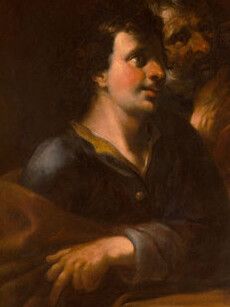
St. Silas

Silas was chosen by St. Paul as companion on his second missionary journey.

Read the essentials →
Feast July 13 · Apostle

St. Silas

Current feast

July 13 (also listed: January 26, February 10, July 30)
Secondary source · Wikipedia infobox

Traditional feast

July 13
1914 / pre-1969 calendar, per Baring-Gould (1897)

Represents

Apostle

Feast days

Feast: July 13

This Saint’s Story

Adapted in modern English from Baring-Gould (1897–98) · original text below · little is known

(The surviving account on this page begins partway through the story.)

He stayed behind at Beraea with Timothy while Paul went on to Athens, and rejoined him at Corinth, where his presence is mentioned several times.

He may be the Silvanus who carried St. Peter's first letter to Asia Minor; Baring-Gould thinks this likely. A slender tradition makes him bishop of Corinth. Pope Sergius gave his relics to the bishop of the Morini, and they were honoured at Therouanne until the emperor Charles V destroyed the town in 1553.
Short entry · the summary here is 176 words; Baring-Gould’s fuller original text and its sources are below. We have not filled any gap with invented detail.

What he represents

How he teaches us to live

Drawn from themes in the original account

Share your faith, in words and by example. Preaching and conversion are part of this story.

Celebrate this saint’s feast day. Remember him on July 13 with a short prayer, and ask for his help.

The full story

Baring-Gould’s account retold in modern English

Read the full story · 179 words · about 1 min

…for we find him chosen by Saint Paul as the companion of his second missionary journey. At Beraea, he was left behind with Saint Timothy, while Saint Paul went on to Athens, and we hear nothing more of his movements until he rejoined the Apostle at Corinth. His presence at Corinth is mentioned several times. Whether he was the Silvanus who delivered Saint Peter's First Epistle to Asia Minor is uncertain; however, the evidence suggests they may be the same person. A tradition, which has very little support, claims that Silas became the bishop of Corinth; it is not unlikely that he held this position. Some people have identified him with Terentius, who is mentioned by Saint Paul in his Epistle to the Romans. The relics of Saint Silas were given by Pope Sergius in 691 to Saint Bainus, the bishop of the Morini (a group of people in what is now northern France); they were highly honored at Therouanne, in the church of Saint Mary, until the town and church were destroyed by Emperor Charles V in 1553.

Footnotes

  1. The relics of Saint Silas were given by Pope Sergius in 691 to Saint Bainus, the bishop of the Morini.

Baring-Gould’s own footnotes, in modern English.

Read the original 1870s text

Baring-Gould’s sources: Ado, Usuardus, Notker, Roman Martyrology. By the Greeks, Silas is distinguished from Silvan us, and both are commemorated on the same day, July aoth; Silas as Bishop of Corinth, Silvanus as Bishop of Thessalonica. At Angers there is a proper office for S. Silas, so also at Bayeux and Beauvais. He is regarded as the patron of Epinay, in the diocese of Paris. Authority: — Mention in the Acts of the Apostles and the 143rd Ep. of S. Jerome.] N the Epistles of S. Paul, Silas, the companion of S. Paul, is called Silvanus. He appears first as one of the Elders of the Church at Jerusalem, 1 holding office as an inspired teacher. 2 His name, derived from the Latin word “ Silva,” a wood, betokens him a Hellenistic Jew, and he appears to have had the rights of a Roman citizen. 8 He was appointed as a delegate to accompany SS. Paul and Barnabas on their return to Antioch, with the decree of the Council of Jerusalem. 4 Having accomplished this mission, he returned to Jerusalem. 6 He must, however, have immediately re-visited Antioch, July «3J 31 Sara.

…for we find him selected by S. Paul as the companion of his second missionary journey. 1 At Beraea he was left behind with S. Timothy, whilst S. Paul proceeded to Athens, 2 and we hear nothing more of his movements until he rejoined the Apostle at Corinth. 3 His presence at Corinth is several times noticed. 4 Whether he was the Silvanus who conveyed S. Peter's First Epistle to Asia Minor, 5 is doubtful; the probabilities are in favour of the identity. A tradition, of very slender authority, represents Silas as having become bishop of Corinth; that he did occupy this position cannot be accounted as improbable. By some he has been identified with Terentius, mentioned by S. Paul in his Epistle to the Romans. 6 The relics [the bodily remains of a saint, or objects they used, kept with honor] of S. Silas were given by Pope Sergius, in 691, to S.. Bainus, bishop of the Morini; and they were held in high honour at Therouanne, in the church of S. Mary, till the destruction of that town and church by the Emperor Charles V., in 1553.

Help us add to this saint's story

Everything is read by a person before anything appears. Facts are checked against trusted sources first.

Facts are welcome; a source link helps (optional).With your permission we may share it on this page.

Nine days · Free

Pray the novena
with us.

One short email a day for nine days. The day's prayer, a line from St. Silas's story, and a nudge to keep going.

Also on July 13
St. Sara

St. Sara

July 13 · Virgin, Abbess
M

Sts. Maura and Bridget

July 13 · Virgins, Martyrs
E

St. Eugenius of Carthage

July 13 · Bishop
← All 1970 saints in the library
Sources & notes

Feast-day sources

Story sources

Sources

Credits

Image: Michael Václav Halbax - St Paul and Silas in Prison - O 2303 - National Gallery Prague (cropped).jpg · Unknown · Public domain, via Wikimedia Commons

Image: Unknown, Wikimedia Commons (Public domain)

Retold in plain modern English from Baring-Gould’s public-domain text, sentence by sentence, keeping the same facts and order. Short explanations in parentheses are ours.

From Sabine Baring-Gould, The Lives of the Saints, new edition in 16 vols. (London: John C. Nimmo, 1897–98); text from the Internet Archive scan (OCR, lightly cleaned; errors possible). Public domain in the United States. Reproduced unedited, except for short bracketed notes in grey that we added to explain names and terms (“S.” is the old abbreviation for Saint). Some history and judgments reflect 19th-century scholarship.