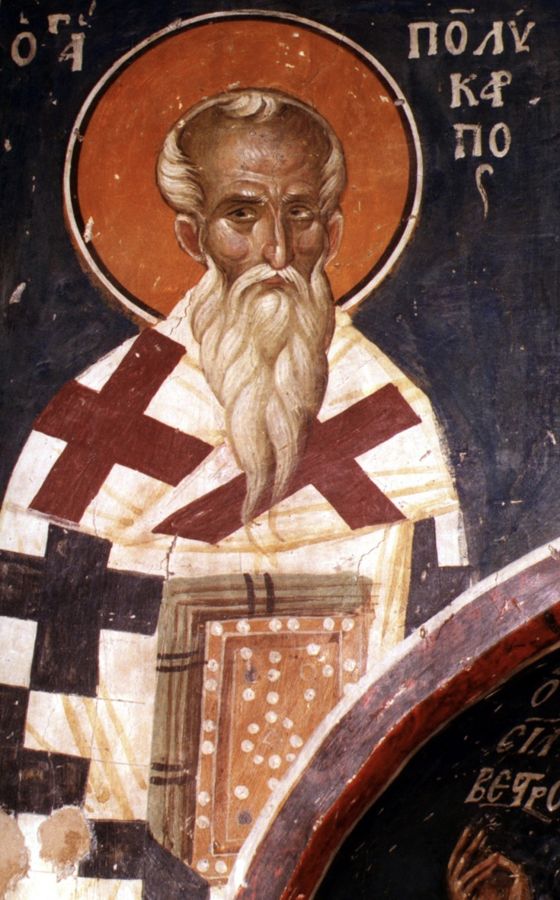
Saint Polycarp was converted to Christianity in the year 80 when he was quite young. He had the privilege of accompanying those who had seen Jesus Christ. Saint John, who was his special disciple, consecrated him as Bishop of Smyrna in the year 96. He is believed to be the Angel or Bishop of the Church of Smyrna, to whom alone, in the messages recorded in the Apocalypse (the Book of Revelation), Jesus Christ addressed praise without any blame.
"I know your works, and tribulation, and poverty, (but you are rich), and I know the blasphemy of those who say they are Jews and are not, but are the synagogue of Satan. Do not fear any of those things which you are about to suffer; behold, the devil will cast some of you into prison, that you may be tested; and you will have tribulation for ten days; be faithful unto death, and I will give you a crown of life."
In the year 158, Polycarp visited Rome. The exact reason for his visit is not clearly stated; however, he had a meeting with Pope Anicetus about when to celebrate the Paschal Feast. The debates on this topic were so intense in the second century that we might not need to look for another reason for Polycarp making such a long journey. The first day of the week, or Sunday, has been considered sacred since the very beginning of the Church because of our Lord's Resurrection. Eastern and western Christians agreed to observe a solemn fast for some time before the feast of the Resurrection.
However, there was one significant difference between them. The Christians in Asia celebrated a feast on the actual Passover, in addition to observing the major Easter festival. In contrast, the western Christians celebrated the Paschal feast on Easter Day. By separating the Passover feast from the feast of the Resurrection, the Eastern Christians created a burst of festivity that disrupted the solemnity of the great fast, which greatly offended the western sense of propriety. Both groups claimed apostolic authority for their customs. The eastern Christians argued that Saints John and Philip had approved their practice, while the Christians in Rome defended their tradition based on the authority of Saints Peter and Paul.
Given this situation, and with neither side willing to compromise, a meeting between an Asian Bishop and the Bishop of Rome seemed very necessary. Polycarp had personally known Saint John and had been appointed to his bishopric by him. Anicetus was, interestingly, the seventh Bishop of Rome since the start of the century, while Polycarp had been the bishop of Smyrna during that entire time. Saint Irenaeus, who recounts the meeting between Anicetus and Polycarp, notes that neither could persuade the other. However, the meeting was conducted and concluded in complete friendship. The two bishops were steadfast and committed to their respective customs, but the bond of peace between them remained intact. As a sign of their mutual goodwill, they shared the Eucharist together, with the Pope allowing Polycarp, out of respect for his age and character, to lead the celebration.
In the sixth year of the reign of Marcus Aurelius, an exhibition of games in Smyrna (a city in what is now Turkey) kept the city excited for several days. During this time, Christians were forced to fight wild beasts for the amusement of the crowd. Polycarp himself was advised to escape the danger, and he hid for a while not far from the city. However, his hiding place was revealed by a boy, who was threatened with torture unless he disclosed Polycarp's location. Herod, the magistrate responsible for maintaining order, sent horsemen at night to surround his lodgings.
Polycarp was upstairs in bed but refused to flee, saying, "God's will be done." He went downstairs, met the horsemen at the door, offered them a nice supper, and asked for some time to pray before going with them. This was granted, and he began his prayer standing, continuing for two hours. He prayed earnestly for his flock and the entire Church, with such devotion that some of those who had come to arrest him regretted their mission. They placed him on a donkey and were taking him toward the city when they encountered Herod and his father, Nicetes, on the road. They took him into their chariot and tried to persuade him to comply, saying, "What harm is there in sacrificing to escape death?"
At first, the bishop remained silent, following the example of our Savior. But when pressed, he firmly replied, "I shall never do what you desire of me." Upon hearing this, they violently threw him out of the chariot, causing his leg to bruise from the fall. The holy man continued on cheerfully to the place where the people had gathered. As he entered, a voice from heaven was heard by many, saying, "Polycarp, be courageous, and play the man." He was brought directly to the tribunal of the pro-consul, who urged him to respect his age, to swear by the genius (spirit) of the Emperor, and to blaspheme Christ. Polycarp responded, "I have served Him for eighty-six years, and He has never done me any harm, but much good. How can I then blaspheme my King and my Savior? If you want me to swear by the genius of Caesar, as you call it, hear my free confession: I am a Christian. But if you want to learn about the Christian faith, set a time and hear me."
The pro-consul then, adopting a severe tone, said, "I have wild beasts." "Call for them," replied the Saint, "for we are firmly resolved not to change from good to evil. It is only good to pass from evil to good." The pro-consul said, "If you despise the beasts, I will have you burnt to ashes." Polycarp answered, "You threaten me with a fire that burns for a short time and then goes out; but you are ignorant of the judgment to come and of the fire prepared for the wicked. Why do you delay? Bring against me whatever you wish." As he said this, his face shone with a certain heavenly grace, so much so that the pro-consul was struck with admiration. However, he ordered a crier to make a public proclamation three times, "Polycarp has confessed himself a Christian." At this proclamation, the entire crowd of Jews and Gentiles shouted loudly. They unanimously demanded that he should be burnt alive. As soon as their request was granted, everyone rushed to fetch wood from the baths and shops. The Jews were particularly active and busy on this occasion.
Once the pile was prepared, Polycarp removed his garments, untied his girdle, and began to take off his shoes. The wood and other combustibles were heaped around him. The executioners wanted to tie him to the stake, but he said to them, "Let me stand as I am. He who gives me the grace to endure this fire will enable me to stand still without that precaution." They then contented themselves with tying his hands behind his back, and in this position, looking up towards heaven, he prayed as follows: "O Almighty Lord God, Father of Your beloved and blessed Son Jesus Christ, by whom we have received the knowledge of You, God of angels, powers, and every creature, and of all the race of the just who live in Your presence! I bless You for having been pleased in Your goodness to bring me to this hour, that I may receive a portion among Your martyrs and partake of the chalice of Your Christ, for the resurrection to eternal life, in the incorruptibility of the Holy Spirit. Grant me to be received this day as a pleasing sacrifice, such as You Yourself have prepared, so that You may accomplish what You, O true and faithful God, have foreshown. Therefore, for all things, I praise, bless, and glorify You, through the eternal high priest Jesus Christ, Your beloved Son, with whom, to You, and the Holy Spirit, be glory now and forever. Amen."
He had hardly said Amen when fire was set to the pile, and it grew into a mighty flame. "But behold a wonder seen by us," say the authors of these Acts. "The flames formed an arch, like the sails of a ship filled with wind, gently encircling the body of the martyr, which stood in the middle, like purified gold or silver, appearing bright through the flames; and his body emitted such a fragrance that we seemed to smell precious spices." The heathens were angered to see that his body could not be consumed, and they ordered a spearman to pierce him through, which he did, and such a quantity of blood flowed from his left side that it quenched the fire. The malice of the devil did not end there; he tried to prevent the relics of the martyr from being taken by the Christians, as many wished to do so to show their respect for his body. Therefore, at the suggestion of Satan, Nicetes advised the pro-consul not to give it to the Christians, lest, he said, abandoning the crucified man, they should worship Polycarp. The Jews suggested this, "Not knowing," say the authors of these Acts, "that we can never forsake Christ, nor worship any other, even though we love the martyrs as His disciples and imitators for the great love they bore their King and Master." The centurion then threw the body into the fire and burnt it to ashes. "We afterwards took up the bones," say the writers of the Acts, "more precious than the richest jewels or gold, and buried them decently in a place where, may God grant us to gather with joy, to celebrate the birthday of the martyr."
His tomb is still shown near Smyrna.
Footnotes
- "the synagogue of Satan" refers to a group opposing the early Christians.
- Saint Irenaeus, who recounts the meeting between Anicetus and Polycarp, notes that neither could persuade the other.
- The authors of these Acts refer to those who documented Polycarp's martyrdom.
- Nicetes was likely a local leader or official involved in the events.
Baring-Gould’s own footnotes, in modern English.
Read the original 1870s text
Baring-Gould’s sources: Roman Martyrology. Authorities: His Acts, written by the Church of Smyrna immediately after his martyrdom, Eusebius, &c.
Saint Polycarp was converted to Christianity in the year 80, when quite young, and he had the privilege of accompanying those who had seen Jesus Christ. S. John, whose special disciple he was, consecrated him Bishop of Smyrna in the year 96. He is supposed to be the Angel or Bishop of the Church of Smyrna, to whom alone, in the messages recorded in the Apocalypse, did Jesus Christ address praise unmixed with blame. [124] "I know thy works, and tribulation, and poverty, (but thou art rich), and I know the blasphemy of them which say they are Jews, and are not, but are the synagogue of Satan. Fear none of those things which thou shalt suffer; behold, the devil shall cast some of you into prison, that ye may be tried; and ye shall have tribulation ten days; be thou faithful unto death, and I will give thee a crown of life."
In the year 158, S. Polycarp visited Rome. The cause of his visit is not exactly declared; but he had a conference with Pope Anicetus concerning the time of celebrating the Paschal Feast; and the disputes upon this subject were carried on so warmly, in the second century, that perhaps we are to seek no other reason for Polycarp undertaking so long a journey. The first day of the week, or Sunday, appears to have been held sacred, on account of our Lord's Resurrection, from the very beginning of the Church. The eastern and western Christians agreed in keeping a solemn fast for some time preceding the feast of the Resurrection. There was, however, one important difference between them. The Asiatic Christians kept a feast on the true Passover, as well as observing the great Easter festival. The western Christians kept the Paschal feast on Easter Day. By separating the Passover feast from the feast of the Resurrection, the Easterns had a burst of festivity interrupting discordantly the hush of the great fast, which caused great offence to the western sense of propriety. Both parties laid claims to apostolic authority for their respective customs. The eastern Christians asserted that SS. John and Philip had sanctioned their custom; while the brethren at Rome defended themselves by the authority of SS. Peter and Paul. This being the case, and neither of the parties being willing to concede, a conference between an Asiatic Bishop and the Bishop of Rome seemed a very desirable measure. Polycarp had been personally known to S. John, and had been appointed by him to his bishopric. Anicetus was, singularly enough, the seventh Bishop of Rome since the beginning of the century, but Polycarp had occupied the see of Smyrna [a bishop’s “see” is his diocese, named from his seat (Latin sedes)] during the whole of that time. S. Irenæus, who relates the conference between Anicetus and Polycarp, states that neither could convince the other. The meeting was, however, conducted and terminated in perfect amity. The two bishops were firm, and wedded to their respective customs; but the bond of peace was not broken between them; and as proof of their mutual goodwill, they received together the supersubstantial food, the Pope allowing Polycarp, out of respect for his age and character, to celebrate.
In the sixth year of the reign of Marcus Aurelius, an exhibition of games in Smyrna kept the city in excitement for some days, and the Christians were made to fight with wild beasts for the amusement of the populace. Polycarp himself was advised to withdraw from the storm, and he concealed himself for some time at a short distance from the city. His retreat was betrayed by a boy, who was threatened with the rack unless he discovered him. Herod, the magistrate, whose office it was to prevent misdemeanours, sent horsemen by night to beset his lodgings. The Saint was above stairs in bed, but refused to make his escape, saying, "God's will be done." He went down, met them at the door, ordered them a handsome supper, and desired only some time for prayer before he went with them. This granted, he began his prayer standing, and continued it in that posture for two hours, recommending to God his own flock and the whole Church, with so much earnestness and devotion, that several of those that were come to seize him, repented having undertaken the commission. They set him on an ass, and were conducting him towards the city, when he was met on the road by Herod and his father, Nicetes, who took him into their chariot, and endeavoured to persuade him to a little compliance, saying, "What harm is there in sacrificing, to escape death?" The bishop at first was silent, in imitation of our Saviour: but being pressed, he gave them this resolute answer, "I shall never do what you desire of me." At these words, they thrust him out of the chariot with such violence, that his leg was bruised by the fall. The holy man went forward cheerfully to the place where the people were assembled. Upon his entering it, a voice from heaven was heard by many: "Polycarp, be courageous, and play the man." He was led directly to the tribunal of the pro-consul, who exhorted him to respect his own age, to swear by the genius of the Emperor, and blaspheme Christ. Polycarp replied, "I have served Him these fourscore and six years, and He never did me any harm, but much good. How can I then blaspheme my King and my Saviour? If you require of me to swear by the genius of Cæsar, as you call it, hear my free confession; I am a Christian: but if you desire to learn the Christian religion, appoint a time, and hear me."
The pro-consul then, assuming a tone of severity, said, "I have wild beasts." "Call for them," replied the Saint: "for we are unalterably resolved not to change from good to evil. It is only good to pass from evil to good." The pro-consul said, "If you despise the beasts, I will cause you to be burnt to ashes." Polycarp answered, "You threaten me with a fire which burns for a short time, and then goes out; but are, yourself, ignorant of the judgment to come, and of the fire prepared for the wicked. Why do you delay? Bring against me what you please." Whilst he said this his countenance shone with a certain heavenly grace, insomuch that the pro-consul was struck with admiration. However, he ordered a crier to make public proclamation three times, "Polycarp has confessed himself a Christian." At this proclamation the whole multitude of Jews and Gentiles gave a great shout. They unanimously demanded that he should be burnt alive. Their request was no sooner granted than every one ran, with all speed, to fetch wood from the baths and shops. The Jews were particularly active and busy on this occasion. The pile being prepared, Polycarp put off his garments, untied his girdle, and began to take off his shoes. The wood and other combustibles were heaped around him. The executioners would have attached him to the stake; but he said to them, "Suffer me to be as I am. He who gives me grace to endure this fire, will enable me to stand still without that precaution." They, therefore, contented themselves with tying his hands behind his back, and in this posture, looking up towards heaven, he prayed as follows: "O Almighty Lord God, Father of Thy beloved and blessed Son Jesus Christ, by whom we have received the knowledge of Thee, God of angels, powers, and every creature, and of all the race of the just that live in Thy presence! I bless Thee for having been pleased in Thy goodness to bring me to this hour, that I may receive a portion in the number of Thy martyrs, and partake of the chalice of Thy Christ, for the resurrection to eternal life, in the incorruptibleness of the Holy Spirit. Grant me to be received this day as a pleasing sacrifice, such an one as thou Thyself hast prepared, that so Thou mayest accomplish what Thou, O true and faithful God! hast foreshown. Wherefore, for all things I praise, bless, and glorify Thee, through the eternal high priest Jesus Christ, Thy beloved Son, with whom, to Thee, and the Holy Ghost, be glory now and for ever. Amen." He had scarce said Amen, when fire was set to the pile, and increased to a mighty flame. "But behold a wonder seen by us," say the authors of these Acts. "The flames forming themselves into an arch, like the sails of a ship swelled with the wind, gently encircled the body of the martyr; which stood in the middle, like purified gold or silver, appearing bright through the flames; and his body sending forth such a fragrance, that we seemed to smell precious spices." The heathen were exasperated to see that his body could not be consumed, and ordered a spearman to pierce him through, which he did, and such a quantity of blood issued out of his left side as to quench the fire. The malice of the devil ended not here: he endeavoured to obstruct the relics [the bodily remains of a saint, or objects they used, kept with honor] of the martyr being carried off by the Christians; for many desired to do it, to show their respect to his body. Therefore, by the suggestion of Satan, Nicetes advised the pro-consul not to bestow it on the Christians, lest, said he, abandoning the crucified man, they should adore Polycarp: the Jews suggested this, "Not knowing," say the authors of these Acts, "that we can never forsake Christ, nor adore any other, though we love the martyrs, as his disciples and imitators, for the great love they bore their King and Master." The centurion then cast the body into the midst of the fire, and burnt it to ashes. "We afterwards took up the bones," say the writers of the Acts, "more precious than the richest jewels or gold, and deposited them decently in a place at which, may God grant us to assemble with joy, to celebrate the birthday of the martyr."
His tomb is still shown near Smyrna.