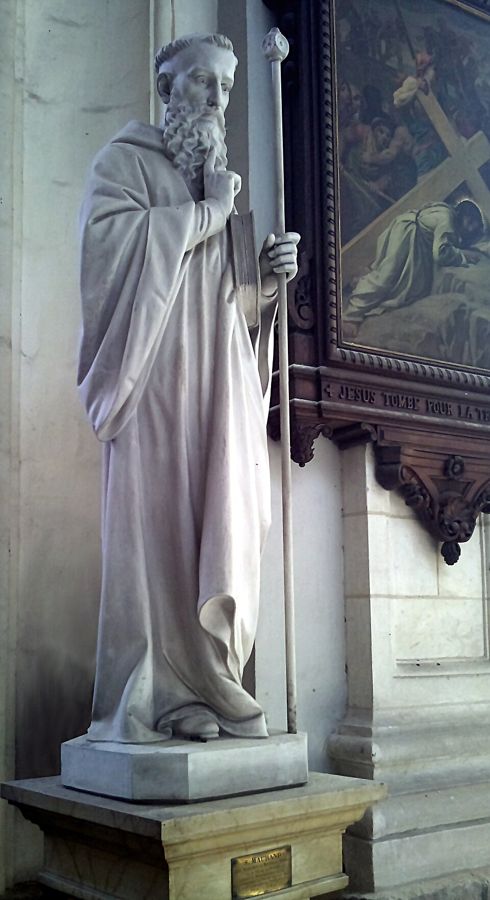
St. Pius, Pope

Michele Ghislieri, later Pope Pius V, was born at Bosco near Alessandria in Lombardy on 17 January 1504.

Read the essentials →
Feast April 30 · Virgin

St. Pius, Pope

Current feast

April 30
Verified · General Roman Calendar

Traditional feast

May 5
1914 / pre-1969 calendar, per Baring-Gould (1897)

Represents

Virgin

Feast days

Feast: April 30
Traditional: May 5

This Saint’s Story

The Catholic Encyclopedia describes a poor though noble family; Baring-Gould likewise stresses his humble extraction. Taken in by the Dominicans (the Order of Preachers founded by St. Dominic) of Voghera, he entered the Order of Preachers, was ordained in 1528, and for many years taught theology and philosophy, served as master of novices, and was elected prior of several houses. He travelled on foot, fasted, and kept long watches of prayer.

In 1556 Paul IV made him Bishop of Sutri. He was soon created cardinal and named inquisitor general. In 1559 he was transferred to Mondovi, where he worked to restore discipline after the Piedmontese wars. He opposed Pius IV's plan to admit the thirteen-year-old Ferdinand de' Medici to the Sacred College, and he resisted Emperor Maximilian II's project to abolish clerical celibacy. On Pius IV's death he was elected pope on 7 January 1566, despite his own tears and entreaties.

As pope he lived with monastic austerity, gave large alms, visited hospitals, and laboured with Charles Borromeo for clerical reform. He enforced the discipline of the Council of Trent (1545–1563, the Catholic Church's council answering the Protestant Reformation), and the Encyclopedia records his issue of the reformed Breviary (the book of the Church's daily prayer) and related liturgical work that shaped Roman practice for centuries. In 1570 he excommunicated Elizabeth I of England. He also sought to unite Christian princes against Ottoman (the Turkish empire) power. After the victory of Lepanto on 7 October 1571, tradition holds that he knew of the triumph before messengers arrived; in thanksgiving he instituted a feast of the Rosary and added "Help of Christians" to the Litany of Loreto.

He died of gravel on 1 May 1572, repeating a prayer for patience in suffering. Baring-Gould's feast date of 5 May marks the liturgical memorial rather than the day of death. Clement X beatified (declared 'Blessed', the step before sainthood) him in 1672; Clement XI canonized (officially declared a saint by the pope) him in 1712.

What she represents

How she teaches us to live

Drawn from themes in the original account

Pray a little every day. Prayer is part of this story.

Give to people in need. The account records care for the poor.

The full story

Baring-Gould’s account retold in modern English

Read the full story · 3,313 words · about 14 min

Having been appointed as the commissary of the Inquisition in Rome, he was soon recognized by Paul IV, who declared Fra Michele to be an eminent servant of God and deserving of higher honors. He promoted him to the bishopric of Nepi, and, to ensure that he would not return to the comfort of his cloister, as Michele himself tells us, “that he might not creep back again to the repose of his cloister," in 1577 he nominated him as cardinal. In this new position, Ghisliere remained, as always, poor, austere, and unpretentious. He instructed his household to imagine they were living in a monastery; for himself, his only interest was still focused on devotional exercises and the work of the Inquisition. Pope Paul IV died in 1559 and was succeeded by Pius IV, who transferred Cardinal Ghisliere to the bishopric of Mondovi, in Piedmont, a church that had been reduced to a deplorable condition by the wars. The saint quickly went to his new flock; and through his zeal and energy, he restored peace, reformed abuses, and repaired the physical damage caused by war, as much as he could. His strong sense of right and wrong led him to oppose the appointment of Ferdinand of Medicis, a boy of only thirteen years, to the position of cardinal by Pius IV.

After the death of that pope on December 9, 1565, and at the urging of Saint Charles Borromeo, Michele Ghisliere was elected to fill the vacant position of Saint Peter. He maintained all the monastic strictness of his life even when he became pope; his fasts were observed with the same rigor and punctuality; he allowed himself no clothing of finer material than he was used to. However, he was careful that his private devotions did not interfere with his public duties, and although he rose with the first light of day, he would not allow himself the customary afternoon nap. Yet, the responsibilities and work of the papacy were a burden to him. He complained that they hindered the progress of his soul towards salvation and the joys of paradise. “But for the support of prayer, the weight of this burden would be more than I could endure.”

The intensity of his devotion often brought tears to his eyes, and he frequently rose from his knees with the confidence that his prayers had been answered. When the people saw him in processions, barefoot and with his head uncovered, his face shining with piety and his long white beard brushing against his chest, they were filled with enthusiastic reverence; they believed that such a pious pope had never existed before, and stories circulated among them about how he had converted Protestants simply by the sight of his face. Pius was also kind and friendly; his demeanor towards his old servants was very warm. Humble, resigned, and child-like as he was.

was, yet his character had a narrow, harsh, and almost forbidding side. He was a complete contrast to another great pope honored in the same month of May, Gregory VII. Their minds were shaped in entirely different ways. Gregory was a man of great intellectual power and commanding authority. Pius was narrow-minded, and it was his virtues, not his intellectual superiority, that gave him influence. Yet both were driven by the same principle; each was as rigid in following the path marked out by their conscience. Pius V could not tolerate contradiction and was impatient with views that did not align with his own. He did not allow himself to act on his first impressions regarding individuals and those he encountered, but once he formed an opinion about a person, whether positive or negative, nothing could change his mind.

He would never lessen a penal sentence; this was something that was frequently noted about him. Instead, he would express his disapproval of any leniency in a punishment that had been decided. However, he never took offense at wrongs done to himself personally. A young man had caricatured him and was caught and brought before him. “Go,” said the pope, “and consider yourself fortunate. Had you ridiculed the pope instead of Michele Ghislieri, you would have faced a different outcome.” His predecessor, Pius IV, had not fully supported the Inquisition. Soranzo remarked about that pope, “It is well known that he dislikes the great severity with which the Inquisitors handle those accused. He makes it known that it would please him more if they were to proceed with gentleness rather than harshness.” The situation was the opposite with Pius V. If there was any town where few punishments were imposed, he attributed that solely to a lack of proper enforcement.

to the negligence of the officials. He was not satisfied to see the Inquisition addressing offenses that were recent. Instead, he caused it to investigate offenses that were ten or twenty years old. The strictness with which he insisted on maintaining Church discipline is notable. “We forbid,” he states in one of his official documents, “that any physician, attending a patient confined to his bed, should visit him longer than three days without receiving a certificate that the sick man has confessed his sins anew.” A second document outlines the punishments for breaking the Sabbath and for blasphemy. There were fines for the wealthy; however, “for the common man, who cannot pay, he shall stand before the church door for one whole day with his hands tied behind his back for the first offense; for the second, he shall be whipped through the city; but for the third, his tongue shall be bored through, and he shall be sent to the galleys.” While this harshness might have been counterproductive, there is no doubt about the earnestness and religious zeal of the man who enforced it. He did not understand that people cannot be made Christians and virtuous through force, but it was his love for Christianity and virtue that drove him to try. He expelled all the courtesans from Rome, and when he was confronted about it, he replied, “If they return, I leave the city.”

The bull “In Coena Domini” had often been criticized by the princes of Europe, and Pius IV had openly stated that the policies of his predecessors had caused several nations to leave the Church. However, Pius V reissued the controversial bull and even made it more burdensome by adding his own special clauses. Even Philip of Spain, who was usually very devout, once felt compelled to warn the pope to be careful not to drive princes to desperation. Pius V took this rebuke to heart. He sometimes felt very unhappy in his high position and declared himself “weary of living.” He complained that by acting without regard for individuals, he had made enemies, and that he had never been free from troubles and persecutions since he had taken the papal throne.

Although Pius V could not satisfy the entire world any more than other men could, it is clear that his honest character and sincere intentions had an immense influence on his contemporaries, which benefited the Church as a whole. The long-promised reform of the papal court finally began in earnest. The expenses of the papal household were significantly reduced. Pius V needed very little for himself and often said that “he who would govern others must begin by ruling himself.” He took good care of those servants who had served him faithfully, but he kept his other dependents under stricter control than had ever been seen under any other pope. He made his nephew, Bonelli, a cardinal only because he was advised that this would help him maintain a more confidential relationship with the secular rulers. However, he granted Bonelli only a modest income, and when the new cardinal once invited his father to Rome, Pius ordered him to leave the city immediately. He would never elevate the rest of his relatives above a middle-class status, and anyone among them whom he caught in wrongdoing was expelled from his presence without mercy. He worked diligently to eliminate abuses. He instructed his auditor-general to take action against any bishops and archbishops who failed to reside in their dioceses and to report the disobedient to him for immediate removal. He ordered both monks and nuns to remain in strict seclusion. The religious Orders complained that he imposed rules on them that were more severe than those they had originally agreed to. Not satisfied with urging all magistrates to pay close attention to their responsibilities, he held a public session with the cardinals on the last Wednesday of every month, during which anyone who felt wronged by the regular courts could appeal to him.

He visited the hospitals in Rome and generously contributed to their support. One of his kindest and most beneficial charities was a yearly dowry he provided for a certain number of poor girls. During a time of great famine, he imported grain at his own expense from Sicily and France. He sold part of this grain at a low price and distributed the rest freely to the poorest people.

Seeing that the poor suffered greatly from having to borrow money from the Jews at exorbitant interest rates, which led them into debt they could not escape, he encouraged the savings banks established by Paul III in 1559. His troops patrolled the countryside and suppressed the banditry that had become almost as widespread and accepted as it is in the Abruzzi region today. However, the leader of the bandits, Mariana d’Ascoli, managed to evade capture.

A peasant offered to deliver him to the pope, saying, “He is close to me, and I can take advantage of the trust he places in me to betray him.” The pontiff exclaimed, “Never, never, so help me God! Trust and friendship must forever be held sacred.” When Mariana learned that the pope had refused to take advantage of this situation, he left the papal states and never returned.

The pope gained significant power in all the Catholic kingdoms and states, which he used tirelessly to unite their rulers against the spread of Protestantism. The unfortunate jealousy between France and Spain primarily facilitated the spread of heresy in Germany, France, and the Low Countries. The rivalry between Charles V and Francis I occupied the attention and resources of these great sovereigns, diverting their efforts from suppressing the religious revolt. Pius V worked tirelessly to remedy, as much as possible, the disastrous consequences of this policy.

France, embroiled in civil wars, had either renounced its previous hostility toward Spain or was unable to act on it. Philip II of Spain was devoted to the pope and enforced his papal bulls. The Inquisition in Spain was allowed to carry out its judgments with extreme severity, even targeting the archbishop of Toledo, who was executed. One auto-da-fé (a public ceremony of penance) followed another until every trace of heresy was eradicated. Duke Cosimo of Florence willingly surrendered to the pope anyone condemned by the Inquisition, and even Casmesecchi, who was connected to the ruling house, perished in the flames. Cosimo was completely devoted to the pope; he assisted him in all his endeavors and did not hesitate to acknowledge all his spiritual claims. Pius was moved by this loyalty and rewarded Cosimo's ambition by crowning him grand duke of Tuscany.

Not entirely friendly were the terms on which the pope interacted with the Venetians. He still made great efforts to avoid a break with them. He declared that “the republic” was “firmly seated in the faith, and has always maintained herself as most Catholic; she alone has been exempt from the incursions of barbarians; the honors of Italy rest upon her.” The Venetians also granted him more than they had ever given to any other pope. They handed over the unfortunate Guido Zanetti of Fario, whose religious beliefs had come under suspicion, a move never before recorded in their history. The clergy in their city was brought into strict discipline. The churches of Verona became examples of order. Milan, under the leadership of Saint Charles Borromeo, was widely recognized for its piety and organization.

In England, there had been a significant uprising of Catholics in the north, which was suppressed and punished with brutal cruelty. Mary, Queen of Scots, had placed herself in the hands of Elizabeth, who, driven by jealousy, treated her as a prisoner. Pius V believed he needed to intervene. He hoped that by openly exercising his authority, he could unite France and Spain in a crusade against England. On February 28, 1570, he suddenly issued a bull, so there would be no objections, declaring Elizabeth to be cut off, as a minister of iniquity, from the communion of the faithful. He released her subjects from their loyalty to her and forbade them, under the threat of incurring the same sentence as her, to recognize her as their sovereign any longer. At the same time, unaware of the complete failure of the uprising in England, he wrote a letter of encouragement to the Earls of Westmoreland and Northumberland, who were leading it.

However, Pius V foresaw and prevented a danger that threatened all of Eastern and Southern Europe. The Ottoman Empire was making rapid advances. Its dominance was established in the Mediterranean, and its various attempts, first on Malta and then on Cyprus, made it clear that it was determined to conquer the still unconquered islands. Italy itself was threatened from Hungary and Greece. After much effort, Pius succeeded in awakening the Catholic rulers to the reality of the imminent danger. The idea of a coalition among these princes was suggested to the pope by the attack on Cyprus; he proposed this to Venice on one side and to Spain on the other. “When I received permission to negotiate with him on that subject,” said the Venetian ambassador, “and communicated my instructions to that effect, he raised his hands to heaven, offering thanks to God, and promising that every thought and all the strength he could muster would be devoted to that purpose.”

The pontiff faced countless troubles and challenges before he could overcome the obstacles blocking the union of the two maritime powers. He managed to involve the other States of Italy in this effort. Although he initially had no money, ships, or weapons, he still found ways to strengthen the fleet with a few papal galleys. He also played a role in selecting Don John of Austria as the general and appointed Antony Colonna as the admiral. To prevent the jealousy and conflicts that could arise among the princes joining the campaign, the pope was declared the leader of the league and the expedition. Along with his apostolic blessing, the pope sent the general a promise of victory and instructed him to dismiss any soldiers who appeared to have joined the expedition solely for the sake of looting, as well as any scandalous individuals whose sins could bring God's wrath upon them and jeopardize their chances of success.

The Christians sailed from Corfu and found the Turkish fleet anchored in the harbor of Lepanto. Six hundred warships faced each other on October 7, 1571. Rarely in history had such a magnificent scene of military display been witnessed. The October sun illuminated the many beauties of an Ionian landscape. Athens and Corinth were behind the combatants; the mountains of Alexander's Macedon rose in the distance, and the heights of Actium were in front of them. Since the day when the world had been lost and won beneath that famous promontory, no such battle as the one now approaching had been fought on the waves. Don John of Austria sent energetic messages to his fellow captains. Colonna responded to his leader in the words of Saint Peter, “Though I die, yet will I not deny thee." With a crucifix in hand, the High Admiral rowed from ship to ship, encouraging generals and soldiers to prove themselves worthy of such a holy cause. Don John knelt on his deck and offered a prayer. He then ordered the trumpets to sound the assault and commanded his sailing-master to position him alongside the Turkish Admiral, and the battle began. The Venetians, who were the first to be attacked, destroyed ship after ship of their assailants after a close and stubborn fight. But the action quickly became widespread. From noon until evening, it raged, with a level of carnage rarely recorded in history. By sunset, the battle had been won. Of nearly three hundred Turkish galleys, only fifty managed to escape. Between twenty-five and thirty thousand Turks were killed, and perhaps ten thousand Christians. The meager result of the contest is as notorious as the victory itself. While Constantinople, almost undefended, was trembling with fear, the rival generals were already arguing with hostility. If the Christian fleet had advanced, the capital would have surrendered without a fight, and the power of the Crescent in Europe would have ended forever. However, the mutual jealousies of the commanders prevented them from taking this final step, and Don John sailed westward with his ships. Nevertheless, a significant blow had been dealt that crippled Turkish power, and from that moment, its advances in Europe and its dominance in the Mediterranean were over. The pope, from the beginning of the expedition, had ordered public prayers and fasts and had not ceased to plead with heaven, like Moses on the mountain, with outstretched hands, for victory for the Christian forces. At the time of the engagement, a Rosary procession was pouring forth prayers for the army in the church of the Minerva. The pope was then discussing business with some cardinals when suddenly, he left them abruptly, threw open a window, stood for some time with his eyes fixed on heaven, and then turned to the astonished cardinals and said, “No more business, let us give thanks to God for the great victory He has granted to the arms of the Christians.” This event was carefully recorded both at the time and later in the process of canonization of the saint. In memory of this glorious victory, the pope established the Festival of the Rosary to be observed on the first Sunday in October and ordered the words “Succour of Christians” to be added to the Litany of Our Lady. His next plan was to form a league against England. He promised that he would spend the entire treasure of the Church, including the chalices and crosses, on an expedition against that country; he even declared that he would personally lead the effort. The main topic of his last words was the league, and the last coins sent from his hand were intended for this purpose. But death was approaching, and it was left to a successor to see the attempt made and fail. When he sensed that death was near, he once more visited the seven Basilican churches, “in order,” as he said, “to take leave of the holy places.” He kissed the lowest steps of the Scala Santa three times. Then he returned to die in the Vatican on May 1, 1572, at the age of sixty-eight, having governed the Church for six years and almost four months.

His relics lie in the church of Santa Maria Maggiore (St. Mary Major) in Rome.

Evodius, Bishop and Martyr of Antioch, died around A.D. 66.

Saint John is commemorated before the Latin Gate in Rome, having died in A.D. 95 (see December 27th).

Saint Lucius of Cyrene was a Bishop in the 1st century.

Saint Justus, Bishop and Martyr of Vienne in Gaul (modern-day France), died in A.D. 178.

Saint Eadbert was the Bishop of Lindisfarne and died in A.D. 698.

Saint John Damascene was a Monk and Confessor in Palestine, who lived around A.D. 770.

Blessed Elizabeth of Hungary was a Virgin who died in Toss, Switzerland, in A.D. 1338.

Footnotes

  1. Saint Charles Borromeo was a prominent figure in the Catholic Reformation.
  2. Informatione di Pio V.—“It is more difficult to free him from a bad impression than a good one; especially with regard to people of whom he knows but little.”
  3. When he sent forces to aid the French Catholics, he instructed their leader, Count Santafiore, to "take no Huguenot prisoners, but instantly kill everyone that should fall into his hands.” And Catena says, "He complained of the Count for not having obeyed his command.”
  4. Supragregem Dominicum: Bull iv. ii., p. 218.
  5. Pius V was a pope from 1566 to 1572.
  6. Bonelli refers to his nephew, who became Cardinal Bonelli.
  7. The Inquisition was allowed in Spain to execute its judgment with extreme rigor.
  8. One auto-da-fé followed another, till every germ of heresy was extirpated.
  9. The republic was declared to be firmly seated in the faith.
  10. The unfortunate Guido Zanetti of Fario was handed over, a move never before recorded.
  11. Milan was widely recognized for its piety and organization under Saint Charles Borromeo.
  12. The uprising of Catholics in the north was suppressed with brutal cruelty.
  13. Pius V issued a bull declaring Elizabeth cut off from the communion of the faithful.
  14. The Ottoman Empire was making rapid advances, threatening Italy from Hungary and Greece.
  15. Colonna responded to his leader in the words of Saint Peter, “Though I die, yet will I not deny thee."
  16. The pope established the Festival of the Rosary to be observed on the first Sunday in October.
  17. He promised that he would spend the entire treasure of the Church, including the chalices and crosses, on an expedition against that country.
  18. He kissed the lowest steps of the Scala Santa three times.
  19. Evodius, Bishop and Martyr of Antioch, died around A.D. 66.
  20. Saint John is commemorated before the Latin Gate in Rome, having died in A.D. 95 (see December 27th).
  21. Saint Justus, Bishop and Martyr of Vienne in Gaul, died in A.D. 178.
  22. Saint Eadbert was the Bishop of Lindisfarne and died in A.D. 698.
  23. Saint John Damascene was a Monk and Confessor in Palestine, who lived around A.D. 770.
  24. Blessed Elizabeth of Hungary was a Virgin who died in Toss, Switzerland, in A.D. 1338.

Baring-Gould’s own footnotes, in modern English.

Read the original 1870s text

Baring-Gould’s sources: Roman Martyrology, beatified by Clement X. in 1672; canonized by Clement XI., in 1712. Authorities: — A life by Jerome Catena, in Italian; another in Latin by Antonio Gabutio.] Michele Ghislieri, afterwards Pius V., was of humble extraction; he was born at Bosco, near Alexandria, in 1504, and entered a convent of Dominicans at the age of fourteen. Here he resigned himself, body and spirit, to the devotion and monastic poverty enjoined by his order. Of the alms he gathered, he did not retain so much for himself as would have bought him a cloak for the winter. Though confessor to the governor of Milan, he always travelled on foot with his wallet on his back. When he taught, his instructions were given with zeal and precision; when, as prior, it was his office to administer the affairs of a monastery, he did this with the utmost rigour and frugality. More than one house was freed from debt by his careful management. The formation of his character was effected during those years when the strife between Protestant innovation and the ancient doctrine of the Church had extended into Italy. He was early invested with the office of Inquisitor, and was called on to perform his duties in places of peculiar danger, as Como and Bergamo. In these cities an intercourse with the Swiss and Germans was not to be avoided; he was also appointed to the Valteline, which, as belonging to the Grisons, was in like manner infested by heretics. In this employment he displayed resolution and enthusiasm. On entering the city of Como, he was sometimes received with volleys of stones; to save his life he was frequently compelled to steal away like an outlaw, and conceal himself by night in the huts of the peasantry • but, he suffered no personal danger to deter him from his purposes. On one occasion the Count della Trinita threatened to have him thrown into a well. “ As to that, it shall be as God pleases,” was the Dominican's reply. Moreover, he took eager part in the contest of intellectual and political powers then existing in Italy; and as the side to which he attached himself was victorious, he advanced in importance.

Having been appointed commissary of the Inquisition in Rome, he was soon marked by Paul IV., who declared Fra Michele an eminent servant of God, and worthy of higher honours. He promoted him to the bishopric of Nepi, and, by way of placing “a chain round his foot," as Michele himself tells us, “ that he might not creep back again to the repose of his cloister," in 1577 he nominated him cardinal. In this new dignity Ghislieri continued, as ever, poor, austere, and unpretending. He told his household that they must fancy themselves living in a monastery; for himself, his sole interest was still centred in devotional exercises and the business of the Inquisition. Pope Paul IV. died in 1559, and was succeeded by Pius IV., who translated Cardinal Ghislieri to the bishopric of Mondovi, in Piedmont,

a church reduced by the wars to a deplorable condition. The saint hastened to his new flock; and by his zeal and energy re-established peace, reformed abuses, and repaired the material devastations of war, so far as lay in his power. His strict sense of what was right made him oppose the appointment of Ferdinand of Medicis, a boy of only thirteen years, to the dignity of cardinal, by Pius IV. On the death of that pope, December 9th, 1565, at the instigation of S. Charles Borromeo, Michele Ghislieri was elected to fill the vacant chair of S. Peter. He maintained all the monastic severity of his life even when pope; his fasts were kept with the same rigour and punctuality; he permitted himself no garment of finer texture than his wont. Yet he was careful that his private devotions should offer no impediment to his public duties, and, though rising with the first light of day, he would not indulge himself with the customary afternoon nap. But the cares and business of the papacy were a grievance to him. He complained that they impeded the progress of his soul towards salvation and the joys of paradise. “ But for the support of prayer, the weight of this burden would be more than I could endure.”

The warmth of his devotion often brought tears to his eyes, and he constantly arose from his knees with the assurance that his prayers had received fulfilment. When the people beheld him in processions, barefoot, and with uncovered head, his face beaming with piety, and his long white beard sweeping his breast, they were excited to enthusiastic reverence; they believed that so pious a pope had never before existed, and stories were current among them of his having converted Protestants by the mere aspect of his countenance. Pius was, moreover, kind and affable; his manner towards his old servants was extremely cordial. Humble, resigned, and child-like as he S. PlUS V.

was, yet his character had its narrow, harsh, and almost forbidding side. He was a complete contrast to that other great pope venerated in the same month of May, Gregory VII. Their minds were cast in wholly different moulds. Gregory was a man of great intellectual power, and a commanding authority. Pius was narrow in mind, and his virtues, not his intellectual superiority, gave him influence. Yet both were actuated by the same principle, each was as rigid in following with unswerving pertinacity the track marked out by conscience. Pius V. could not endure contradiction, and was impatient of views not coincident with his own. He did not indeed permit himself to act on his first impressions, as regarded individuals, and those with whom he came in contact* but having once made up his mind about any man, for good or evil, nothing could afterwards shake his opinion.1 Never would he mitigate a penal sentence; this was constantly remarked of him rather would he express his disapproval of the lenity of a punishment decreed. But he never resented a wrong done to himself personally. A young man had caricatured him; was caught and brought before him. “Go,” said the pontiff, “ and consider yourself fortunate. Had you turned the pope into ridicule, and not Michele Ghislieri, you would have fared otherwise.” His predecessor, Pius IV., had not cordially maintained the Inquisition. Soranzo said of that pontiff, “ It is well known that he dislikes the great severity with which the Inquisitors handle those accused. He makes it known that it would better please him were they to proceed with gentleness rather than harshness •” it was the reverse with Pius V. If there were any town wherein few punishments were inflicted, he ascribed the fact solely 1 Informatione di Pio V.—“ It is more difficult to free him from a bad impression than a good one; especially with regard to people of whom he knows but little.”

to the negligence of the officials. He was not satisfied to see the Inquisition visiting offences of recent date, but caused it to enquire into such as were of ten or twenty years standing.1 The severity with which he insisted on the maintenance of Church discipline is characteristic. “We forbid,” says he, in one of his bulls, “that any physician, attending a patient confined to his bed, should visit him longer than three days, without receiving a certificate that the sick man has confessed his sins anew.”2 A second bull sets forth the punishments for violation of the Sunday, and for blasphemy. There were fines for the rich; but “for the common man, who cannot pay, he shall stand before the church door, for one whole day, with his hands tied behind his back, for the first offence; for the second, he shall be whipped through the city; but his tongue, for the third, shall be bored through, and he shall be sent to the galleys.” But if this severity was calculated to defeat its object, there can be no question as to the earnestness and religious zeal of the man who exercised it. That men cannot be made Christians and virtuous by compulsion he failed to see, but it was his love of Christianity and virtue that made him attempt it. He drove all the courtesans out of Rome, and when he was remonstrated with, “ If they return, I leave the city,” was his reply.

The bull “In Coena Domini” had been often complained of by the princes of Europe, and Pius IV. had openly stated that the policy of his predecessors had lost several nations to the Church. But Pius V. proclaimed the obnoxious bull anew, and even rendered it more 1 When he sent forces to the aid of the French Catholics, he enjoined their leader, Count Santafiore, to u take no Huguenot prisoners, but instantly to kill everyone that should fall into his hands.” And Catena says, ** He complained of the Count for not having obeyed his command,”

2Supragregem Dominicum: Bull iv. ii., p. 218. onerous, by adding special clauses of his own. Even Philip of Spain, though usually so devout, was once moved to warn the pontiff to beware of driving princes to desperation. Pius V. felt this rebuke deeply. He was sometimes most unhappy in his high station, and declared himself “weary of living.” He complained that from having acted without respect of persons he had made him enemies, and that he had never been free from vexations and persecutions since he had ascended the papal throne.

But though Pius V. could no more give satisfaction to the whole world than other men, it is certain that his upright character and sincerity of purpose did exercise incalculable influence over his contemporaries, to the general advantage of the Church. The reformation of the papal court, so often promised, was at length commenced in fact and reality. The expenditure of the household was greatly reduced. Pius V. required little for his own wants, and was accustomed to say, that “he who would govern others must begin by ruling himself.” For such of his servants as had served him truly, he provided well; but his dependents generally were held within closer limits than had ever been known under any other pope. He made his nephew, Bonelli, cardinal, only because he was told this was expedient to his maintaining a more confidential intercourse with the temporal princes. He would, however, confer on him only a very moderate endowment; and when the new cardinal once invited his father to Rome, Pius commanded that he should instantly quit the city. The rest of his relations he would never raise above the middle station; and woe to that one among them whom he detected in any offence, for he was driven without mercy from the pontiffs presence. He proceeded zealously to the removal of abuses. His auditor-general was commanded to proceed against all bishops and archbishops who should neglect to reside in their diocese, and to report the refractory to himself, in order to their instant deposition. He commanded both monks and nuns to remain in the strictest seclusion. The Orders complained that he enforced on them rules of more stringent severity than those to which they had bound themselves. Not content with earnestly enjoining on all magistrates a strict attention to their duties, he held himself a public session with the cardinals, on the last Wednesday in every month, when any person, who might consider himself aggrieved by the ordinary tribunals, was at liberty to appeal to him.

He visited the hospitals in Rome, and gave munificently towards their support One of his kindest and most beneficial charities was a dowry he gave yearly to a certain number of poor girls. At a time of great famine he imported corn at his own expense from Sicily and France, part of which he sold at a low rate, and the rest he distributed freely to the most poor. Finding that the poor suffered much from being driven to borrow of the Jews at an exorbitant interest, and that they fell into debt, from which they were unable to extricate themselves, he encouraged the savings-banks instituted by Paul III. in 15 59. His troops scoured the country and put down the brigandage which had become almost as great and recognized an institution as in the Abruzzi at the present day. The chief of the bandits, Mariana d’Ascoli, however, escaped all pursuit. A peasant offered to deliver him up to the pope. “He is intimate with me, and I can take advantage of the trust he reposes in me to betray him.” “Never, never, so help me God!” exclaimed, the pontiff. “Trust and friendship must for ever be held sacred.” When Mariana heard that the pope had refused May$.j to take this advantage, he withdrew from the pontifical states, and never appeared in them again. The pope obtained great power in all the Catholic kingdoms and states; and he used it incessantly for the purpose of combining their rulers against the advance of Protestantism. The miserable jealousy of France and Spain had principally facilitated the spread of heresy in Germany, France, and the Low Countries; the rivalry of Charles V. and Francis I. had occupied the attention and arms of these great sovereigns, and had diverted their energies from the suppression of the religious revolt. Pius V. laboured indefatigably to remedy, as far as was possible, the disastrous consequences of this policy. France involved in civil wars, had either renounced her former hostility to Spain, or was unable to give it effect. Philip II. of Spain was devoted to the pope, and enforced his bulls. The Inquisition was allowed in Spain to execute its judgment with extreme rigour, and to strike even the archbishop of Toledo, and bring him to the stake. One auto-da-fe followed another, till every germ of heresy was extirpated. Duke Cosmo of Florence gave up to the pope, without hesitation, whomsoever the Inquisition had condemned, and Casnesecchi, though connected with the reigning house, perished in the flames. Cosmo was entirely devoted to the pope; he assisted him in all his enterprises, and did not hesitate to admit all his spiritual claims. Pius was moved by this subservience to gratify the ambition of Cosmo, by crowning him grand duke of Tuscany.

Not altogether so friendly were the terms on which the pope stood with the Venetians. He nevertheless took great pains to avoid a rupture with them. “ The republic " he declared to be “ firmly seated in the faith, ever had she maintained herself most Catholic, she alone had been exempt from the incursions of barbarians, the honours of Italy repose on her head/' The Venetians, also, conceded more to him than they had ever done to any other pontiff. The unhappy Guido Zanetti of Fario, whose religious opinions had become suspected, they resigned^ into his hands, a thing never before recorded in their annals. The clergy of their city was brought into strict discipline. The churches of Verona became models of order. Milan, under the care of S. Charles Borromeo, was universally renowned for its piety and regularity. In England a great rising of the Catholics had taken place in the north, which had been put down and punished with sanguinary cruelty. Mary, Queen of Scots, had placed herself in the hands of Elizabeth, who, instigated by her jealousy, treated her as a prisoner. Pius V. thought himself called upon to interfere. He hoped, by an open exercise of his authority, to unite France and Spain in a crusade against England. On the 28th February, 1570, he suddenly, that there might be no remonstrance, drew up a bull, by which he declared Elizabeth to be cut off, as a minister of iniquity, from the communion of the faithful. He released her subjects from their allegiance, and he forbade them, under pain of incurring the same sentence as herself, to recognize her any longer as their sovereign. At the same time, ignorant of the completeness of the collapse of the insurrection in England, he wrote a letter of encouragement to the Earls of Westmoreland and Northumberland, who were at the head of it.

But now Pius V. foresaw and prevented a danger that menaced all Eastern and Southern Europe. The Ottoman power was making rapid progress. Its ascendency was secured in the Mediterranean, and its various attempts, first upon Malta, and next on Cyprus, rendered obvious the fact, that it was earnestly bent on the subjugation of the yet unconquered islands. Italy herself was menaced from Hungary and Greece. After long efforts, Pius succeeded in awakening the Catholic sovereigns to the perception that there was indeed imminent danger. The idea of a league between these princes was suggested to the pope by the attack on Cyprus; this he proposed to Venice on the one hand, and to Spain on the other. “ When I received permission to negotiate with him on that subject,” says the Venetian ambassador, “and communicated my instructions to that effect, he raised his hands to heaven, offering thanks to God, and promising that his every thought, and all the force he could command, should be devoted to that purpose.”

Infinite were the troubles and labours the pontiff had to undergo before he could remove the difficulties impeding the union of the two maritime powers; he contrived to associate with them the other States of Italy, and although, in the beginning, he had neither money, ships, nor arms, he yet found means to reinforce the fleet with some few papal galleys. He also contributed to the selection of Don John of Austria as general; and made Antony Colonna admiral. To avoid the jealousies and dissensions likely to spring up among the princes uniting in the undertaking, the pope was declared chief of the league and expedition. The pope, together with his apostolic blessing, sent the general an assurance of victory, and an order to disband all soldiers who seemed to have joined the expedition merely for the sake of plunder, and all scandalous livers, whose crimes might draw down the wrath of God upon them, and blight their prospects of success.

The Christians sailed from Corfu, and found the Turkish fleet at anchor in the harbour of Lepanto. Six hundred vessels of war met face to face on October 7th, 1571. Rarely in history had so gorgeous a scene of martial array been witnessed. An October sun gilded the thousand beauties of an Ionian landscape. Athens and Corinth were behind the combatants; the mountains of Alexander's Macedon rose in the distance, and the heights of Actium were before their eyes. Since the day when the world had been lost and won beneath that famous promontary, no such combat as the one now approaching had been fought upon the waves. Don John of Austria despatched energetic messages to his fellow-captains. Colonna answered his chief in the language of S. Peter, “ Though I die, yet will I not deny thee." Crucifix in hand, the High Admiral rowed from ship to ship exhorting generals and soldiers to show themselves worthy of so holy a cause. Don John knelt upon his deck and offered a prayer. He then ordered the trumpets to sound the assault, commanded his sailing-master to lay him alongside the Turkish Admiral, and the battle began. The Venetians, who were first attacked, destroyed ship after ship of their assailants, after a close and obstinate contest. But the action speedily became general. From noon till evening it raged, with a carnage rarely recorded in history. By sunset the battle had been won. Of nearly three hundred Turkish galleys, but fifty made their escape. From twenty-five to thirty thousand Turks were slain, and perhaps ten thousand Christians. The meagre result of the contest is as notorious as the victory. While Constantinople, almost undefended, was quivering with apprehension, the rival generals were already wrangling with animosity. Had the Christian fleet advanced, the capital would have yielded without a blow, and the power of the Crescent in Europe have been at an end for ever. But the mutual jealousies of the commanders prevented them taking this final step, and Don John sailed westward with his ships. Nevertheless a great blow had been struck which crippled the Turkish power, and from that hour its advances in Europe and its supremacy in the Mediterranean were at an end. The pope, from the beginning of the expedition, had ordered public prayers and fasts, and had not ceased to solicit heaven, like Moses on the mount, with outspread hands, for victory on the Christian arms. At the hour of the engagement, the procession of the Rosary was pouring forth prayers for the army in the church of the Minerva. The pope was then conversing with some cardinals on business, when on a sudden, he left them abruptly, threw open a window, stood for some time with his eyes fixed on heaven, and then turning to the astonished cardinals, said, “No more business, let us give thanks to God for the great victory He has accorded to the arms of the Christians.” This fact was carefully attested, and recorded both at the time, and again in the process of canonization of the saint. In memory of this glorious victory, the pope instituted the Festival of the Rosary, to be observed on the first Sunday in October, and ordered the words “Succour of Christians” to be inserted in the Litany of Our Lady. His next design was the formation of a league against England. He promised that he would expend the whole treasure of the Church, the very chalices and crosses included, on an expedition against that country; he even declared that he would, himself, head the undertaking. The principal subject of his last words was the league, and the last coins sent from his hand were destined for this purpose. But death approached, and it was reserved for a successor to see the attempt made and fail. When he felt that death was approaching, he once more visited the seven Basilican churches, “in order,” as he said, “to take leave of the holy places.” Thrice did he kiss the lowest steps of the Scala Santa. Then he returned to die in the Vatican, on May the 1st, 1572, at the age of sixty-eight, having governed the Church six years and almost four months.

His relics [the bodily remains of a saint, or objects they used, kept with honor] lie in the church of S. Maria Maggiore, at 6*. Evodius. May 0. S. Evodius, B.M. ofjlntioch, circ. a.d. 66. S. John before the Latin Gate, at Rome, a.d. 9$ (see Dec, 27 th). S. Lucius of Cyrene, B.y 1 st cent.1 S. Justus, B.M. of Vienne in Gaul [roughly modern France and Belgium], a.d. 178. S- Eaobert, B. of Lindisfarne, a.d. 698. S. John Damascene, Mk.,\C. in Palestine, circ. a.d. 770. B. Elizabeth of Hungary, V. at Toss, in Switzerland, a.d. 1338.
More about St. Pius, Pope

Checked against at least two sources, in our own words

Help us add to this saint's story

Everything is read by a person before anything appears. Facts are checked against trusted sources first.

Facts are welcome; a source link helps (optional).With your permission we may share it on this page.

Nine days · Free

Pray the novena
with us.

One short email a day for nine days. The day's prayer, a line from St. Pius's story, and a nudge to keep going.

Also on May 5
M

St. Maximus of Jerusalem

May 5 · Bishop
St. Hilary of Arles

St. Hilary of Arles

May 5 · Bishop
St. Maurontius

St. Maurontius

May 5 · Abbot
← All 1970 saints in the library
Sources & notes

Feast-day sources

Story sources

Sources

Credits

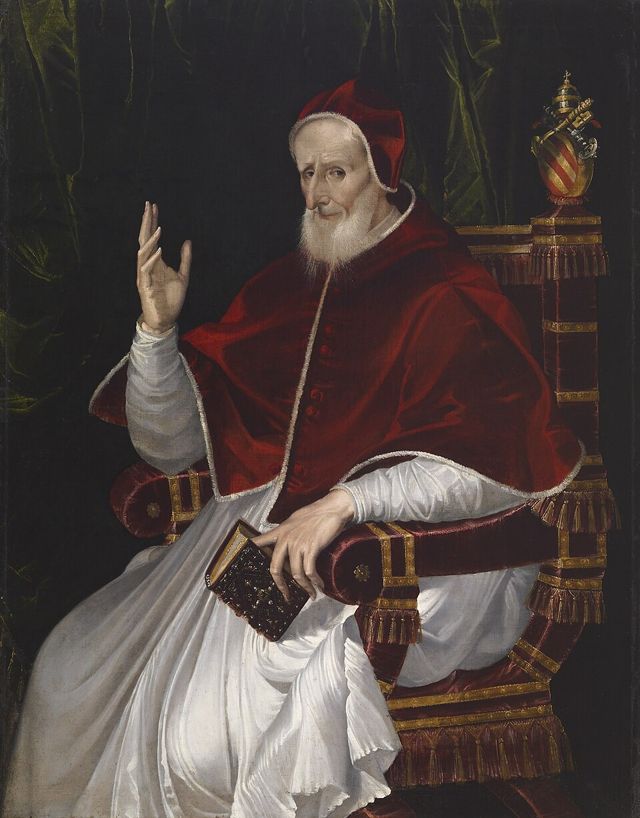
Image: Bartolomeo Passarotti - Pius V.jpg · Bartolomeo Passarotti and workshop · Public domain, via Wikimedia Commons

Image: Bartolomeo Passarotti and workshop, Wikimedia Commons (Public domain)

Retold in plain modern English from Baring-Gould’s public-domain text, sentence by sentence, keeping the same facts and order. Short explanations in parentheses are ours.

From Sabine Baring-Gould, The Lives of the Saints, new edition in 16 vols. (London: John C. Nimmo, 1897–98); text from the Internet Archive scan (OCR, lightly cleaned; errors possible). Public domain in the United States. Reproduced unedited, except for short bracketed notes in grey that we added to explain names and terms (“S.” is the old abbreviation for Saint). Some history and judgments reflect 19th-century scholarship.

Notes

Story retold in our own words from the cited sources.