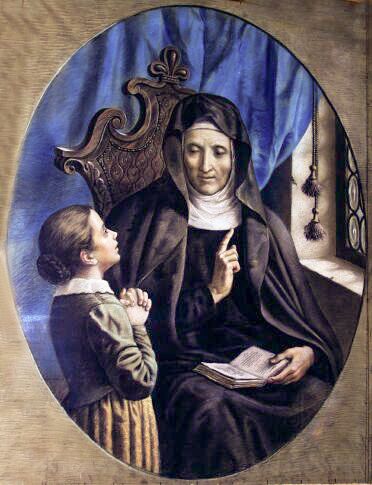
St. Petronilla

Petronilla was a Roman virgin, probably martyred at Rome toward the end of the first century.

Read the essentials →
Feast May 31 · Virgin

St. Petronilla

Current feast

May 31
Secondary source · Wikipedia infobox

Traditional feast

May 31
1914 / pre-1969 calendar, per Baring-Gould (1897)

Represents

Virgin

Feast days

Feast: May 31

This Saint’s Story

The Catholic Encyclopedia treats her fourth-century cult as historically secure. Sixth- and seventh-century lists place her grave on the Via Ardeatina near Sts. Nereus and Achilleus; excavations in the Catacomb of Domitilla, and the church built into that cemetery, confirmed the tombs. A painting from shortly after 356, on a tomb slab behind the basilica’s apse, shows her receiving a deceased woman named Veneranda into heaven and labels her Petronilla Martyr. That witness stands, the encyclopedia insists, even though a later legend knows her only as a virgin. The sarcophagus later taken to St. Peter’s under Paul I bore an inscription that sixteenth-century notices read as Aureliae Petronillae Filiae Dulcissimae—so her name was Aurelia Petronilla. The name may link her to the Christian Flavii of the Aurelii, explaining burial in Domitilla’s catacomb; she may have suffered under Domitian or later.

Her name is absent from the fourth-century Roman calendar of martyr feasts and appears in the Martyrologium Hieronymianum only as a later addition, under 31 May—the date Bede (the English monk-historian, d. 735) and his imitators keep. That absence suggests an early death, before special martyr feasts were usual. After the basilica rose over her remains, her cult spread and her name entered the martyrology. A late-sixth-century legend makes her a daughter of St. Peter, helped by a nameless daughter in the second-century Gnostic Acts of Peter and by her name’s likeness. In the legendary Acts of Nereus and Achilleus, and thence in the Liber Pontificalis (the early medieval 'Book of the Popes', not always reliable for the earliest ones) and medieval martyrologies, she appears as that daughter, but as a virgin rather than a martyr. Baring-Gould, who calls those Acts untrustworthy, retells the Flaccus courtship tale and her paralysis healed at Peter’s word, and notes that some take her as only Peter’s spiritual child. These episodes belong to legend beside the encyclopedia’s archaeological outline.

In 757 her coffin was moved to an old imperial mausoleum near St. Peter’s that became her chapel. She later figured as special patroness of treaties between the popes and the Frankish emperors. At the rebuilding of St. Peter’s in the sixteenth century her remains were translated to an altar still dedicated to her in the upper right aisle near the cupola. Her feast falls on 31 May.

Short entry · the summary here is 104 words; Baring-Gould’s fuller original text and its sources are below. We have not filled any gap with invented detail.

What she represents

How she teaches us to live

Drawn from themes in the original account

Celebrate this saint’s feast day. Remember her on May 31 with a short prayer, and ask for her help.

The full story

Baring-Gould’s account retold in modern English

Read the full story · 109 words · about 1 min

A certain officer, or "Count," named Flaccus greatly admired her beauty. He sent soldiers to her to ask her to be his wife. She replied sharply, "If he wants me to marry him, let him not send rough soldiers to woo me, but respectable matrons, and give me time to make up my mind." The soldiers withdrew, feeling embarrassed. However, before Flaccus could find matrons to convey his offer, Petronilla was dead.

In Rome, there is a catacomb named after her, as well as a church and an altar in the Vatican that enshrines her body. According to some, Saint Petronilla was only the spiritual child of Saint Peter.

Footnotes

  1. Count: a noble title in some European countries.
  2. Saint: a title for a person recognized for holiness or virtue.

Baring-Gould’s own footnotes, in modern English.

Read the original 1870s text

Baring-Gould’s sources: Roman Martyrology. Usuardus, Ado, Notker. Authority: — Mention in the Acts of SS. Nereus and Achilles (May 12th). But these, as has been already pointed out, are quite untrustworthy.] SAINT PETRONILLA is said to have been a daughter of S. Peter the apostle. He took her with him to Rome, where she became paralysed, but Simon Magus having asked him why, if he could perform miracles, he allowed his daughter to remain infirm, S. Peter answered that "It was expedient for her." Then he added, “ Nevertheless, to show the power of God, she shall rise from her bed and walk." Then he called her, and she rose, and was restored to her full health.

A certain officer or Count Flaccus having greatly admired her beauty, sent soldiers to her, to ask her to be his wife. She replied sharply, “If he wants me to marry him, let him not send rough soldiers to woo me, but respectable matrons, and give me time to make up my mind." Whereupon the soldiers withdrew abashed. But before Flaccus had obtained matrons to convey his offer, Petronilla was dead.

At Rome is a catacomb named after her, a church, and an altar in the Vatican, which enshrines her body. According to some, S. Petronilla was only the spiritual child of S. Peter.

From the Catholic Encyclopedia

1913 · 935 words

Virgin, probably martyred at Rome at the end of the first century.

Almost all the sixth- and seventh-century lists of the tombs of the most highly venerated Roman martyrs mention St. Petronilla's grave as situated in the Via Ardeatina near Sts. Nereus and Achilleus (De Rossi, "Roma sotterranea", I, 180-1). These notices have been completely confirmed by the excavations in the Catacomb of Domitilla. One topography of the graves of the Roman martyrs, "Epitome libri de locis sanctorum martyrum", locates on the Via Ardeatina a church of St. Petronilla, in which Sts. Nereus and Achilleus, as well as Petronilla, were buried (De Rossi, loc. cit., 180). This church, built into the above-mentioned catacomb, has been discovered, and the memorials found in it removed all doubt that the tombs of the three saints were once venerated there (De Rossi in "Bullettino di archeol. crist.", 1874 sq., 5 sqq.). A painting, in which Petronilla is represented as receiving a deceased person (named Veneranda) into heaven, was discovered on the closing stone of a tomb in an underground crypt behind the apse of the basilica (Wilpert, "Die Malereien der Katakomben Roms", Freiburg, 1903, plate 213; De Rossi, ibid., 1875, 5 sqq.). Beside the saint's picture is her name: Petronilla Mart. (yr). That the painting was done shortly after 356, is proved by an inscription found in the tomb. It is thus clearly established that Petronilla was venerated at Rome as a martyr in the fourth century, and the testimony must be accepted as certainly historical, notwithstanding the later legend which recognizes her only as a virgin (see below). Another known, but unfortunately no longer extant, memorial was the marble sacrophagus which contained her remains, under Paul I translated to St. Peter's. In the account of this in the "Liber Pontificalis" (ed. Duchesne, I, 466) the inscription carved on the sacrophagus is given thus: Aureae Petronillae Filiae Dulcissimae (of the golden Petronilla, the sweetest daughter). We learn, however, from extant sixteenth-century notices concerning this sacrophagus that the first word was Aur. (Aureliae), so that the martyr's name was Aurelia Petronilla. The second name comes from Petro or Petronius, and, as the name of the great-grandfather of the Christian consul, Flavius Clemens, was Titus Flavius Petronius, it is very possible that Petronilla was a relative of the Christian Flavii, who were descended from the senatorial family of the Aurelii. This theory would also explain why Petronilla was buried in the catacomb of the Flavian Domitilla. Like the latter, Petronilla may have suffered during the persecution of Domitian [Roman emperor 81–96], perhaps not till later.

In the fourth-century Roman catalogue of martyrs' feasts, which is used in the "Martyrologium Hieronymianum", her name seems not to have been inserted. It occurs in the latter martyrology (De Rossi-Duschesne, "Martyrol. Hieronym.", 69), but only as a later addition. Her name is given under 31 May and the Martyrologies of Bede [English monk and historian (d. 735)] and his imitators adopt the same date (Quentin, "Les martyrologes historiques", Paris, 1908, 51, 363, etc.). The absence of her name from the fourth-century Roman calendar of feasts suggests that Petronilla died at the end of the first or during the second century, since no special feasts for martyrs were celebrated during this period. After the erection of the basilica over her remains and those of Sts. Nereus and Achilleus in the fourth century, her cult extended widely and her name was therefore admitted later into the martyrology. A legend, the existence of which in the sixth century is proved by its presence in the list of the tombs of the Roman martyrs prepared by Abbot John at the end of this century (De Rossi, "Roma sotterranea", I, 180), regards Petronilla as a real daughter of St. Peter. In the Gnostic apocryphal Acts of St. Peter, dating from the second century, a daughter of St. Peter is mentioned, although her name is not given (Schmid, "Ein vorirenöische gnostisches Originalwerk in koptischer Sprache" in "Sitzungsber. der Berliner Akademie", 1896, 839 sqq.; Lipsius, "Die apokryphen Apostelgeschichten u. Apostellegenden", II, i, Brunswick, 1887, 203 sqq.). The legend being widely propagated by these apocryphal Acts, Petronilla was identified at Rome with this supposed daughter of St. Peter, probably because of her name and the great antiquity of her tomb. As such, but now as a virgin, not as a martyr, she appears in the legendary Acts of the martyrs St. Nereus and Achilleus and in the "Liber Pontificalis" (loc. cit.). From this legend of Sts. Nereus and Achilleus a similar notice was admitted into the historical martyrologies of the Middle Ages and thence into the modern Roman Martyrology. In 757 the coffin containing the mortal remains of the saint was transferred to an old circular building (an imperial mausoleum dating from the end of the fourth century) near St. Peter's. This building was altered and became the Chapel of St. Petronilla (De Rossi, "Inscriptiones christianae urbis Romae", II, 225). The saint subsequently appears as the special patroness of the treaties concluded between the popes and the Frankish emperors. At the rebuilding of St. Peter's in the sixteenth century, St. Petronilla's remains were translated to an altar (still dedicated to her) in the upper end of the right side-aisle (near the cupola). Her feast falls on 31 May.

Read the rest of the article

DE ROSSI, Sepolcro di S. Petronilla nella basilica in via Ardeatina e sua translazione al Vaticano in Bullettino di arch. crist. (1878), 125 sq. (1879), 5 sq.; DUMAZ, La France et sainte Pétronille in Annales de St. Louis des François (1899), 517 sq.; URBAIN, Ein Martyrologium der christl. Gemeinde zu Rom (Leipzig, 1901), 152; DUFOURCQ, Les Gesta Martyrum romains, I (Paris, 1900) 251 sq.
Help us add to this saint's story

Everything is read by a person before anything appears. Facts are checked against trusted sources first.

Facts are welcome; a source link helps (optional).With your permission we may share it on this page.

Nine days · Free

Pray the novena
with us.

One short email a day for nine days. The day's prayer, a line from St. Petronilla's story, and a nudge to keep going.

Also on May 31
St. Hermias

St. Hermias

May 31 · Martyr
C

Sts. Cantius

May 31 · Martyr
St. Angela of Merici

St. Angela of Merici

May 31 · Virgin
← All 1970 saints in the library
Sources & notes

Feast-day sources

Story sources

Sources

Credits

Image: Petronilla bnfms.jpg · Unknown · Public domain, via Wikimedia Commons

Image: Unknown, Wikimedia Commons (Public domain)

From “Catholic Encyclopedia (1913)/St. Petronilla,” The Catholic Encyclopedia (New York: Robert Appleton Company, 1907–1914), via Wikisource. Public domain. Matched by name and feast date; text unedited except for our bracketed notes in grey.

Retold in plain modern English from Baring-Gould’s public-domain text, sentence by sentence, keeping the same facts and order. Short explanations in parentheses are ours.

From Sabine Baring-Gould, The Lives of the Saints, new edition in 16 vols. (London: John C. Nimmo, 1897–98); text from the Internet Archive scan (OCR, lightly cleaned; errors possible). Public domain in the United States. Reproduced unedited, except for short bracketed notes in grey that we added to explain names and terms (“S.” is the old abbreviation for Saint). Some history and judgments reflect 19th-century scholarship.

Notes

Story retold in our own words from the cited sources.