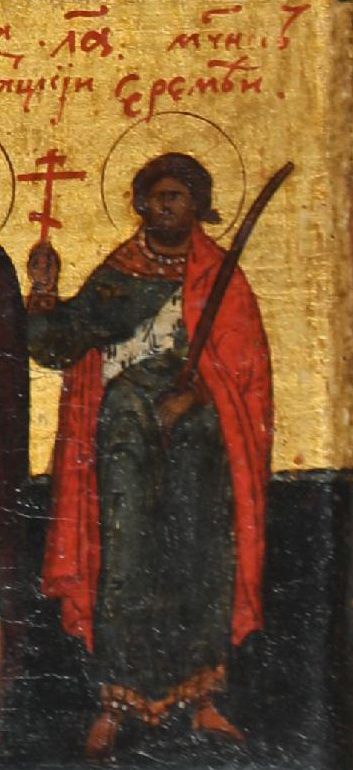
St. Hermias

St. Hermias, a soldier from Comana in Cappadocia, lived during the 2nd century under the reign of Emperor Antoninus Pius.

Read the essentials →
Feast May 31 · Martyr

St. Hermias

Current feast

May 31
Secondary source · Wikipedia infobox

Traditional feast

May 31
1914 / pre-1969 calendar, per Baring-Gould (1897)

Represents

Martyr

Feast days

Feast: May 31

This Saint’s Story

Written for this site from Wikipedia and Sabine Baring-Gould, The Lives of the Saints (source note)

After completing his military service, he openly confessed his faith in Christ, refusing any payment for his service. This act of faith led to his arrest by Sebastian, the local proconsul, who demanded that Hermias renounce his beliefs to demonstrate loyalty to the emperor.

According to the account of his martyrdom, which is legend more than history, Hermias refused and was cruelly tortured. The story says he came out of a furnace unharmed after three days, and that a sorcerer named Marus, called in to poison him, saw him bless the cup and drink it without harm, then confessed Christ himself and was beheaded.

The same account says Hermias suffered further torments while still giving thanks to Christ, until the angry proconsul killed him with his own sword. Local Christians buried him in secret, and later devotion told of healings at his relics.
Short entry · the summary here is 45 words; Baring-Gould’s fuller original text and its sources are below. We have not filled any gap with invented detail.

What he represents

How he teaches us to live

Drawn from themes in the original account

Celebrate this saint’s feast day. Remember him on May 31 with a short prayer, and ask for his help.

Read more

The full original · 45 words

Read Baring-Gould’s full account

Baring-Gould’s sources: Roman Martyrology, inserted by Baronius from the Greek Menology. But he has fallen into several mistakes. Hermias was martyr at Comana, in Cappadocia, not at the place of the same name in Pontus, as the Roman Martyrology asserts; Baronius was also mistaken in the facts. Authority: — The Greek Acts, a late, and not very trustworthy composition.

S. Hermias was a soldier who suffered in the reign of Marcus Aurelius Antoninus [Antoninus Pius, Roman emperor 138–161], at Comana, in Cappadocia [a region of central Turkey]. His jaws were broken with a stone, and his sides, after having been torn, were irritated by the application of vinegar. His head was finally struck off.

More about St. Hermias

Checked against at least two sources, in our own words

Help us add to this saint's story

Everything is read by a person before anything appears. Facts are checked against trusted sources first.

Facts are welcome; a source link helps (optional).With your permission we may share it on this page.

Nine days · Free

Pray the novena
with us.

One short email a day for nine days. The day's prayer, a line from St. Hermias's story, and a nudge to keep going.

Also on May 31
St. Petronilla

St. Petronilla

May 31 · Virgin
C

Sts. Cantius

May 31 · Martyr
St. Angela of Merici

St. Angela of Merici

May 31 · Virgin
← All 1970 saints in the library
Sources & notes

Feast-day sources

Story sources

Sources

Credits

Image: Menaion icon (17 c., TsAK) - May - 46 - Hermias of Comana.jpg · Anonymous Russian icon painter (before 1917)Public domain image (according to PD-Russia-expired) · Public domain, via Wikimedia Commons

Image: Anonymous Russian icon painter (before 1917)Public domain image (according to PD-Russia-expired), Wikimedia Commons (Public domain)

From Sabine Baring-Gould, The Lives of the Saints, new edition in 16 vols. (London: John C. Nimmo, 1897–98); text from the Internet Archive scan (OCR, lightly cleaned; errors possible). Public domain in the United States. Reproduced unedited, except for short bracketed notes in grey that we added to explain names and terms (“S.” is the old abbreviation for Saint). Some history and judgments reflect 19th-century scholarship.