This Saint’s Story
His father worked as a blacksmith, and Peter was the youngest of ten children, with eight siblings having died in childhood. From an early age, he showed a deep commitment to Mary, which guided his spiritual journey. His early experiences included a pilgrimage to a Marian shrine before his First Communion in 1823, and he later visited various sites dedicated to Mary throughout France.
After the death of his mother in 1828, Eymard felt a strong calling to the priesthood, despite his father's opposition. He began his religious training with the Oblates of Mary Immaculate in 1829, but his first attempt at seminary was cut short due to illness. After recovering, he was ordained a priest on July 20, 1834, for the Diocese of Grenoble. His early pastoral assignments included serving as an assistant pastor in Chatte and later as the pastor of Mount Saint-Eynard, where he revitalized a struggling parish.
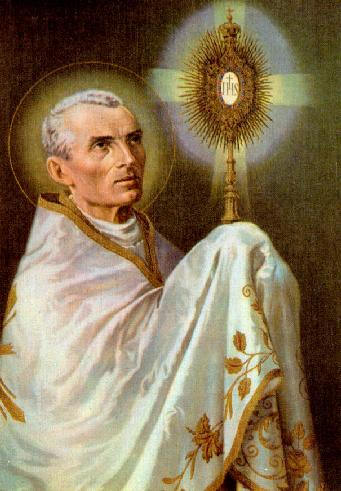
Eymard's spiritual life began to focus on the Eucharist, particularly after he joined the Society of Mary in 1839. He became the Provincial of the Society in 1845 and worked to promote Marian devotion and the Eucharist. His encounter with the practice of perpetual adoration (prayer before the Eucharist kept up day and night) during a trip to Paris in 1849 inspired him to establish a community dedicated to eucharistic worship. However, his superiors did not support this vision, leading him to leave the Marists and pursue his goal independently.
On May 13, 1856, Eymard received permission from the bishops of Paris to establish the Congregation of the Blessed Sacrament. The first public exposition of the Blessed Sacrament took place on January 6, 1857, in a modest building in Paris. Eymard's community focused on preparing children for their First Communion and reaching out to inactive Catholics. He also started a contemplative congregation for women dedicated to the Eucharist in 1858, further expanding his mission of eucharistic devotion.
Eymard faced numerous challenges, including financial difficulties and the need to relocate his communities. Despite these trials, he remained committed to promoting frequent Holy Communion and eucharistic adoration. He died on August 1, 1868, from complications of a brain hemorrhage. His remains were initially buried in La Mure but were later moved to the Corpus Christi (the feast of the Body of Christ in the Eucharist) Chapel in Paris. Eymard was declared venerable in 1908, beatified (declared 'Blessed', the step before sainthood) by Pope Pius XI in 1925, and canonized (officially declared a saint by the pope) by Pope John XXIII on December 9, 1962.
His feast day is celebrated on August 2, and he is honored as the 'Apostle of the Eucharist' for his significant contributions to eucharistic spirituality.