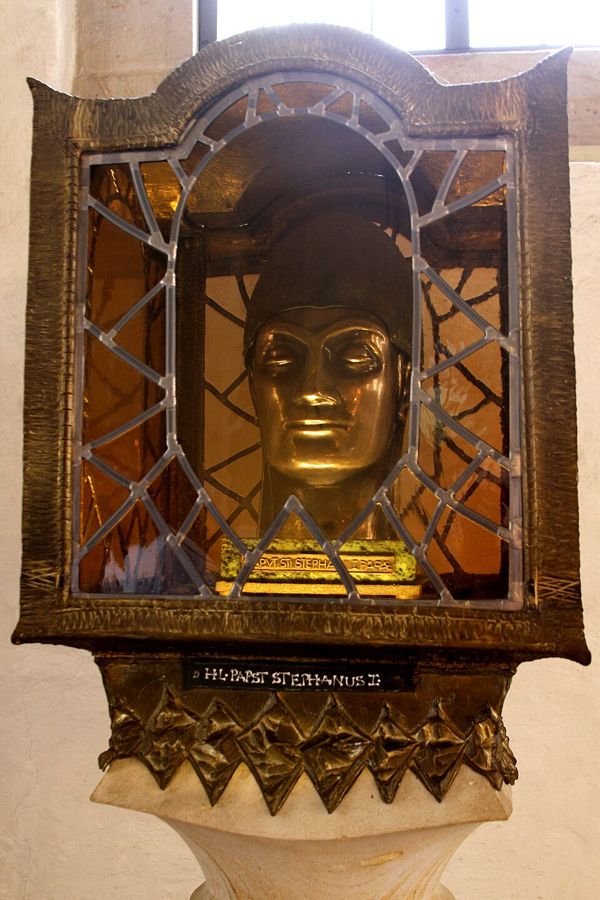
St. Stephen I. Pope

Stephen I succeeded Lucius as bishop of Rome.

Read the essentials →
Feast August 2 · Martyr

St. Stephen I. Pope

Current feast

August 2 (also listed: August 3)
Secondary source · Wikipedia infobox

Traditional feast

August 2
1914 / pre-1969 calendar, per Baring-Gould (1897)

Represents

Martyr

Feast days

Feast: August 2

This Saint’s Story

The Catholic Encyclopedia places his consecration on 12 May 254 and his death on 2 August 257, while acknowledging some uncertainty in the chronology. Ancient catalogues call him a Roman and the son of Jovius. Baring-Gould begins his account with Lucius's death in 253; the Encyclopedia's chronology places Stephen's accession a year later.

His pontificate is remembered especially for the dispute over baptism administered outside the Church's communion. Stephen defended its validity; Cyprian of Carthage and other bishops in Africa and Asia maintained that those entering the Church should be baptized anew. Baring-Gould explains Stephen's position in terms of the right matter and words. He also emphasizes that Stephen's own letters are lost, so accounts of his conduct come from opponents.

Baring-Gould describes the bitter exchanges, the refusal to receive Cyprian's envoys, and African councils which upheld their own judgment. The Encyclopedia treats Stephen's defence of baptism as his most important work and judges his position correct. Read together, the accounts distinguish the doctrinal question from the harsh language and strained relations through which the controversy unfolded. Baring-Gould says its immediate conclusion is unknown and that discussion continued under Stephen's successor.

Other disputes brought Stephen and Cyprian into correspondence. Cyprian urged action against Marcian of Arles for denying communion to penitent Christians who had fallen in persecution. In Spain, Basilides and Martial appealed against their deposition. The Encyclopedia says Stephen supported restoration after being misled about the facts; an African council renewed their condemnation. It also records Stephen's practical charity towards needy communities in Syria and Arabia.

Baring-Gould counts Stephen among the first victims of Valerian's persecution. The Encyclopedia is more cautious: although the later papal biography calls his death a martyrdom, the evidence is generally considered doubtful. Both accounts place his death on 2 August 257 and his burial in the cemetery of Callistus. His body was subsequently transferred by Pope Paul I to a monastery founded in his honour.

Struggles & surrender

His struggles

  • A bitter quarrel with Cyprian ·
    In the controversy over baptism by heretics, Stephen broke off communion with the Churches of Africa and the East and refused even to receive St Cyprian's envoys. His own letters are lost, but his opponents, Cyprian and Firmilian among them, accused him of imperious dictation and harshly censured his obstinacy.

What he represents

How he teaches us to live

Drawn from themes in the original account

Celebrate this saint’s feast day. Remember him on August 2 with a short prayer, and ask for his help.

The full story

Baring-Gould’s account retold in modern English

Read the full story · 402 words · about 2 min

Lucius, Pope of Rome, died in 253 and was succeeded by Stephen. This pope did not adopt the harsh view of the Eastern bishops. He argued that every baptism performed with the correct matter and the correct words granted access to Christian privileges. Unfortunately, Stephen’s letters are lost; his opponents accuse him of enforcing his rule with arrogant authority.

On August 2, Saint Stephen, Saint Cyprian of Carthage, and Saint Dionysius of Alexandria wrote to him. He replied by denouncing Saint Cyprian as a false Christ, a false apostle, and a deceitful worker. He also broke off communion with all the Churches of the East and Africa that adhered to the stricter practice. Saint Cyprian called a council to meet at Carthage. Seventy-one bishops from Africa gathered and asserted the independent judgment of the African Churches.

Saint Cyprian sent two bishops to Rome with a copy of the decisions from the Carthaginian council and letters from himself. Saint Stephen would not allow the messengers to enter his presence and forbade the faithful to show them any hospitality, to welcome them into their homes, or to wish them well. Cyprian wrote in anger. He condemned Stephen’s behavior in strong terms, calling it perverse, obstinate, and rebellious. He published, in Latin, a letter from Saint Firmilian, Bishop of Cappadocian Caesarea, which was even harsher in its criticisms. Firmilian denounced Stephen’s audacity and insolence, mocked his claimed descent from Saint Peter, and declared that by his sin, he had excommunicated himself. He called Stephen a schismatic and an apostate from the unity of the Church. Cyprian convened another council. Eighty-seven bishops met under his leadership, reaffirmed their previous decision, rejected Stephen's claim to the title Bishop of Bishops, and opposed the arbitrary authority of one bishop over all of Christendom.

This occurred in 256 AD. The council included fifteen confessors, some of whom bore scars and were maimed for their faith. It is not known how this dispute ended. It continued during the papacy of Saint Sixtus, who succeeded Saint Stephen, as Saint Dionysius wrote to him about the matter. The sudden outbreak of persecution under Valerian in the year following the council, in 257 AD, shifted focus from these issues to the more urgent needs of a time of intense trial.

One of the first victims was Saint Stephen. He died on August 2, 257 AD, and was buried in the cemetery of Callixtus.

Footnotes

  1. Saint Firmilian was a bishop in Cappadocia (a region in modern-day Turkey).
  2. The cemetery of Callixtus is a famous burial site in Rome.

Baring-Gould’s own footnotes, in modern English.

Read the original 1870s text

Baring-Gould’s sources: Roman Martyrology, Ado, Usuardus, ancient Roman Martyrology. By the Greeks on the 30th August or 7th Sept. But in the Martyrology of the Emperor Basil on August 2. Authority ' The letters of S. Cyprian, Anastasius Bibliothecarius, &c.] URING the interval of peace that elapsed between the Decian and Valerian persecutions, a controversy sprang up on the rebaptism of heretics. Africa and the East, Alexandria, with less decision, declared the baptism by heretics to be an idle ceremony, and even an impious mimicry of that holy sacrament, which could only be valid when performed by clergy duly consecrated, and maintaining their union with the body of the Church.

Lucius, Pope of Rome, died in 253, and was succeeded by Stephen. This pope did not adopt the harsh view of the Eastern prelates. Every baptism performed with the right matter and the right words, he contended, admitted to Christian privileges. Unfortunately, Stephen’s letters are lost; his adversaries charge him with having enforced his rule with imperious dictation.

Allgust 2.].S'. Stephen. S. Cyprian of Carthage, S. Dionysius of Alexandria, wrote to him. He replied denouncing S. Cyprian as a false Christ, a false apostle, a deceitful worker; and broke off communion with all the Churches of the East and of Africa which adhered to the more rigorous practice. S. Cyprian summoned a council to meet at Carthage. Seventy-one bishops of Africa assembled, and asserted the independent judgment of the African Churches.

S. Cyprian sent two bishops to Rome with a copy of the decisions of the Carthaginian council, and letters from himself. S. Stephen would not allow the messengers to enter his presence, and forbad the faithful to show them the smallest hospitality, to receive them into their houses, or wish them God-speed. Cyprian wrote in indignation. He condemned in severe terms the perverseness, obstinacy, contumacy of Stephen. He promulgated, in Latin, a letter of S. Firmilian, Bishop of Cappadocian Caesarea, still more unmeasured in its censures. Firmilian denounced the audacity, the insolence of Stephen - scoffed at his boasted descent from S. Peter; declared that, by his sin, he had excommunicated himself; that he was a schismatic, an apostate from the unity of the Church. Cyprian assembled another council. Eighty-seven bishops met under his presidency, reasserted their previous decision, repudiated the assumption by Stephen of the title Bishop of Bishops, and the arbitrary dictation of one bishop to all Christendom.

This was in a.d. 256. In the council were fifteen confessors, some with scars, and maimed for the faith. It is not known what was the end of this dispute. It lasted under the pontificate of S. Sixtus, successor of S. Stephen; for S. Dionysius wrote to him on the subject. The sudden break out of persecution under Valerian [Roman emperor 253–260, who persecuted bishops and clergy] in the year following the council, a.d. 257, drew attention VOL. ix. 2 from these questions to the more pressing necessities of a time of fiery trial.

One of the first victims was S. Stephen. He died on the 2nd of August, a.d. 257, and was buried in the cemetery of Callixtus.

From the Catholic Encyclopedia

1913 · 686 words

Although there is some doubt as to the dates connected with the pontificate of Stephen, it is generally believed that he was consecrated 12 May, 254, and that he died 2 August, 257. According to the most ancient catalogues, he was a Roman by birth, and the son of Jovius, and there is no reason to doubt the assertion of the "Liber Pontificalis" that Lucius I, when about to be martyred, made over the care of the Church to his archdeacon Stephen (254). Most of what we know regarding Pope Stephen is connected directly or indirectly with the severe teachings of the heretic Novatus. Concerning his most important work, his defence of the validity of heretical baptism against the mistaken opinion of St. Cyprian and other bishops of Africa and Asia, there is no need to speak now, as the history of this important controversy will be found under BAPTISM and SAINT CYPRIAN OF CARTHAGE. Suffice it here to call attention to certain newly discovered letters on the subject by St. Dionysius of Alexandria ("Eng. Hist. Rev.", Jan., 1910, 111 sq.), and to note, with the late Archbishop Benson of Canterbury, that Stephen "triumphed, and in him the Church of Rome triumphed, as she deserved" [E.W. Benson, "Cyprian, His Life, His Times, His Works", VIII (London), 1897, 3]. In the early part of his pontificate Stephen was frequently urged by Faustinus, Bishop of Lyons, to take action against Marcian, Bishop of Arles, who, attaching himself to doctrines of Novatus, denied communion to the penitent lapsi. For some reason unknown to us Stephen did not move. The bishops of Gaul [roughly modern France and Belgium] accordingly turned to Cyprian, and begged him to write to the pope. This the saint did in a letter which is our sole source of information regarding this affair (Epp. lxix, lxviii). The Bishop of Carthage entreats Stephen to imitate his martyred predecessors, and to instruct the bishops of Gaul to condemn Marcian, and to elect another bishop in his stead. As no more is said by St. Cyprian on this affair, it is supposed that the pope acted in accordance with his wishes, and that Marcian was deposed. The case of the Spanish bishops Martial and Basilides also brought Stephen in connection with St. Cyprian. As libellatici they had been condemned by the bishops of their province for denying the Faith. At first they acknowledged their guilt, but afterwards appealed to Rome, and, deceived by their story, Stephen exerted himself to secure their restoration. Accordingly some of their fellow bishops took their part, but the others laid the case before St. Cyprian. An assembly of African bishops which he convoked renewed the condemnation of Basilides and Martial, and exhorted the people to enter into communion with their successors. At the same time they were at pains to point out that Stephen had acted as he had done because "situated at a distance, and ignorant of the true facts of the case" he had been deceived by Basilides. Anxious to preserve the tradition of his predecessors in matters of practical charity, as well as of faith, Stephen, we are told, relieved in their necessities "all the provinces of Syria and Arabia". In his days the vestments worn by the clergy at Mass and other church services did not differ in shape or material from those ordinarily worn by the laity. Stephen, however, is said by the "Liber Pontificalis" to have ordained that the vestments which had been used for ecclesiastical purposes were not to be employed for daily wear. The same authority adds that he finished his pontificate by martyrdom, but the evidence for this is generally regarded as doubtful. He was buried in the cemetery of St. Calixtus, whence his body was transferred by Paul I to a monastery which he had founded in his honour.

DUCHESNE, Liber Pontificalis, I (Paris, 1886), xcvii, 153-4; EUSEBIUS, Hist. Eccles., VII, 2-5; the letters of ST. CYPRIAN, lxvii sq., in any ed. of his Works, or ap. COUSTANT, Epp.; Rom. Pont., I (Paris, 1721), 211 sq.; JAFFÉ, Regesta, I (Leipzig, 1888), 20-1; HEFELE, Conciles; I (Paris, 1869), 97 sq.

More about St. Stephen I. Pope

Checked against at least two sources, in our own words

Help us add to this saint's story

Everything is read by a person before anything appears. Facts are checked against trusted sources first.

Facts are welcome; a source link helps (optional).With your permission we may share it on this page.

Nine days · Free

Pray the novena
with us.

One short email a day for nine days. The day's prayer, a line from St. Stephen I. Pope's story, and a nudge to keep going.

Also on August 2
R

St. Rutilius

August 2 · Martyr
T

St. Theodota

August 2 · Martyr
E

St. Etheldritha

August 2 · Virgin
← All 1970 saints in the library
Sources & notes

Feast-day sources

Story sources

Sources

Credits

Image: Head of Pope Saint Stephen I - Speyer Cathedral - Speyer - Germany 2017.jpg · José Luiz · CC BY-SA 4.0, via Wikimedia Commons

Image: José Luiz, Wikimedia Commons (CC BY-SA 4.0)

From “Catholic Encyclopedia (1913)/Pope St. Stephen I,” The Catholic Encyclopedia (New York: Robert Appleton Company, 1907–1914), via Wikisource. Public domain. Matched by name and feast date; text unedited except for our bracketed notes in grey.

Retold in plain modern English from Baring-Gould’s public-domain text, sentence by sentence, keeping the same facts and order. Short explanations in parentheses are ours.

From Sabine Baring-Gould, The Lives of the Saints, new edition in 16 vols. (London: John C. Nimmo, 1897–98); text from the Internet Archive scan (OCR, lightly cleaned; errors possible). Public domain in the United States. Reproduced unedited, except for short bracketed notes in grey that we added to explain names and terms (“S.” is the old abbreviation for Saint). Some history and judgments reflect 19th-century scholarship.

Notes

Story retold in our own words from the cited sources.