This Saint’s Story
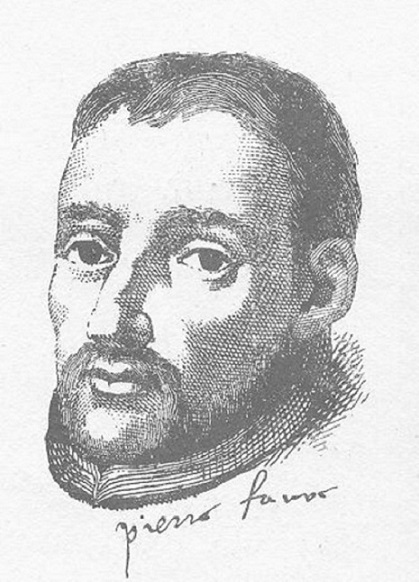
During his childhood, he tended sheep and had limited formal education, yet he possessed an exceptional memory, allowing him to recall sermons accurately. His desire for knowledge led him to attend a small school, and in 1525, he moved to Paris to study at the Collège Sainte-Barbe, where he shared a room with Francis Xavier. It was in this vibrant academic environment that he met Ignatius of Loyola, who would significantly shape his spiritual path.
Faber was ordained a priest on May 30, 1534, and took religious vows with Ignatius and his companions on August 15 of the same year. He became the first among them to receive ordination. Following Ignatius's guidance, Faber led his companions to Venice in November 1536, where they initially intended to evangelize the Holy Land. However, due to political tensions, they redirected their efforts towards establishing the Society of Jesus, focusing on education and spiritual renewal instead.
Faber's ministry took him across Europe, where he preached and conducted the Spiritual Exercises (his month-long program of guided prayer), a series of meditations aimed at deepening one's relationship with God. He was known for his gentle demeanor and ability to connect with individuals from various backgrounds. His missions in Germany were particularly impactful, where he worked to reform the Catholic clergy and address the challenges posed by the Protestant Reformation. Faber emphasized personal transformation over theological disputes, earning him respect among both clergy and laypeople.
In 1546, Faber was appointed to represent the Catholic Church at a significant council aimed at addressing various issues within the Church. However, his health deteriorated due to his extensive travels and tireless efforts. He arrived in Rome on July 17, 1546, but passed away on August 1, 1546, reportedly in the presence of Ignatius. His remains were initially interred in a church that served as a center for the Jesuit (member of the Society of Jesus, founded by St. Ignatius of Loyola) community, later moved to the Church of the Gesù in Rome, where they remain today.
Faber was beatified (declared 'Blessed', the step before sainthood) on September 5, 1872, by Pope Pius IX, and canonized (officially declared a saint by the pope) on December 17, 2013, by Pope Francis. His feast day is celebrated on August 2, and he is remembered for his dedication to spiritual guidance and renewal.