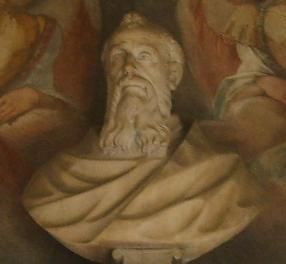
Peter, known as Damian, was born around the year 988 in Ravenna, to a good family, the Onesti, which had fallen on hard times. He was the youngest of many children, and when he was very young, he lost both his father and mother. He was then left in the care of a married brother, who treated him more like a servant than a family member. As he grew up, he was sent to tend to pigs.
One day, he came into possession of a piece of money. Instead of spending it on himself, he gave it as alms to a priest, asking him to pray for his father's soul. He had another brother named Damian, who was the archpriest of Ravenna and later became a monk. Taking pity on Peter, Damian provided him with an education. He sent Peter to school first in Faenza and then in Parma.
With his natural intelligence, it didn't take long for Peter to be able to teach others. To protect himself from the temptations of pleasure and the tricks of the devil, he began to wear a rough hair-shirt under his clothes and trained himself in fasting, vigilance, and prayer. At night, if he felt tempted by lust, he would get out of bed and jump into the river. After this, he would visit churches, reciting the psalter while performing this devotion until the church office began.
He not only gave generously to the poor but also often had someone in need at his table, taking pleasure in serving them himself. Eventually, he decided to leave the world behind and embrace monastic life, away from his homeland. While he was contemplating this, two monks from the order of Saint Benedict, who belonged to Font-Avellano, a hermitage at the foot of the Apennines in Umbria, visited him. Inspired by their selflessness, he resolved to join their community, which he did shortly after.
This hermitage had been founded by Blessed Ludolf about twenty years before Peter arrived and was well-regarded at that time. The hermits lived in pairs in separate cells. They ate only bread and water for four days each week, and on Tuesdays and Thursdays, they consumed pulses and herbs, which each prepared in their own cell. On fasting days, their bread was given to them by weight. They rarely drank wine, which was common in the area, except for Mass or when sick. They went barefoot, practiced self-discipline, made many genuflections, struck their breasts, and prayed with their arms stretched out, each according to their strength and devotion.
After the night office, they recited the entire psalter before dawn. This strict lifestyle led to Peter suffering from severe insomnia, which nearly exhausted him and was very difficult to cure. However, he learned to exercise more discretion as a result. He dedicated a significant amount of time to sacred studies and became as knowledgeable in the Scriptures as he had been in secular literature.
His superior instructed him to frequently encourage the other monks, and since he had gained a strong reputation for virtue and learning, Guy, the abbot of Pomposia, requested that Peter be sent to teach at his monastery, which had a hundred monks. Peter stayed there for two years before being called back by his abbot and sent to fulfill the same role at the large abbey of Saint Vincent, near Pietra Pertusa, or Hollow Rock. Upon his return, his abbot, with the unanimous agreement of the hermitage, commanded him to take over the leadership of the community after his death.
Therefore, after the abbot passed away in 1041, Peter took charge of that holy family, which he governed with wisdom and holiness. He founded five additional hermitages, appointing priors who were under his authority. His main focus was to instill in his disciples the spirit of solitude, charity, and humility. Among them, many became prominent figures in the Church, such as Saint Ralph, bishop of Gubbio, whose feast is celebrated on June 26; Saint Dominic, known as Loricatus, on October 14; and Saint John of Lodi, who succeeded Peter as the prior of the Holy Cross and was also bishop of Gubbio, and wrote Peter's life story, along with many others.
For twelve years, he was actively involved in the service of the Church, working with many dedicated bishops and four successive popes: Gregory VI, Clement II, Leo IX, and Victor II. Their successor, Stephen IX, in 1057, persuaded him to leave his hermitage and appointed him cardinal bishop of Ostia.
Stephen IX died in 1058, and Nicolas II was chosen as pope. He was a man of deep insight, great virtue, and learning. After receiving complaints about simony in the Church of Milan, Nicolas II sent Peter there as his representative. After serving for two years and six months, Nicolas II died, and Alexander II was elected pope in 1062.
Saint Peter had persistently asked Nicolas II for permission to resign from his bishopric and return to his solitude, but he could not obtain it. His successor, Alexander II, out of affection for the holy man, was persuaded to grant this request in 1062, but not without great difficulty. He also reserved the right to call upon Peter for assistance in important Church matters as needed in the future. From that time on, the saint believed he was relieved not only from the burden of his flock but also from the governance of the various priories that depended on his monastery.
In his retirement, he inspired the Church through his penance and deep remorse, and he worked through his writings to promote discipline and morality. He wrote a treatise to the bishop of Besançon, opposing the custom that the canons of that Church had of saying the divine office while sitting, a practice that has unfortunately become common since his time; however, he recognized the appropriateness of everyone sitting during the lessons. This saint wrote very critically about the obligations of religious individuals, particularly against their wandering from place to place and moving from monastery to monastery. He expressed concern about certain excuses that many used to justify real violations of their vow of poverty. He rightly noted, "We can never restore what is decayed of primitive discipline; and if we, by negligence, allow any reduction in what remains established, future generations will never be able to repair such breaches. Let us not bring upon ourselves such a disgrace; but let us faithfully pass on to future generations the examples of virtue that we have received from our ancestors."
The holy man was compelled to interrupt his solitude in obedience to the pope, who sent him as a legate to France in 1063, commanding the archbishops and others to receive him as if he were the pope himself. There, he reconciled disputes, defined the boundaries of certain dioceses' jurisdictions, and condemned and deposed those convicted of simony in councils. Nevertheless, he balanced his strictness with kindness and leniency towards penitents when charity and wisdom required such compassion.
Henry IV, king of Germany, married Bertha, the daughter of Otho, marquis of the Marches of Italy, in 1067. However, in 1069, he sought a divorce and persuaded the Archbishop of Mentz to support his plan by promising to pay him the money owed if he complied, and threatening to invade his territories with armed forces if he refused. To approve the divorce, the archbishop convened a council at Mentz. Pope Alexander II forbade him from consenting to such an injustice and appointed Peter Damiani as his legate to preside over the synod. The venerable legate met the king and bishops at Frankfort, presented the pope's orders and instructions, and in the pope's name urged the king to respect God's law, the canons of the Church, and his own reputation, and to seriously consider the public scandal of such a harmful example. The noblemen also stood up and urged their sovereign never to tarnish his honor with such a disgraceful act. The king, unable to resist such compelling authority, abandoned his plan for a divorce; however, he remained the same man at heart and continued to despise the queen even more than before.
Peter hurried back to his desert of Font-Avellano. Whatever strict practices he recommended to others, he was the first to follow himself, not easing up on them even in his old age. He lived confined in his cell as if it were a prison, fasting every day except on festivals. He allowed himself no other food than coarse bread, bran, herbs, and water, which he never drank fresh, but only what he had kept from the day before. He tortured his body with iron girdles and frequent self-discipline to make it more obedient to the spirit. He spent the first three days of every Lent and Advent without taking any food at all. Often, for forty days at a time, he lived only on raw herbs and fruits, or on pulses soaked in cold water, without touching bread or anything that had been cooked. A mat spread on the floor served as his bed. He would make wooden spoons and other useful, inexpensive items to practice manual labor for certain hours.
Henry, the archbishop of Ravenna, had been excommunicated for serious offenses. Peter was sent by Pope Alexander II as a legate to address the Church's issues. When he arrived in Ravenna in 1072, he found the unfortunate archbishop had just died. However, he brought the accomplices of Henry's crimes to recognize their guilt and imposed appropriate penance on them. This was his last task for the Church, as God soon called him to eternal rest and the reward for his labors. Old age and the fatigue of his journey did not lead him to abandon his usual self-denials, through which he fulfilled his offering to God. On his way back to Rome, he was stopped by a fever at the monastery of Our Lady, located outside the gates of Faenza, and died there on the eighth day of his illness while the monks were reciting Matins around him. He transitioned from that work, which had been the joy of his heart on earth, to sing the same praises of God in eternal glory on February 22, 1072, at the age of eighty-three. He is honored as a patron in Faenza and Font-Avellano on the 23rd of the same month.
Footnotes
- Blessed Ludolf was a significant figure in the founding of the hermitage.
- The order of Saint Benedict is a monastic religious order in the Catholic Church.
- Pietra Pertusa means "Hollow Rock" in Italian.
- Pope Alexander II was the pope from 1061 to 1073.
- Simony is the act of selling church offices or roles.
- Peter is honored as a patron in Faenza and Font-Avellano.
Baring-Gould’s own footnotes, in modern English.
Read the original 1870s text
Baring-Gould’s sources: Roman Martyrology. A double of the Breviary. Pope Leo XII. gave to S. Peter Damiani the title of Doctor of the Church, and extended to the whole of the Catholic Church the right of venerating him, which was formerly reserved to the Camaldolese, and to the dioceses of Ravenna and Falonza. Authority:—Life by his disciple, John of Lodi.
Peter , surnamed of Damian, was born about the year 988, in Ravenna, of a good family, the Onesti, that was considerably reduced in circumstances. He was the youngest of many children, and when very young, losing his father and mother, he was left in the hands of a married brother, in whose house he was treated more as a slave than a relation; and when grown up, he was sent to keep swine. One day he became possessed of a piece of money, which, instead of spending on himself, he bestowed in alms on a priest, desiring him to offer up prayers for his father's soul. He had another brother called Damian, who was arch-priest of Ravenna, and afterwards a monk; who, taking pity on him, gave him an education. Damian sent Peter to school, first at Faenza, afterwards at Parma. Having good natural parts, it was not long before Peter found himself in a capacity to teach others. To arm himself against the allurements of pleasure, and the artifices of the devil, he began to wear a rough hair-shirt under his clothes, and to inure himself to fasting, watching, and prayer. In the night, if any temptation of concupiscence arose, he got out of bed and plunged into the river. After this, he visited churches, reciting the psalter whilst he performed this devotion, till the church office began. He not only gave much away in alms, but was seldom without some poor person at his table, and took a pleasure in serving them with his own hands. But at length he came to the resolution of deserting the world, and embracing the monastic life, at a distance from his own country. While his mind was full of these thoughts, two religious of the order of S. Benedict [father of Western monks (d. c. 547), author of the Rule], belonging to Font-Avellano, a desert at the foot of the Apennines in Umbria, happened to call at the place of his abode; and being much edified at their disinterestedness, he resolved to embrace their institute; which he did shortly after. This hermitage had been founded by Blessed Ludolf, about twenty years before S. Peter came thither, and was then in the greatest repute. The hermits, in pairs, occupied separate cells. They lived on bread and water four days in the week: on Tuesdays and Thursdays they ate pulse and herbs, which every one dressed in his own cell: on their fast days all their bread was given them by weight. They never used any wine (the common drink of the country) except for mass, or in sickness: they went barefoot, used disciplines, made many genuflections, struck their breasts, stood with their arms stretched out in prayer, each according to his strength and devotion. After the night office they said the whole psalter before day. This severe life brought on S. Peter a nervous attack of wakefulness, which nearly wore him out, and of which he was cured with very great difficulty. But he learned from this to use more discretion. He gave a considerable time to sacred studies, and became as well versed in the Scriptures as he was before in profane literature. His superior ordered him to make frequent exhortations to the religious, and as he had acquired a very great character for virtue and learning, Guy, abbot of Pomposia, begged his superior to send him to instruct his monastery, which consisted of a hundred monks. Peter staid there two years, and was then called back by his abbot, and sent to perform the same function in the large abbey of S. Vincent, near the Pietra Pertusa, or Hollow Rock. On his recall, he was commanded by his abbot, with the unanimous consent of the hermitage, to take upon him the government of the desert after his death, Therefore, on the decease of the abbot, in 1041, Peter assumed the direction of that holy family, which he governed with wisdom and sanctity. He founded five other hermitages; in which he placed priors subject to his jurisdiction. His principal care was to cherish in his disciples the spirit of solitude, charity, and humility. Among them, many became great lights of the Church, as S. Ralph, bishop of Gubbio, whose festival is kept on the 26th of June; S. Dominic, surnamed Loricatus, the 14th of October; S. John of Lodi, his successor in the priory of the Holy Cross, who was also bishop of Gubbio, and wrote S. Peter's life; and many others. He was for twelve years much employed in the service of the Church by many zealous bishops, and by four popes successively, namely, Gregory VI., Clement II., Leo IX., and Victor II. Their successor, Stephen IX., 1057, prevailed on him to quit his desert, and made him cardinal bishop of Ostia.
Stephen IX. dying in 1058, Nicolas II. was chosen pope, a man of deep penetration, of great virtue and learning. Upon complaints of simony in the Church of Milan, Nicolas II. sent Peter thither as his legate [an official representative sent by the pope]. Nicolas II. dying, after having sat two years and six months, Alexander II. was chosen pope, in 1062. S. Peter had with great importunity solicited Nicolas II. to grant him leave to resign his bishopric, and return to his solitude; but could not obtain it. His successor, Alexander II., out of affection for the holy man, was prevailed upon to allow it, in 1062, but not without great difficulty, and the reserve of a power to employ him in Church-matters of importance, as he might have occasion hereafter for his assistance. The saint from that time thought himself discharged, not only from the burden of his flock, but also from the government, as Superior of the several priories, dependent on his monastery.
In this retirement he edified the Church by his penance and compunction, and laboured by his writings to enforce the observance of discipline and morality. He wrote a treatise to the bishop of Besançon, against the custom which the canons of that Church had, of saying the divine office sitting, a custom which has unfortunately, since his time, become general; but he saw the propriety of all sitting during the lessons. This saint wrote most severely on the obligations of religious, particularly against their rambling over the country, and going from monastery to monastery. He complained of certain evasions, by which many palliated real infractions of their vow of poverty. He justly observed, "We can never restore what is decayed of primitive discipline; and if we, by negligence, suffer any diminution in what remains established, future ages will never be able to repair such breaches. Let us not draw upon ourselves so base a reproach; but let us faithfully transmit to posterity the examples of virtue which we have received from our forefathers." The holy man was obliged to interrupt his solitude in obedience to the pope, who sent him in the capacity of legate, into France, in 1063, commanding the archbishops and others to receive him as himself. S. Peter there reconciled discords, settled the bounds of the jurisdiction of certain dioceses, and condemned and deposed in councils those who were convicted of simony. He notwithstanding, tempered his severity with mildness and indulgence towards penitents, where charity and prudence required such a condescension. Henry IV., king of Germany, in 1067, married Bertha, daughter of Otho, marquis of the Marches of Italy, but afterwards, in 1069, sought a divorce, and persuaded the Archbishop of Mentz to favour his design, by promising full payment of monies due to him if he complied, and threatening to fall on his territories with an armed band if he refused. For the purpose of sanctioning the divorce, the archbishop assembled a council at Mentz. Pope Alexander II. forbade him ever to consent to such an injustice, and chose Peter Damiani for his legate to preside in the synod. The venerable legate met the king and bishops at Frankfort, laid before them the orders and instructions of the pope, and in his name conjured the king to pay a due regard towards the law of God, the canons of the Church, and his own reputation, and seriously reflect on the public scandal of so pernicious an example. The noblemen likewise all rose up, and entreated their sovereign never to stain his honour by so foul an action. The king, unable to resist so cogent an authority, dropped his project of a divorce; but remaining the same man in his heart, continued to hate the queen more than ever.
S. Peter hastened back to his desert of Font-Avellano. Whatever austerities he prescribed to others he was the first to practise himself, remitting nothing of them, even in his old age. He lived shut up in his cell as in a prison, fasted every day, except festivals, and allowed himself no other subsistence than coarse bread, bran, herbs, and water, and this he never drank fresh, but what he had kept from the day before. He tortured his body with iron girdles and frequent disciplines, to render it more obedient to the spirit. He passed the first three days of every Lent [the forty days of fasting before Easter] and Advent without taking any kind of nourishment whatsoever; and often for forty days together, lived only on raw herbs and fruits, or on pulse steeped in cold water, without touching so much as bread, or anything that had passed the fire. A mat spread on the floor was his bed. He used to make wooden spoons and such like useful cheap things, to exercise himself at certain hours in manual labour. Henry, archbishop of Ravenna, having been excommunicated for grievous enormities, S. Peter was sent by Pope Alexander II. in the character of legate, to adjust the affairs of the Church. When he arrived at Ravenna, in 1072, he found the unfortunate prelate just dead; but brought the accomplices of his crimes to a sense of their guilt, and imposed on them a suitable penance. This was his last undertaking for the Church, God being pleased soon after to call him to eternal rest, and to the crown of his labours. Old age and the fatigues of his journey did not make him lay aside his accustomed mortifications, by which he fulfilled his burnt-offering. In his return towards Rome, he was stopped by a fever in the monastery of Our Lady, outside the gates of Faenza, and died there, on the eighth day of his sickness, whilst the monks were reciting Matins [the night prayer of the Divine Office] round about him. He passed from that employment, which had been the delight of his heart on earth, to sing the same praises of God in eternal glory, on the 22nd of February, 1072, being fourscore and three years old. He is honoured as patron at Faenza and Font-Avellano, on the 23rd of the same month.