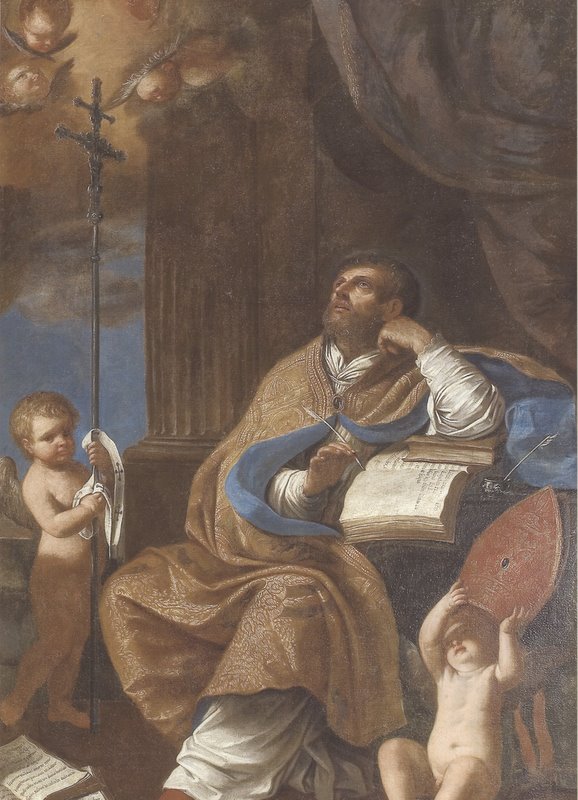
St. Peter Chrysologus

Peter Chrysologus was born at Imola in 406 and died there in 450.

Read the essentials →
Feast July 30 · Bishop

St. Peter Chrysologus

Current feast

July 30
Verified · General Roman Calendar (Wikipedia list)

Traditional feast

December 2
1914 / pre-1969 calendar, per Baring-Gould (1897)

Represents

Bishop

Feast days

Feast: July 30
Traditional: December 2

This Saint’s Story

The Catholic Encyclopedia notes that his first biography, written by Agnellus of Ravenna in the ninth century (Liber pontificalis ecclesiae Ravennatis), gives only a scanty account. He was baptized, educated, and ordained deacon by Cornelius, Bishop of Imola, and in 433 was elevated to the bishopric of Ravenna. There are indications that Ravenna already held metropolitan rank before his time.

His piety and zeal won wide admiration, and his oratory earned him the name Chrysologus, "golden word." He shared the confidence of Pope Leo the Great and enjoyed the patronage of the Empress Galla Placidia, whose court made Ravenna a center of imperial and church life in the West. After the Synod of Constantinople condemned the Monophysite Eutyches in 448, Eutyches tried to win Peter's support by letter and failed. Benedict XIII later numbered Peter among the Doctors of the Church (1729).

Felix, Bishop of Ravenna from 707 to 717, gathered a collection of 176 homilies under Peter's name. Some pieces in that collection are interpolations, and other sermons known to be his appear elsewhere under different names. The authentic ones are brief and close to Scripture. They explain the mystery of the Incarnation, answer the errors of Arius and Eutyches, expound the Apostles' Creed, and include series dedicated to the Blessed Virgin and to St. John the Baptist. Early printed editions at Bologna and Venice, and later the Patrologia Latina, made the corpus widely available.
Short entry · the summary here is 99 words; Baring-Gould’s fuller original text and its sources are below. We have not filled any gap with invented detail.

What he represents

How he teaches us to live

Drawn from themes in the original account

Share your faith, in words and by example. Preaching and conversion are part of this story.

Celebrate this saint’s feast day. Remember him on July 30 with a short prayer, and ask for his help.

The full story

Baring-Gould’s account retold in modern English

Read the full story · 99 words · about 1 min

Saint Germanus of Auxerre died in Ravenna and was buried by Saint Peter, who inherited his old rough sackcloth as a priceless treasure. Eutycheus wrote to the archbishop to complain about his condemnation by Flavian, and Peter sent him a letter in response that is still preserved. Seventy-six of his sermons are also still available. If these sermons earned him the title of "Golden Speaker," then the average quality of preaching at that time must have been quite poor. The chapel where he used to officiate is still standing, decorated with contemporary mosaics, in the archiepiscopal palace at Ravenna.

Footnotes

  1. Eutycheus was a Christian theologian who faced condemnation for his beliefs.

Baring-Gould’s own footnotes, in modern English.

Read the original 1870s text

Baring-Gould’s sources: Roman Martyrology, Dec. 2 and 4. Authorities Mention in Life of S. Germanus of Auxerre, his Epistle to Eutyches, &c.] S. Peter Chrysologus was a native of Imola. He was ordained deacon by his bishop, Cornelius. On the death of John I., bishop of Ravenna, Peter was elected by the clergy and people as his successor.

S. Germanus of Auxerre died at Ravenna, and was buried by S. Peter, who inherited as inestimable treasure his old rough sackcloth. Eutychec wrote to the archbishop to complain of his condemnation by Flavian, and Peter sent him a letter in reply which is still preserved. Seventy-six of his sermons are also extant. If they obtained for him his title of “ Golden Speaker,” the average powers of preaching at the period must have been very leaden. The chapel in which he was accustomed to officiate is still standing, adorned with contemporary mosaics, in the archiepiscopal palace at Ravenna.

From the Catholic Encyclopedia

1913 · 313 words

Born at Imola, 406; died there, 450. His biography, first written by Agnellus (Liber pontificalis ecclesi=E6 Ravennatis) in the ninth century, gives but scanty information about him. He was baptised, educated, and ordained deacon by Cornelius, Bishop of Imola, and was elevated to the Bishopric of Ravenna in 433. There are indications that Ravenna held the rank of metropolitan [the archbishop who heads a group of dioceses] before this time. His piety and zeal won for him universal admiration, and his oratory merited for him the name Chrysologus. He shared the confidence of Leo the Great and enjoyed the patronage of the Empress Galla Placidia. After his condemnation by the Synod of Constantinople (448), the Monophysite Eutyches endeavoured to win the support of Peter, but without success.

A collection of his homilies, numbering 176, was made by Felix, Bishop of Ravenna (707-17). Some are interpolations, and several other homilies known to be written by the saint are included in other collections under different names. They are in a great measure explanatory of Biblical texts and are brief and concise. He has explained beautifully the mystery of the Incarnation, the heresies of Arius and Eutyches, the Apostles' Creed, and he dedicated a series of homilies to the Blessed Virgin and St. John the Baptist. His works were first edited by Agapitus Vicentinus (Bologna, 1534), and later by D. Mita (Bolonga, 1634), and S. Pauli (Venice, 1775)-the later collection having been reprinted in P.L., LII. Fr. Liverani ("Spicilegium Liberianum"), Florence, 1863, 125 seq.) edited nine new homilies and published from manuscripts in Italian libraries different readings of several other sermons. Several homilies were translated into German by M. Held (Kempten, 1874).

BARDENHEWER, Patrology, tr. SHAHAN, 526 sqq.; DAPPER, Der hl. Petrus von Ravenna Chrysologus (Posen, 1871); LOOSHORN, Der hl. Petrus Chrysologus und seine Schriflen in Zeitschrift f. kathol. Theol., III (1879), 238 seq.; WAYMAN, Zu Petrus Chrysologus in Philologus, LV (1896), 464 seq.

Learn more about this saint →Their full life, teachings, every verified quotation in their own words, legacy, and free public-domain reading.

Help us add to this saint's story

Everything is read by a person before anything appears. Facts are checked against trusted sources first.

Facts are welcome; a source link helps (optional).With your permission we may share it on this page.

Nine days · Free

Pray the novena
with us.

One short email a day for nine days. The day's prayer, a line from St. Peter Chrysologus's story, and a nudge to keep going.

Also on December 2
F

St. Florentia (December…

December 2 · Virgin
A

St. Algeric of Verdun

December 2 · Bishop
St. Eligius of Noyon

St. Eligius of Noyon

December 2 · Bishop
← All 1970 saints in the library
Sources & notes

Feast-day sources

Story sources

Sources

Credits

Image: Saint Peter Chrysologus.jpg · School of Guercino · Public domain, via Wikimedia Commons

Image: School of Guercino, Wikimedia Commons (Public domain)

From “Catholic Encyclopedia (1913)/St. Peter Chrysologus,” The Catholic Encyclopedia (New York: Robert Appleton Company, 1907–1914), via Wikisource. Public domain. Matched by name and feast date; text unedited except for our bracketed notes in grey.

Retold in plain modern English from Baring-Gould’s public-domain text, sentence by sentence, keeping the same facts and order. Short explanations in parentheses are ours.

From Sabine Baring-Gould, The Lives of the Saints, new edition in 16 vols. (London: John C. Nimmo, 1897–98); text from the Internet Archive scan (OCR, lightly cleaned; errors possible). Public domain in the United States. Reproduced unedited, except for short bracketed notes in grey that we added to explain names and terms (“S.” is the old abbreviation for Saint). Some history and judgments reflect 19th-century scholarship.

Notes

Story retold in our own words from the cited sources.