St. Eligius of Noyon

Eligius, in French Eloi, was born about 590 at Chaptelat near Limoges, the son of Eucherius and Terrigia.

Read the essentials →
Traditional feast December 2 · Bishop

St. Eligius of Noyon

Feast

Traditional feast: December 2 (Roman Martyrology 1916 (archive.org OCR, sources/rm1916.txt))
Traditional date · cited source, no current calendar entry found

Traditional feast

December 2
1914 / pre-1969 calendar, per Baring-Gould (1897)

Represents

Bishop

Feast days

Feast: December 2

This Saint’s Story

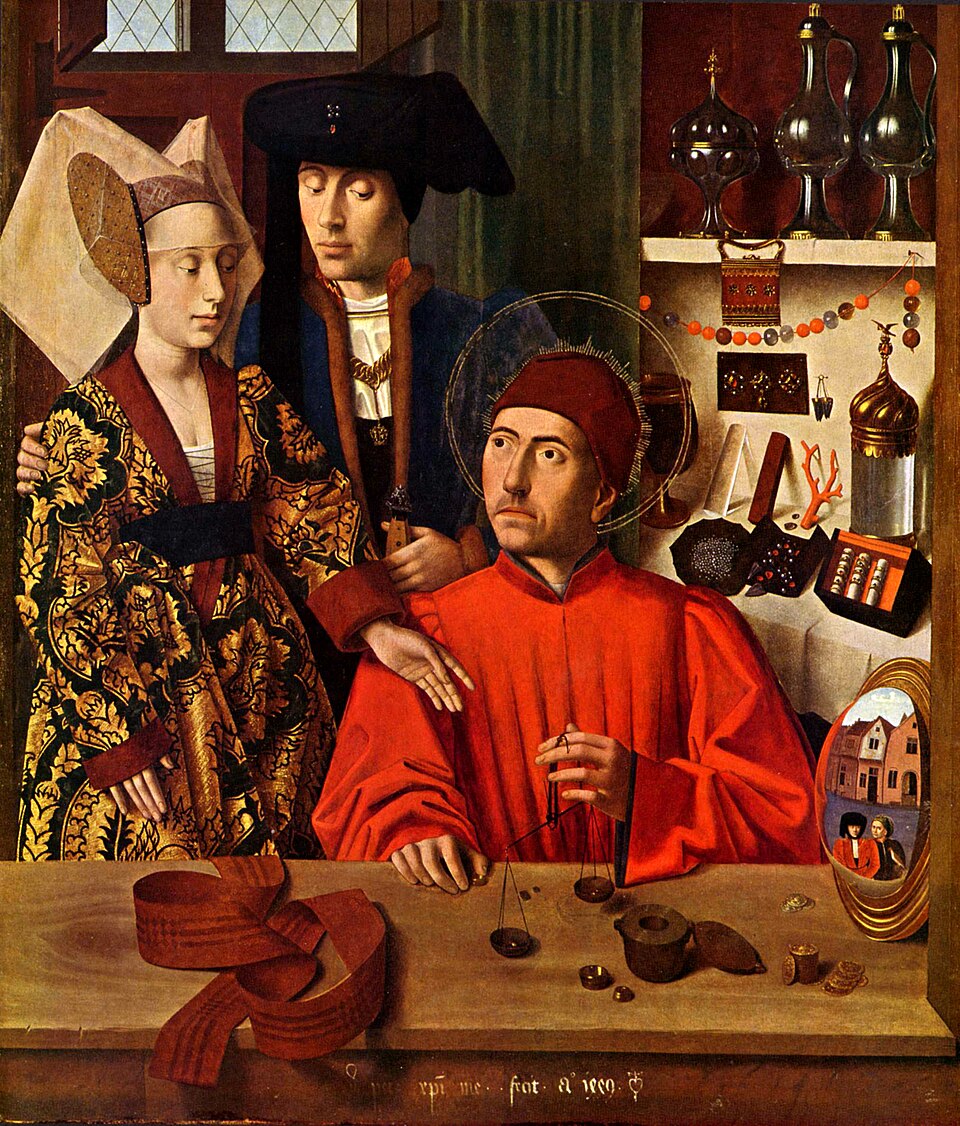
His father saw his talent and sent him to Abbo, a goldsmith and master of the mint at Limoges. In Neustria he worked under the royal treasurer Babo, and Clotaire II commissioned him to make a throne of gold set with precious stones. His honesty with the materials so pleased the king that he made him master of the mint at Marseilles and took him into his household. Baring-Gould says the king would sooner take Eligius's word than another man's oath.

Under Dagobert he became chief councillor. Ambassadors called on him before they called on the king, and in 636–37 he persuaded the Breton king Judicail to submit. He used his influence to win alms for the poor and to ransom captives arriving daily at Marseilles, whether Roman, Gallic, Breton, Saxon or Moorish. With the king's leave he had the bodies of executed criminals taken down and decently buried. With his friend Dado, St. Ouen, he lived at court by the Irish rule of St. Columbanus. He founded Solignac in 632 and a convent in Paris where three hundred virgins lived under the Abbess Aurea.

After Dagobert died in 639, Eligius and Dado left the court for the priesthood. In 640 he succeeded Acarius as Bishop of Noyon-Tournai, a diocese still largely pagan, and he worked to convert the Flemings, the people of Antwerp, the Frisians and the Suevi. He built a church to St. Quentin and translated the remains of St. Fursey. A sermon of his against pagan practices survives. Baring-Gould gives stories of relic-finding and the famous tale of a restive horse whose leg he is said to have taken off, shod and put back. These belong to tradition rather than sober history.

He died at Noyon on 1 December 660; Baring-Gould dates it 659. His relics were often translated in the Middle Ages, and he is especially honoured in Flanders. The Catholic Encyclopedia states that he is the patron of goldsmiths, blacksmiths and all metalworkers, and that cabmen have also placed themselves under his protection.

Struggles & surrender

His struggles

  • A scrupulous conscience ·
    He hesitated to swear allegiance in case he could not serve with a good conscience, and after confession he longed for a sign that he was truly forgiven (St. Ouen).

What he represents

How he teaches us to live

Drawn from themes in the original account

Build up the community you belong to. Community life is part of this story.

Celebrate this saint’s feast day. Remember him on December 2 with a short prayer, and ask for his help.

The full story

Baring-Gould’s account retold in modern English

Read the full story · 2,155 words · about 9 min

Eligius worked closely with a goldsmith from Limoges named Abbo, who was the master of the mint there. With Abbo's guidance, Eligius gained significant skill in working with precious metals and possibly also in the enamel work that later made Limoges famous.

He then moved to Paris, where he was placed under Bobbo, the treasurer of King Clothair II. The king wanted a throne made of precious metal, and since he could not find anyone else capable of doing the job, he entrusted it to Eligius, providing him with the necessary metal.

Eligius discovered that he had enough metal to create two thrones. Once they were completed, he presented one to the king, who admired it and ordered payment for the skilled craftsman. Eligius then revealed the second throne. The king was so impressed by Eligius's honesty that he immediately promoted him to master of the mint and placed his full trust in him.

To secure Eligius's loyalty, the king brought him before some relics and asked him to place his hand on them and swear allegiance. Eligius hesitated, unsure of how he could serve his master with a clear conscience. Instead of being offended by this hesitation, Clothair respected it and stated that he would prefer Eligius's word over the oath of anyone else.

At that time, Saint Ouen was at the court of Dagobert. He was a young noble, a few years younger than Eligius. Ouen and Eligius formed a close bond and shared their hopes and struggles with each other. Eligius hung small packets of relics from nails in the ceiling of his bedroom. After making his general confession and imposing a penance on himself, he was eager to know if he had truly been forgiven and if his penance had been accepted.

One of the little hanging packets began to emit a peculiar odor and drip with an oily substance. Eligius took this as a sign that he had been absolved in heaven.

The affection that Clothair II had for Eligius was passed on to the king's son, Dagobert. This king honored his master of the mint with his special trust. He even chose Eligius as his ambassador to the prince of Brittany, likely Judicael, who had taken on the royal title and had attacked and defeated the Frank soldiers in the plains of Le Mans. Judicael was the father of Saint Winoc and Saint Judoc, and he is also honored among the saints. Dagobert found the Breton prince to be a dangerous neighbor, and the task he assigned to Eligius was a delicate one. Eligius was to warn the prince about the dangers of provoking the powerful Frank monarch and to establish peace without resorting to arms. According to Fredegar, Judicael came to Clichy and paid homage to Dagobert.

Eligius returned to Paris and focused on creating gold and jewel-encrusted vessels for his master. As the master of the mint, he struck coins, some of which still exist today, bearing his name. His friend Saint Ouen provides the following description of his appearance: “He was tall, with a ruddy face; his hair and beard were naturally curly. His hands were well-formed, and his fingers were long. His face had an angelic sweetness, and his expression conveyed prudence and simplicity. At first, he wore garments adorned with gold and precious stones, and he had belts sewn with pearls. His clothing was made of linen encrusted with gold, and the edges of his tunic were trimmed with gold embroidery; indeed, his attire was very expensive, and some of his garments were made of silk. This was his appearance during his early time at court, and he dressed this way to avoid standing out. However, beneath these rich garments, he wore rough sackcloth. Later on, he gave away all his ornaments to help the needy, and he could be seen wearing only a cord around his waist and simple clothes. Sometimes, when the king saw him without his rich clothing, he would take off his own cloak and belt and give them to him, saying, 'It is not suitable that those who live for the world should be richly clad, and that those who despoil themselves for Christ should be without glory.'”

Dagobert was willing to grant him any reasonable favor he requested. Eligius asked the king for the estate of Solignac in Limousin, where he wanted to establish a monastery. The location was beautiful, with a river flowing around the piece of land where the abbey would be built. It was surrounded by hills and woods, and the rocky slope leading to the river was rich in spring with golden broom and purple lungwort, and in autumn with crimson wild vine, yellow maples, and brown beech trees. When Eligius completed the abbey, it was filled with a large number of monks, growing to one hundred and fifty. When S. Ouen stayed there, he found that it was unmatched by any monastery in France in its strict observance of discipline.

Eligius gave up his own house in Paris to S. Aurea so that it could become a convent for religious women under her guidance. His strict integrity was evident in the founding of this religious house, just as it was in the making of a throne. He had requested a grant of the land on which the house stood from the king, and he was granted it. He had claimed it occupied a certain number of yards of ground. However, when the outbuildings were cleared away and the land was remeasured, it turned out that his estimate was off by a yard or two, and there was actually more land than he had stated. He immediately halted the construction and refused to allow it to continue until he had informed the king of the situation and received his approval for the use of the additional few yards. After this, he rebuilt the dilapidated church of S. Martial.

Not long after, Paris was engulfed in flames, and the fire approached the new church. Sparks and smoke were blown over the roof, and at any moment, it was feared that S. Martial's church would catch fire. Then Eligius shouted, “Martial! Martial! Take good care of your church, for if you do not protect it, you can be sure that Eligius will not bother to rebuild it for you.” The saint understood the message and saved the church from destruction. Eligius continued to work with precious metals and created shrines for many relics, the most famous being those for S. Martin and S. Brice. He covered the marble tomb of S. Denys with gold and jewels, and he adorned the ends of the altar with gold, featuring gold apples set with jewels, likely pomegranates, with crimson rubies representing the seeds bursting through the golden pods.

After the death of Acharius, the bishop of Noyon, Eligius was chosen to succeed him. He and his friend Saint Ouen were consecrated on the same day, May 14, Rogation Sunday, in the year 640. Eligius became the bishop of Noyon, which included the see of Tournai, and he had jurisdiction over Ghent and Courtrai. Ouen was consecrated as the bishop of Rouen.

As a bishop, Eligius was as diligent as he had been when he was a layman. He worked tirelessly to convert the half-Christian, half-pagan Flemings and to ensure that his clergy were examples of light in the world. Saint Ouen has preserved a very valuable sermon by Eligius, which provides significant insight into the superstitious practices that were common among the people at that time. In this sermon, he cautions his congregation not to consider sneezing as an omen, except, of course, in the case of the coming.

December 1: Saint Eligius. He advises against being troubled by a heavy cold in the head, nor should one pay superstitious attention to the songs of birds or the days when they leave their nests, such as the first day of the new moon or during eclipses. He forbids celebrating the first of January with feasting, dancing, and profane ceremonies, as well as the festival of Saint John the Baptist and the solstices, which involve capers, "carols," and diabolical songs.

He specifically condemns the observance of the month of May, as well as the festivals dedicated to moths and mice. The lighting of torches along the side of a road—apparently not for the purpose of providing light but for some superstitious reason—should be avoided. He criticizes the practice of priests writing passages of Scripture on scraps of paper to be worn around the neck as charms.

Saint Eligius wisely states that such charms are not a Christian remedy but rather devil’s poison. The practice of passing cattle through a hole made in the earth or through a hole in a tree is also to be rejected. Women must not wear amber around their necks or in their belts while invoking Minerva. Only fools believe, according to Eligius, that madmen are influenced by the changes of the moon.

He advises against consulting quack doctors and witches when sick, instead recommending that the efficacy of holy unction be tried, which will help in recovering the sick from their ailments. Fountains should not be considered sacred, trees that are venerated should be cut down, and anyone who finds small representations of feet hung up at crossroads should throw them away.

The sermon goes on to give very wholesome moral advice, which, however, contains little that is unique. Saint Eligius found much paganism lingering in the area around Antwerp, and he is said to have converted many Suevi. One would hardly expect to find Swabians so far north as his diocese.

But if Eligius saw the conversion of pagans and the improvement of professed Christians as a duty, he pursued the discovery of the bones of martyrs with great enthusiasm. Noyon believed it was the site of the martyrdom of Saint Quentin. If Quentin had died there, he must have been buried there. If he was buried there, then his remains might be found. Eligius decided to search for the bones. Several people told him that if he was buried there, Quentin must have turned to dust long ago. However, Eligius was not convinced by such arguments. He vowed not to eat anything until he found a body that could be recognized as that of Saint Quentin. He began to dig up the church floor. The sacred area looked like a mine. Workers dug here and there in all the most likely spots, but found nothing. Eligius had gone three days without food when, at last, in the most unlikely place for a martyr's body to be buried, in the ditch of the church, the laborers discovered a tomb made of stones, and inside it were bones and nails. Eligius's enthusiasm turned into wild joy when, while pulling the teeth out of the jaw for distribution to other churches, a drop of some slimy substance that looked like blood appeared at the root of one of the fangs. The nails found in the tomb probably belonged to a wooden coffin, but their presence convinced Eligius that he had found the genuine body of the martyr, who, according to legend, was killed by having nails driven into his head. After this discovery, Eligius began to search for other saints and was fortunate enough to also find Saint Piatus, who also had nails. He made gold shrines for all these relics, as well as for the bodies of Saints Crispin and Crispinian, which he unearthed at Soissons. According to the story, in Beauvais, he miraculously discovered the body of Saint Lucian, the companion of Saint Quentin, and he made a shrine for him as well.

He attended the council of Châlons-sur-Saône in either 644 or 650, but the exact date cannot be determined with certainty. It was on his return from this council that he took charge of Saint Godeberta, as is mentioned in the life of that saint (April 11). Saint Eligius died on December 1, 659, surrounded by his faithful servants and beloved by his flock. The relics of Saint Eligius are still located in the cathedral of Noyon. His head is in the parish church of Saint André at Chelles. Other relics, including teeth and bits of bone, are found at Saint Barthélemy in Noyon, the cathedral in Bruges, Saint Martin in Tournai, and Saint Pierre in Douai. An arm is kept in the cathedral in Paris. In art, he is mistakenly depicted as a farrier, holding a horse's leg. The story goes that while he was shoeing a horse one day, the animal became restless, so he removed the leg, shod it, and then put it back on without any negative consequences.

It is, however, quite possible that the discovery of nails in the vault containing the supposed relics may have given rise to the fable of martyrdom by means of nails.

Footnotes

  1. Aimoin speaks of Dagobert using a golden throne, no doubt that fashioned by Eligius.
  2. A gold sou with the head of Dagobert on one side and the legend “Panama ceve fit (Paris ina civitate fecit),” on the other a cross and the legend “Dagobertus rex.” Under the arms of the cross "Eligius."
  3. Another gold sou, with a similar head and cross, and the legends "Parisiis fit" and "Eligius mone" (monetarius).
  4. Another coin of the same value, with the legend "Mon palati" (moneta palatina) and "Scolare T.A." Under the arms of the cross "Eligius."
  5. Another of the same value, with the legend "Parisi civ... Dagobertus rex," and "Eligius fit."
  6. One struck in 637 or 638 for Clovis II.
  7. The estate of Solignac is located in Limousin, a region in France.
  8. S. Ouen is a saint known for his role in the church.
  9. S. Aurea is a saint who led a convent for women.
  10. S. Martial is a saint associated with the church mentioned.
  11. S. Denys is a saint whose tomb was elaborately decorated.
  12. “Consecrati sum us gratis ab episcopis pariter episcopi ego Rodamo, ille Norinio.”
  13. The observance of the festival of Saint John the Baptist is forbidden, along with solstice celebrations, dancing, and diabolical songs.
  14. An Irishman once asked for a "Gospel" to be written on a scrap of paper to hang around his child's neck as protection against measles and diarrhea. These charms are often sought by the Irish from their priests and are sewn into small bags for a fee.
  15. The Council of Auxerre in 589 forbade the creation of small representations of feet or human figures.
  16. Except, perhaps, this: “ Qui ante legitimas nuptias habere concubinam praesumit, pejus peccat quam qui adulterium committit.”
  17. A phallus was sculptured over one of the city gates; this has been obliterated only in recent times.
  18. Christianity so far sanctioned this heathen superstition as to make the “ sacrosanctum pracputium ” the palladium of Antwerp.
  19. In like manner in Elsass in heathen times the club of Hercules received sacred worship.
  20. When Elsass was Christianized this was converted into the staff of Saint Peter given to Saint Maternus.
  21. Fragments still receive veneration.
  22. The “ sacrosanctum pracputium ” has been made to disappear; it has not, at all events, been presented to the adoration of the faithful since the riots of 256.
  23. The discovery of nails in the vault may have originated the fable of martyrdom by means of nails.

Baring-Gould’s own footnotes, in modern English.

Read the original 1870s text

Baring-Gould’s sources: Roman and Gallican Martyrologies, Usuardus, &c. Authorities: — A Life by Dado (S. Ouen) bishop of Rouen, d. 683; in Ghasqui&re, A A. SS. Belgii, iii. p. 198; and Dachery, Spicil. v. p. 156; in Surius altered and curtailed.] Eligius was bom at Chitelat near Limoges. His father's name was Eucherius, his mother's Terrigia. He was placed Dec. x.] S. Eligius.

Nearly with a goldsmith of Limoges, named Abbo, master of the mint there, and with him Eligius acquired great skill in the work of the precious metals, and, perhaps, also in that enamel work which afterwards made Limoges famous.. He went next to Paris, and was placed with Bobbo, treasurer of Clothair II. The king wanted a seat, or throne, made of precious metal, and as he could find no one else capable of undertaking the task, he confided it to Eligius, giving him at the same time the metal necessary for making the throne. Eligius found that he had enough to make two seats. When they were done he gave one to the king, who admired it, and ordered payment to be made to the skilful workman. Then Eligius produced the second throne.1 The king was so struck with his honesty, that he immediately advanced him to be master of the mint, and gave him his entire confidence. The king, anxious to secure Eligius to him more securely, brought him before some relics [the bodily remains of a saint, or objects they used, kept with honor] and bade him place his hand on them, and swear to him devout allegiance. The goldsmith hesitated: he was uncertain how far he could serve his master with a good conscience. Clothair, instead of being offended at this hesitation, respected it, and said he had rather have the word of Eligius than the oath of another man.

S. Ouen was then at the court of Dagobert; he was a young noble, a few years the junior of Eligius. Ouen and Eligius became mutually attached, and confided to each other their desires and troubles. Eligius hung little packets of relics from nails in the ceiling all round his bedroom. After having made his general confession, and imposed on himself a penance, he was very desirous of knowing if he were really pardoned, and his penance accepted. One of the little hanging packets dignitati congruam.” Mediaeval artists rendered this a saddle, and made of Eligius a farrier. Aimoin speaks of Dagobert using a golden throne, no doubt that fashioned by Eligius.

began to emit a peculiar odour, and drip with some oily matter, and Eligius accepted this as an omen that he was absolved in heaven.

The affection borne by Clothair II. to Eligius passed to the king's son Dagobert, and this king honoured his master of the mint with his special confidence. He even chose him as his ambassador to the prince of Brittany, apparently Judicael, who had assumed the royal title, and attacked and defeated the Frank soldiers in the plains of Le Mans. Judicael was the father of S. Winoc and S. Judoc, and is also honoured among the saints. Dagobert found the Breton prince a dangerous neighbour, and the commission he gave to Eligius was a delicate one — to enforce on the prince the danger of provoking the powerful Frank monarch, and to establish peace without having recourse to arms. Judicael, according to Fredegar, came to Clichy and did homage to Dagobert. Eligius returned to Paris, and occupied himself in hammering out gold and jewel-encrusted vessels for his master. As master of the mint he struck coins, some of these remain, bearing his name.1 His friend S. Ouen gives the following description of his appearance: — “ He was tall, with a ruddy face, his hair and beard were naturally curly; his hands wellmade and his fingers long, his face was full of angelic sweetness, and his expression was one of prudence and simplicity. At first he wore habits covered with gold and precious stones, he had also belts sewn with pearls. His dress was of linen encrusted with gold, and the edges of his tunic trimmed with gold embroidery; indeed, his clothing was very costly, and 1 (>) A gold i sou with the head of Dagobert on one side and the legend “ Panama ceve fit ** (Paris ina civitate fecit), on the other a cross and the legend “ Dagobert us rex.*' Under the arms of the cross " Eligi.” (s) Another gold i sou, with similar head and cross, and the legends " Parisiis fit** and "Eligius mone " (monetarius). (3) Another coin of same value, with legend " Mon palati *’ (moneta palatina) and " Scolare T.A." Under the arms of the cross " Eligi." (4) Another of same value, with legend " Pari si civ... “ Dagobert us rex," and " Eligi fit." (5) One struck in 637 or 638 for Clovis II.

some of his dresses were of silk. Such was his exterior in his first period at court, and he dressed thus to avoid singularity; but under these rich garments he wore a rough sackcloth, and later on, he disposed of all his ornaments to relieve the distressed, and he might be seen with only a cord round his waist, and common clothes. Sometimes the king, seeing him thus divested of his rich clothing, would take off his own cloak and girdle, and give them to him, saying, * It is not suitable that those who live for the world should be richly clad, and that those who despoil themselves for Christ should be without glory/ ”

Dagobert was ready to grant him any favour he liked to ask in reason. Eligius requested the king to grant him the estate of Solignac in Limousin, on which to found a monastery. The situation was delightful, a river swept round the tongue of land on which the abbey was to rise, hills and woods surrounded it, and the rocky descent to the river was rich in spring with golden broom and purple lungwort, and in autumn with crimson wild vine, yellow maples, and brown beech. The abbey when completed by Eligius was filled by a swarm of monks, the numbers grew to a hundred and fifty, and when S. Ouen lodged there he found that it was unsurpassed by any monastery in France in its regular observance of discipline. He gave up his own house in Paris to S. Aurea, to become a convent for religious women under her guidance. His strict integrity appeared in the foundation of this religious house, as in the making of a throne. He had asked of the king a grant of the land on which the house stood, and had been accorded it He had represented it as occupying so many yards of ground. But when outbuildings were cleared away, and the land was remeasured, it was found that his estimate was wrong by a yard or two, and that there was more ground than he had represented. He at once stopped the works, and refused to allow them to be fDec. i.

proceeded with till he had stated the fact to the king, and obtained his consent to the appropriation of the additional few yards. After this he rebuilt the dilapidated church of S. Martial. Not long after Paris was in flames, and the conflagration neared the new church. Sparks and smoke were carried over the roof, and at every moment it was thought S. Martial's church would burst into flame. Then Eligius cried out: “ Martial ! Martial ! look well after thy church, for if thou dost not protect it, thou must be assured that Eligius will not take the trouble to rebuild it for thee.” The saint took the hint, and saved the church from destruction. He continued to work at the precious metals, and made shrines for a great many relics, the most famous ones were those for S. Martin [St. Martin of Tours (d. 397), soldier turned bishop] and S. Brice. The marble tomb of S. Denys he covered with gold and jewels, he encased the ends of the altar in gold, with gold apples set with jewels, probably pomegranates, with crimson rubies for the seed bursting through the golden pods.

On the death of Acharius, bishop of Noyon, Eligius was elected to succeed him. He and his friend S. Ouen were consecrated the same day, May 14, Rogation Sunday, 640, he to the see of Noyon [a bishop’s “see” is his diocese, named from his seat (Latin sedes)], including that of Tournai, with jurisdiction over Ghent and Courtrai, and Ouen to the bishopric of Rouen.1 As a bishop, Eligius was as conscientious as he had proved himself when a layman. He laboured indefatigably at the conversion of the half-Christian, half heathen Flemings, and at making his clergy lights to the world. S. Ouen has preserved to us a most precious sermon of Eligius, which throws much light on the superstitious practices then I in vogue among the people. He warns his people not to ' regard sneezing as ominous, except, of course, of the coming 1 “ Consecrati sum us gratis ab episcopis pariter episcopi ego Rodamo (sic), ille Norinio.”

on of a heavy cold in the head, nor to pay superstitious regard to the songs of birds, nor to the days on which they leave home — such as the first day of the new moon, or the eclipses; he forbids the observance of the first of January with feasting, dancing, and profane ceremonies, or the festival of S. John the Baptist, and the solstices, with capers, “carols,” and diabolical songs.1 The observance of the month of May he specially condemns; as also the festivals of moths and mice.2 The lighting of torches along the side of a road — not apparently for the sake of giving light, but for some superstitious reason— was to be avoided. He reprobates the custom of priests writing passages of Scripture on scraps of paper to be hung round the neck as charms.3 Such charms, says S. Eligius, very sensibly, are not a Christian remedy, but devil’s poison. The passing of cattle through a hole made in the earth, or through a hole in a tree, is also to be renounced; women must not wear amber round their necks, or in their zones, with invocation of Minerva. Only fools think, says Eligius, that madmen are affected by the changes of the moon. Quack doctors and witches are not to be resorted to in cases of sickness, but the efficacy of holy unction is to be tried, and that will prove of avail in recovering the sick of his malady. Fountains are not to be held sacred, trees which receive veneration are to be cut down, and whoever finds little representations of feet hung up in cross roads is to fling them away.4 The sermon goes 1 “ Nullus in fesrivitate S. Joann is.... solstitia, aut vallationes, vel saltationes, aut caraulus aut cantica diabolica exerceat. ” 3 An Irishman came to me one day in Yorkshire, and asked me for a “ Gospel,” r.r., for a text to be written on a scrap of paper to hang round his child's neck, " as a preservative against measles and looseness of the bowels." These charms are commonly sought by the Irish of their priests, and are sewn up in little bags. They pay a fee for them.

4 “ Pedum similitudines, quos per bivia ponunt, fieri vetate, et, ubi inveneritis, igni cremate.” The Council of Auxerre (589) forbade (art. 3) " nec sculptilia aut pede aut homine lineo fieri prsesumat.”

[Doc. i. on to give very wholesome moral advice, which, however, contains little that is peculiar.1 S. Eligius found most paganism hanging about the neighbourhood of Antwerp,2 and he is said to have converted many Suevi. One would hardly have expected to find Swabians so far north as his diocese.

But if Eligius pursued the conversion of heathen and the perfecting of professed Christians as a duty, he prosecuted the discovery of the bones of martyrs with the zest of pleasure. Noyon flattered itself that it was the scene of the martyrdom of S. Quentin. If Quentin had died there, he must have been buried there. If buried there, he might be found. Eligius determined to discover the bones. Several persons represented to him that if buried, Quentin must have dissolved to dust long ago. But Eligius was above conviction by such arguments as these. He vowed not to eat a morsel till he had found a body which would, at all events, pass for that of S. Quentin. He turned up the earth of the church floor. The sacred precincts resembled a mine. Workmen grubbed here, and grubbed there, in all the most likely places, but found nothing. Eligius had passed three days without food, when at last, in the most unlikely place for a martyr's body to be laid, in the ditch of the church, the labourers came on a tomb of stones, and within it were bones and nails. The enthusiasm of Eligius passed into the wildest transports of exultation, when, on pulling the teeth 1 Except, perhaps, this: “ Qui ante legitimas nuptias habere concubinam praesumit, pejus peccat quam qui adulterium committit.” A phallus was sculptured over one of the city gates; this has been obliterated only in recent times. Christianity so far sanctioned this heathen superstition as to make the “ sacrosanctum pracputium ” the palladium of Antwerp. In like manner in Elsass in heathen times the club of Hercules received sacred worship. When Elsass was Christianized this was converted into the staff of S. Peter given to S. Maternus. Fragments still receive veneration. The “ sacrosanctum pracputium ” has been made to disappear; it has not, at all events, been presented to the adoration of the faithful since the riots of 1566.

out of the jaw for distribution to other churches, a drop of some slimy matter that looked like blood exhibited itself at the root of one of the fangs. The nails found in the vault had probably belonged to a wooden coffin, but their presence served to convince Eligius that he had the genuine body of the martyr, who, according to legend, was put to death by means of nails driven into his head.1 After this discovery Eligius set to work to unearth other saints, and was so happy as to discover also S. Piatus, also with nails. He made gold shrines for ail these relics, and also for the bodies of SS. Crispin and Crispinian, which he exhumed at Soissons. At Beauvais he discovered miraculously the body of S. Lucian, the companion of S. Quentin, and he made a shrine for him also.

He attended the council of Châlons-sur-Saône in 644 or 650 — the date cannot be fixed with certainty; and it was on his return from this council that he took charge of S. Godeberta, as is related in the life of that saint (April 1 1). S. Eligius died in 659, on December 1, in the midst of his faithful servants, beloved by his flock. The relics of S. Eligius are still in the cathedral of Noyon. His head is in the parish church of S. André at Chelles. Other relics, teeth, bits of bone, &c., at S. Barthdlemy, Noyon, the cathedral at Bruges, S. Martin at Tournai, S. Pierre at Douai. In the cathedral at Paris an arm. In art he is represented erroneously as a farrier, with a j horse’s leg in his hand; the story going that as he was one day shoeing a horse, the animal proved restive, so he took the leg off, shod it, and put it on again, without evil consequences.

1 It is, however, quite possible that this discovery of nails in the vault containing the supposed relics may have originated the fable of the martyrdom by means of Mill.
Patron saint of

  • goldsmiths trade
    The Catholic Encyclopedia states that he is the patron of goldsmiths, blacksmiths, and all workers in metal.
  • blacksmiths trade
    The Catholic Encyclopedia states that he is the patron of goldsmiths, blacksmiths, and all workers in metal.
  • metalworkers trade
    The Catholic Encyclopedia states that he is the patron of goldsmiths, blacksmiths, and all workers in metal.

Help us add to this saint's story

Everything is read by a person before anything appears. Facts are checked against trusted sources first.

Facts are welcome; a source link helps (optional).With your permission we may share it on this page.

Nine days · Free

Pray the novena
with us.

One short email a day for nine days. The day's prayer, a line from St. Eligius of Noyon's story, and a nudge to keep going.

Also on December 2
F

St. Florentia (December…

December 2 · Virgin
A

St. Algeric of Verdun

December 2 · Bishop
St. Bibiana

St. Bibiana

December 2 · Virgin, Martyr
← All 1970 saints in the library
Sources & notes

Feast-day sources

Story sources

Sources

Credits

Image: Petrus Christus 003.jpg · Petrus Christus · Public domain, via Wikimedia Commons

Image: Petrus Christus, Wikimedia Commons (Public domain)

Retold in plain modern English from Baring-Gould’s public-domain text, sentence by sentence, keeping the same facts and order. Short explanations in parentheses are ours.

From Sabine Baring-Gould, The Lives of the Saints, new edition in 16 vols. (London: John C. Nimmo, 1897–98); text from the Internet Archive scan (OCR, lightly cleaned; errors possible). Public domain in the United States. Reproduced unedited, except for short bracketed notes in grey that we added to explain names and terms (“S.” is the old abbreviation for Saint). Some history and judgments reflect 19th-century scholarship.

Notes

Story retold in our own words from the cited sources.