This Saint’s Story
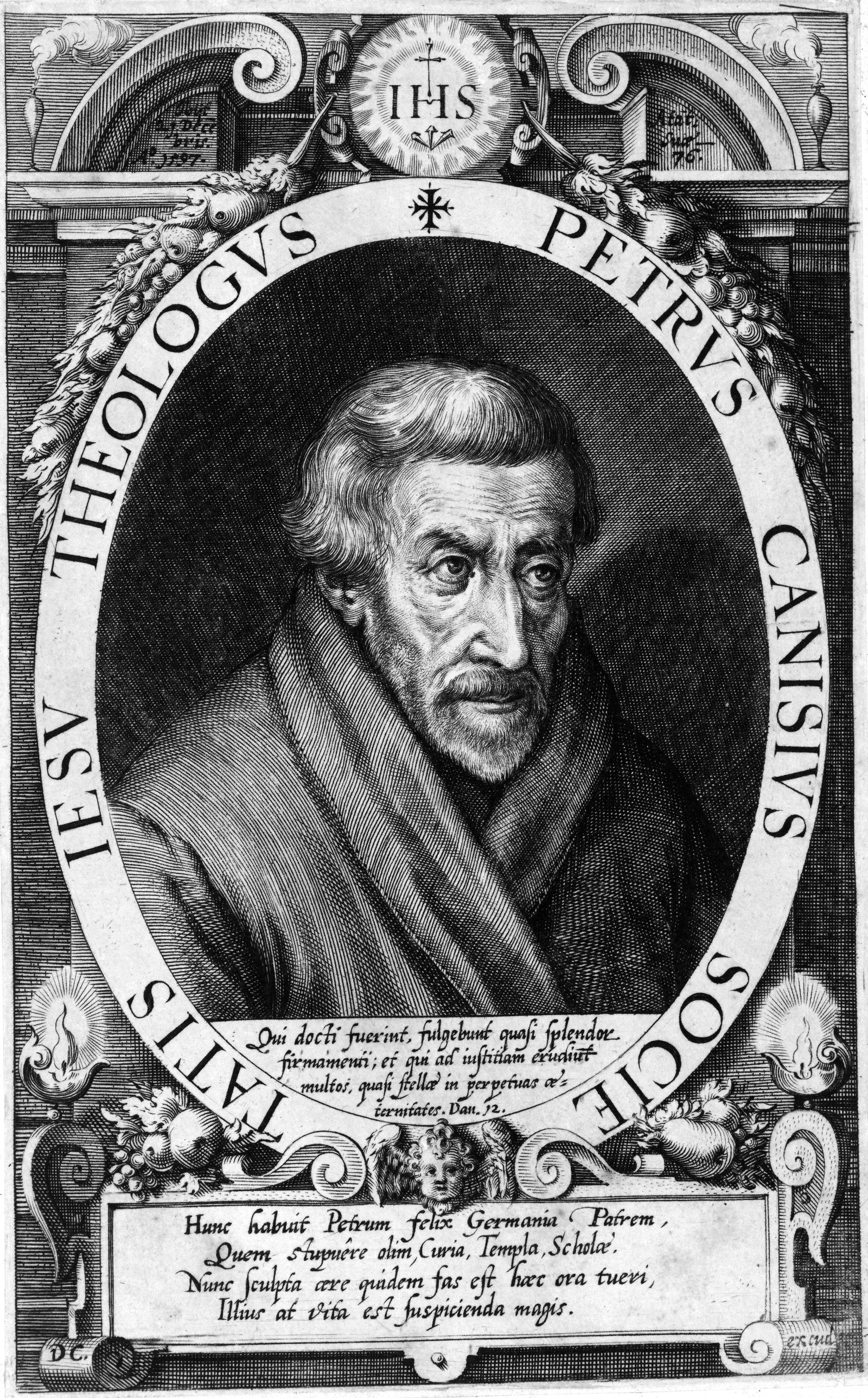
Peter Canisius was a Dutch Jesuit (member of the Society of Jesus, founded by St. Ignatius of Loyola) priest and a Doctor of the Church (a title the pope gives to a saint whose teaching is of special value to the whole Church). He was born on 8 May 1521 at Nijmegen, then in the Duchy of Guelders. His father, Jacob Kanis, was a wealthy burgomaster. His mother, Ægidia van Houweningen, died shortly after his birth. He studied at the University of Cologne and took a master's degree by the age of 19. There he met Peter Faber, one of the first companions of Ignatius of Loyola, and in 1543 he entered the Society of Jesus, the first Dutch member of the order. After his theological studies he was ordained a priest in 1546.
He spent his life in Germany, Austria, Bohemia, Switzerland, and for a time in Poland, preaching, founding colleges, and writing. He helped to establish the first Jesuit colleges in the German-speaking lands, often under hard conditions. He advised Emperor Ferdinand I, including in a case where he argued against the appointment of a married priest to a high post, and the priest was dismissed. In 1547 he took part in the Council of Trent (1545–1563, the Catholic Church's council answering the Protestant Reformation). In 1554 he was offered the see of Vienna and declined it, so that he could go on traveling and teaching. He later served as the main preacher in the cathedral of Augsburg.
His catechisms, written in several lengths, were the books many parishes used to teach the faith during the Reformation. They ran to hundreds of editions in German and Latin. He wrote so that ordinary people could follow Catholic teaching. His own letters treat it as a rule of the work that he would not answer insult with insult. He helped to hold Bavaria and the Rhineland for the Catholic faith, and he worked in Poland as well. In his later years he founded the Jesuit Collège Saint-Michel in Fribourg, in Switzerland, and went on teaching, writing, and hearing confessions there. He died in Fribourg on 21 December 1597, after a stroke.
Pope Pius IX beatified (declared 'Blessed', the step before sainthood) him in 1864. Pope Pius XI canonized (officially declared a saint by the pope) him on 21 May 1925 and declared him a Doctor of the Church. The General Roman Calendar keeps his optional memorial on 21 December, the day of his death. Parishes and schools still use his name.
For today: Teaching the faith in a divided time needs a book people can actually use. Canisius wrote catechisms in more than one length. You can explain one belief this week in words a teenager can repeat, and you can leave the insults out.