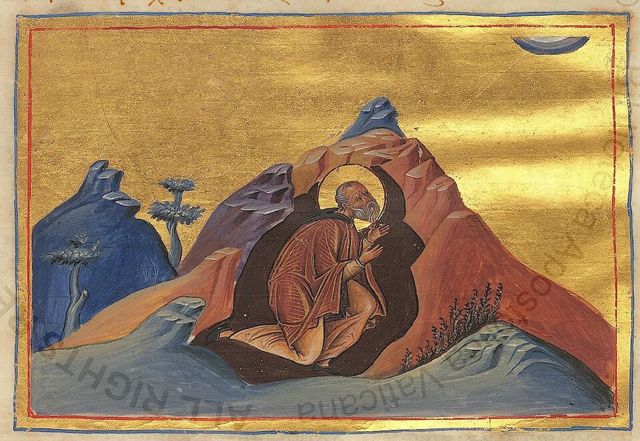
Paul the Simple was one of the first disciples of Saint Antony. He did not begin his religious life until he was sixty years old, and this was due to the bad behavior of his wife. He had been a laborer in a village in the Thebaid (a region in Egypt), and he was very uneducated. He came to Saint Antony, but the patriarch of hermits refused to accept him, thinking he was too old to take on the monastic life. However, Paul stayed outside Antony's cell for three days and nights, refusing to leave.
Antony then came out and saw that the man had no food; therefore, he allowed him to stay for a while, hoping that the harshness of hermit life would discourage him. He instructed Paul to pray outside his door and told him not to stop until he was released. The simple old laborer obeyed, and Antony watched him, unseen, as he prayed under the blazing sun at noon and under the moon at night, standing as still and unmoving as one of the date palms in the desert. Antony then brought him into his cave and gave him some weaving to do. When Paul finished, Antony scolded him for doing it poorly and told him to undo his work. The postulant complied without complaint.
Then Antony brought out bread, set the table for supper, and called the hungry Paul to join him. He said, "Before we eat, let us recite twelve psalms and twelve prayers," and they did so. When the psalms and prayers were finished, Antony said, "We have looked at the bread; that will be enough for supper. Now let us go to rest." Yet Paul did not complain, so Antony realized that he was fit to be a monk.
Once, while Antony and some of his guests were discussing spiritual matters, Paul asked very simply, "Were the prophets before Jesus Christ, or was Jesus Christ before the prophets?" Antony turned red and told him to stay in the background and be quiet. Paul immediately obeyed and remained silent and out of sight for a while, and the others informed Antony of this. Then he said, "Oh, my brothers! Learn from this man what our obedience to God should be. If I say anything, he does it instantly and cheerfully, and we—do we behave like this towards our God?"
Footnotes
- Thebaid: a region in Egypt known for its early Christian monastic communities.
Baring-Gould’s own footnotes, in modern English.
Read the original 1870s text
Baring-Gould’s sources: Greek Menæa and Roman Martyrology on the same day. But some Latin Martyrologies on Dec. 18th, others on Jan. 11th. Authorities:—Palladius, in his Hist. Lausiaca; Ruffinus, in his Lives of the Fathers of the Desert; and Sozomen, Hist. Eccles., lib. i., c. 13.
Paul the Simple was one of the first disciples of S. Antony. He did not embrace the religious life till he was sixty, and then it was in consequence of the bad conduct of his wife. He had been a labourer in a village of the Thebaid [the desert region of Upper (southern) Egypt], and was very ignorant. He came to S. Antony, but the patriarch [the title of the bishops of the great ancient sees: Rome, Constantinople, Alexandria, Antioch, Jerusalem] of hermits refused to admit him, thinking him too old to adopt the monastic life. Paul, however, remained three days and nights outside the cell of Antony, and would not leave. Antony then came forth, and found that the man had no food; he, therefore, received him for a while, hoping to disgust him with the life of a hermit by the severity of his discipline. He set Paul to pray outside his door, and told him not to desist till he was released. The simple old labourer obeyed, and Antony observed him, unseen, praying with the blazing sun shining down on his head at noon-day, and the moon looking on him at night, as rigid and immoveable as one of the date palms of the desert. He then brought him into his cave, and gave him some platting to do. When it was accomplished he rebuked Paul for his having done it badly, and bade him undo his work again. The postulant did as ordered without a murmur. Then Antony brought bread, and set the table in order for supper, and called the hungry Paul to it; then he said, "Before we eat, let us recite twelve psalms and twelve prayers," and he did so; and when the psalms and prayers were done, Antony said, "We have looked on the bread, that will suffice for supper; now let us retire to rest." Yet Paul murmured not; so Antony saw that he was qualified to be a monk.
Once, as Antony and some of his guests were discoursing on spiritual matters, Paul asked very simply, "Were the prophets before Jesus Christ, or Jesus Christ before the prophets?" Then Antony reddened, and bade him keep in the background, and hold his tongue. Now Paul at once obeyed, and remained for some time silent, and out of sight, and they told Antony of it. Then he said, "Oh, my brethren! learn from this man what our obedience towards God ought to be. If I say anything, he does it instantly and cheerfully, and we—do we thus behave towards our God?"