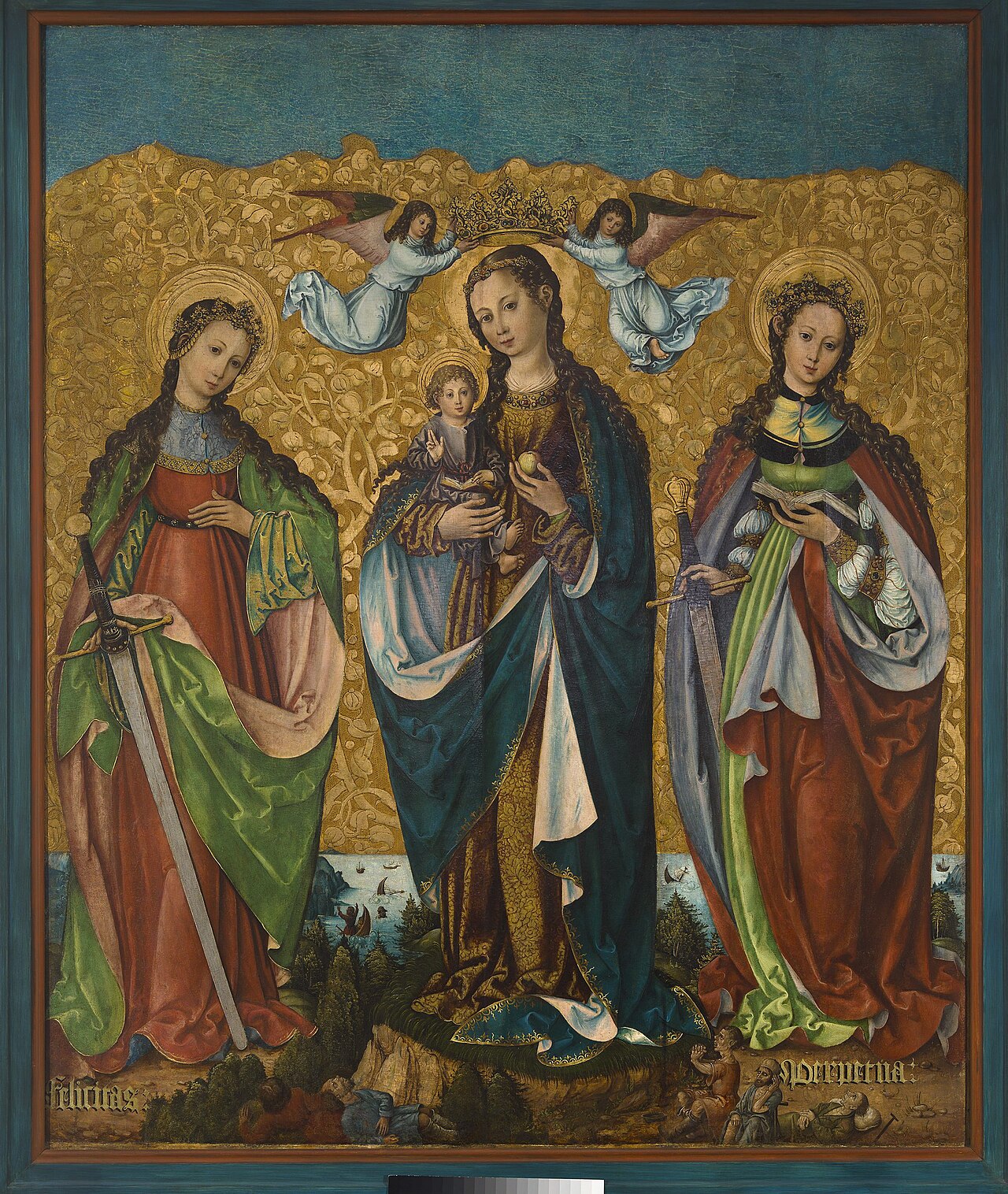
A violent persecution began under Emperor Severus in the year 202. It reached Africa the following year when, by order of Minutius Timinianus, or Firminianus, five catechumens were arrested in Carthage for their faith. These were Revocatus, his fellow-slave Felicitas, Saturninus, Secundulus, and Vivia Perpetua. Felicitas was pregnant, and Perpetua had an infant at her breast. She came from a good family, was twenty-two years old, and was married to a person of high status in the city. She had a father, a mother, and two brothers; the third brother, Dinocrates, had died when he was about seven years old. These five martyrs were joined by Saturus, who was probably Saturninus's brother and seemed to be their instructor. He voluntarily imprisoned himself because he did not want to abandon them.
Perpetua's father, who was a Pagan and advanced in years, loved her more than all his other children. Her mother was probably a Christian, as was one of her brothers, while the other was a catechumen. For several days before they were sent to prison, the martyrs were kept under strong guard in a private house. The account that Perpetua gives of their sufferings leading up to their death is as follows: "We were in the hands of our persecutors when my father, out of his affection for me, made new efforts to shake my resolution. I said to him, 'Can that vessel, which you see, change its name?' He replied, 'No.' I said, 'Nor can I call myself anything other than I am, a Christian.' At that word, my father, in a rage, attacked me as if he would have pulled out my eyes and beat me, but he left in confusion, seeing that I was unyielding.
After this, we enjoyed a little rest, and during that time, we received baptism. The Holy Spirit, as we came out of the water, inspired me to pray for nothing but patience under physical suffering. A few days later, we were put into prison. I was shocked by the horror and darkness of the place, for until then, I had not known what such places were like. We suffered greatly that day, mainly due to the intense heat caused by the crowd and the mistreatment we received from the soldiers. I was also tormented with worry because I did not have my baby with me. However, the deacons, Tertius and Pomponius, who assisted us, managed to pay for us to spend some hours in a more comfortable part of the prison to refresh ourselves. My infant was then brought to me, almost starving, and I nursed him. I carefully entrusted him to my mother afterward and encouraged my brother, but I was very troubled to see their concern for me.
After a few days, my sorrow turned into comfort, and my prison itself seemed bearable. One day my brother said to me, 'Sister, I am convinced that you are a special favorite of heaven; pray to God to reveal to you whether this imprisonment will end in martyrdom or not.' Knowing that God gave me daily signs of His goodness, I confidently replied that I would inform him the next day. I therefore asked God for that favor and had this vision. I saw a golden ladder that reached from earth to heaven, but it was so narrow that only one person could climb it at a time. On both sides were fastened all kinds of iron instruments, swords, lances, hooks, and knives, so that if anyone went up carelessly, they were in great danger of having their flesh torn. At the foot of the ladder lay a huge dragon, who kept guard to turn back and frighten those who tried to climb it.
The first to ascend was Saturus, who had not been arrested with us but had voluntarily surrendered himself later on our behalf. When he reached the top of the ladder, he turned to me and said, 'Perpetua, I wait for you; but be careful lest the dragon bite you.' I replied, 'In the name of our Lord Jesus Christ, he shall not harm me.' Then the dragon, as if afraid of me, gently lifted his head from under the ladder, and I, having reached the first step, placed my foot on his head. Thus, I climbed to the top, where I saw a vast garden, and in the middle of it sat a tall man dressed like a shepherd, with white hair. He was milking his sheep, surrounded by many thousands of people dressed in white. He called me by name, welcomed me, and gave me some curds made from the milk he had drawn. I joined my hands, took them, and ate them, and all those present said aloud, Amen. The noise woke me, and I was chewing something very sweet. As soon as I shared this vision with my brother, we both concluded that we would face death.
After a few days, a rumor spread that we were going to be examined. My father came from the city to the prison, filled with grief. "Daughter," he said, "have pity on my grey hair, if I still deserve to be called your father; if I have raised you. I ask you to remember that my love for you made me always prefer you to your brothers, and do not make me a source of shame to others now. Have respect for your mother and your aunt; have compassion on your child who cannot survive you; set aside this stubbornness, lest you ruin us all. None of us will dare to speak again if misfortune befalls you." He took my hands and kissed them; then he fell at my feet in tears. I admit, I was filled with sorrow when I realized that my father was the only one in our family who would not rejoice at my martyrdom. I tried to comfort him, saying, "Father, do not grieve; nothing will happen except what pleases God, for we are not in control of our own fate." He then left, very troubled.
The next day, while we were having dinner, someone suddenly came in to summon us for examination. This news quickly drew a large crowd into the audience chamber. We were placed on a sort of platform before the judge, Hilarian, the procurator of the province, since the proconsul had recently died. Everyone who was questioned before me boldly confessed their faith in Jesus Christ. When it was my turn, my father stepped forward, holding my infant. He pulled me aside a little, pleading with me in the most tender way not to be indifferent to the suffering I would cause that innocent child, whom I had given life. The president Hilarian joined my father and said, "What! Will neither the grey hair of a father nor the tender innocence of a child move you? Sacrifice for the prosperity of the emperors." I replied, "I will not do it." "Are you then a Christian?" asked Hilarian. I answered, "Yes, I am." As my father tried to pull me down from the platform, Hilarian ordered him to be pushed away, and he was struck with a stick, which pained me as much as if I had been hit myself, for I was deeply saddened to see my father treated this way in his old age. Then the judge pronounced our sentence, condemning us all to be exposed to wild beasts. We joyfully returned to our prison; and since my infant was not yet weaned, I immediately sent Pomponius the deacon to ask my father for him, but he refused to send him. And God arranged it so that the child no longer needed to nurse, nor did my milk cause me any discomfort.
Secundulus, who is not mentioned again, seems to have died in prison before this questioning. Before Hilarian pronounced the sentence, he had ordered Saturus, Saturninus, and Revocatus to be whipped, and Perpetua and Felicitas to be struck in the face. They were kept for the shows that were to be held for the soldiers in the camp, during the festival of Geta, who had been made Cæsar four years earlier by his father Severus, when his brother Caracalla was made Augustus.
Perpetua shares another vision she experienced, saying: "A few days after receiving my sentence, while we were all together in prayer, I happened to mention Dinocrates. I was surprised because I had not thought of him before, and in that moment, I realized I should pray for him. I began to pray for him earnestly before God. That same night, I had the following vision: I saw Dinocrates coming out of a dark place, where there were many others who were very hot and thirsty. His face was dirty, and his complexion was pale, with the ulcer on his face that had caused his death at the age of seven. It was for him that I had prayed. There seemed to be a great distance between us, making it impossible for us to reach each other. Near him stood a vessel full of water. He tried to drink from it but could not reach it. This deeply saddened me, and I woke up. From this, I understood that my brother was suffering, but I believed I could help him through my prayers. So, I began to pray for him, pleading with God in tears, day and night, that He would grant my request. I continued this until we were moved to the camp prison, where we were to be displayed during the festival of Cæsar Geta. On the day we were in the stocks, I had this vision: I saw the place that had previously been dark now shining with light. Dinocrates appeared, his body very clean and well-dressed, refreshing himself. The wound on his face had turned into just a scar. I woke up and knew he had been relieved of his pain."
Some days later, Pudens, the officer in charge of the prison guards, noticed that God favored us with many gifts. He held us in high regard and allowed many people to visit us for our mutual comfort. On the day of the public shows, my father came to me, overwhelmed with sorrow. He tore his beard, threw himself on the ground, cursed his years, and spoke in a way that would move anyone. I felt as if I could die from sorrow seeing my father in such a miserable state.
On the eve of the shows, I had a vision. I thought the deacon Pomponius knocked very hard at the prison door, which I opened for him. He was dressed in a white robe, embroidered with countless golden pomegranates. He said to me, "Perpetua, we are waiting for you, come along." He then took my hand and led me through very rough places to the center of the amphitheater, telling me, "Do not be afraid." After leaving me, he said again, "I will be with you shortly and share in your suffering."
I was surprised that the beasts were not released against us when a very unattractive black man came to fight me along with others. However, a beautiful group of young men came to my aid and anointed me with oil for the battle. Then a tall man appeared, dressed in fine clothing, like the master of the gladiators. He held a wand in one hand and a green branch with golden apples hanging from it in the other. After calling for silence, he announced that the branch would be my prize if I defeated the black man. But if he defeated me, he would kill me with a sword.
After a long and fierce fight, I threw the black man to the ground and stepped on his head. The crowd applauded my victory loudly. I then approached the master of the amphitheater, who gave me the branch with a kiss and said, "Peace be with you, my daughter." After this, I woke up and realized that I was not to fight wild beasts but rather against devils.
Here ends the account of St. Perpetua.
Saturus had a vision that he wrote down himself. He and his companions were led by a bright angel into a very pleasant garden, where they met some holy martyrs who had recently died. These martyrs were Jocundus, Saturninus, and Artaxius, who had been burned alive for their faith, and Quintus, who had died in prison. They asked about other martyrs they knew and were taken to a grand palace that shone like the sun. Inside, they saw the king of this glorious place surrounded by his joyful subjects and heard a great multitude crying, "Holy, holy, holy." Saturus turned to Perpetua and said, "Here is what you desired." She replied, "God be praised, I have more joy here than I ever had in the flesh."
He added that when they left the garden, they found the bishop of Carthage, Optatus, on the right side of the gate, and Aspasius, a priest of the same church, on the left. Both were alone and sorrowful. They fell at the martyrs' feet and begged them to reconcile them, as a disagreement had occurred between them. The martyrs embraced them and said, "Aren't you our bishop, and you a priest of our Lord? It is our duty to bow before you." Perpetua was speaking with them, but certain angels came and drove away Optatus and Aspasius, telling them not to disturb the martyrs and to be reconciled with each other. The bishop, Optatus, was also instructed to heal the divisions in his church. After these reprimands, the angels seemed ready to close the gates of the garden. "Here," he said, "we saw many of our brothers and martyrs as well. We were filled with an indescribable fragrance that delighted and satisfied us." Such was Saturus's vision. The rest of the Acts were added by an eyewitness.
God had called Secundulus to Himself in prison. Felicitas was eight months pregnant, and as the day of the shows approached, she was inconsolable, fearing she would not give birth before then. She worried that her martyrdom would be delayed because pregnant women were not allowed to be executed until after they delivered. The others were also deeply troubled at the thought of leaving her behind. Therefore, they all prayed together to God that she might give birth before the day of the shows. Hardly had they finished their prayer when Felicitas went into labor. She cried out in pain, and one of the guards asked her if she could not endure the pains of childbirth without crying out, what would she do when faced with wild beasts. She answered, "I am enduring these pains now; but then there will be another with me who will suffer for me, because I shall suffer for Him." She then gave birth to a daughter, whom a certain Christian woman took care of and raised as her own child. Pudens, the prison keeper, who had already converted, secretly did all he could to help them.
The day before they suffered, they were given their last meal, known as a free supper, and they ate in public. Their room was full of people, with whom they spoke, warning them of God's judgments and praising the happiness of their own sufferings. Saturus, smiling at the curiosity of those who came to see them, said to them, "Will not tomorrow be enough to satisfy your cruel curiosity? Although you may seem to pity us now, tomorrow you will clap your hands at our death and cheer our murderers. But pay close attention to our faces, so you may recognize them again on that terrible day when all men will be judged." They spoke with such courage and fearlessness that they astonished the non-believers and led to the conversion of several among them.
When the day of their triumph arrived, they left the prison for the amphitheater filled with joy. Perpetua walked with a calm demeanor and steady pace, her eyes modestly cast down; Felicitas followed her, unable to contain her joy. When they reached the gate of the amphitheater, the guards offered them, as was customary, the superstitious garments worn by those who appeared at such events. The men were offered a red mantle, which was the attire of the priests of Saturn; the women were offered a small headband worn by the priestesses of Ceres. The martyrs rejected those idolatrous garments and, through Perpetua, stated that they had come there of their own accord, based on the promise that they would not be forced to do anything against their religion. The tribune then agreed that they could appear in the amphitheater as they were. Perpetua sang, as if already victorious; Revocatus, Saturninus, and Saturus warned the crowd watching them of God's judgments. As they passed before the balcony of Hilarian, they said to him, "You judge us in this world, but God will judge you in the next."
The people, angered by their boldness, demanded that they be scourged, and this was granted. They were then brought before the hunters, each of whom struck them with a whip. They rejoiced greatly at being considered worthy to resemble our Savior in His sufferings. God granted each of them the death they desired; for when they discussed what kind of martyrdom would be agreeable to each, Saturninus expressed a preference for being exposed to various beasts, so his sufferings might be intensified. Accordingly, he and Revocatus were attacked by a leopard and then also assaulted by a bear. Saturus feared nothing more than a bear and thus hoped a leopard would quickly kill him. He was then exposed to a wild boar, but the beast turned on its keeper, who was wounded and died a few days later, while Saturus was only dragged along by it. They then tied the martyr near a bear, but that beast did not come out of its den, so Saturus, being unharmed, was called for a second encounter. This gave him a chance to speak to Pudens, the converted jailer. The martyr encouraged him to remain steadfast in the faith and said to him, "You see I have not yet been hurt by any beast, as I desired and foretold: believe then firmly in Christ; I am going where you will see a leopard take my life with one bite."
It happened as he said; a leopard was released upon him, sprang at him, and in an instant, he was covered in blood, prompting the crowd to jeer, "He is well baptized." The martyr said to Pudens, "Go, remember my faith, and let our sufferings strengthen rather than trouble you. Give me the ring you have on your finger." Saturus dipped it in his wound and returned it to him as a pledge to encourage him to remain steadfast in his faith, and soon after, he fell down dead. Thus, he went first to glory, waiting for Perpetua, according to her vision.
In the meantime, Perpetua and Felicitas had been exposed to a wild cow. Perpetua and Felicitas were the first to be attacked, and the cow tossed Perpetua, causing her to fall on her back. Then, putting herself in a sitting position and noticing that her clothes were torn, she gathered them around her as best as she could to cover herself, thinking more about decency than her suffering.
Getting up, so as not to appear disheartened, she tied up her hair, which had fallen loose. She then saw Felicitas on the ground, hurt from being tossed by the cow, and helped her to rise. They stood together, expecting another attack from the beasts, but the crowd shouted that it was enough. They were then led to the gate Sanevivaria, where those who were not killed by the beasts were executed at the end of the shows by the executioners.
Perpetua was received there by Rusticus, a catechumen. She seemed as if she had just come out of a long trance and asked when she was to fight the wild cow. When she was told what had happened, she could not believe it until she saw the marks of her suffering on her body and clothes. She called for her brother and said to him and Rusticus, "Continue firm in the faith, love one another, and do not be distressed by our suffering."
All the martyrs were now brought to the place of their execution. However, the crowd, not yet satisfied with seeing blood, shouted to have them led into the middle of the amphitheater so they could enjoy watching them receive the final blow. At this, some of the martyrs stood up and, after exchanging a kiss of peace, went voluntarily into the arena; others were killed without speaking or moving from where they were.
Saint Perpetua fell into the hands of a very timid and unskilled apprentice of the gladiators, who, with a trembling hand, inflicted many slight wounds on her, causing her to suffer for a long time. Thus, says Saint Augustine, did two women, amidst fierce beasts and the swords of gladiators, conquer the devil and all his fury. The day of their martyrdom was the 7th of March, as noted in the oldest martyrologies and in a Roman Martyrology dating back to the year 554. Saint Prosper states that they suffered in Carthage, which aligns with all the details. Their bodies were preserved in the great church of Carthage in the 5th century, as Victor of Utica reports. The body of Saint Perpetua is said to be preserved in Bologna, in the Church of the Franciscans, but it is very questionable whether it is indeed that of the Saint Perpetua of Carthage, whose passion has just been recounted.
Footnotes
- Minutius Timinianus, or Firminianus: two names for the same Roman official.
- Tertius and Pomponius: deacons who assisted the martyrs in prison.
- Secundulus seems to have died in prison before this questioning.
- Geta was made Cæsar four years earlier by his father Severus.
- Cæsar Geta: a Roman emperor who ruled from 209 to 211 AD.
- St. Perpetua is a Christian martyr from the early 3rd century.
- Optatus of Milevis was a bishop in North Africa.
- Ceres was a Roman goddess of agriculture.
- Saint Augustine is a prominent early Christian theologian and philosopher.
- Saint Prosper was a Christian writer and theologian from the 5th century.
- Victor of Utica was a Christian writer known for his accounts of martyrs.
Baring-Gould’s own footnotes, in modern English.
Read the original 1870s text
Baring-Gould’s sources: Roman and all Western Martyrologies on this day, but by the Greeks on March 1st. Authorities:—The genuine Acts of these martyrs, and a sermon by S. Augustine of Hippo on them. The names of Perpetua and Felicitas occur in the Canon of the Mass. The first part of the Acts was written by S. Perpetua herself, and reaches to the eve of her martyrdom. S. Saturus then took the pen, and added the account of his vision; and when he had gained his crown, an eye-witness of their passion closed the account. Tertullian quotes these Acts in his Book De Anima, c. 55; and S. Augustine in his Sermons, 280, 283, and 294. They were anciently read publicly in the churches of Africa.
A violent persecution broke out under the Emperor Severus, in 202. It reached Africa the following year; when, by order of Minutius Timinianus, or Firminianus, five catechumens were apprehended at Carthage for the faith; namely, Revocatus, and his fellow-slave Felicitas, Saturninus, and Secundulus, and Vivia Perpetua. Felicitas was expecting her confinement; and Perpetua had an infant at her breast, was of a good family, twenty-two years of age, and married to a person of quality in the city. She had a father, a mother, and two brothers; the third, Dinocrates, died about seven years old. These five martyrs were joined by Saturus, probably brother to Saturninus, and who seems to have been their instructor: he underwent a voluntary imprisonment, because he would not abandon them. The father of S. Perpetua, who was a Pagan, and advanced in years, loved her more than all his other children. Her mother was probably a Christian, as was one of her brothers, the other a catechumen [a person preparing for baptism]. The martyrs, for some days before they were committed to prison, were kept under a strong guard in a private house: and the account Perpetua gives of their sufferings to the eve of their death, is as follows: "We were in the hands of our persecutors, when my father, out of the affection he bore me, made new efforts to shake my resolution. I said to him, 'Can that vessel, which you see, change its name?' He said, 'No.' I replied, 'Nor can I call myself any other than I am, a Christian.' At that word my father in a rage fell upon me, as if he would have pulled out my eyes, and beat me; but went away in confusion, seeing me invincible. After this we enjoyed a little repose, and in that interval received baptism. The Holy Ghost, on our coming out of the water, inspired me to pray for nothing but patience under bodily sufferings. A few days after this we were put into prison; I was shocked at the horror and darkness of the place; for till then I knew not what such sort of places were. We suffered much that day, chiefly on account of the great heat caused by the crowd, and the ill-treatment we met with from the soldiers. I was, moreover, tortured with concern, because I had not my baby with me. But the deacons, Tertius and Pomponius, who assisted us, obtained, by money, that we might pass some hours in a more commodious part of the prison, to refresh ourselves. My infant was then brought to me almost famished, and I gave it the breast. I recommended him afterward carefully to my mother, and encouraged my brother; but was much afflicted to see their concern for me. After a few days my sorrow was changed into comfort, and my prison itself seemed agreeable. One day my brother said to me, 'Sister, I am persuaded that you are a special favourite of heaven; pray to God to reveal to you whether this imprisonment will end in martyrdom, or not.' I, knowing God gave me daily tokens of His goodness, answered, full of confidence, that I would inform him on the morrow. I therefore asked that favour of God, and had this vision. I saw a golden ladder, which reached from earth to heaven; but so narrow that only one could mount it at a time. To the two sides were fastened all sorts of iron instruments, swords, lances, hooks, and knives; so that if any one went up carelessly, he was in great danger of having his flesh torn. At the foot of the ladder lay a dragon of enormous size, who kept guard to turn back and terrify those that endeavoured to mount it. The first that went up was Saturus, who was not apprehended with us, but voluntarily surrendered himself afterward on our account: when he had reached the top of the ladder, he turned towards me, and said, 'Perpetua, I wait for you; but take care lest the dragon bite you.' I answered, 'In the name of our Lord Jesus Christ, he shall not hurt me.' Then the dragon, as if afraid of me, gently lifted his head from under the ladder, and I, having got upon the first step, set my foot upon his head. Thus I mounted to the top, and there I saw an extensive garden, and in the middle of it a tall man sitting down dressed like a shepherd, having white hair. He was milking his sheep, surrounded with many thousands of persons clad in white. He called me by my name, bid me welcome, and gave me some curds made of the milk which he had drawn: I put my hands together, and took and ate them; and all that were present said aloud, Amen. The noise awakened me, chewing something very sweet. As soon as I had related this vision to my brother, we both concluded that we should suffer death.
"After some days, a rumour having got about that we were to be examined, my father came from the city to the prison, overwhelmed with grief. 'Daughter,' said he, 'have pity on my grey hairs, if I yet deserve to be called your father; if I have brought you up. I pray you consider that my love of you made me always prefer you to your brothers, and make me not now a reproach to mankind. Have respect for your mother and your aunt; have compassion on your child that cannot survive you; lay aside this obstinacy, lest you ruin us all; for not one of us will dare open his lips any more if misfortune befall you.' He took me by the hands at the same time, and kissed them; he threw himself at my feet in tears. I confess, I was pierced with sorrow when I considered that my father was the only person of our family that would not rejoice at my martyrdom. I endeavoured to comfort him, saying, 'Father, grieve not; nothing will happen but what pleases God; for we are not at our own disposal.' He then departed, much concerned. Next day, whilst we were at dinner, a person came in suddenly to summon us to examination. The report of this soon brought a vast crowd of people into the audience chamber. We were placed on a sort of scaffold before the judge, Hilarian, procurator of the province, the proconsul having lately died. All who were questioned before me boldly confessed Jesus Christ. When it came to my turn, my father stood forward, holding up my infant. He drew me a little aside, conjuring me in the most tender manner not to be insensible to the misery I should bring on that innocent creature, to which I had given life. The president Hilarian joined with my father, and said, 'What! will neither the gray hairs of a father, nor the tender innocence of a child, move you? Sacrifice for the prosperity of the emperors.' I replied, 'I will not do it.' 'Are you then a Christian,' said Hilarian. I answered, 'Yes, I am.' As my father attempted to draw me from the scaffold, Hilarian commanded him to be beaten off, and he had a blow given him with a stick, which I felt as much as if I had been struck myself, so much was I grieved to see my father thus treated in his old age. Then the judge pronounced our sentence, by which we were all condemned to be exposed to wild beasts. We then joyfully returned to our prison; and as my infant was not yet weaned, I immediately sent Pomponius the deacon, to demand him of my father, but he refused to send him. And God so ordered it, that the child no longer required to suck, nor did my milk incommode me." Secundulus, being no more mentioned, seems to have died in prison before this interrogatory. Before Hilarian pronounced sentence, he had caused Saturus, Saturninus, and Revocatus to be scourged; and Perpetua and Felicitas to be beaten on the face. They were reserved for the shows which were to be exhibited for the soldiers in the camp, on the festival of Geta, who had been made Cæsar four years before, by his father Severus, when his brother Caracalla was created Augustus.
S. Perpetua relates another vision with which she was favoured, as follows: "A few days after receiving sentence, when we were all together in prayer, I happened to name Dinocrates, at which I was astonished, because I had not before had him in my thoughts; and I that moment knew that I ought to pray for him. This I began to do with great fervour before God; and the same night I had the following vision: I saw Dinocrates coming out of a dark place, where there were many others, exceedingly hot and thirsty; his face was dirty, his complexion pale, with the ulcer in his face of which he had died at seven years of age, and it was for him that I had prayed. There seemed a great distance between him and me, so that it was impossible for us to come to each other. Near him stood a vessel full of water: he attempted to drink, but could not reach it. This mightily grieved me, and I awoke. By this I knew my brother was in pain, but I trusted I could relieve him by prayer: so I began to pray for him, beseeching God with tears, day and night, that he would grant me my request; and I continued doing this till we were removed to the camp prison: being destined for a public show on the festival of the Cæsar Geta. The day we were in the stocks I had this vision; I saw the place, which I had beheld dark before, now luminous; and Dinocrates, with his body very clean and well clad, refreshing himself; and in the place of his wound was a scar only. I awoke, and knew he was relieved from his pain.
"Some days after, Pudens, the officer who commanded the guards of the prison, seeing that God favoured us with many gifts, had a great esteem of us, and admitted many people to visit us, for our mutual comfort. On the day of the public shows, my father came overwhelmed with sorrow. He tore his beard, threw himself on the ground, cursed his years, and said enough to move any creature; and I was ready to die with sorrow to see my father in so deplorable a condition. On the eve of the shows I was favoured with the following vision. The deacon Pomponius, methought, knocked very hard at the prison door, which I opened to him. He was clothed with a white robe, embroidered with innumerable pomegranates of gold. He said to me, 'Perpetua, we wait for thee, come along.' He then took me by the hand and led me through very rough places into the middle of the amphitheatre, and said, 'Fear not.' And, leaving me, said again, 'I will be with thee in a moment, and bear a part with thee in thy pains.' I was wondering the beasts were not let out against us, when there appeared a very ill-favoured negro, who came to encounter me with others. But another beautiful troop of young men declared for me, and anointed me with oil for the combat. Then appeared a man of a great stature, in rich apparel, like the master of the gladiators, having a wand in one hand, and in the other a green bough on which hung golden apples. Having ordered silence, he said that the bough should be my prize, if I vanquished the negro: but that if he conquered me, he would kill me with a sword. After a long and obstinate engagement, I threw the negro on his face, and trod upon his head. The people applauded my victory loudly. I then approached the master of the amphitheatre, who gave me the bough with a kiss, and said, 'Peace be with thee, my daughter.' After this I awoke, and found that I was not to combat with wild beasts so much as with devils." Here ends the relation of S. Perpetua.
S. Saturus had also a vision, which he wrote down himself. He and his companions were conducted by a bright angel into a most delightful garden, in which they met some holy martyrs lately dead, namely Jocundus, Saturninus, and Artaxius, who had been burned alive for the faith, and Quintus, who had died in prison. They inquired after other martyrs of their acquaintance, and were conducted into a most stately palace, shining like the sun; and in it saw the king of this most glorious place surrounded by his happy subjects, and heard the voice of a great multitude crying, "Holy, holy, holy." Saturus, turning to Perpetua, said, "Thou hast here what thou didst desire." She replied, "God be praised, I have more joy here than ever I had in the flesh." He adds, that on going out of the garden they found before the gate, on the right hand, the bishop of Carthage, Optatus, and on the left, Aspasius, priest of the same church, both of them alone and sorrowful. They fell at the martyrs' feet, and begged that they would reconcile them together, for a dissension had happened between them. The martyrs embraced them, saying, "Art not thou our bishop, and thou a priest of our Lord? It is our duty to prostrate ourselves before you." Perpetua was discoursing with them; but certain angels came and drove away Optatus and Aspasius; and bade them not to disturb the martyrs, but be reconciled to each other. The bishop, Optatus, was also charged to heal the divisions that reigned in his church. The angels after these reprimands seemed ready to shut the gates of the garden. "Here," says he, "we saw many of our brethren and martyrs likewise. We were fed with an ineffable odour, which delighted and satisfied us." Such was the vision of Saturus. The rest of the Acts were added by an eye-witness. God had called to himself Secundulus in prison. Felicitas was eight months gone with child, and as the day of the shows approached, she was inconsolable lest she should not be confined before then; fearing that her martyrdom would be deferred on that account, because women with child were not allowed to be executed, before they were delivered: the rest also were sensibly afflicted on their part to leave her behind. Therefore they unanimously joined in prayer to obtain of God that she might be delivered before the day of the shows. Scarce had they finished their prayer, when Felicitas found herself in labour. She cried out under the violence of her pain; then one of the guards asked her, if she could not bear the throes of childbirth without crying out, what she would do when exposed to the wild beasts. She answered, "It is I myself that am enduring these pangs now; but then there will be another with me who will suffer for me, because I shall suffer for Him." She was then delivered of a daughter, which a certain Christian woman took care of, and brought up as her own child. Pudens, the keeper of the prison, having been already converted, secretly did them all the good offices in his power. The day before they suffered they were given, according to custom, their last meal, which was called a free supper, and they ate in public. Their chamber was full of people, with whom they talked, threatening them with the judgments of God, and extolling the happiness of their own sufferings. Saturus, smiling at the curiosity of those that came to see them, said to them, "Will not to-morrow suffice to satisfy your inhuman curiosity? However you may seem now to pity us, to-morrow you will clap your hands at our death, and applaud our murderers. But observe well our faces, that you may know them again at that terrible day when all men shall be judged." They spoke with such courage and intrepidity that they astonished the infidels, and occasioned the conversion of several among them. The day of their triumph having come, they went out of the prison to the amphitheatre full of joy. Perpetua walked with a composed countenance and easy pace, with her eyes modestly cast down; Felicitas went with her, following the men, not able to contain her joy. When they came to the gate of the amphitheatre, the guards would have given them, according to custom, the superstitious habits with which they adorned such as appeared at these sights. For the men, a red mantle, which was the habit of the priests of Saturn; for the women, a little fillet round the head, by which the priestesses of Ceres were known. The martyrs rejected those idolatrous vestments; and, by the mouth of Perpetua, said they came thither of their own accord, on the promise made them that they should not be forced to anything contrary to their religion. The tribune then consented that they should appear in the amphitheatre habited as they were. Perpetua sang, as being already victorious; Revocatus, Saturninus, and Saturus threatened the people that beheld them with the judgments of God: and as they passed before the balcony of Hilarian, they said to him, "Thou judgest us in this world, but God will judge thee in the next." The people, enraged at their boldness, begged that they might be scourged, and this was granted. They accordingly passed before the Venatores, or hunters, each of whom gave them a lash. They rejoiced exceedingly in being thought worthy to resemble our Saviour in his sufferings. God granted to each of them the death they desired; for when they had discoursed together about what kind of martyrdom would be agreeable to each, Saturninus declared that he should prefer to be exposed to beasts of several sorts, in order that his sufferings might be aggravated. Accordingly, he and Revocatus, after having been attacked by a leopard, were also assaulted by a bear. Saturus dreaded nothing so much as a bear, and therefore hoped a leopard would despatch him at once with his teeth. He was then exposed to a wild boar, but the beast turned upon his keeper, who received such a wound from him, that he died in a few days after, and Saturus was only dragged along by him. Then they tied the martyr near a bear, but that beast came not out of his lodge, so that Saturus, being sound and not hurt, was called upon for a second encounter. This gave him an opportunity of speaking to Pudens, the gaoler that had been converted. The martyr encouraged him to constancy in the faith, and said to him, "Thou seest I have not yet been hurt by any beast, as I desired and foretold: believe then stedfastly in Christ; I am going where thou wilt see a leopard with one bite take away my life." It happened so, for a leopard being let out upon him, sprang upon him, and in a moment he was deluged with blood, whereupon the people jeering, cried out, "He is well baptized." The martyr said to Pudens, "Go, remember my faith, and let our sufferings rather strengthen than trouble thee. Give me the ring thou hast on thy finger." Saturus, having dipped it in his wound gave it him back to keep as a pledge to animate him to steadfastness in his faith, and soon after, fell down dead. Thus he went first to glory, to wait for Perpetua, according to her vision.
In the mean time, Perpetua and Felicitas had been exposed to a wild cow; Perpetua and Felicitas were the first attacked, and the cow having tossed the former, she fell on her back. Then putting herself in a sitting posture, and perceiving her clothes were torn, she gathered them about her in the best manner she could, to cover herself, thinking more of decency than her sufferings. Getting up, not to seem disconsolate, she tied up her hair, which was fallen loose, and perceiving Felicitas on the ground much hurt by a toss of the cow, she helped her to rise. They stood together, expecting another assault from the beasts, but the people crying out that it was enough, they were led to the gate Sanevivaria, where those that were not killed by the beasts were despatched at the end of the shows by the confectores. Perpetua was here received by Rusticus, a catechumen. She seemed as if just returning out of a long ecstasy, and asked when she was to fight the wild cow. When told what had passed, she could not believe it till she saw on her body and clothes the marks of what she had suffered. She called for her brother, and said to him and Rusticus, "Continue firm in the faith, love one another, and be not distressed at our sufferings." All the martyrs were now brought to the place of their butchery. But the people, not yet satisfied with beholding blood, cried out to have them led into the middle of the amphitheatre, that they might have the pleasure of seeing them receive the last blow. Upon this, some of the martyrs rose up, and having given one another the kiss of peace, went of their own accord into the arena; others were despatched without speaking, or stirring out of the places they were in. S. Perpetua fell into the hands of a very timorous and unskilful apprentice of the gladiators, who, with a trembling hand, gave her many slight wounds, which made her languish a long time. Thus, says S. Augustine, did two women, amidst fierce beasts and the swords of gladiators, vanquish the devil and all his fury. The day of their martyrdom was the 7th of March, as it is marked in the most ancient martyrologies, and in a Roman Martyrology as old as the year 554. S. Prosper says they suffered at Carthage, which agrees with all the circumstances. Their bodies were preserved in the great church of Carthage, in the 5th century, as Victor of Utica relates. The body of S. Perpetua is said to be preserved at Bologna, in the Church of the Franciscans, but it is very questionable whether it is that of the S. Perpetua of Carthage, whose passion has just been narrated.