St. Owen

Bede (the English monk-historian, d. 735) describes Owen as a monk of great merit.

Read the essentials →
Traditional feast March 4 · —

St. Owen

Traditional feast

March 4
1914 / pre-1969 calendar, per Baring-Gould (1897)

Represents

Feast

Feast days

Feast: March 4

This Saint’s Story

Adapted in modern English from Baring-Gould (1897) · original text below

He had come with Queen Etheldreda from East Anglia as her chief minister and head of her household. Resolving to leave the world, he gave up everything, put on a plain garment, and came to St. Chad's monastery at Lastingham carrying an axe and hatchet, to show he came to work, not to live idly. Less able to study Scripture, he worked all the harder with his hands, doing outside tasks while the brothers read.

One day, while the others were in church and Owen was working outside, Chad was alone in the oratory. Owen heard sweet singing descend from heaven, from the south-east, fill the oratory, and after about half an hour rise again and return. Chad opened the window, signalled with his hand, and called him in.

Chad told him his death was near: the angels had said they would come for him in seven days. Seven days later Chad died. Nothing more is known of Owen. A stone cross he set up is preserved in Ely cathedral.

What he represents

How he teaches us to live

Drawn from themes in the original account

Build up the community you belong to. Community life is part of this story.

Celebrate this saint’s feast day. Remember him on March 4 with a short prayer, and ask for his help.

The full story

Baring-Gould’s account retold in modern English

Read the full story · 398 words · about 2 min

The venerable Bede says, "Owen was a monk of great merit. He left the world with the pure intention of obtaining a heavenly reward. He was worthy in all respects to have the secrets of our Lord revealed to him, and his hearers were right to trust what he said. He came with Queen Etheldreda from the province of East Anglia and served as her prime minister and governor of her household. As his faith grew stronger, he decided to renounce the world. He did not approach this decision lazily. Instead, he left everything he had, dressed in a simple garment, and carried an axe and hatchet in his hands. He went to the monastery of S. Chad at Lastingham, showing that he did not intend to live idly there, as some do, but to work. He confirmed this by his actions; since he found it harder to meditate on the Holy Scriptures, he devoted himself more earnestly to manual labor. In short, he was welcomed by the bishop into the aforementioned house, where he was entertained with the other brothers. While they were engaged in reading inside, he was outside doing necessary tasks.

"One day, while he was working outside and his companions had gone to church, the bishop was alone, reading or praying in the oratory of that place. Suddenly, as he later recounted, he heard voices singing beautifully and joyfully, seemingly descending from heaven. This sound appeared to come from the southeast and gradually approached the oratory where the bishop was. It entered the oratory and filled it and the surrounding area. He listened carefully to what he heard, and after about half an hour, he noticed the same joyful melody rising from the roof of the oratory and returning to heaven the same way it had come, with indescribable sweetness. After standing in wonder for some time, the bishop opened the window of the oratory and, making a noise with his hand, called for him to come inside.

"Then the holy Chad told him that the day of his death was approaching. The angelic spirits had informed him that in seven days they would return to take him with them. And so it happened: seven days later, S. Chad entered into his rest." Nothing more is known of Owen. A stone cross erected by Owen remains at Ely and is preserved in that cathedral.

Footnotes

  1. Etheldreda: a queen and saint, known for her piety and founding monasteries.
  2. S. Chad: a bishop and saint, known for his dedication to the church.

Baring-Gould’s own footnotes, in modern English.

Read the original 1870s text

Baring-Gould’s sources: Anglican and Benedictine Martyrologies. Authority:—Bede, Hist. Eccl., lib. iv. c. 3.

The venerable Bede [English monk and historian (d. 735)] says, "Owen was a monk of great merit, having forsaken the world with the pure intention of obtaining the heavenly reward; worthy in all respects to have the secrets of our Lord revealed to him, and worthy to have credit given by his hearers to what he said; for he came with Queen Etheldreda from the province of the East Angles, and was her prime minister, and governor of her household. As the fervour of his faith increased, resolving to renounce the world, he did not go about it slothfully, but quitting all he had, clad in a plain garment, and carrying an axe and hatchet in his hand, came to the monastery of S. Chad, at Lastingham: denoting that he did not go to the monastery to live idly, as some do, but to labour, and this he confirmed by his practice; for as he was less capable of meditating on the Holy Scriptures, he the more earnestly applied himself to the labour of his hands. In short, he was received by the bishop into the house aforesaid, and there entertained with the brethren, and whilst they were engaged within in reading, he was without doing such things as were necessary.

"One day, when he was thus employed abroad, and his companions were gone to the church, the bishop was alone, reading or praying in the oratory of that place, when, on a sudden, as he afterwards said, he heard voices singing most sweetly, and rejoicing, and appearing to descend from heaven. And this sound seemed to come from the south-east, and it afterwards drew nigh him to the oratory, where the bishop then was, and entering therein, filled the same and all around. He listened attentively to what he heard, and after about half an hour noticed the same strain of joy ascend from the roof of the oratory, and return to heaven the same way it came, with inexpressible sweetness. When he had stood some time wondering, the bishop opened the window of the oratory, and, making a noise with his hand, ordered him to come in to him.

"Then the holy Chad told him that the day of his death was at hand, and that the angelic spirits had told him that in seven days they would return and take him with them. And so it was: seven days after, S. Chad entered into his rest." Nothing more is known of Owen. A stone cross put up by Owen remains at Ely, and is preserved in that cathedral.
Help us add to this saint's story

Everything is read by a person before anything appears. Facts are checked against trusted sources first.

Facts are welcome; a source link helps (optional).With your permission we may share it on this page.

Nine days · Free

Pray the novena
with us.

One short email a day for nine days. The day's prayer, a line from St. Owen's story, and a nudge to keep going.

Also on March 4
St. Lucius, Pope

St. Lucius

March 4 · Martyr
C

St. Caius the Palatine…

March 4 · Martyrs
B

St. Basinus of Treves

March 4 · Bishop
← All 1970 saints in the library
Sources & notes

Feast-day sources

Story sources

Sources

Credits

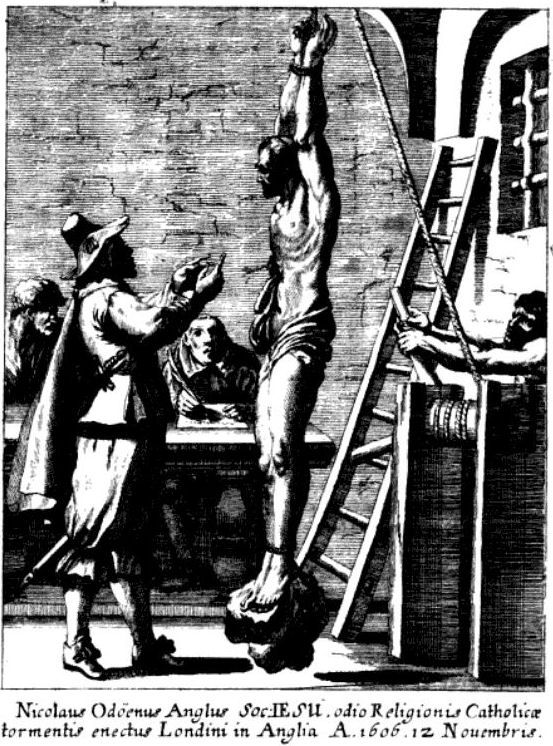
Image: Nicholas Owen in the manacles.jpg · Mathias Tanner. Engraver Melchior Kusell · Public domain, via Wikimedia Commons

Image: Mathias Tanner. Engraver Melchior Kusell, Wikimedia Commons (Public domain)

Retold in plain modern English from Baring-Gould’s public-domain text, sentence by sentence, keeping the same facts and order. Short explanations in parentheses are ours.

From Sabine Baring-Gould, The Lives of the Saints, new edition in 16 vols. (London: John C. Nimmo, 1897), digitized text from Project Gutenberg. Public domain in the United States. Reproduced unedited, except for short bracketed notes in grey that we added to explain names and terms (“S.” is the old abbreviation for Saint). Some history and judgments reflect 19th-century scholarship.