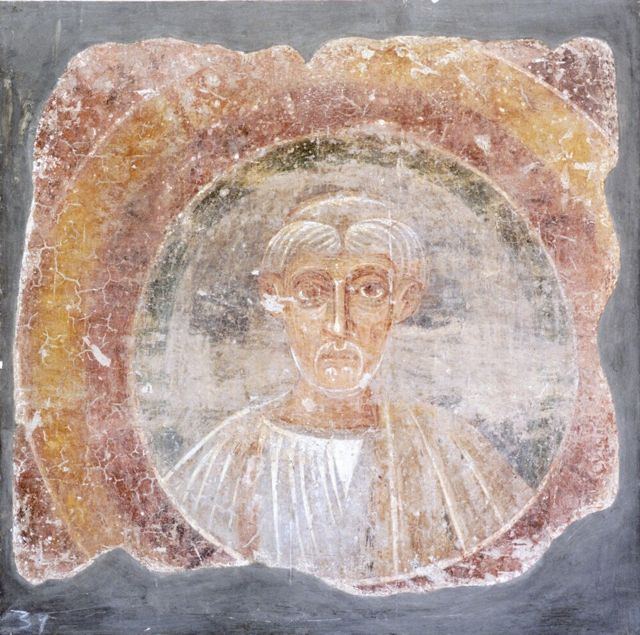
Saint Lucius was a Roman by birth and was one of the clergy of that church under Saints Fabian and Cornelius. After Cornelius was martyred in 252, Saint Lucius succeeded him as pope. The emperor Gallus renewed the persecution initiated by his predecessor Decius, at least in Rome. As soon as this holy pope was placed in the chair of Saint Peter, he was banished, although the exact location of his exile is uncertain. "Thus," says Saint Dionysius of Alexandria, "did Gallus deprive himself of the help of heaven by expelling those who every day prayed to God for his peace and prosperity."
Saint Cyprian wrote to Saint Lucius to congratulate him both on his promotion and on having the grace to suffer banishment for Christ. Our saint had been in exile for only a short time when he was recalled, to the great joy of his people, who went out of Rome in crowds to meet him. Saint Cyprian wrote him a second letter of congratulations on this occasion. He stated that Saint Lucius had not lost the dignity of martyrdom because he had the will to suffer, like the three children in the furnace, even though God preserved him from death. This glory added a new dignity to his priesthood, so that he, as a bishop, could assist at God's altar and encourage his flock to martyrdom by both his example and his words. By granting such graces to his pastors, God demonstrated where His true Church was, for He denied the same glory of suffering to the Novatian heretics. The enemy of Christ only attacks the soldiers of Christ; he knows that heretics are already his own and passes them by.
We pray to God the Father and His Son, our Lord, giving thanks and praying together, that He who perfects all may bring you to the glorious crown of your confession. Perhaps He has only recalled you so that your glory might not be hidden, for the victim who owes his brethren an example of virtue and faith ought to be sacrificed before their eyes.
Eusebius says that Lucius did not hold the papal office for more than eight months. He seems to have died on March 4th, during the reign of Gallus, but we do not know the details. His body was found in the Catacombs and was placed in the church of Saint Cecilia in Rome, where it is now available for the veneration of the faithful. Significant portions of the body of Saint Lucius, martyr, are preserved in Bologna, and a head, claimed to be that of Saint Lucius, was historically one of the great relics of Roeskilde Cathedral. However, these must be the remains of other saints with the same name, and it was a mistake by the clergy of Bologna and Roeskilde to claim that these relics belonged to the martyred pope. Such a mistake could easily have occurred, as two martyrs named Lucius are commemorated on this day, the second being a companion of Caius the Palatine. There are also six martyrs in January and six in February, not to mention those in the other months. In the Schleswig Breviary, published in 1512, the feast of Saint Lucius, Pope and Martyr, was celebrated due to the presence of the head of a Saint Lucius, martyr, at Roeskilde, with nine lessons at matins, of which the first six were taken from the account of the Life and Translation of Saint Lucius the pope, written by Pope Paschal in 812.
Footnotes
- The second Lucius commemorated on this day was a companion of Caius the Palatine.
- The Schleswig Breviary was published in 1512.
- The Life and Translation of Saint Lucius was made by Pope Paschal in 812.
Baring-Gould’s own footnotes, in modern English.
Read the original 1870s text
Baring-Gould’s sources: Usuardus, Ado, Notker, Wandelbert, and Roman Martyrologies. Authorities:—Eusebius, the letters of S. Cyprian, Anastasius Bibliothecarius, and a Life by Guaiserius, a monk, (11th cent.)
Saint Lucius was a Roman by birth, and one of the clergy of that church under SS. Fabian and Cornelius. This latter having been crowned with martyrdom, in 252, S. Lucius succeeded him in the pontificate. The emperor Gallus having renewed the persecution of his predecessor Decius [Roman emperor 249–251, who ordered everyone to sacrifice to the gods], at least in Rome, this holy pope was no sooner placed in the chair of S. Peter, than he was banished, though to what place is uncertain. "Thus," says S. Dionysius of Alexandria, "did Gallus deprive himself of the succour of heaven, by expelling those who every day prayed to God for his peace and prosperity." S. Cyprian wrote to S. Lucius to congratulate him both on his promotion, and on having had grace to suffer banishment for Christ. Our saint had been but a short time in exile when he was recalled, to the great joy of his people, who went out of Rome in crowds to meet him. S. Cyprian wrote to him a second letter of congratulation on this occasion. He says, "He had not lost the dignity of martyrdom because he had the will, as the three children in the furnace, though preserved by God from death; this glory added a new dignity to his priesthood; so that he, a bishop, assisted at God's altar, who could exhort his flock to martyrdom by his own example as well as by his words. By giving such graces to his pastors, God showed where his true Church was: for he denied the like glory of suffering to the Novatian heretics. The enemy of Christ only attacks the soldiers of Christ: heretics he knows to be already his own, and passes them by. We supplicate God the Father and His Son, our Lord, giving thanks and praying together, that He who perfects all may bring you to the glorious crown of your confession, who, perhaps, has only recalled you that your glory might not be hidden; for the victim who owes his brethren an example of virtue and faith, ought to be sacrificed before their eyes."
Eusebius [Eusebius of Caesarea (d. c. 339), the first historian of the Church] says that Lucius did not occupy the pontifical throne for above eight months. He seems to have died on March 4th, under Gallus, but how we know not. His body was found in the Catacombs, and was laid in the church of S. Cecilia at Rome, where it is now exposed to the veneration of the faithful. Considerable portions of the body of S. Lucius, M., are preserved at Bologna, and a head, purporting to be that of S. Lucius, was anciently one of the great relics [the bodily remains of a saint, or objects they used, kept with honor] of Roeskilde Cathedral. But these must be the remains of other saints of the same name, and it was an error of the clergy of Bologna and of Roeskilde to assert that these relics belonged to the martyred pope. That such a mistake may easily have been made is seen from the fact that two martyrs of the name of Lucius are commemorated on this day, the second being a companion of Caius the Palatine; and six in January, and as many in February, not to mention those in the other months. In the Schleswig Breviary, published in 1512, the feast of S. Lucius, Pope, M., was observed on account of the presence of the head of a S. Lucius, M., at Roeskilde, with nine lessons at matins, of which the six first were taken from the account of the Life and Translation of S. Lucius the pope, made by pope Paschal in 812.