This Saint’s Story
The Catholic Encyclopedia places her birth at the end of the seventh century and her death about 720. It names her parents as the Frankish lord Adalrich (also called Aticus or Etik) and his wife Bereswinda, who held large estates in Alsace. Baring-Gould’s telling of the legend uses the forms Adalric and Berchsind, and links Berchsind as maternal aunt of St. Leodegar. What is certain in the encyclopedia’s account is that she founded the convent of Hohenburg, later called the Odilienberg, in Alsace.
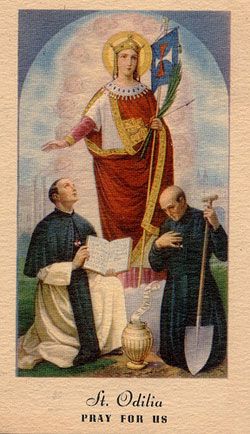
Charlemagne granted the house immunity; Louis the Pious confirmed that grant on 9 March 837 and endowed the foundation. A tenth-century Vita survives, with signs of an earlier eighth-century life behind it; a shorter independent text is preserved in an early eleventh-century manuscript. A further Vita that J. Vignier claimed to have found has been proved a forgery. Her feast is 13 December. Her grave is in a chapel near the convent church on the Odilienberg, and in art she is shown with a book on which lie two eyes.
The encyclopedia records the Vita’s narrative that she was born blind and miraculously received her sight at baptism. Baring-Gould warns that the legend must not be treated as serious history in its details: Adalric, disgusted at a blind child, ordered her exposed or killed; the mother saved her and later sent her to the convent of Baume, where she remained unbaptized for years until a Bavarian bishop, Erhardt, came in obedience to a dream and baptized her, whereupon her eyes were opened. Later episodes in that telling—the father’s accidental killing of her brother, a rock that opened to hide her from a forced marriage, and the cave spring near Freiburg—are likewise framed as legend. Baring-Gould notes that confusion with St. Lucy, commemorated the same day and sharing the eyes symbol, may have helped shape the blindness tale. He adds that she is invoked for diseases of the eyes, and that pilgrims long resorted to her shrine and to the spring at St. Odilien near Freiburg.
