St. Mary Magdalen of Pazzi

Mary Magdalen de' Pazzi, Carmelite (an order that began with hermits on Mount Carmel in the Holy Land) virgin, was born in Florence on 2 April 1566 and died on 25 May 1607.

Read the essentials →
Feast May 25 · Virgin

St. Mary Magdalen of Pazzi

Current feast

May 25
Verified · General Roman Calendar

Traditional feast

May 25
1914 / pre-1969 calendar, per Baring-Gould (1897)

Represents

Virgin

Feast days

Feast: May 25

This Saint’s Story

Her father was Camillo Geri de' Pazzi and her mother a Buondelmonti; she was baptized Caterina in the city's great baptistery. The Catholic Encyclopedia notes in her childhood an early love of prayer and penance, charity to the poor, and an intense attraction to the Blessed Sacrament. She made her First Communion at ten and shortly afterwards vowed her virginity to God. At fourteen she was sent to the convent school of Cavalaresse. After some difficulty in persuading her parents to relinquish their only daughter, she entered in December 1582 the Carmelite convent of Santa Maria degli Angeli, founded in 1450 and known for strict observance; she chose it chiefly because the nuns received Communion daily.

Clothed in 1583 and taking the name Maria Maddalena, she was professed on 29 May 1584 while so ill that recovery seemed unlikely. After profession she was, the Catholic Encyclopedia reports, subject to a daily ecstasy for forty consecutive days and seemed at the point of death; tradition holds that she then recovered in a miraculous way. Despite constant bad health she served as mistress of externs, teacher of the juniors, novice mistress for six years, and from 1604 as superior. From 1585 to 1590 she endured severe inward desolation and temptation. From her clothing until death her life was marked by raptures; companions wrote down the counsels she spoke in ecstasy, sometimes described as her "Works," though she wrote none of them herself.

That ecstatic life did not hinder her usefulness. She was noted for common sense, strict government, and intense charity. As novice mistress she was renowned for a gift of reading hearts. The Catholic Encyclopedia records the tradition that she once beheld St. Catherine de' Ricci at Prato answering her letter, though the two never met in the ordinary way. She died after nearly three years of painful illness, borne with joy. The process for beatification began in 1610 under Paul V and finished under Urban VIII in 1626; Clement IX canonized (officially declared a saint by the pope) her on 28 April 1669. The Catholic Encyclopedia gives her feast as 27 May.

Struggles & surrender

Her struggles

  • Five years of desolation ·
    After her profession and forty days of ecstasy came the years 1585 to 1590, a long time of desolation and violent temptations. She persevered and later trained novices and governed her community.

Short entry · the summary here is 59 words; Baring-Gould’s fuller original text and its sources are below. We have not filled any gap with invented detail.

What she represents

How she teaches us to live

Drawn from themes in the original account

Celebrate this saint’s feast day. Remember her on May 25 with a short prayer, and ask for her help.

The full story

Baring-Gould’s account retold in modern English

Read the full story · 62 words · about 1 min

She died on May 15, in the year 1607, at the age of 41. She was buried in the Church of her Order in Florence. In art, she is usually depicted with a ring on her finger because she is said to have once seen the Saviour in a vision, who placed the ring on her finger, betrothing her to His service.

Read the original 1870s text

Baring-Gould’s sources: Roman and Carmelite Martyrology. Beatified by Pope Urban VIII. in 1626, canonized by Alexander VII. in 1669. Authorities: — A life from notes by Vincent Puccini, who was confessor to the convent after 1605; this was dedicated to Q. Mary de Medici, in 1609. Also another life written in 1625, by Virgilius Cepari, S. J., her confessor.] This saint belonged to the ancient family of Pazzi, at Florence; she was born in 1566, and received at the font the name of Catherine. From her earliest childhood her desire was to devote herself to the religious life. Her father having been appointed governor of Cortina, placed his child in the convent of S. John at Florence. At the end of fifteen months he returned to Florence, and wished to provide for his daughter a suitable marriage, but she so earnestly besought him to allow her to enter religion, that he consented, and she took the habit in 1583, when she was eighteen years old, in the order of Mount Carmel. She professed the following year, and took the name of Mary Magdalen in religion. In 1585, on the vigil of Pentecost she saw herself transported in vision to a horrible swamp filled with the most revolting forms. This vision made a deep impression on her, and feared it was sent to forewarn her of an impending temptation. She resolved to meet all trials with submission to the sweet Will of God, in which she experienced the liveliest confidence. On the following Trinity Sunday the signification of her vision was made manifest, for she entered that “ Den of Lions,” as she called the dismal swamp of her vision, by becoming a prey to the most distressing thoughts. Ideas of indescribable profanity and sensuality forced themselves into her mind. The face of God seemed to be withdrawn from her, all was desolation and a horror of foul imaginations. She combated them by crying perpetually, “ Thy will, Thy will be done, O my God, but suffer me not to fall from Thee.” This harrowing condition lasted five years. Her colour went, and she became thin, and worn in face * but suddenly, in 1590, as the sisters were chanting Te Deum in choir, she felt that she was released from her den of lions * and when Matins were over, she rushed to the prioress, radiant with joy, exclaiming, “ Rejoice with me, my mother, the storm is passed.” In her last sickness, her confessor urged her to pray for some alleviations of her sufferings. “ Let the will of God be done,” was her answer.

She died on May 15, in the year 1607, aged 41 years. She was buried in the Church of her Order in Florence. She generally appears in art represented with a ring on her finger, because she is said once in vision to have seen the Saviour, who placed the ring on her finger, betrothing her to His service.

From the Catholic Encyclopedia

1913 · 914 words

Carmelite Virgin, born 2 April, 1566; died 25 May, 1607. Of outward events there were very few in the saint's life. She came of two noble families, her father being Camillo Geri de' Pazzi and her mother a Buondelmonti. She was baptized, and named Caterina, in the great baptistery. Her childhood much resembled that of some other women saints who have become great mystics, in an early love of prayer and penance, great charity to the poor, an apostolic spirit of teaching religious truths, and a charm and sweetness of nature that made her a general favourite. But above all other spiritual characteristics was Caterina's intense attraction towards the Blessed Sacrament, her longing to receive It, and her delight in touching and being near those who were speaking of It, or who had just been to Communion. She made her own First Communion at the age of ten, and shortly afterwards vowed her virginity to God. At fourteen she was sent to school at the convent of Cavalaresse, where she lived in so mortified and fervent a manner as to make the sisters prophesy that she would become a great saint; and, on leaving it, she told her parents of her resolve to enter the religious state. They were truly spiritual people; and, after a little difficulty in persuading them to relinquish their only daughter, she finally entered in December, 1582, the Carmelite convent of Santa Maria degl' Angeli, founded by four Florentine ladies in 1450 and renowned for its strict observance. Her chief reason for choosing this convent was the rule there followed of daily Communion.

Caterina was clothed in 1583, when she took the name of Maria Maddalena; and on 29 May, 1584, being then so ill that they feared she would not recover, she was professed. After her profession, she was subject to an extraordinary daily ecstasy for forty consecutive days, at the end of which time she appeared at the point of death. According to the story, she recovered, however, miraculously; and henceforth, in spite of constant bad health, was able to fill with energy the various offices to which she was appointed. She became, in turn, mistress of externs—i.e. of girls coming to the convent on trial—teacher and mistress of the juniors, novice mistress (which post she held for six years), and finally, in 1604, superior. For five years (1585-90) God allowed her to be tried by terrible inward desolation and temptations, and by external diabolic attacks; but the courageous severity and deep humility of the means that she took for overcoming these only served to make her virtues shine more brilliantly in the eyes of her community.

From the time of her clothing with the religious habit till her death the saint's life was one series of raptures and ecstasies, of which only the most notable characteristics can be named in a short notice.

Read the rest of the article

This ecstatic life in no wise interfered with the saint's usefulness in her community. She was noted for her strong common-sense, as well as for the high standard and strictness of her government, and was most dearly loved to the end of her life by all for the spirit of intense charity that accompanied her somewhat severe code of discipline. As novice-mistress she was renowned for a miraculous gift of reading her subjects' hearts—which gift, indeed, was not entirely confined to her community. Many miracles, both of this and of other kinds, she performed for the benefit either of her own convent or of outsiders. She often saw things far off, and is said once to have supernaturally beheld St. Catherine de' Ricci in her convent at Prato, reading a letter that she had sent her and writing the answer; but the two saints never met in a natural manner. To St. Mary Magdalen's numerous penances, and to the ardent love of suffering that made her genuinely wish to live long in order to suffer with Christ, we can here merely refer; but it must not be forgotten that she was one of the strongest upholders of the value of suffering for the love of God and the salvation of our fellow-creatures, that ever lived. Her death was fully in accordance with her life in this respect, for she died after an illness of nearly three years' duration and of indescribable painfulness, borne with heroic joy to the end. Innumerable miracles followed the saint's death, and the process for her beatification was begun in 1610 under Paul V, and finished under Urban VIII in 1626. She was not, however, canonized till sixty-two years after her death, when Clement IX raised her to the altars in 28 April, 1669. Her feast is kept on 27 May.

(1) The Oratorian Life (1849), translated from the Italian Life by CEPARI, for a long time confessor [in old usage, a saint who was not martyred, or who suffered for the faith without being killed] to the saint and her community; the edition translated is that of 1669, published in Rome by BERNABO. (2) A MS. Life—of which copies exist in England, only in several convents—compiled by PANTING from the above-named work of CEPARI's, and from another Italian Life by PUCCINI, who was the saint's confessor for about two years before her death. (3) Oeuvres de S. M. M. de' Pazzi, compiled in French by LAURENT MARIA BRANCACCIO, a Neapolitan Carmelite, from Puccini's work. This book consists of her maxims, aspirations, etc., as collected by the Community. (4) A small Manual of the saint's counsels on the Religious Life, translated from the French by FARRINGTON (Dublin, 1891).
More about St. Mary Magdalen of Pazzi

Checked against at least two sources, in our own words

Help us add to this saint's story

Everything is read by a person before anything appears. Facts are checked against trusted sources first.

Facts are welcome; a source link helps (optional).With your permission we may share it on this page.

Nine days · Free

Pray the novena
with us.

One short email a day for nine days. The day's prayer, a line from St. Mary Magdalen of…'s story, and a nudge to keep going.

Also on May 25
St. Urban I., Pope

St. Urban I.

May 25 · Martyr
M

Sts. Maximus and…

May 25 · Martyrs
I

Sts. Injuriosus and…

May 25 · Feast
← All 1970 saints in the library
Sources & notes

Feast-day sources

Story sources

Sources

Credits

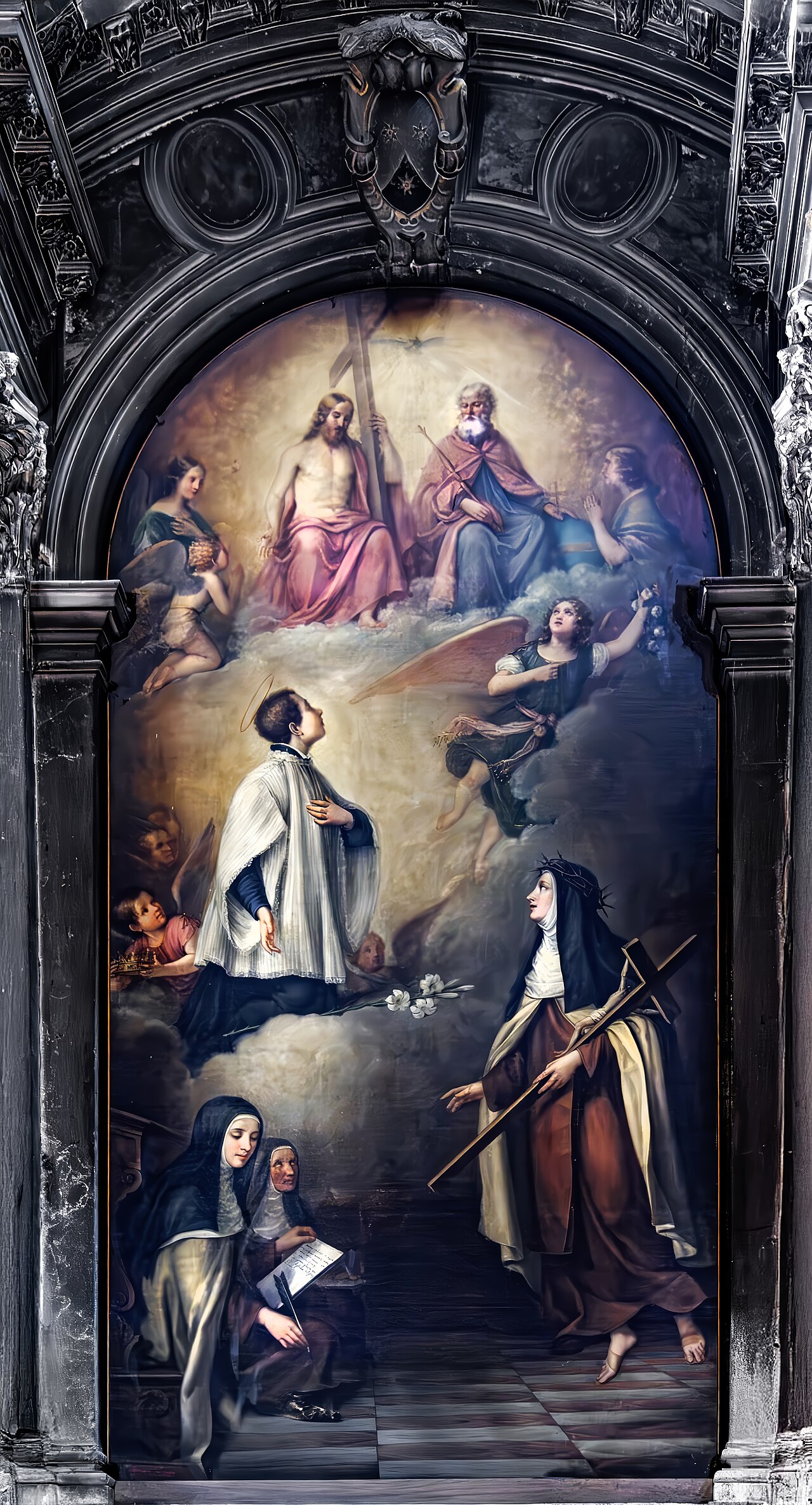
Image: (Venice) Santa Maria dei Carmini - The Holy Trinity, Mary Magdalene de Pazzi and Saint Louis Gonzaga by Bernardino Prudenti.jpg · Didier Descouens · Public domain, via Wikimedia Commons

Image: Didier Descouens, Wikimedia Commons (Public domain)

From “Catholic Encyclopedia (1913)/St. Mary Magdalen de' Pazzi,” The Catholic Encyclopedia (New York: Robert Appleton Company, 1907–1914), via Wikisource. Public domain. Matched by name and feast date; text unedited except for our bracketed notes in grey.

Retold in plain modern English from Baring-Gould’s public-domain text, sentence by sentence, keeping the same facts and order. Short explanations in parentheses are ours.

From Sabine Baring-Gould, The Lives of the Saints, new edition in 16 vols. (London: John C. Nimmo, 1897–98); text from the Internet Archive scan (OCR, lightly cleaned; errors possible). Public domain in the United States. Reproduced unedited, except for short bracketed notes in grey that we added to explain names and terms (“S.” is the old abbreviation for Saint). Some history and judgments reflect 19th-century scholarship.

Notes

Story retold in our own words from the cited sources.