This Saint’s Story
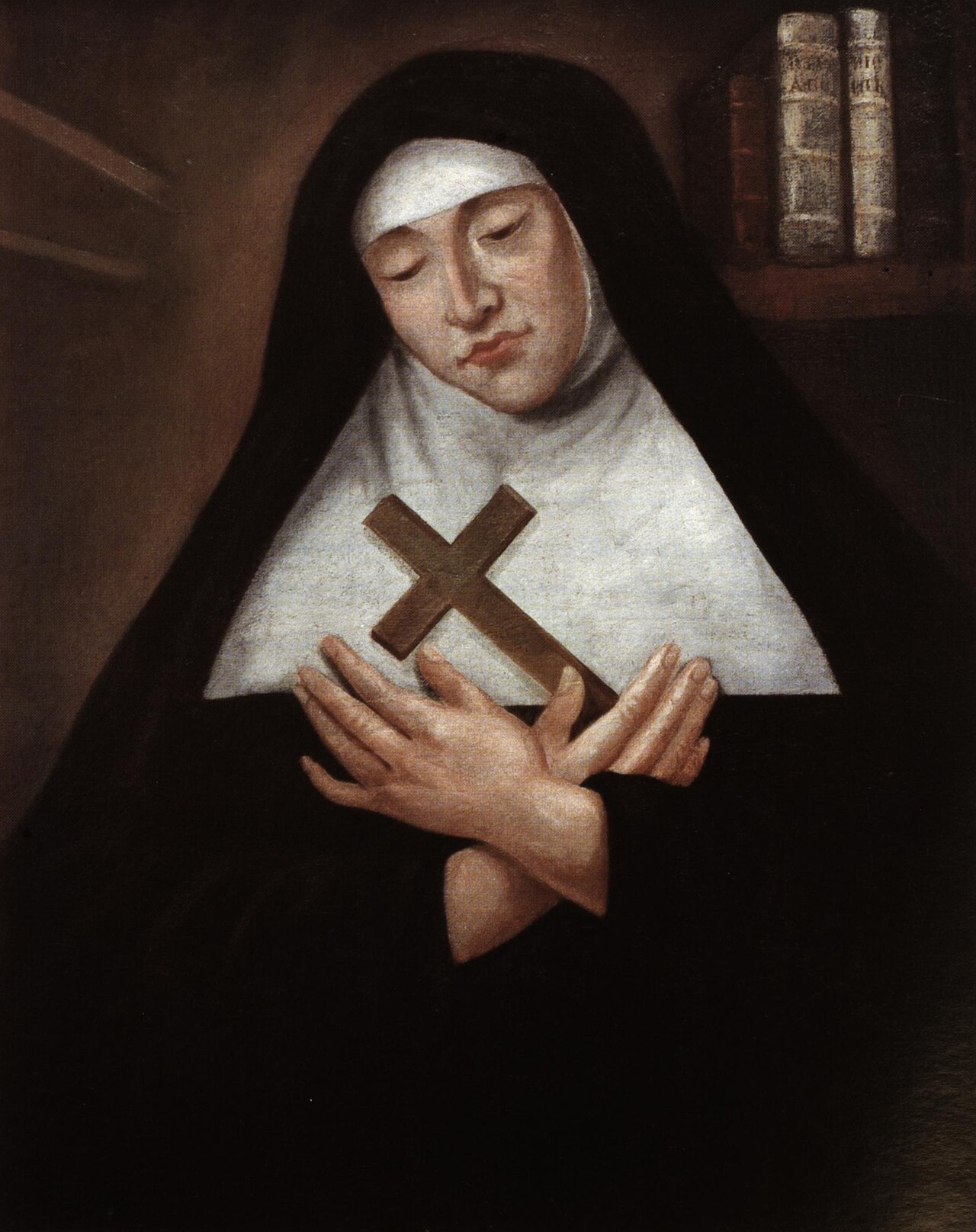
From a young age, she exhibited a strong inclination towards spirituality, experiencing a mystical encounter with Jesus at the age of seven. Despite her desire to enter religious life early on, her parents arranged her marriage to Claude Martin, a silk worker, when she was seventeen. The marriage was short-lived, as Martin died six months after their son Claude was born, leaving Marie a widow at nineteen. Following this loss, she focused on her spiritual growth and eventually sought to join the Ursuline Order.
In 1631, after years of contemplation and spiritual direction, Marie entered the Ursuline convent in Tours, taking the name Marie de l'Incarnation. In 1633, she professed her vows, and her spiritual journey deepened further. Inspired by a vision in which she felt called to evangelize in the New World, she prepared for a mission to Canada. Despite facing familial and financial obstacles, her determination remained unshaken, and she received support from a wealthy widow, Madeleine de la Peltrie, who became her co-worker in this endeavor.
On May 4, 1639, Marie and a small group of Ursuline sisters set sail from Dieppe to Quebec. They arrived on August 1, 1639, at a time when Quebec was still a nascent settlement. The sisters initially lived in a modest house in the lower town before moving to a more permanent structure in the upper town in 1642. Marie played a crucial role in establishing the first school for girls in North America, which became a cornerstone for education and religious instruction in the region.
Marie faced numerous challenges, including cultural differences with Indigenous populations and the impact of European diseases on their communities. Despite these trials, she dedicated herself to learning Indigenous languages and educating young girls, both Indigenous and French. Her leadership and compassion earned her respect among the settlers and the Indigenous peoples alike. She also endured hardships such as a devastating fire in 1650 that destroyed the Ursuline monastery, yet she persevered in her mission.
Marie of the Incarnation passed away on April 30, 1672, after dedicating over thirty years to her mission in Canada. Her writings, including letters and catechisms, reflect her deep spirituality and commitment to her faith. She was beatified (declared 'Blessed', the step before sainthood) by Pope John Paul II on June 22, 1980, and canonized (officially declared a saint by the pope) by Pope Francis on April 3, 2014, recognizing her significant contributions to the Catholic Church and education in Canada.