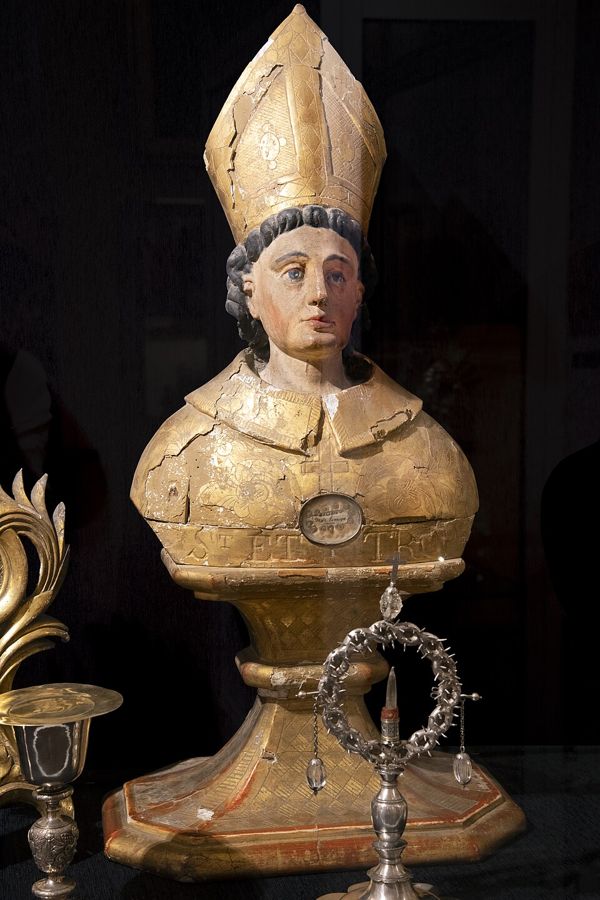
He had come from Rome with Saint Denys, and now he sought to bring the people of the beautiful city to the knowledge of the true God. We follow the tradition from Saintes, although we cannot place complete trust in it. The people of Saintes rejected the apostle and would not allow him to stay within their walls. So, he built a hut outside the city and preached to those who passed by.
It happened that the governor had a daughter named Eustella, who, having heard the Word, believed with all her heart. When her father learned of this, he drove her from his house, and she took shelter near the hovel of the man of God. Then the governor, filled with rage, went out with a group of soldiers and ordered Eutropius to be struck on the head with an axe. When he died, Eustella respectfully buried him in the ground beneath the hovel where he had lived. Later, Saint Palladius, Bishop of Saintes, built a grand church over his tomb. Such is the tradition.
The false Acts push the entire story back to the first century and claim that Eutropius was the son of Xerxes, king of Babylon. They say that as a boy, he was sent to Jerusalem to be a page for King Herod. He was present when Christ fed the five thousand with five loaves and came to believe. When Christ rode into Jerusalem, he went ahead, scattering flowers and leaves. On the Feast of Pentecost, he received the Holy Spirit along with the apostles, and then went with Saint Simon and Saint Thaddaeus to preach the Gospel in Babylon. There, he converted his father and all his court, placing them under the care of Bishop Abdias. He witnessed and wrote the accounts of the martyrdom of Saints Simon and Thaddaeus, and then came to Rome, where he was sent into Gaul by Saint Clement. After this, the story given above follows. The Bollandists consider these Acts to be so completely worthless that they have not even published them.
Footnotes
- The Bollandists are a group of scholars who study and publish the lives of saints.
Baring-Gould’s own footnotes, in modern English.
Read the original 1870s text
Baring-Gould’s sources: Roman and Galilean Martyrologies, and those of Usuardus, Ado, Notker, &c. The acts of S. Eutropius pretend to have been written by S. Denys of Paris, and sent by him to S. Clement of Rome. They are wholly fabulous. The legend of S. Eutropius told by Peter de Natali bus, and popularly adopted at Saintes, is also most questionable. There can be little question that S. Eutropius lived in the 3rd century, and not, as is pretended, in the first, for in the catalogue of bishops of Saintes he occurs as first, and the fourth in succession was Peter, who subscribed the council of Orleans in 509. The mistake has arisen from S. Denys of Paris, who, according to Gregory of Tours and Sulpicius Severus, came to Gaul in 205, being identified with S. Dionysius the Areopagite.j The visitor to the beautifully-situated city of Saintes in the Saintonge cannot fail to admire the exquisite church of S. Eutropius, with its marvellously rich early crypt, at the east end of which a marble slab covers the tomb of the patron Saint The body of S. Eutropius is gone, having been torn from its shrine by the French revolutionists, but a lamp burns perpetually in the gloomy crypt above the place where for many centuries the apostle of the Saintonge lay. Saintes was an ancient Roman city, as the numerous Roman remains, especially the amphitheatre still extant, testify. Hither, in the third century, came Eutropius, bearing the light of revelation.
He had come from Rome with S. Denys, and now he sought to bring the people of the beautiful city to the knowledge of the true God. We follow the Saintes tradition, though we cannot place unqualified reliance in it The people of Saintes repulsed the apostle, and would not suffer him to dwell within their walls. Then he built himself a hut outside the city, and preached to such as passed by. Now it fell out that the governor had a daughter named Eustella, who having heard the Word, believed with all her heart And when her father heard it, he drave her from April jo.] 51 Marian^ James, & Comp. 371 his house, and she lodged near the hovel of the man of God. Then the governor full of wrath went forth with a company of soldiers, and despatched Eutropius, striking him on the head with an axe. And when he was dead Eustella reverently buried him in the ground under the hovel where he had lived. But in later ages S. Palladius, Bishop of Saintes, built a noble church over his tomb. Such is the tradition. The false Acts throw back the whole story to the 1 st century, and tell how Eutropius was the son of Xerxes, king of Babylon, and how as a boy he was sent to Jerusalem to be king Herod's page. He was present when Christ fed the five thousand with the five loaves, and believed. When Christ rode into Jerusalem, he went before strewing flowers and leaves. On the Feast of Pentecost he received the Holy Ghost along with the apostles, and then went with S. Simon and S. Thaddaeus to preach the Gospel at Babylon; there he converted his father and all his court, and placed them under the care of bishop Abdias. He witnessed and wrote the acts of the martyrdom of SS. Simon and Thaddaeus, and then came to Rome and was sent into Gaul [roughly modern France and Belgium] by S. Clement, After which follows the story given above. The Bollandists [Jesuit scholars who since the 1600s have critically studied the lives of the saints] regard these Acts as so utterly worthless that they have not even printed them.