This Saint’s Story
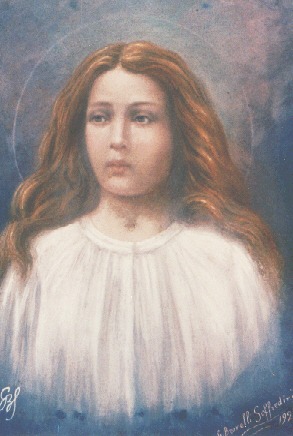
Maria Teresa Goretti was born on October 16, 1890, in Corinaldo, in the Italian province of Ancona, the third of seven children of Luigi Goretti and Assunta Carlini. The family were poor farmers, and by the time Maria was five they had lost their own land and had to work for others. They moved first to Colle Gianturco near Paliano, and in 1899 to Le Ferriere, near Nettuno, where they shared a farmhouse with Giovanni Serenelli and his son Alessandro. Soon afterward Luigi died of malaria. Maria was nine. While her mother and brothers worked in the fields, she cooked, sewed, kept the house, and looked after her little sister Teresa.
On July 5, 1902, Maria was sewing on the steps of the house and watching Teresa when Alessandro, then twenty, came back from the threshing floor and tried to force her into sin. Maria refused, telling him that what he wanted was a grave sin, and she resisted even when he threatened her with an awl—a sharp pointed tool used for piercing leather or wood, not a dagger. Alessandro then stabbed her fourteen times with the awl and fled. She was carried to the hospital in Nettuno, where surgeons could not save her. Before dying on July 6, she said she forgave Alessandro and wanted him with her in Heaven, and her thoughts turned to her mother.
Alessandro was convicted and, because he was still a minor, sentenced to thirty years. In prison he at first showed no remorse, but over time he repented. Released after twenty-seven years, he went to Assunta Goretti and asked her pardon, which she gave, and the two received Communion together. Alessandro later lived as a lay brother with the Capuchins (a strict branch of the Franciscan friars, founded 1525) and died in 1970.
Pope Pius XII beatified (declared 'Blessed', the step before sainthood) Maria on April 27, 1947, and canonized (officially declared a saint by the pope) her on June 24, 1950, before a vast crowd in Rome that included her mother. She is especially honored by the Passionists, who care for her shrine and her remains in Nettuno. Her feast is July 6. Her story is remembered above all for her courage and for a forgiveness that, in time, changed the man who killed her.