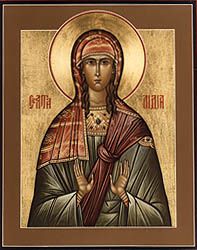
St. Lydia

Lydia of Thyatira is recognized as the first known individual to embrace Christianity in Europe.

Read the essentials →
Feast August 3 · —

St. Lydia

Current feast

August 3 (also listed: January 27, May 20)
Secondary source · Wikipedia infobox

Traditional feast

August 3
1914 / pre-1969 calendar, per Baring-Gould (1897)

Represents

Feast

Feast days

Feast: August 3

This Saint’s Story

Written for this site from Wikipedia and Sabine Baring-Gould, The Lives of the Saints (source note)

She originated from Thyatira, an ancient city in Asia Minor, which is now part of modern Turkey. As a merchant of purple cloth, a valuable trade in her time, she was likely quite affluent and resided in Philippi, a Roman city in Macedonia.

Her meeting with St. Paul and his companions took place during a Sabbath gathering by the river, where she was drawn to his teachings. Moved by the message, Lydia and her household were baptized. In gratitude for her faith, she invited Paul and his companions to stay at her home, showcasing her generosity and leadership within her household.

The discussion around Lydia's social status is ongoing among scholars. While some suggest she may have been a widow or a free woman, her ability to host Paul and his companions indicates she held a significant position. Artistic representations of her often include purple cloth, symbolizing both her trade and her elevated status.

Lydia is honored as a saint across various Christian denominations, with her feast day celebrated on different occasions. The Catholic Church commemorates her on August 3 in the Extraordinary Form and May 20 in the Ordinary Form. Her influence is particularly recognized in the Orthodox Churches, which bestow upon her the title 'Equal to the Apostles'.
What she represents

How she teaches us to live

Drawn from themes in the original account

Share your faith, in words and by example. Preaching and conversion are part of this story.

Celebrate this saint’s feast day. Remember her on August 3 with a short prayer, and ask for her help.

Read more

The full original · 99 words

Read Baring-Gould’s full account

Baring-Gould’s sources: Modem Romah Martyrology. Not in any ancient Latin or Greek kalendars. Authority: — The Acts of the Apostles, xvi.

LYDIA, the first European convert of S. Paul, and afterwards his hostess during his first stay at Philippi, was probably a Jewess there at the time of the Apostle’s coming; and it was at the Jewish Sabbath worship in an oratory by the river side that the preaching of the Gospel reached her heart. Her native place was Thyatira, in the province of Asia. Thyatira was famous for its dyeing works; and Lydia was connected with this trade, either as a seller of dyes or of dyed goods. We may infer that she was a woman of considerable wealth.

More about St. Lydia

Checked against at least two sources, in our own words

Help us add to this saint's story

Everything is read by a person before anything appears. Facts are checked against trusted sources first.

Facts are welcome; a source link helps (optional).With your permission we may share it on this page.

Nine days · Free

Pray the novena
with us.

One short email a day for nine days. The day's prayer, a line from St. Lydia's story, and a nudge to keep going.

Also on August 3
St. Aspren

St. Aspren

August 3 · Bishop, Confessor
D

St. Dalmatius

August 3 · Abbot
M

Sts. Marana and Cyra

August 3 · Feast
← All 1970 saints in the library
Sources & notes

Feast-day sources

Story sources

Sources

Credits

Image: Lidia.jpg · Russisch Ikone in Gemeinfreiheit - public domain · Public domain, via Wikimedia Commons

Image: Russisch Ikone in Gemeinfreiheit - public domain, Wikimedia Commons (Public domain)

From Sabine Baring-Gould, The Lives of the Saints, new edition in 16 vols. (London: John C. Nimmo, 1897–98); text from the Internet Archive scan (OCR, lightly cleaned; errors possible). Public domain in the United States. Reproduced unedited, except for short bracketed notes in grey that we added to explain names and terms (“S.” is the old abbreviation for Saint). Some history and judgments reflect 19th-century scholarship.