His guide was his mother, Blanche of Castile, who was the daughter of Alfonso IX and Eleanor of England, the daughter of King John. “If passionate love should seek beauty, where could it find it fairer than in Blanche? If devoted love should search for virtue, where could it find it more virtuous than in Blanche? If ambitious love sought a match of noble birth, whose blood runs richer than that of royal Blanche?” At the age of thirty-eight, the mature beauty of the Queen was as appealing as her youthful grace had been when she was a child-bride at twelve years old.
She had nurtured her son with care, tenderness, and devotion. Her example was as pure and lovely as her name and appearance. Her treatment of Louis showed no tolerance for laziness in thought or behavior. Once, in his early youth, he had looked with interest at a beautiful young woman. “I would rather he were dead,” said his mother, “than that he should commit sin.”
Saint Louis was crowned at Reims on the First Sunday of Advent in the year 1226 by the Bishop of Soissons, as the archbishopric of Reims was vacant at that time. During the young King’s minority, Blanche of Castile took on the role of regent.
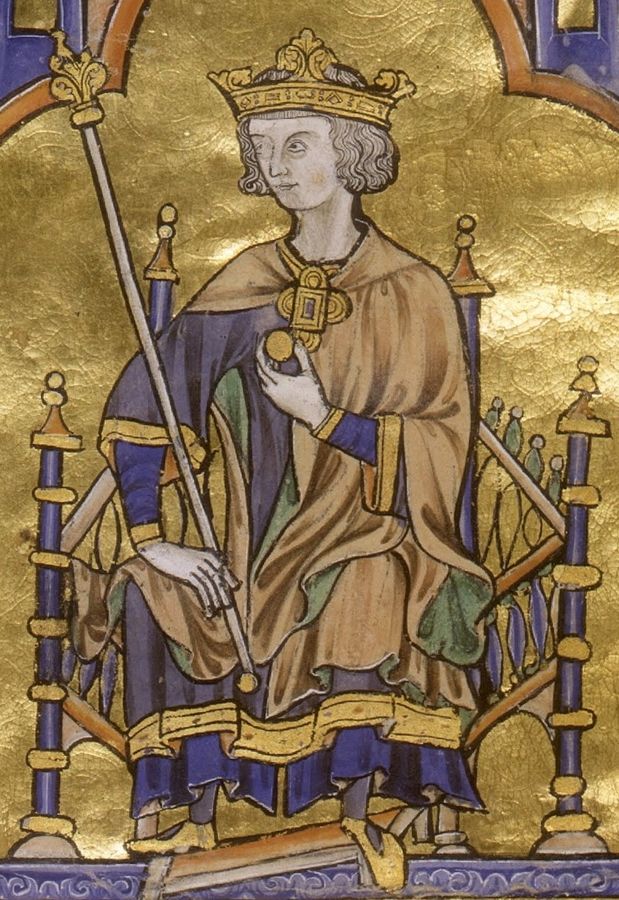
On April 25, 1228, Saint Louis entered his fourteenth year and was immediately given a tutor to teach him letters and manners. The King would later recount how harshly the tutor treated him and how he forced Latin into his head with blows from a stick. The young King had a fair complexion and inherited the handsome features of his grandmother, Isabelle of Hainault. His expression was so sweet and charming that, as we are told, no one could look him in the face without loving him. These traits are confirmed by the only authentic portrait of the good King that still exists, which, although it depicts him at a relatively older age, shows a remarkable combination of beauty, features, and a gentle expression.
The early years of Louis IX's reign were not without disturbance. The powerful barons revolted but were brought back into obedience. I do not intend to delve into the political history of the time, except as necessary to illustrate the character of Saint Louis. This history is available to every reader in the history of France. On the throne, Saint Louis garnered immense admiration for both his virtues and his amiability. He had a frank playfulness, or at least a pleasant manner, which Henry IV never surpassed, and a blamelessness that had rarely been seen before and, until very recent times, never after on the throne of France.
He had kingly qualities of the highest order, including gentleness, friendliness, humanity, and a passionate love for justice, truth, and honor. These qualities saved him from making errors or committing wrongs against the eternal principles of right, which a superstitious person might have easily fallen into, overlooked, or openly supported, as was often the case with the clergy of that time. No act of religious persecution tarnishes the reputation of Louis IX.
When Innocent IV excommunicated Emperor Frederick II, deposed him from his throne, and offered the imperial crown as a tempting reward to Louis for his brother, the saintly King coldly refused it. Although the Pope urgently urged him to take up arms against the German Emperor, whose power Gregory IX and Innocent IV were jealous of and wanted to humble, Louis refused to allow the collection of funds in France to support a war that his conscience told him was unjust.
The reliquary of the Sainte Chapelle, a bust made of gold and richly adorned with jewels, was melted down during the first revolution; however, an accurate engraving of it had been made by Ducange for his edition of Joinville’s Memoirs. During all the major religious seasons of fasting, the young King observed the strictest abstinence. He would only allow himself to taste fruit once a year, and he wore the roughest sackcloth next to his skin. His spiritual director convinced him to adopt a less severe practice, allowing him to deny himself only unripe fruit and to wear sackcloth made of a softer material.
Every Friday, and during Lent on Mondays, Wednesdays, and Fridays, he isolated himself in his chamber, searching every corner to ensure no one was present, along with his confessor, the Dominican Geoffroy de Beaulieu, who administered a strict discipline using a wire whip. One day, he made a pilgrimage barefoot from Nogent l’Erembert to the church of Our Lady at Chartres, a distance of about four leagues. His bleeding feet became so inflamed that he could only complete the journey by leaning on the arms of his attendants.
He regularly washed the feet of beggars, invited the poor to his table, and visited the sick in their homes or in hospitals. A leper on the other side of a swamp begged for his help. Louis waded through the muddy water to assist the poor man. He attended two, sometimes three or four, masses daily; while riding, his chaplain recited the prayers. A Dominican preacher urged him to moderate his fervor, suggesting that one mass a day was sufficient and that his royal dignity was diminished by mingling with beggars. “If I spent twice as much time playing dice and hunting, would I be rebuked for that?” replied the gentle King.
He accepted even insults with humility. A woman named Sarrete, arguing in the king’s court, said, “Shame on you! You are not the King of France; you are only a king of friars, priests, and clerks. It is a shame that you are King; you should be removed from your position.” The blessed King did not permit his attendants to punish the woman. “You speak the truth,” he replied. “It has pleased the Lord to make me king; but I know well that it would have been better had He appointed
Footnotes
- King John, act ii. sc. 2.
- From a Picture by M. Meison. Saint Louis.
- The reliquary of the Sainte Chapelle was melted down during the first revolution.
- Ducange made an accurate engraving of it for his edition of Joinville’s Memoirs.
Baring-Gould’s own footnotes, in modern English.
Read the original 1870s text
Baring-Gould’s sources: Roman and Gallican Martyrologies. Canonized by Boniface VIII. in 1296. Authorities: — A life by Geoffroi de Beaulieu, the King's Confessor who died 1274, only four years after the king. Another life by an anonymous writer, the Confessor of Queen Margaret; the memoirs of the Sieur de Joinville, the King's friend and companion. A history of S. Louis by Guillaume de Nangis (d. i3or). Robert de Sainceriaux, "Sermon en vers sur la mort du roy S. Louys.” The bull of canonization published by Boniface VIII. in 1296; an " Epistola super obitu Ludovici IX.” ap. Duchesne, Script. Hist. Franc., v. p. 440. “ Epistola Thunensis episc. ad Theobaldum regem Navarrse de felice obitu S. Ludovici,” ap. Martene, Collect. Ampl., vi. p. r2r8; " Gesta S. Ludovici autore monacho S. Dionysii anonymo,” ap. Duchesne; “ De vita et actibus Ludovici IX.,” by William of Chartres, royal chaplain, ap. Duchesne, v. p. 466. Much valuable matter relating to the life and times of S. Louis has been collected by modem historians. Le Nain de Tillemont (d. 1698) compiled a voluminous collection of extracts relating to the reign of S. Louis, arranged in methodical and chronological order, and comprising almost every fact o* importance then known to bear on the subject. "Vie de S. Louis," par Le Nain de Tillemont, Paris, 1847-51. For a list of 147 works bearing on S. Louis, see Catalogue de la bibliothfeque imp^riale, Paris, 1855; also Struve, Bibl. historica, ed. Mensel, vii. 2, pp. 74 — 80. In addition to those mentioned in these two works, see Bastie La vie de S. Louis, in Mém. de l'Acad. des Inscriptions, xv. pp. 692 — 736; Lebeuf, Remarques critiques sur les actes de S. Louis, nouvellement publics par les Bollandistes, in Mém. de l’Acad. des Inscript., xvi. p. 186; De Wailly, Examen critique de la vie de S. Louis par Geoffroy de Beaulieu, 1. c. xv. p. 403. Bibliothfeque de l’^cole des chartes, v. p. 205. Chabannes, Vie du bienheureux Th. Helye, aumbnier de S. Louis, Tournai, 1863; Documenti inediti riguardanti li due crociate di san Ludovico, illustr. da Belgrano; Genova, 1859. Lettres des évêques de la province de Reims de 1274 pour la canonisation de Louis IX. ap. Marlot, Hist, de Reims, p. 3, &c.] “ There are perhaps,1' says M. Guizot, “only two princes who, on every occasion, formed the first rule of their conduct from their moral creeds — Marcus Aurelius, a Stoic; tf( f i Xa/n be orra^e, -mxC icvc-x- certs "\Jt7vji ij vjJ\ic fut, ©w«t ee ^acrc -moni^Sin£'u*r tirccf £ot/*. baivf Ceftuje -Diwe be exm 5. Tpar-frcs rc'ue-rena ycre ctv Oxen 3tie[ftrC ^accrues o& bstfoeper a^xclq-nc beJTnflon^/ Ce premier dtmam’jje bca rodent-* en t>rcfeftee ’bu SIom b<uujlcterrc, et bes Tjriace.s frcrcs bu voyrTre^xc^onfe -jnovvCl fut^raaio toyci Saint Louis, a Christian.”1 Even the freethinker Gibbon could not fail to admire the beauty of the character of S. Louis: “ He united the virtues of a king, a hero, and a man and Voltaire sums up his character in the emphatic word, “ Never has it been accorded to man to push virtue further.”3 The life of S. Louis is eminently instructive, for, as has been judiciously remarked, “ This prince showed that it is not impossible to ally the majesty of the throne with the holiness of the Gospel, that without quitting the most exalted rank, one may practise the humiliations of penitence, that a really Christian king renders his greatness independent of events, and fears not to lose through adversity what prosperity could not have accorded him.”1 Louis VIII. was returning (a.d. 1226) from an expedition against Languedoc, which Amaury de Montfort had ceded to the crown of France, when he was attacked by a fatal sickness at Montpensier. The King therefore summoned his barons about him, and made them swear allegiance to his eldest son, Louis, then only twelve years old. He expired on All Saints’ Day, and was buried at S. Denys, by the side of his father, Philip Augustus. The young prince who was now summoned to take possession of the splendid inheritance of the kingdom of France was bom in 1215, on the feast of S. Mark, and was baptized at Poissi on the left bank of the Seine.5 His early 1 Hist, de la Civil. Frangaise, sect. xiv. a Decline and Fall, c. 6. 3 Essai sur les Mceurs des Nations, c. 58. 5 In the parish church is shown a font, in which it is said the Royal Saint was baptized, but the font is certainly — in its present condition — of later date. In one of the windows of the chapel that contains it, is stained glass of the 16th century, on which are inscribed the following lines: — '* Saint Louis fut enfant nd de Poissi Et baptist en la prdsente dglise, Les fonts en sont gardds encore ici, Et conserves comme relique exquise.”
…guide was his mother, Blanche of Castile, daughter of Alfonso IX, and Eleanor of England, daughter of King John. ‘ 1 If lusty love should go in quest of beauty, Where should he find it fairer than in Blanche ? If zealous love should go in search of virtue, Where should he find it fairer than in Blanche ? If love ambitious sought a match of birth, Whose veins bound richer blood than royal Blanche P”1 At the age of thirty-eight the matronly comeliness of the Queen was as attractive as her maiden grace had been when a child-bride of twelve summers.
She had carefully, tenderly, religiously nurtured her son. Her example was as white and comely as her name and face. Her treatment of Louis showed no indulgence for laxity of thought and conduct. Once in his early youth he had looked with kindling eye on some fair damsel. “I had rather he were dead,” said the mother, “than that he should commit sin.”
S. Louis was crowned at Reims on the First Sunday in Advent, a.d. 1226, by the Bishop of Soissons, for the archbishopric of Reims was at that time ' vacant. During the young King’s minority Blanche of Castile assumed the regency.
On April the 25th, a.d. 1228, S. Louis entered on his fourteenth year, and was forthwith given a tutor to instruct him in letters and manners. The King used himself to relate in after days how hardly the tutor had treated him, and how he forced Latin into his head by blows of a stick. The young King was fair complexioned, and had inherited from his grandmother, Isabelle of Hainault, the handsome features of that family. His expression was so sweet and winning, that, we are told, no one could look him in the face without loving him. These characteristics are borne out by 1 King John, act ii. sc. 2.
From a Picture by M. Meison. S. Louis. 1 the only authentic portrait of the good King now extant, which though representing him at a comparatively advanced age, shows a remarkable union of beauty and feature and gentleness of expression.1 The first years of the reign of Louis IX. were not undisturbed. The powerful barons revolted, and were brought to obedience. Into the political history of the time it is not my purpose to enter, further than is necessary to illustrate the character of S. Louis. It is accessible to every reader in the history of France. On the throne S. Louis attracted unbounded admiration both by his virtues and by his amiability. His was a frank playfulness, or amenity, at least, of manner, which Henry IV. never surpassed, and a blamelessness hardly ever before, till very recent times never after, seen on the throne of France.
He had kingly qualities of the noblest order, gentleness, affability, humanity, a passionate love of justice and truth and honour which saved him from committing those errors, those wrongs against the eternal principles of right, which a superstitious character might have readily fallen into, connived at, or openly advocated, as they too often were, by the clergy of that period. No act of religious persecution sullies the lilies of the crown of Louis IX. When Innocent IV. excommunicated the Emperor Frederick II., deposed him from his throne, and offered the imperial crown as a flattering bait to Louis for his brother, the saintly King coldly refused it. Though solicited by the Pope most urgently to take up arms against the German Emperor, of whose power Gregory IX. and Innocent IV. were jealous, and whom they were bent on humbling, Louis refused to permit the levy of subsidies in the realm of France, to aid a war which his conscience told him was unjust. 1 The reliquary of the Sainte Chapelle, a bust of gold richly jewelled, this was melted up in the first revolution; but an accurate engraving of it had been made by Ducange for his edition of Joinville’s Memoirs. At all the great religious seasons of fasting, the young King observed the strictest abstinence. Only once in the year would he allow himself to taste fruit; he wore the roughest sackcloth next his skin. His spiritual director persuaded him to less severe observance, to deny himself only unripe fruit, and to wear sackcloth of less fretting texture. Every Friday, and in Lent [the forty days of fasting before Easter] on Mondays, Wednesdays, and Fridays, he shut himself up in his chamber, searching every corner, lest any one should be present, with his confessor [in old usage, a saint who was not martyred, or who suffered for the faith without being killed], the Dominican, Geoffroy de Beaulieu, who administered to him with heavy, unsparing hand, a discipline of wire. One day he made a pilgrimage with bare feet from Nogent l’Erembert to the church of Our Lady at Chartres, a distance of four leagues; his bleeding feet became so inflamed that he could only complete this journey by leaning on the arms of his attendants. He constantly washed the feet of beggars, invited the poor to his table, and visited the sick in their cottages or in hospitals. A leper on the farther side of a swamp begged of him. Louis waded through the morass to relieve the poor wretch. He heard daily two, sometimes three or four, masses; as he rode, his chaplain recited the offices. A Dominican preacher urged him to moderate his enthusiasm, one mass a day was ample; the royal dignity moreover was injured by association with beggars. “ If I spent twice as much time in dice and hawking, should I be so rebuked ?” answered the gentle King.
He bore even reproach with meekness. A woman named Sarrete, pleading in the king’s court, said, “ Fie ! you are not King of France; you are only a king of friars, priests, and clerks. It is a pity you are King; you should be turned out of your sovereignty.” The blessed King would not allow his attendants to chastise the woman. “ You say true,” he answered. “ It has pleased the Lord to make me king; but I well know that it would have been well had he appointed