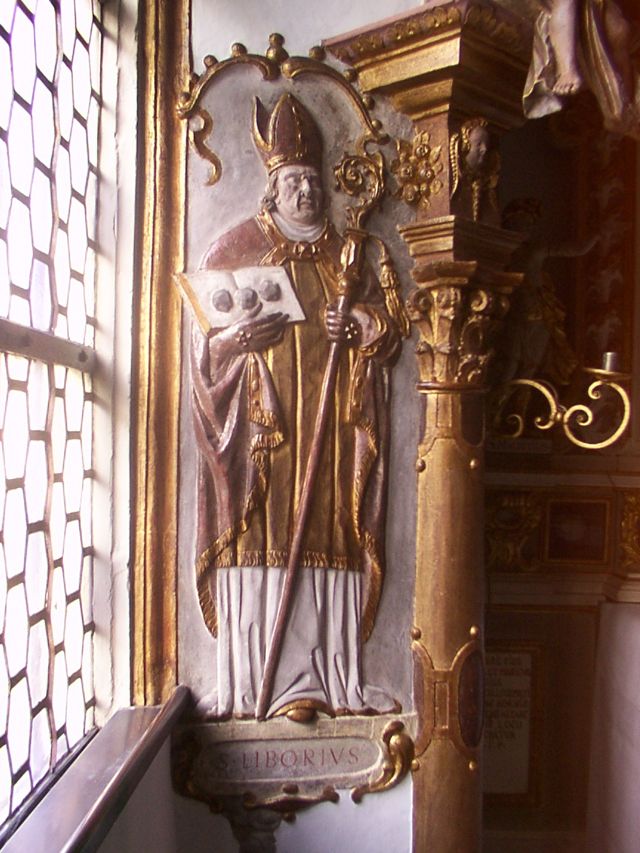
St. Liborius

Liborius came from a noble Gaulish family and became a priest of the church of Mans.

Read the essentials →
Feast July 23 · Bishop

St. Liborius

Current feast

July 23
Secondary source · Wikipedia infobox

Traditional feast

July 23
1914 / pre-1969 calendar, per Baring-Gould (1897)

Represents

Bishop

Feast days

Feast: July 23

This Saint’s Story

Adapted in modern English from Alban Butler's Lives of the Saints · Baring-Gould original below · little is known

He loved retirement and prayer and kept company only with clergy who would help his spiritual life. In 348 he was chosen fourth bishop of Mans. He fasted and prayed much, cared for the poor and built many churches.

He governed for forty-nine years and died about 397. His relics were moved to Paderborn in 836, and he is honoured as patron of that city. Baring-Gould places him at the end of the fourth century.

Short entry · the summary here is 54 words; Baring-Gould’s fuller original text and its sources are below. We have not filled any gap with invented detail.

What he represents

How he teaches us to live

Drawn from themes in the original account

Feed your mind with Scripture and good books. Learning and the Scriptures matter in this life.

Celebrate this saint’s feast day. Remember him on July 23 with a short prayer, and ask for his help.

The full story

Baring-Gould’s account retold in modern English

Read the full story · 59 words · about 1 min

Leborius was the bishop of Sens in Gaul, and he was a friend of Martin, who buried him. This is really all that is known about this saint. His relics were moved to Paderborn in 836. He is called upon for protection against gravel and stones, and he is depicted holding calculi (stones) on a book in his hand.

Read the original 1870s text

Baring-Gould’s sources: Roman, Galilean, and German Martyrologies. Authorities Four lives, all written late, and containing no facts, but a great amount of padding to take the place of facts.!

S. Leborius was bishop of Sens in Gaul [roughly modern France and Belgium], and a friend of S. Martin [St. Martin of Tours (d. 397), soldier turned bishop], who buried him. This is really all that is known of this saint. His relics [the bodily remains of a saint, or objects they used, kept with honor] were translated to Paderborn in 836. He is invoked against gravel and the stone, and is represented holding calculi on a book in his hand.

Help us add to this saint's story

Everything is read by a person before anything appears. Facts are checked against trusted sources first.

Facts are welcome; a source link helps (optional).With your permission we may share it on this page.

Nine days · Free

Pray the novena
with us.

One short email a day for nine days. The day's prayer, a line from St. Liborius's story, and a nudge to keep going.

Also on July 23
St. Apollinaris

St. Apollinaris

July 23 · Bishop, Martyr
St. John Cassian

St. John Cassian

July 23 · Abbot
R

St. Romula

July 23 · Virgin
← All 1970 saints in the library
Sources & notes

Feast-day sources

Story sources

Sources

Credits

Image: Paderborner Dom Dreifaltigkeitskapelle Liborius.jpg · ludger1961 · CC BY-SA 3.0, via Wikimedia Commons

Image: ludger1961, Wikimedia Commons (CC BY-SA 3.0)

Retold in plain modern English from Baring-Gould’s public-domain text, sentence by sentence, keeping the same facts and order. Short explanations in parentheses are ours.

From Sabine Baring-Gould, The Lives of the Saints, new edition in 16 vols. (London: John C. Nimmo, 1897–98); text from the Internet Archive scan (OCR, lightly cleaned; errors possible). Public domain in the United States. Reproduced unedited, except for short bracketed notes in grey that we added to explain names and terms (“S.” is the old abbreviation for Saint). Some history and judgments reflect 19th-century scholarship.